
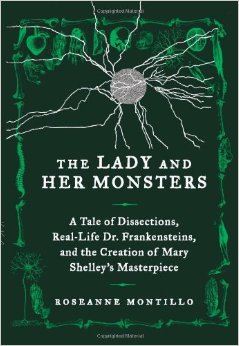
 I miss my monsters, especially when I stay away too long. I had eyeballed Roseanne Montillo’s The Lady and Her Monsters: A Tale of Dissections, Real-Life Dr. Frankensteins, and the Creation of Mary Shelley’s Masterpiece nearly a year ago in a busy Port Authority bookshop, and wanted to curl up with it right away. Well, work and the world intervened, but finally I found time for the beast. Although a member of the monster kid generation, as a child I never felt much kinship with Frankenstein’s creation. I think it is because there was so much human intention involved in his origins. Almost ungodly. Too godly. Vampires and werewolves, and even mummies, seemed to have come up on the wrong side of a curse and couldn’t be blamed for being what they were. Frankenstein’s monster had a willful, if neglectful, creator. A human being, and fully so. There was, it seemed, some kind of blasphemy at work here.
Montillo’s book, however, gives me pause to rethink this. I had never realized, foe example, that Shelley’s book unfolds over nine months, and that Mary Godwin Shelley had suffered as her own fate unfolded—or unraveled—after Percy Shelley’s death. Nor had I stopped to consider that in the lifetime of these young lovers scientists and poets were overlapping careers with philosophy holding them together. I also hadn’t realized that Percy Shelley also shared his beau’s enchantment with the fantastic. But Montillo gives us so much more, wandering through the seedy world of body-snatchers and scientists who experimented on the dead, often with an eye toward a secular resurrection.
Frankenstein’s monster has, of course, become an instantly recognizable fixture in our society. Indeed, it is almost the definition of monstrosity: the ultimate mischwesen while being technically only one species. A creature that crosses boundaries and is both dead and alive, a miracle and a curse, innocent and evil. Morillo places this creature in the context of a world where galvanism was thought to bring life and medical schools scrambled to find corpses to dissect and on which to experiment. A world where the Shelleys would visit Lord Byron and Polidori, literally on a stormy night, and give the world both Frankenstein and the prototype of Dracula. Where the three men of that night all died prematurely and tragically, survived by a struggling Mary who lived only to fifty-three and who gave the world one of its most memorable nightmares. Horror fiction was, and is, considered lowbrow entertainment, but there is something profound here. And we are richer, if more unsettled, for having it.
 Steve A. Wiggins