Reptile Puppet

I read about Reptilicus, but I can’t remember where.  A monster movie shot simultaneously in English and Danish in 1960, with two different directors, it was universally panned.  Some times you just have to see a bad movie.  This one qualifies.  I actually laughed out loud a time or two.  The idea behind the story holds promise: some animals can regenerate lost limbs, or even entire bodies from a severed piece.  What if a giant reptile could do the same?  The film’s problem is in the execution.  So, a team drilling for copper above the arctic circle—they’re sweating and working with their sleeves rolled up in a temperate forest—hits a frozen animal in the permafrost under the tundra.  Taken to an aquarium in Copenhagen, the animal’s tail is kept frozen until someone leaves the door open overnight.  When it thaws it begins to regenerate.
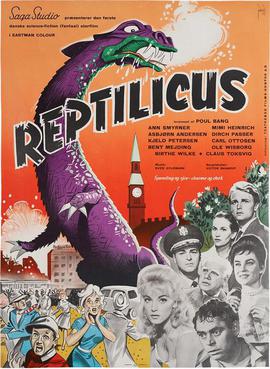
Once fully formed—and nobody could see this coming—it breaks out and terrorizes Denmark.  There are some scenes thrown in to show off Copenhagen, and the film makes liberal use of stock footage from military exercises.  The dialogue, poorly written, is delivered with wooden earnestness by actors who struggle to be convincing in their roles.  The monster, Reptilicus, is so obviously a puppet that it could scare no-one.  But it’s a monster movie!  Those of us who grew up on such fare sometimes feel a need to go back to the well.  To appreciate a bad movie, I always approach it with a certain hopefulness.  Here I am, over six decades later, watching the film.  If that can happen, perhaps someone will see that publishing my novels isn’t the worst you could do?  It makes for a crooked kind of logic.  

The main thing Reptilicus has going for it is its near indestructibility and its ability to regenerate.  How is it finally destroyed?  We’re not shown.  In one scene the general asks the head scientist, something like, “If we can knock it out, you can kill it?”  Receiving an affirmative answer, they drug the monster and send the scientist off to do his work (after he’s suffered a heart attack).  I’ve read novels where it seems pretty clear that the author was unsure how the resolution actually goes—I’ve painted myself into that corner a time or two, so I know how it feels.  If you’ve got a budget and backers, however, you have to deliver something.  The movie performed reasonably well at the box office, which shows just how indestructible some monsters can be.
Stupid Burnt Lizard

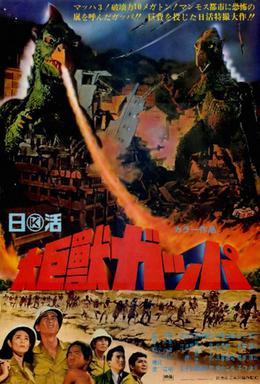
The kaiju monster film has evolved significantly, as my post on Godzilla Minus One may indicate.  Monster boomers grew up with Saturday afternoon kaiju, although we never heard that word.  (Or at least I didn’t.)  Godzilla was the most famous, but some people trace the origins of the idea to King Kong.  The kaiju, or “strange beast,” genre features outsized monsters that, when they come in contact with civilization, wreak havoc.  Many are primarily symbols of atomic fear, and after watching Godzilla again, I settled down one uncomfortably hot summer afternoon to watch Monster from a Prehistoric Planet, a wildly misleading title for a movie also called Gappa, which is more accurate but less eye-catching.  A gappa is a “triphibian beast” that does equally well on land, water, or in the air.  I do have to wonder if Michael Crichton saw this film before coming up with the idea for Jurassic Park.

A wealthy publisher wants to open a tropical island resort in Japan.  (You see?)  He wants to fill it with exotic animals, and among those in the model are dinosaurs.  His expedition to collect specimens leads a Japanese crew to discover a newly hatched gappa, which they take back to Japan.  (The publisher, concerned that their find has been exaggerated, utters the title of this post.)  Meanwhile, back on Obelisk Island, the gappa parents return and aren’t pleased to find their baby gone.  They head to Japan to stomp around, Godzilla style.  It takes the sole survivor from Obelisk Island, a young boy, to figure out that the parents really only want their baby back.  The publisher, scientist, and journalist (all male) don’t want to give it up.  The female lead, also a journalist, convinces them that they must.  Japan is saved.

Kaiju have more recently become somewhat believable, and even a bit scary.  The monsters themselves seem to be metaphors.  It’s no accident that these early movies, such as Gappa, expend much of their screen time on explosions.  From the artificial volcano on Obelisk Island to the model tanks and missiles, to the plumes rising as the gappa lead to destruction, things are always blowing up.  The Japanese think at first that “Gappa” is a god, but the local boy who survives is emphatic that “Gappa” is “no god.”  Yet the locals are careful not to raise their wrath.  These movies aren’t great in any traditional sense, but they are imbued with reminders of war—no god—and the lasting damage it causes.  And the wealthy can lead to the destruction of many cities for the sake of making money off of a stupid burnt lizard.


Plus One

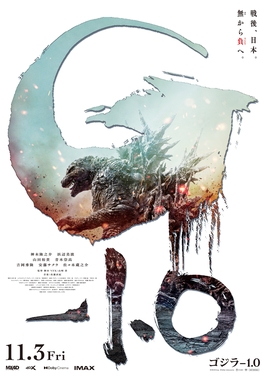
When one of your oldest friends suggests a movie, it’s a good idea to watch it.  I began watching Godzilla movies when I was quite young but I stopped after seeing the 1998 Roland Emmerich version.  A friend from high school told me I should see Godzilla Minus One, and I took that advice seriously, if slowly.  It certainly raises the bar on kaiju movies.  An epic film of over two hours, it isn’t just a monster destroying towns—it may not be a standard horror movie but it is an exceptional Godzilla film.  Following the story of Kōichi Shikishima, a kamikaze pilot who couldn’t bring himself to suicide, it introduces the kaiju in the last days of World War Two.  There is a lot of political sensitivity in the movie.  Godzilla—by far the scariest I’ve seen—kills off the Japanese crew on a Pacific island.  Shikishima survives and returns home to find his family dead from bombing in Tokyo.  He is shamed by his neighbor for failing in his kamikaze duty.

Shikishima assists Noriko Ōishi, also without family, in raising an orphaned infant.  Meanwhile, Godzilla starts reappearing.  The problem is, tensions between the Soviet Union and United States means that outside help isn’t available.  Japan had been forced to disarm its military due to the war, and therefore it has to rely on civilians to organize and try to stop the monster.  They devise a plan to try to sink the monster far enough into an ocean trench to crush it, and barring that, raise it rapidly to the surface so the depressurization will be fatal.  Meanwhile, Shikishima, who believes Ōishi died in a Godzilla attack, discovers an experimental new plane that he then has made into a kamikaze-style fighter.  The plan is to fly it into Godzilla’s mouth, killing the monster.

As a movie this succeeds in making the human story poignant enough that the kaiju threat becomes a way of tying together the fragments of a life shattered by war.  Indeed, the condemnation of war is one the elements that makes the film exceptional.  Godzilla is, of course, radioactive, but the movie doesn’t make that a cudgel.  No, it explores how human foibles—beyond war, the national posturing—prevents humans from helping one another in time of need.  And how war itself destroys life among the survivors.  Like all Godzilla movies (and there are many), it leaves many holes in the story, but it has the feeling of a real movie.  I agree with my friend that it’s well worth seeing.


Troubled Water

There’s nothing like a good monster movie.  Of course, your local streaming service will have some considerable say over what you might watch.  Amazon Prime is likely my biggest influencer because I can’t afford the movies on my watch list and there’s a monster-load of “free” content.  Still, I fear something may have been lost in translation.  I wasn’t in the mood for anything too heavy, and The Lake thumbnail had a retro-Godzilla vibe to it.  The fact that it’s a Thai horror film certainly enhanced the appeal.  But I’m not sure I understand what it’s supposed to be saying.  The dialogue translation wasn’t, I suspect, very accurate.  More than that, however, I’m in no position to judge cultural tastes for a culture I know primarily through cuisine.  There’s more than a rampaging monster here, but it doesn’t translate well.

There’s a monster in the lake, shown pretty clearly early on.  It kills several villagers, perhaps for disturbing its egg.  A bunch of characters are thrown at the viewer—a family where the brother psychically bonds with the young monster (there’s a bigger, madder, mother monster), a researcher and his assistant, a detective and, quite late in the movie, his daughter, a police chief and his daughter, and none of them have enough screen time for us to figure out who the story’s about.  The monster doesn’t seem evil, although it killed several people at the start.  The police chief evacuates people to the temple and some Buddhist priests show up.  There’s religion and horror worth exploring here, but the dubbing calls the temple a “church” more than once.

The story largely seems to be about family.  The initial family, after losing a couple of members, reunites.  The detective’s daughter dies after he has reconciled with her in the ambulance.  The female police officer reveals near the end that the chief is her father.  (The researcher doesn’t seem to be related to his assistant, but they drop out of the plot.)  It’s difficult to tell if this is a bad movie or simply a cultural gap that puts real understanding beyond the reach of those in such a different realm.  From my viewpoint it was a movie not unlike the Godzilla films with which I grew up.  In other words, better than sleeping away an afternoon but not worth putting too much brain power behind trying to comprehend.  Technically it was a movie better than I could hope to make.  Some of the cinematography was quite nice.  I’m just not sure if I understood what was being translated or not. 


Trending Horror

It’s not often that I can claim to be ahead of the curve.  A “late bloomer,” I was a timid child whose reaction to most of the world was a species of phobia.  It probably didn’t help that I watched monster movies and was an early fan of the original Dark Shadows.  As I learned to relate to others and take consolation in religion, these more macabre interests became latent rather than obvious, only to come out into the open when working at a Gothic seminary in the woods of Wisconsin and then being fired from said seminary, casting me into the outer darkness.  I found myself being interested in horror again although I’d put it aside from bachelor’s to doctorate.  Now it started to feel therapeutic.

My wife sent me an NPR story by Ruthanna Emrys titled “Reading Horror Can Arm Us Against A Horrifying World.”  The premise is one I’d read before—we find horror compelling because it gives us skills that we need to survive.  It teaches us how to separate evil from mere shadow and how to (or not to) fight such evil.  In other words, horror can be heuristic.  Those who know me as a generally calm, quiet—shy even—individual express surprise when I confess to my secret fascination.  One of the most common responses is the question of “why?”  Why would anyone want to watch such stuff?  My observation is that those who ask haven’t tried.  Horror is not often what it seems.  Or perhaps they have better coping mechanisms than I have already in place.

The names of many writers of what might be considered horror have gained mainstream respectability.  Stephen King’s name alone is enough to assure the success of a novel.  These days you can mention the name Lovecraft and a fair number of people will have at least heard of it (him) before.  Jorge Luis Borges has respectability for having been Argentine.  Joyce Carol Oates for being both an academic and a woman.  If you’ve read their works, however, there’s no doubt that something scary is going on here.  As Emrys points out, with our world becoming a more polarized and frightened place, horror may be ready to hang out its shingle saying “the mad doctor is in.”  In fact, it may become even more popular than it is already.  We human beings set ourselves up for horror constantly and repeatedly.  I’m seldom ahead of the curve.  I hang back to see what might happen to those out in front.  Call it a survival technique.