
B movies are a guilty pleasure. Weekends sometimes allow for guilty pleasures, when I can check my mind at the door, take a seat near the screen, dim the lights and grab the popcorn. 1950‘s sci-fi reflects paradigms that have ossified in some people’s brains, it seems. It has been many, many years since I watched Attack of the Fifty Foot Woman. I was a child the last time I saw it. As an adult the message is strikingly different. The year is 1958, and my parents haven’t even married yet. Millionaire Nancy Archer has a run-in with an alien in a “satellite,” but he only wants her for her jewelry. Meanwhile her cheating sleaze of a husband, Harry, is making out with the redhead at the local, and plotting to kill his wife for her money. So far the story is fine, if tragic. Then the woman, enlarged by radiation, breaks free from her chains, rips the roof from the bar, and grabs her husband. To the local sheriff, there’s only one option—shoot the “monster.” He unloads a riot gun into her, and, hitting a transformer, electrocutes her. The crowd, aghast, run to see if her trashy husband is alive. The wronged woman they ignore. The metaphorical elephant in the room. Role end credits.
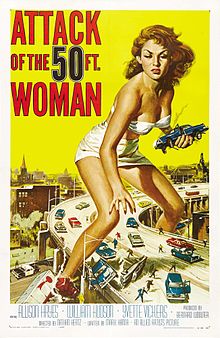
The misogyny of this story escaped me as a child, as did the sexual innuendo. I was only after the cheap thrills of cheap special effects. So I turned to The Incredible Shrinking Man, released a year earlier in 1957. Scott Carey, after sending his loyal wife Louise to the galley for a beer, is hit by a radioactive cloud while on his brother’s boat. An accidental dose of insecticide some months later sets him to shrinking—a freudian fear for all men. As he grows smaller, his will to dominate his wife—now a giant to him, increases. Many scenes end with a tiny man leaving his wife in tears. Even when he is supposed dead, but in reality is too small to make himself heard, Louise is reluctant to leave, in case he still needs her help. Like a short beer, I suppose. The spider scene, which no doubt caused nightmares when I was a child, follows on his monologue about having to dominate his new, tiny universe. The little man shrinks into non-existence with the realization that “to God there is no zero.” What he doesn’t say aloud is, “as long as one is male.”
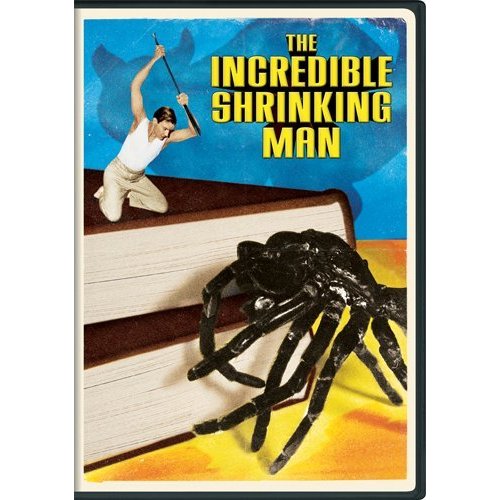
These are the 1950s to which some political commentators (and not a few voters) wish us to return. Men fear being dwarfed by women. Call it radiation, or call it social regress, or call it paranoia—the message is all the same. Man must dominate. Women who overshadow are a threat. In the earlier film, Scott Carey is a passively shrinking man. By the next year, when Nancy Archer grows, it is now an “Attack.” Fast forward half a century. Dreamwork’s Monsters vs Aliens makes a parody of Nancy Archer, and Susan Murphy’s fiancé, Derek Dietl (who is clearly modeled on the smug, self-righteous newscaster in Attack of the Fifty Foot Woman) ends up alive, but shamed. The male alien who seeks to dominate her is destroyed. And the male monsters feel somehow less fierce in her presence. As this year’s political posturing clearly demonstrates, there is still a long, long way to go before true equality appears. Many men are clearly stuck in the black-and-white fifties. The full-color, larger than life Ginormica will hopefully better reflect the paradigms of the future.

 Steve A. Wiggins