
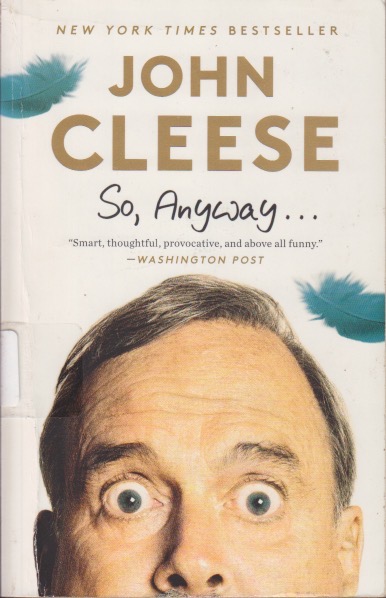
C. S. Lewis wrote somewhere (I can’t recall, but it was probably in Surprised by Joy) that when reading autobiographies, he found the youngest years the most informative. I found that true for So, Anyway… , John Cleese’s memoir of his life up until the founding of Monty Python. My wife and I read this book together—I tend not to gravitate towards autobiographies of living persons unless it’s someone I’m utterly fascinated by, but since we both enjoy Monty Python, why not? It gave me quite a bit to think about. Some parts are very funny, others more mundane, but mainly it was the path to a writer’s life that interested me. I typecast Cleese in my mind as an actor, specifically a comedic one. Of course, comics often write their own material. Or at least some of it. What became clear is that Cleese thinks of himself primarily as a writer. That helps me understand.
It struck me that becoming a writer might’ve been easier had I started trying to get published when I was younger. Of course, I didn’t have the advantage of attending Cambridge, or any other university where connections might’ve paid off. Or having my writing encouraged after high school. Already by college I’d been writing both fiction and non for many years. In any case, Cleese found a teaching job because he’d attended the school himself, and then studied for a career in law. Performing, however, and the attendant writing, soon came to be his self-identified career. Anyone interested in Monty Python would find this an interesting account. It only goes up to that point in the author’s life, which was, of course, only until he was still a fairly young man. These days it’s difficult to be taken seriously as a writer without a degree in English or journalism. The rest of us founder.
Monty Python was a group effort. My wife and I read Eric Idle’s memoirs a couple years back (for some reason I didn’t post about it). So, Anyway… was, however, a find at a used book sale, and we’re not actively looking for Michael Palin, Terry Jones, or Terry Gilliam’s reflections. (Graham Chapman died young, of course.) Mental typecasting is probably a crime against a fellow creative but the space someone moves into in our consciousness tends to be the same room they will always rent there. It’s difficult to make a living as a writer and many who declare that as their identity work other jobs to make it possible. Sometimes, such as the case of the famous, that other job may be the one where all the recognition lies. Such is the creative life.


 Steve A. Wiggins