God in the Shops

Over the past few weeks, as I’ve been out and about, I’ve been noticing the way that the divine has been utilized by shop-keepers. In a culture where incipient religion is so pervasive, it seems that God is treated much like the NSA in some quarters—always watching, always vigilant. I popped into a shop selling locally made items (I try to support the local economy when I’ve got a greenback or two to spare, although that is rare), where I saw a sign reading “Shoplifting & Theft Will Be Judged By God.” The sentiment gave me pause. Deeply embedded in our society is the idea that without a divine mall cop, we would all run amok with crime. Although religion is pervasive in the world, much of it is non-deistic, and yet highly moral (particularly in east Asian nations). Their cultures have advanced, even beyond western culture in many aspects of technology, and yet gods (and specifically our God) do not figure into the ethical equation. Pillage and plunder do not seem to erupt when God is not in the shop.

IMG_0903

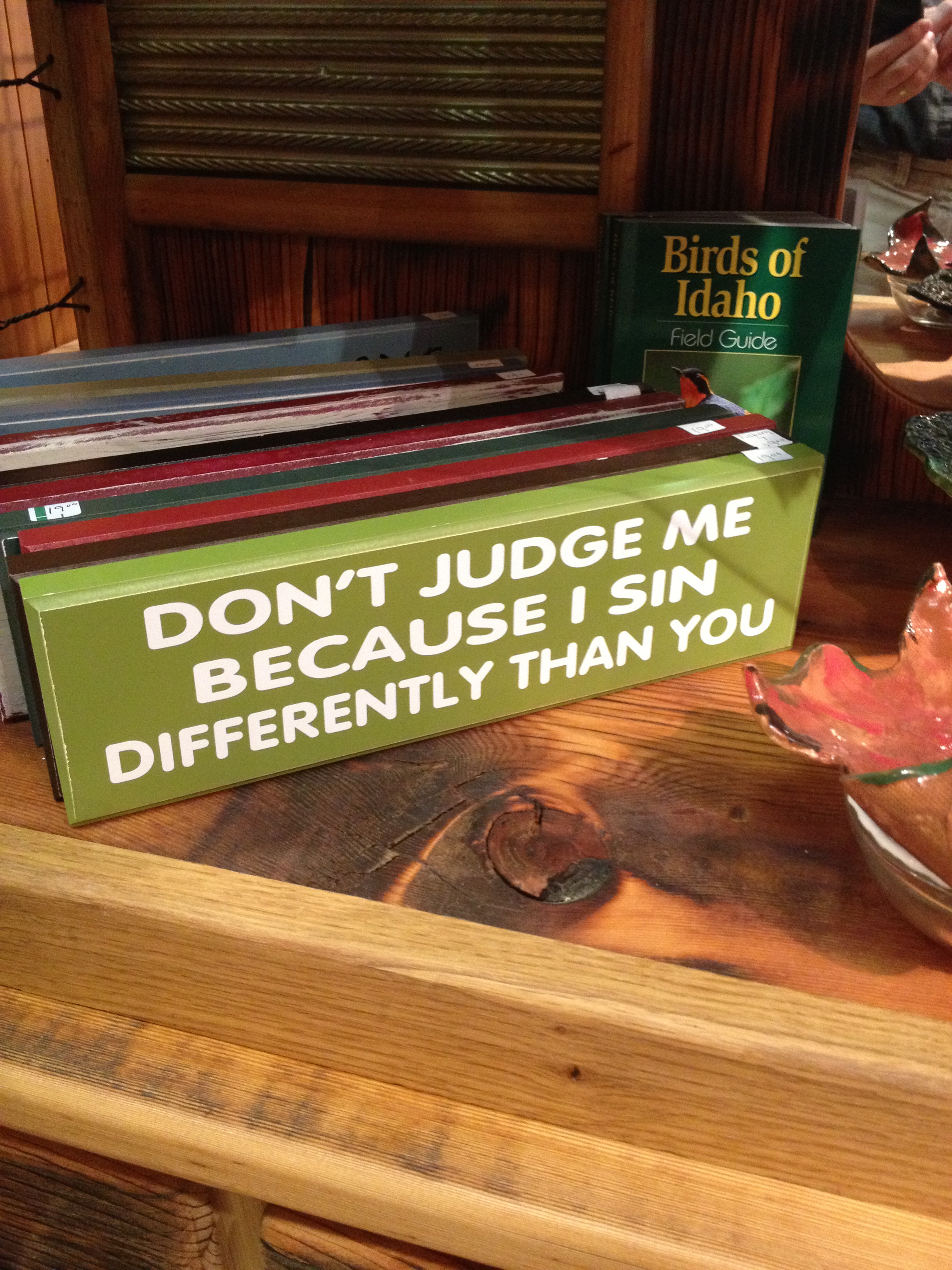
Whimsical signs have been popular decorative items for decades now. The problem with whimsy is that it loses its effectiveness once the initial chuckle is over. Signs reading “no pain, no gain” in fitness clubs may inspire day after day (although I have my doubts), but the cute warning that “the dog is crazy” on your doormat fails to impress after the first reading. (It must be pretty obvious that I don’t entertain much.) Nevertheless, shops stock those impulse-buy signs that are clever and witty, if soon outdated. I found one the other day reading, “Don’t judge me because I sin differently than you.” Even with the strains of self-righteousness, there is valid thought here. When the woman caught in adultery was brought before Jesus, he said, “Let the one without sin throw the first stone.” This disputed passage is one of the most pertinent in all of Scripture. No stones flew.
IMG_0909

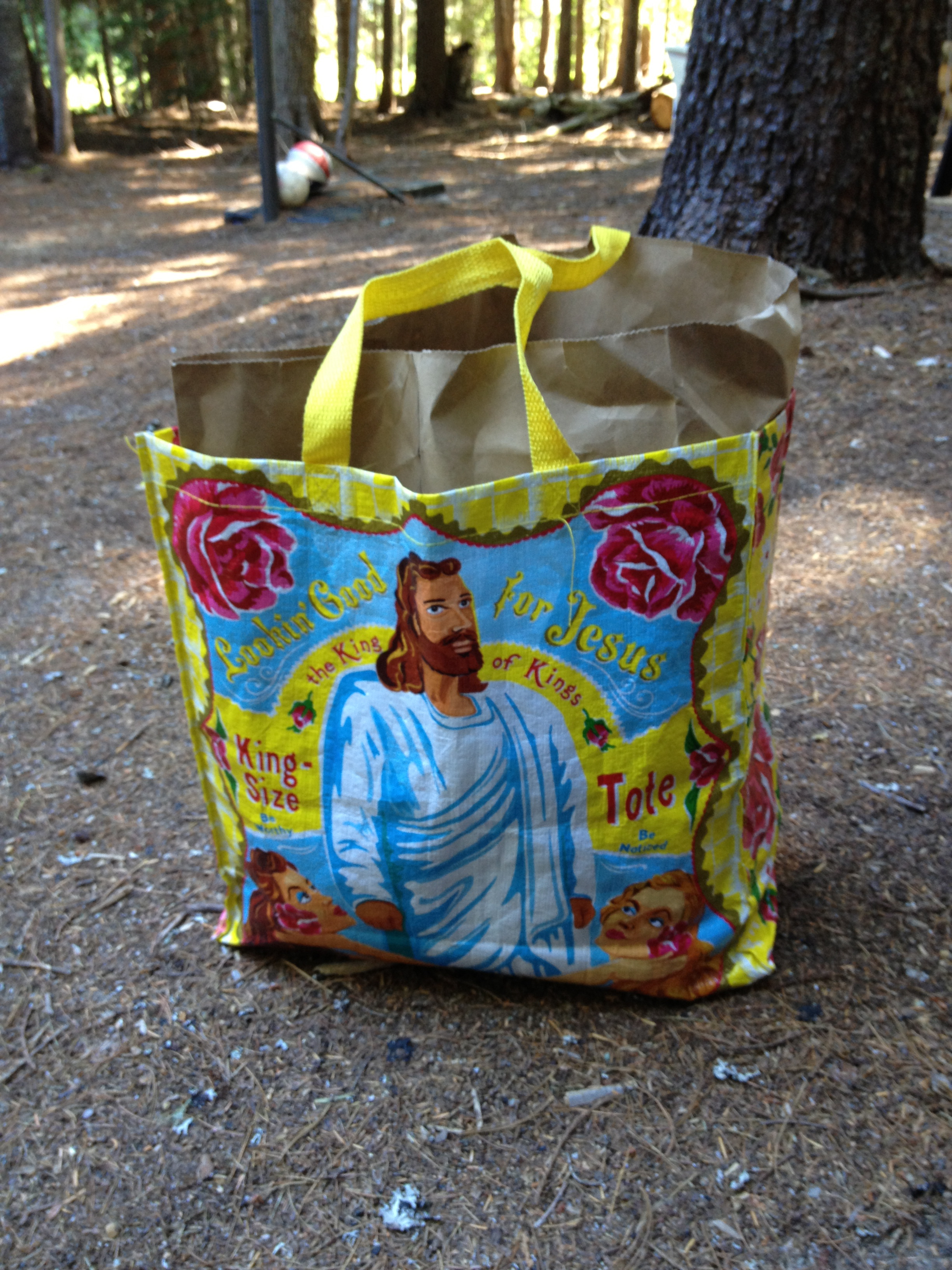
Finally, a friend came in bearing a shopping bag with Jesus on it. “Lookin’ good for Jesus, the King of Kings, King-size Tote” it read. The bag was clearly designed with a heavy dose of irony. I couldn’t help but notice that the bag was full of bottled gas. This portable version of the only begotten is a reminder of how commercial our religion has truly become. Although clearly presented with tongue distending cheek, we know that, as I tried to convince many at Gorgias Press, Sects Sells. People will buy cute knock-offs of their deities. In Wisconsin we used to visit Holy Hill, a Carmelite shrine where all manner of sacred kitsch lined the walls, from glow-in-the-dark rosaries to cheap, plastic saviors. The shop was never empty. Perhaps it is possible to worship both God and mammon after all.
IMG_0908


Evolving Morals

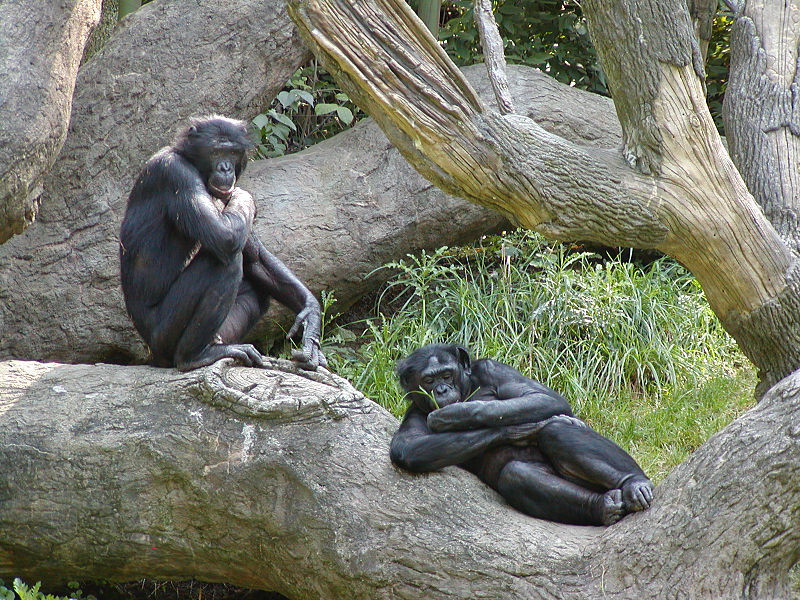
CNN recently interviewed Frans de Waal about his new book, The Bonobo and the Atheist: In Search of Humanism among the Primates. Of course the book immediately went on my “to read” list. I’ve followed de Waal’s non-technical work for years and I have come to trust his judgment. As director of part of Yerkes Primate Research Center, de Waal knows apes better than most of us know our neighbors. He has been exploring the origins of altruism and empathy in the great apes and has come to some amazing conclusions. His past work has shown that much of what we have attributed to special revelation has actually arisen in people through regular evolution. The apes, particularly the bonobos, but also chimpanzees, show startlingly human reactions to moral situations. In the interview, de Waal notes the implications for religion. In his opinion, morality predates religion since the former is seen in other primates while the latter is not.

As much as I trust de Waal’s judgment, the unanswered question remains: what exactly is religion? Animals display rudimentary religious behaviors, but in human-speak religion is often intertwined with belief. In watching a recent episode of Morgan Freeman’s Through the Wormhole—“Is There Life After Death?”—it was clear that while scientists tend to stand on the “no” side of this divide, in the end it comes down to a matter of belief. Not all religions, however, are tied to belief. Some religions assert that what you believe is not important, but rather, what you do. In such religions morality is much more like our primate kin’s version of religion. As Freeman points out, you really can’t know what another person believes. You can ask, but if you believe their response is always an open question. Here is the dilemma of religion as a matter of belief. Even Jesus putatively said, “by their fruits you will know them.” Morality here sounds like religion.

Frans de Waal suggests in his interview that morality differs from religion by being earlier in the evolutionary scale. If, however, religion evolved—which it surely did, as we can continue to observe its evolution today—it may be of a piece with morality. We object to suggesting animals have religion; this suggestion would knock humanity off its pedestal as the only species to which an incredibly human-like god revealed (as it is said) himself. What de Waal has gone beyond proving in his previous books is that much of what qualifies as religion is found among the great apes. De Waal doesn’t put it in those words, but as a lifelong student of religion I have observed the connections first-hand. A scientist may not feel qualified to define religion, just as a religionist is not qualified to correct a scientist. I eagerly await the chance to read The Bonobo and the Atheist, but I already know that I will find much of what de Waal writes to be beyond question, and we may all be much closer to the origins of religion than we realize. Even our great ape kin.

Michelangelo's muse? (Photo by Greg Hume)

Michelangelo’s muse? (Photo by Greg Hume)


Tell-Tale Hearts

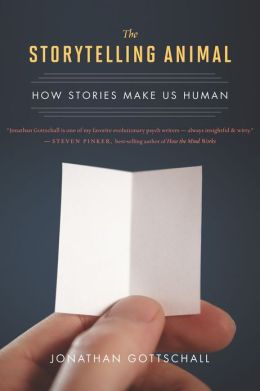
StorytellingAnimal As a sometime dabbler in the fictional arts, I was intrigued by Jonathan Gottschall’s The Storytelling Animal: How Stories Make us Human. I read the book because of my own fascination with fiction—it is a transcendent activity to read it, but more so to write it. I‘ve always wondered why. Gottschall, a fellow academic making a living as an adjunct instructor, is a lucid writer and a great storyteller. His book opens with the unusual fact that even the most logical and rational of humans are addicted to stories. Our brains work to spin unrelated events into narratives. Even while we sleep, our minds continue to tell fictitious accounts of weird adventures. To be human, Gottschall clearly demonstrates, is to be in love with stories.

In chapter 6, “The Moral of the Story,” Gottschall turns his attention to religions. That far into his book it is no surprise that we find religions are largely based on story. Those who’ve studied mythology plainly see the story-ridden origins of religions. Religions, after all, have nothing if not great explanatory value. They tell the tales of why we’re here—the technical name is “etiology,” stories of origins, but also tales of what the gods, the tao, or the force demand of us. Believers often take such fanciful narratives literally, missing the point of it all, the proverbial moral of the story. The story is the moral. We find the deepest truths in fiction.

Many of my friends are fiction writers. Most have never been published or struggle to find representation. None simply give up. The draw of narrative is as palpable as the need to eat or sleep, as strong as the urge for sex or recognition. It is far stronger than the desire for money since nothing material can substitute for our desire for stories. After a busy day we send our children off to bed with a nighttime tale. Many of us climb into bed with a book—the more fictional the better—to end our conscious hours each day. We dream our way through the night and spend our long days fabricating a narrative we call “my life.” Those of us who indulge in fiction are sometimes solitary individuals, but we crave the awareness that we are not alone. Others too, as Gottschall clearly proves, are alone with us. In fact, all humans are gathered around this campfire of the storyteller. Thank you, fiction, for coming to the rescue.


Inventing God

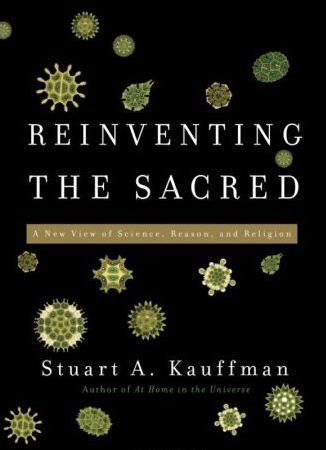
Reductionism has been a hallmark of science for many years with the most extreme forms suggesting a kind of cold determinism in the universe. Having known since my undergraduate days that science is the key to knowing, yet having the experience of believing as well, I wondered how they fit together. If they fit. I have just finished reading a very important book on the topic – Stuart A. Kauffman’s Reinventing the Sacred. A theoretical biologist, Kauffman has come to the conclusion that reductionism cannot account for many aspects of the world we actually experience. Evolution, biologically as well as culturally, demonstrates again and again a creativity that cannot be predicted, no matter how much data is acquired. Kauffman suggests that this non-reducible creativity is what might properly be called “God.” Not a believer in a transcendent creator God, Kauffman does not wish to remove the God meme from our psychological vocabulary, but to reinvent it.

In many ways, I found Kauffman’s work to be some of the most affirming science writing I’ve ever read. He believes there is a place for creativity in the overall human experience of knowing and being. Values are not simply arbitrary points selected by people, nor are they imposed on us from a personified God. Values and beauty are emergent phenomena. As Kauffman argues, they are clearly and blatantly real, but not reducible to physics. He also demonstrates that economics falls into the same category of real but non-reducible. As a researcher in complex systems, Kauffman quickly left me in the dust when he reached the more theoretical material. I am not equipped to assess his scientific conclusions. Overall, however, his book possesses a rare sort of urgency for a scientific exploration, and it values the whole of the human experience.

Demonstrating that ethics emerge not from “on high” but from a human sense of value and “right,” Kauffman suggests that we desperately need a global ethic to realize our full potential. In the ongoing debate between science and religion, Kauffman is a voice of both reason and compassion. Science is the way we know – there is no point in debating that. If you are reading this on a computer, Q.E.D. If you are a human being, then you have also experienced the phenomenon of believing, whether or not it is religious. Kauffman has addressed the question directly and has given both specialists in science and in religion a trenchant analysis of an intractable issue. His irenic approach is to be applauded, and hopefully, widely read.


Cheating God

Anyone engaged in education long enough will eventually encounter cheating in one form or another. Social psychologists have suggested that whether one believes in God or not has little bearing on moral behavior. A recent report in the International Journal for the Psychology of Religion demonstrates that belief in God does not effect cheating by undergraduates. Among those that believe in God, however, those that believe in an angry, punishing God cheat less than those who believe in a loving, forgiving God. An explanation of the study may be found at Medicalexpress.com.

Someone's watching you

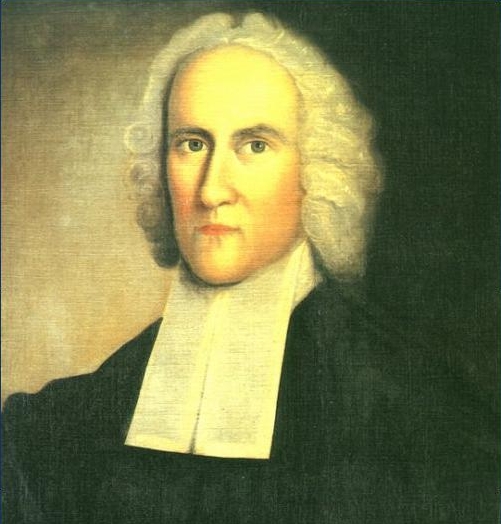
Jonathan Edwards’ famous sermon, “Sinners in the Hands of an Angry God,” it seems, is the bane of cheaters. The Great Awakening chased along the heels of a wrathful deity baying “believe or else!” Those believing in a nicer God are more apt to take liberties. The interesting corollary of this finding is that it does not divide believers along denominational lines but rather along personal outlooks on God’s kindliness. Nobel pagans and fearful believers share a strong moral center.

An informative follow-up would be a study to determine how many believe in a loving versus a wrathful God. From such data we might be able to extrapolate who is more likely to cheat on taxes, spouses, or any other big-ticket items in the economy of our society. Given the number of high profile spouse-cheatings among televangelists and Christian politicians, one thing seems clear: belief in a friendly God willing to look the other way is in no danger of extinction any time soon. Oh, and please keep your eyes on your own paper.


Aye, Robot

Being a “biblical scholar,” having an interest in robots might seem counter-intuitive. I was intrigued by the topic as a youngster, but convinced that if what the Bible said was true it deserved nothing less than full attention, I let my formal study of science lapse (although I kept an active reading life on it). Now, through the interest of my daughter, I have found myself mentoring budding young engineers, mostly by helping put things away and correcting grammar. Yesterday we took our robots outside for the local street fair. Almost always the response we get from local people is “Robots? Our school has robots?” Well, partly correct. The schools house the robots, but our robotics club is largely self-funded, so the robots might be said to belong to the team rather than the school. In any case, yesterday the robots played soccer in the street for the amusement of festive fair-goers.

People often fear “soulless machines.” They run by predetermined rules, set down explicitly in computer code, and do only what they are programmed to do. Some fear artificial intelligence for this very reason: what if robots or computers are programmed to think? Does this make them something more than physical machines? The standard, religiously biased, answer is that the soul, or even mind, is a uniquely human possession. Animals may act on instinct, some may qualify as having a limited mind, but definitely not souls. That would simply cross too many boundaries. When asked to produce a human soul for scientific scrutiny all religions come up blank. We don’t actually know what a soul might be – an everliving component that God might throw into Hell or spoil in Heaven seems to be the general gist. And it makes our moral choices for us.

In the Bible if any animal (say a bull) gores a person to death, and that bull had a prior reputation, not only beast but master could be put to death. It seems that the bull has a bad moral intention. If robots hurt people, in violation of Asimov’s first law of robotics, they are treated as acting with moral intention. We project souls onto them for the convenience of condemnation. If an animal, such as a zoo gorilla, saves a human child, that animal receives the treatment of a souled being for a while, until the act is forgotten. It seems that souls are immaterial components of a closed system used to reward or punish an individual. How much of themselves do humans have to put into their robots before they can have souls as well?

Robots among the people


Ape Versus Primate


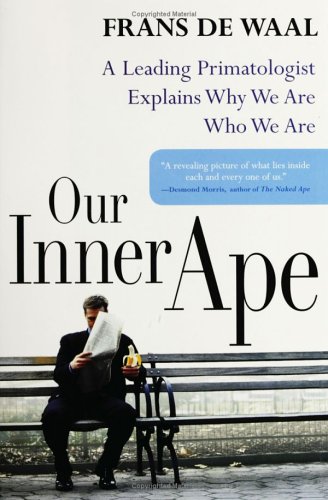
I have just finished reading one of the most important books I’ve found in quite some time: Frans de Waal’s Our Inner Ape. My attention was first drawn to the author when Rutgers University sponsored a talk he gave in the fall that I was unfortunately unable to attend. Simultaneously I saw his book footnoted in a text I was reading and decided to follow up on it. In addition to containing fascinating, documented anecdotes concerning ape behavior (he tells of a bonobo that attempted to help an injured bird fly!) de Waal holds a mirror up to the great apes and sees humanity reflected back. His discussion of the origins of morality makes far more sense to me than any theory I’ve seen a professional ethicist concoct. Our sense of empathy, de Waal notes with considerable evidence, derives from our common ancestor with the apes.

After discussing the understudied trait of kindness in the apes, de Waal writes: “With morality firmly rooted in sentiment it’s easy to agree with Darwin and Westermarck on its evolution and to disagree with those who think culture and religion contain the answer. Modern religions are only a few thousand years old. It’s hard to imagine that human psychology was radically different before religions arose. It’s not that religion and culture don’t have a role to play, but the building blocks of morality clearly predate humanity. We recognize them in our primate relatives, with empathy being most conspicuous in the bonobo and reciprocity in the chimpanzee. Moral rules tell us when and how to apply these tendencies, but the tendencies themselves have been in the works since time immemorial” (225).

These might just be platitudes if ample evidence did not demonstrate their veracity. Apes plan ahead, recognize fairness, and can even see issues from the point of view of others (something Gorgias Press might benefit from learning). They are clearly inheritors of the moral sense that evolution has crafted among all cooperative animals over the eons. Religions like to lay claim to the origins of morality: we behave this way because our god told us to. In a sense that may be true, but only if the “god” is nature itself and the instruction it gives is the way for a species to thrive. Caring for one another, all religions aside, is the formula that evolution presents as the most successful choice of natural selection.