Tweets from Heaven

What do the ultra-rich know about morals?  I read recently that now that Elon Musk has purchased Twitter for billions and billions of dollars, that he’s going to allow Trump back on because it’s “morally wrong” to prevent him.  Heaven help us when the plutocrats start dictating morals.  One of the odd things about my strange career is that I was an undecided major in college.  I settled eventually on religion, but my transcript shows a restless mind.  One subject that I came back to time and again was ethics.  I want to know what is right.  Shutting up a deranged narcissist who wants to run the country only to enhance his image of himself seems a moral no-brainer.  The case was different before he was elected the first time.  Now we know.  Now we have a responsibility.

Those who can afford to buy the moon shouldn’t make declarations on what is moral.  The church, however, has largely become irrelevant.  “It’s easier for a camel to pass through the eye of a needle,” a famous moralist, whose name is unfortunately forgotten, once said.  The moral compass of the uberwealthy is irrevocably squewed by a massive loadstone known as personal wealth.  Indeed, our very laws are made by the wealthy to protect the interests of the wealthy.  They do this by courting biblicists who seem to have forgotten—what is his name again?  You know, the one who seemed to have a problem with the rich?

Photo by Sharon McCutcheon on Unsplash

Morality has somehow become confused with concerns about other people’s genitalia.  We don’t ask what the wealthy do with theirs—it’s pretty clear what one tweeting resident of Mar-a-Lago has done with his.  Ironically Protestants broke away from the Catholic Church largely because of the sale of indulgences.  The idea that the rich could buy their way out of sins rankled sixteenth-century moralists into saying sola scriptura.  But now they have lost even their solaScriptura, for its part, is unequivocal about one thing—the problem of the rich.  The poor aren’t the problem.  In this new gospel, however, victims are blamed while the powerful rightly rule all.  The divine right of riches.  The wealthy, so misunderstood; the poor are the way they are because they’re lazy.  There’s no systemic cause for anyone not to have as much money as he wants (and it seems they’re generally he’s).  And they have a right to say whatever they want because their word comes down from heaven, echoing out from their private space rockets to the stars.
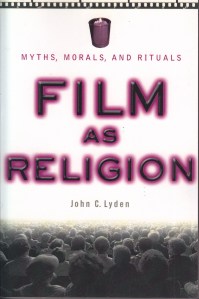

Seeing Belief

Although most of us can recognize it on sight, we have a difficult time defining religion. In the early parts of Film as Religion: Myths, Morals, and Rituals, John C. Lyden discusses this lack of definition and offers some broad categorizations since his thesis depends upon it. How can one assert that film may be understood as religion if religion isn’t identified? Lyden makes clear that this book won’t be about an ideological or theological interpretation of film. It’s more about popular culture and how elements of that culture, such as cinema, may be religion. This leads to the discussion of the topics of his subtitle: myths, rituals, and morals. These all share some conceptual territory with movies, therefore understanding them is important.

To me the most interesting part of the book is the consideration of genres (westerns, gangster movies, melodramas, romantic comedies, children’s movies, science fiction, thrillers and horror) as exemplars of various aspects of this religion. Each genre includes the discussion of a feature film, and some even have two. Of course, Lyden’s book is a few years old now and other studies have shed further light on both how religion and film interact and also on the interpretation of various genres of movie. The hope of the book—that it may be the start of a new kind of discussion about religion—has to some extent been realized, although the analysis has taken off in several directions at once. There can be no doubt that cinema taps deep spiritual needs in a way not unlike a religious ceremony.

It seems that society has come to distrust the usual purveyors of religion. Dishonesty almost as deep as that of the government has been found in it and the responses are remarkably similar—cover-ups and denials and many species of prevarication. Cinema seems downright credible in comparison. What you see is what you see. The big difference between movies and religion, however, is that we’re only too glad to acknowledge the human sources of celluloid. Many religions, especially in the monotheistic tradition, rely on direct divine revelation as their origin. Lyden isn’t suggesting that film substitutes for religion in that way, but on a more practical level it may. It meets our needs. We trust we’ll get what the poster and trailers promise us. We sit reverently in the dark awaiting illumination. And yes, there’s an exchange of money involved for any kind of worship involves an offering. No religion’s free of cost.