Consciousness Conscience

Not so long ago—remember, I read old books—living to 60 was considered a full life.  I’ve passed that and while I’m in no hurry to shuffle off this mortal coil, I often think of how improved medical practice has prolonged many lives.  This is a good thing, but it does make death a more difficult fact to deal with.  If there is any good that came from my Fundamentalist upbringing, it was that it taught me early on to think about death with some frequency.  I’m not a particularly morbid person, but since we all have to face this, avoidance seems to lead to grief, shock, and acute mental pain.  I tend to consider watching horror movies a spiritual practice.  Little reminders, in case I forget to consider my own mortality today.

Our faith in science is a little bit misplaced.  Sure, it helps enormous numbers of people live longer, healthier lives.  But it may also detract from the necessity of attending to our spiritual lives.  I don’t care if you call it consciousness, your soul, psyche, or mind, but we have a life we’re accountable to, and it’s not all physical.  Since consciousness feels neutral enough, let’s go with that.  We don’t know what happens to our consciousness after death.  There are plenty of theories and ideas about it, but no certain knowledge.  There may be faith, and there may even be some evidence, but it is always disputed.  It does seem to me that facing death squarely on may help take care of at least some of the anxiety.  Fear of the unknown is probably the greatest fear our species possesses, so pondering it may take the edge off a bit.

Some people claim to remember past lives.  Sometimes I wonder if they might be tapping into the great unknown: consciousness.  Perhaps consciousness survives without a physical body.  Perhaps it’s large—expansive—and encompasses far more than we can imagine.  Maybe some people can access part of that consciousness that includes the past lives of others.  We have no way of knowing, but it seems worth thinking about on this All Souls Day.  Of course, I have the advantage of having lived what used to be considered a full life.  In it I have set aside at least a little time each day to consider what happens after this.  Do I have a definitive answer?  No.  I do have faith and I do have beliefs.  And I’m always reflective on All Souls Day.
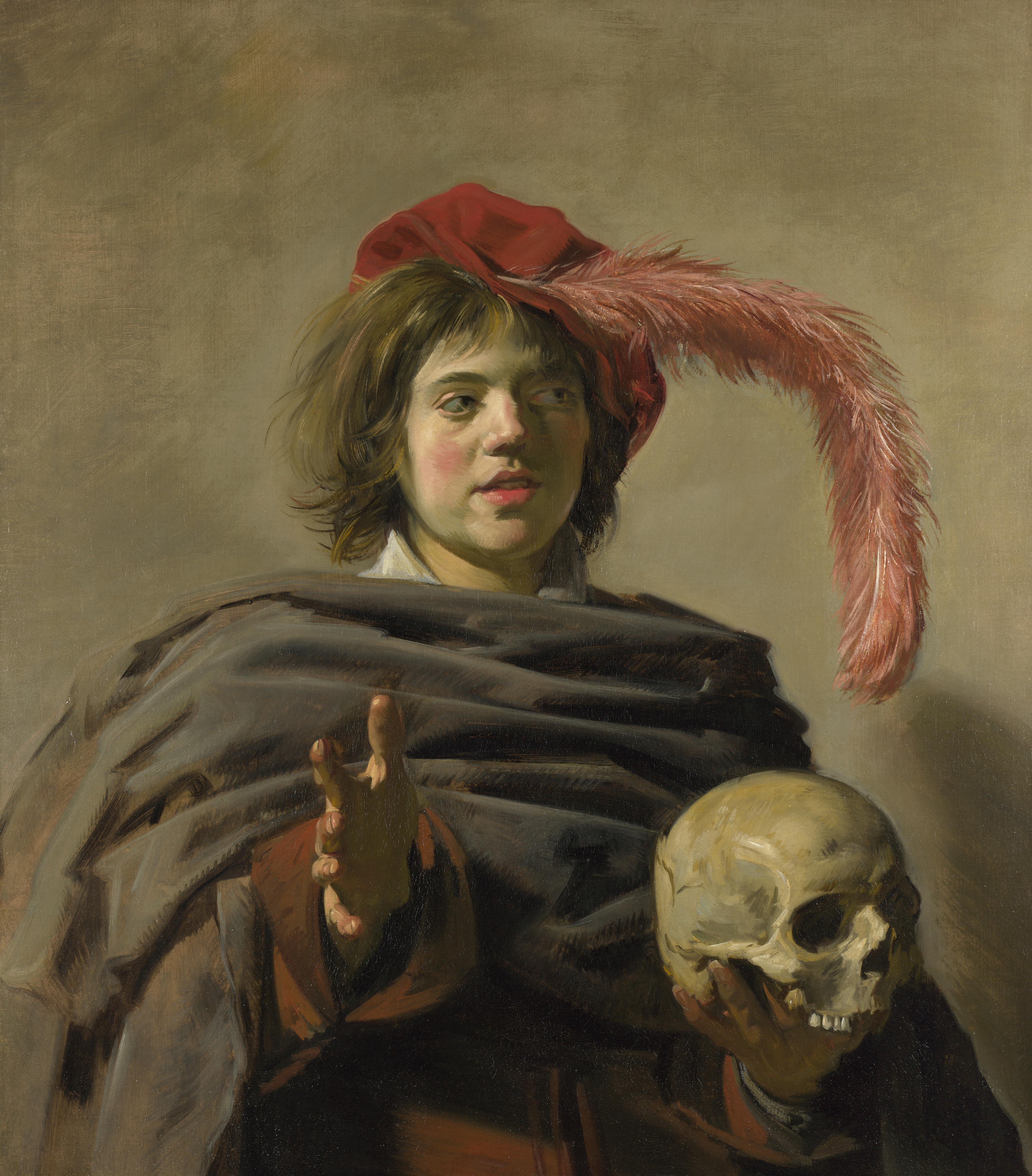
Frans Hals, Young Man holding a Skull (Vanitas), public domain via Wikimedia Commons


Status Check

It took many months, but one of my few Twitter followers was removed not for trying to take the nation by force, but because he’d died.  If I learn to tweet from beyond perhaps I’ll score a few more followers.  The situation, however, is one of the oddities of our socially mediated world.  I was trying to find some information on a potential author the other day and the only online presence I could locate was LinkedIn.  I clicked on the profile only to see the latest update was “Deceased.”  More than that, the Experience column indicated that “Deceased” continued from the date of passing up to the present.  I guess once you’re gone, your gone for good.  Social media, however, will perhaps find a way to keep you alive.

When I’m gone, I imagine WordPress will shut this blog down because nobody will be paying for it.  It’ll probably take a while for Facebook or Twitter to figure out I’m in the new category of “deceased.”  I do hope Academia.edu will keep my downloaded papers there for free. Real immortality, it seems to me, lies in the writing of books.  They too will eventually disappear, and who knows about the real longevity of social media.  It’s pretty difficult to believe Facebook wasn’t even around at the turn of the millennium.  I drive a car that’s older than Facebook.  I keep thinking of LinkedIn listing “Deceased” as a vocation.  Isn’t it really the ultimate vocation for all of us?  If you can’t be found online, do your really exist at all?

While experts debate social media, my job prevents me from using Facebook or Twitter during the day.  After work I’m anxious to get on to the other things in life that virtual friends and followers have to wait.  Early in the mornings I write and research.  I have mere minutes a day to look over social media.  I check Facebook only for alerts.  Life is short.  Is social media making it better?  It’s easy enough to be overlooked in real life, so why indulge in it virtually as well?  Of course, many see social media as a place to vent their spleen.  Why not try to inject some good into the virtual world instead?  There is hope for the dead, for they may still publish.  Their tweets may become somewhat less frequent.  Only the most callous, however, would drop them as friends for being dead.  Let’s just wait for Zuckerberg or Musk to notice.  It may take a few months.


Without a Hitch

I’m not really afraid of dying. All those years of being taught that “to die is to gain” have obviously done their work. At the same time, it is a poignant exercise to read the posthumous memoirs of a dying man. I remember my first funeral. Although I don’t recall the name of the poor, deceased honoree, I still see the reactions of the living vividly. I was under ten at the time, and the funeral home in Franklin, Pennsylvania was in a very somber mood. The man, who had been a friend of the family, “was not a Christian.” Having been buffed and rubbed in the Fundamentalist tub from my earliest days, I didn’t realize that what was meant was actually that he hadn’t been an active member of our particular church. Nevertheless, as a child, you get deeply impressed with these kinds of things. “I’ll never go to the funeral of a non-Christian again,” I remember my mother telling a friend. “The minister couldn’t find anything comforting to say.” While funerals are sad occasions by definition, this one left a crater that is still fresh over forty years later.

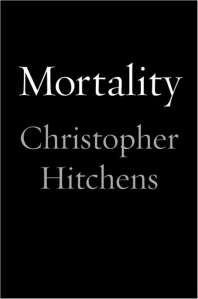
MortalityChristopher Hitchens is someone I found through his book God is Not Great. I don’t have time to read magazines, and I hadn’t read any of his previous works, but he raised some extremely valid points in this diatribe. My wife recently bought me his final oeuvre, Mortality. I felt as if I were back in that funeral home. It is not that I still hold to the odd belief system of Fundamentalism—of this my regular readers will have no doubt—but it is the forlorn feeling of reading the words of someone dying who hopes for nothing. Yes, it may be Stoic, and even noble. Certainly it seems far more worthy than visions of living in opulence with lots of available virgins with whom to toy while angels strum their harps overhead, but the certitude that one’s final days will be nothing but prolonged suffering—ouch! Maybe there isn’t a heaven, and if there’s a hell there’s something morally wrong with the universe, but doesn’t some residue of a human life remain? Even if it’s just the memories, the marks that we’ve made on others’ minds, don’t we somehow survive? Dying without hope nevertheless feels like milling about in that doleful crowd of specific Christians years ago.

Hitchens does offer a chapter in his final words devoted to those Christians who responded to his cancer with an unholy Schadenfreude, trying to torture the thoughts of a dying man with the promise of an eternal hell after experiencing a temporary hell of cancer treatments. This chapter made me sick. Anyone who so completely misses the message of compassion that suffuses the Gospels can hardly claim the designation Christian, I would insist. No one, no matter what their eternal plans, has the right to try to fracture anyone’s tenuous tranquility to make their own crown shine a little brighter. Such weekend warriors likely imagine that they are defending their fragile God, but in reality they are demonstrating that some of the criticisms of Hitchens were very well placed to begin with. No religion will live up to its full potential until it succeeds in the most basic practice of all—treating all people with respect and dignity. Until then, death has the final word.