Climb Every Mountain

In Ancient Near Eastern religions class, we’ve been discussing where the gods live. At least beginning with the Sumerians (perhaps earlier, but since writing hadn’t been invented, we can’t know) the gods typically dwelt on a high mountain. Older writings on Sumerian religion call this the mountain of “Heaven-Earth,” a name that conveys the point, but also misleads. The concept of “Heaven” is much later than the Sumerians, and in western religions, later than the Hebrew Bible. “Heaven” in this sense is nothing more than sanctified sky. The gods live up there, beyond all the trouble we encounter down here. The idea proved remarkably resilient, stretching through the concepts of Mount Sinai, and Mount Zion in the Bible, and Mount Zaphon among the Ugaritians. Even the Greeks found their gods on Mount Olympus.

The logic of the day was simple: no one has been up the mountain to prove otherwise, so the assertion has never been falsified. Mountain climbing is a leisure activity – in ancient times leisure was not a general expectation. Mountains were obstacles, not opportunities. In their remote and rugged heights, where humans could not reach, the gods dwelled. And, perchance someone did climb a mountain and find the wrong gods? There were plenty of extra deities to go around, so no worries there.

An element of the divine on the mountains still exists. Various tourist companies offer Noah’s Ark climbs of Mount Ararat in Turkey. Even without such support, misguided but determined groups still head to this mountain to prove the veracity of the Bible. In their own way they too are seeking god on the mountain. The problem is that we’ve climbed every mountain and not found the gods. In our cosmology the divine has been shoved out further into space. When space becomes infinite, God moves beyond infinity, always one step ahead of our ability to find him. The ancients bequeathed an undying, if evolving concept upon us when they fabricated the mountain of Heaven-Earth.
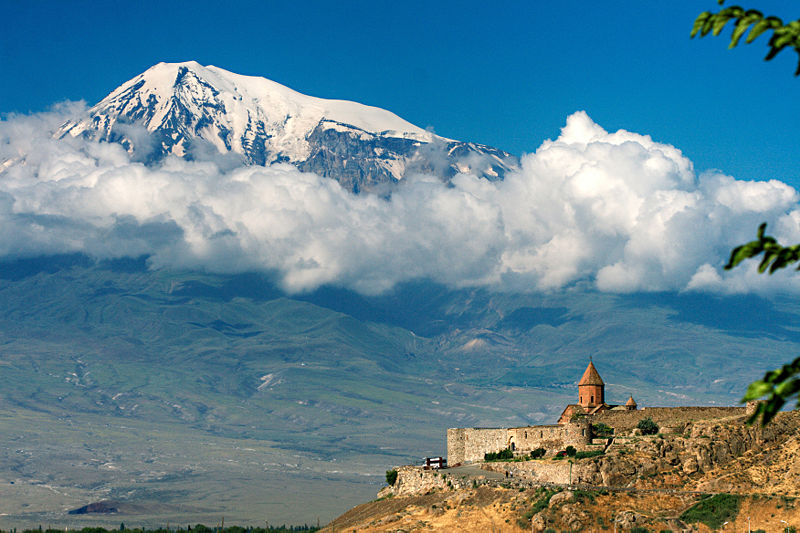
Andrew Behesnilian's photo of Ararat from Wikipedia Commons


Biblical Science Fiction

1950s science fiction films are perhaps the most parsimonious celluloid genre. Standard Saturday afternoon fare in my childhood, I still have a soft spot for the unapologetic self-confidence of these movies with their painted backdrops and hokey effects. The messages are frequently self righteous and often biblical. So yesterday as I treated myself to a viewing of The Mole People, I went on instant alert as the biblical references began right away for an audience that would have known the Bible well enough to take it all in. Set in “Asia,” the archaeologists are digging for Sumerian artifacts when then discover a stone tablet “below the great flood level.” That makes it at least 5,000 years old, the assembled academics declare. A diffident Dr. Roger Bentley tells his fellow excavators, “in archaeology all things are possible!” When a young boy of the indigenous population discovers an oil lamp shaped like a boat, the archaeologists note, “the flood’s been proven to be a historical fact.” The boat is a model of Noah’s ark, the Sumerian version. The scene of the expedition climbing Mount Kuitara includes footage from the 1955 Fernand Navarra trek up Mount Ararat during which a wooden beam was found, reputedly from Noah’s ark.

If you can stomach the bogus Sumerian you’ll learn that ancient Mesopotamians also survived the flood, a kind of “children of Cain” motif. These Ishtar-worshiping pagans are practitioners of a kind of social Darwinism, killing off their own kind when resources in their underground world become strained. Their great underground civilization parallels that of ancient heathenism while more advanced civilization on the surface of the globe has the benefit of an enlightened Christian worldview. Even the Sumerians whipping the actual mole-men is reminiscent of the Egyptians whipping the Hebrews in the Ten Commandments (released the same year).

Fast forward fifty years. We now live in a technologically advanced civilization where the myths of ancient people have little place. Science provides logical explanations for most of what we encounter in the world around us. Yet there are still otherwise intelligent people seeking Noah’s ark on Mount Ararat. The past is impossible to escape. The Sumerians in the film (whose walls are inexplicably decorated by Egyptian artwork and hieroglyphics) represent those who hold onto a confused religion that has become a form of terrorism in the eyes of the more advanced archaeologists. Perhaps the paradigm has shifted, and those who use religion today to gain political power and personal gain have become the self-righteous Sumerians of The Mole People.


Noah’s Lark

This podcast deals with the myth of the great flood. It begins with a consideration of why modern expeditions do not find anything (nothing to be found), and considers the reasons the story is so appealing to present-day readers. The Sun Pictures productions on the flood story are reviewed, along with the story of the hoax played on Sun in their 1992 made-for-television movie. The history of the flood story is briefly narrated, beginning with George Smith’s 1872 discovery of the Mesopotamian flood story, back to Atrahasis and the Eridu Genesis from Sumer. The flood story is one of the earliest religious stories known.