Not Murphy’s Mansion

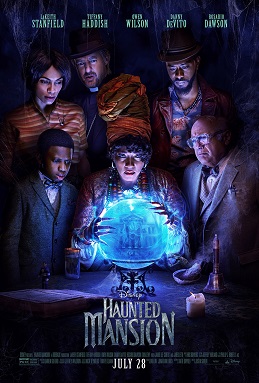
One of the dangers of streaming is that you can be talked into a movie by the fact of its availability.  Curiosity drove me to Disney’s The Haunted Mansion movie and that led to the discovery that there had been a reboot.  I’m drawn to haunted houses but not to theme parks, but well, you wonder how they might’ve thought they could’ve done it better.  The original movie failed to rock the critics, so, as the saying goes, try, try again.  Last year’s Haunted Mansion is over the top.  The story is more complex, with an ensemble cast, and not really funny or scary.  Based on a sad premise—two families with deceased spouses—they’re drawn, with three other New Orleans outsiders, to a, well, haunted mansion.  The main ghost is looking for a soul to harvest but as the two hours wend on, the characters reveal their sadnesses (one doesn’t).  Perhaps the idea is catharsis, but there are too many subplots and too many abrupt shifts of mood.

A movie should know, it seems to me, what it wants to be.  You feel for the sadness and loss of the characters but  I know something about using horror cathartically, and this movie doesn’t do it.  There are jokes and running gags, but they’re not really funny.  There’s religion involved, but it turns out to be fake, with even a faked exorcism.  There are literally 100 ghosts.  And really only one bad guy among them.  There’s drinking to drown sorrows, murders, and even adult humor that is somehow deeply disturbing.  There are a few nods to the original movie but the plot is quite different and it leaves you feeling drained.

With a budget of about $150,000,000, stops were pulled out all over this organ.  It doesn’t, however, have a focus.  In the original film, the Evers family really has a need to reconnect.  The mansion does that for them, through its ghosts.  The reboot implies at the end that two broken families might heal each other and that evil leads to its own punishment.  Still it leaves open the question: what is this movie trying to be?  The more cynical might say it’s only for money (the worldwide gross didn’t reach covering its budget), but I have to think that those who make movies do so for more than just a buck.  Coping with death is a profound human need that begins when a pet or, more seriously, a family member dies.  I’m not sure that Disney is the best authority on the subject.  At least not for those of us who use horror as therapy.


Movies, Paused

Technology breaks the world into bits.  It’s not just pixels, or 1s and 0s, it’s culture.  And we let it happen.  I was thinking this when I should’ve been watching a movie.  I don’t have much time for films, nor do I have money to see everything in a theater.  Or even to pay on a streaming service so that I can watch without commercials.  So like any zombie, I just let it happen.  Recently I was watching a movie—it’s here on this blog someplace—that was uncommonly unified by mood.  Edgar Allan Poe was of the opinion, and I think he was right, that short stories should be brief enough to finish in a single sitting.  Poe opined that such a reading allowed for the continuation of a mood set by the writer.  He was a master at doing this himself.  Breaking up movies with commercials reminds us of his wisdom.

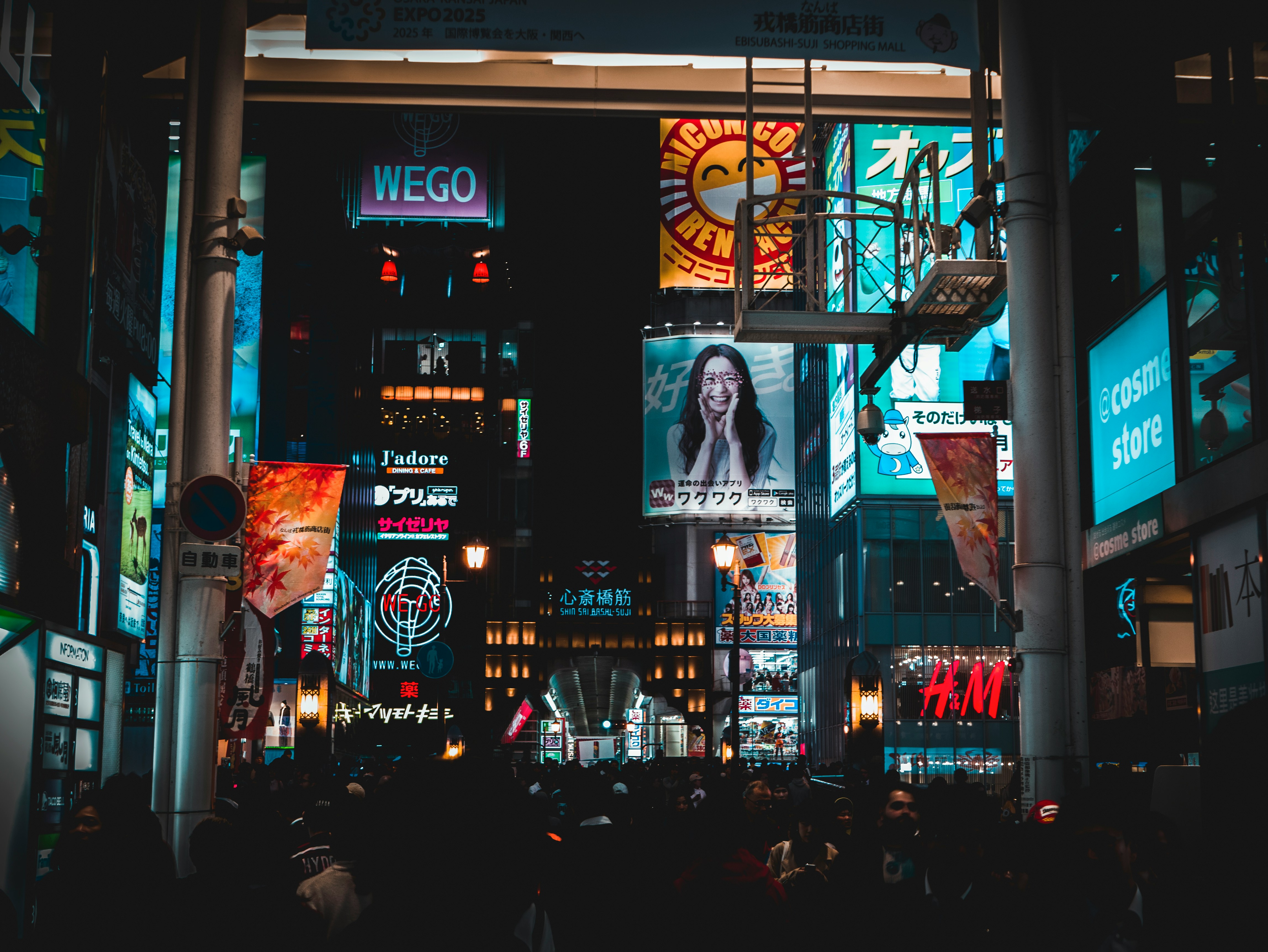
Photo by Ramon Kagie on Unsplash

So I was watching a film where the dread builds up slowly.  The shadows, the music, the unspooling plot—try this new toothpaste!  Here’s a silly television show that you can watch on our network!  What was the mood I was in?  It was shattered by people pushing stuff I’ll never buy.  (I’ve got sensitive teeth, Mr. Commercial, and my dentist has recommended a brand that keeps me from gnawing my tongue off.  And that television show, Ms. Commercial, has no appeal to me.  I won’t watch it.)  Back to the mood you were trying to enjoy.  This isn’t anything new, of course.  I grew up watching Saturday afternoon monster movies and they were constantly interrupted by commercials.  You have to endure the sermon if you want the fun of coffee hour.  But still, but still…

Yes, I know the rules.  Subscribe to a service (I use two) and you can watch what we’ve got.  Only some of it will be interrupted by commercials.  Companies as large as ours didn’t get this way by accident, you know.  We had to show the average person what market research indicates they want—whiter teeth, more entertainment.  Forget what you’re watching at the moment.  Isn’t that mood just a little intense?  Don’t you need a little break just about now?  I don’t know how you see these posts, but I pay extra not to have advertising on my website.  I do hope that’s the case, if you see it from a device other than mine.  Besides


After Effects

Every once in a while you find a book you wish had been published sooner.  The Exorcist Effect, by Joseph P. Laycock and Eric Harrelson is one of those books.  Although it covers many of the same films I talk about in Nightmares with the Bible, it does so with a different target in mind, and a lower price point.  Drawing on the observation that human recall is often accompanied by “source amnesia,” they explore the idea that famous horror films (and some less famous) get remembered as “facts.”  This seems to be a greater danger to those who don’t actually watch horror or who watch it uncritically.  Movies such as The Exorcist become the basis for what individuals believe about demons.  But it’s far more dangerous than that, because in a culture where everything’s politicized, horror movies become “the truth” for groups like QAnon.

Considering Rosemary’s Baby, The Exorcist, and The Omen as prime examples, they then move on to consider the fascinating, if weird, lives of Ed and Lorraine Warren, and Malachi Martin.  Popularizers such as these three influenced both horror films and general public opinion about demonic possession and exorcism.  The study moves on to the Satanic Panic of the eighties and nineties and how heavy metal music both utilizes and ties into the Exorcist Effect.  This important book ends by discussing the very real dangers of a society that elects presidents and others based on this Effect, which confuses reality and movies.  The book shows how many of the ideas behind conspiracy theories either misremember, or intentionally misuse, horror films.

Back in the days when I started Nightmares with the Bible there was comparatively little published in readable terms that discussed demons or, specifically, the portrayal of exorcism in movies.  Laycock and Harrelson’s book would’ve been a welcome contributor to that dearth of resources.  As someone who works on the fringes of the fringe, I don’t always hear the discussions other scholars have and I’m often left to my own devices when it comes to finding and reading information on horror films.  Without library privileges, it often means having to purchase the books to access them.  I was thrilled when I first learned about this book and I’m glad to have finally had the opportunity to read it.  I’m sure I’ll be coming back to it on occasion.  After writing Nightmares, I took a bit of a break from demons because being in the dark for too long can do odd things to a person.  But not knowing about them, as this book shows, might cause even greater problems.


Edge of Civilization

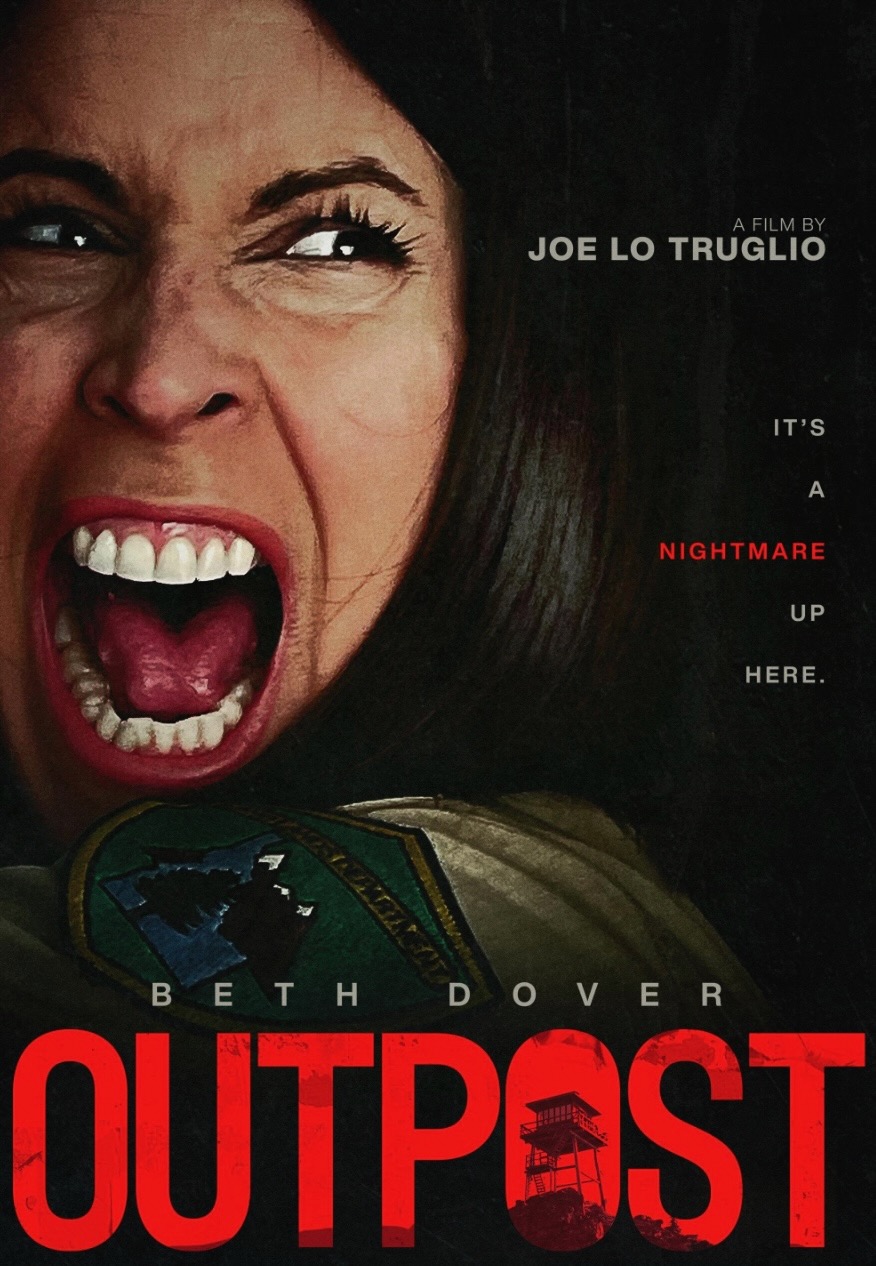
This is not a movie to be watched by someone with PTSD.  I watched Outpost for the scenery (I’ve been to the area it was filmed many times) and because the New York Times highlighted it.  It ended up being the scariest movie I’ve seen since The Shining.  I mean the kind of scary where your heart is still battering around your chest even after the credits roll.  As an indie horror film it may not be well known.  For clarity’s sake I need to say it’s the Outpost released in 2023.  The one about a woman who goes to spend a summer in a fire tower to recover from domestic abuse.  If you haven’t suffered PTSD, and you’re not as emotionally involved as I let myself become, you might guess by about halfway through what’s really going on.  But there are a bunch of people in the northern Idaho woods that you just don’t trust.

I’ll try not to spoil the ending, but here’s how it goes: Kate was beaten by her husband.  And sexually abused by an uncle when she was growing up.  Against the advice of her best friend, whose brother works for the forestry department, she takes a summer job on a fire lookout tower.  The locals at the store, all men, are threatening in her eyes.  Her new boss doesn’t think she’s a good fit for the post, but to help smooth things over with his sister, he lets Kate have the job.  Along with lighthouses, fire lookout towers are some of the loneliest places in the civilized world.  When a couple of young guys hike by, noting she’s all alone in the tower, your skin begins to crawl.  She keeps having flashbacks to the violence in her past.  Then she meets an older woman hiker who stays awhile and teaches her how to shoot.  A local retiree teaches her how to chop wood.

Kate still doesn’t trust the local retiree.  One of her colleagues from the forestry service has surreptitiously taken photos of her and ogles them.  And day after day after day she has to follow a routine and sees no one.  You get the picture.  I don’t want to give too much away, but for some of us this may be among the scariest movies we’ve ever seen, despite most of it being in the clear summer sunshine of northern Idaho.  The movie ends with a contact number for the National Domestic Violence Hotline.  Joe Lo Truglio, the director, is an actor known for comedy.  Outpost makes me think there’s something else behind the laughter.