Parson’s Poe

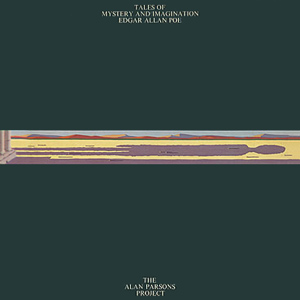
Some things just don’t mix: oil and water, cats and dogs, intelligence and Republican policy.  That’s the way of nature.  I don’t have a lot of time to listen to music—unlike some authors, I can’t write with music playing.  I end up paying attention to the music rather than what I’m trying to do.  So the other day when I had the opportunity, I went through our CDs to see what I hadn’t heard for a while.  I’d completely forgotten about the concept album Tales of Mystery and Imagination Edgar Allan Poe by The Alan Parsons Project.  Now, I’m not the biggest fan of Alan Parsons, but some of their songs are among my absolute favorites.  One of them can almost invariably make me tear up and my throat clench.  And I think Ammonia Avenue is one of the great albums of all time.

You’d think their mix of alternative rock would be favorable to Poe.  Poe is extremely personal to me.  I’ve read probing biographies and put them down thinking how much my perspective is similar to that of Poe.  I mention him in my books because he’s my writing companion.  APP just doesn’t get it.  Neither did Lou Reed.  Like Black Francis, I like Lou Reed.  But I like Poe more.  Not even Poe (sorry Anne Decatur Danielewski) comes close.   I have heard rock adaptations of Poe that I do like, so why didn’t Alan Parson, Lou Reed, or Poe (Danielewski) do it for me?  It’s difficult to say.  Music is very personal to me.  It stays in my head for a very long time, so I have to be careful what I let in there.  I don’t write much about music on this blog because I just don’t know you well enough.

I got the Alan Parson’s album long after it was published.  I can’t remember how I found out about it, but I had great hopes for it.  I guess Poe (the man) has a certain sound profile in my head.  It’s likely because, to me, Poe is more than the author of tales I read when I was young.  He is a symbol, coming to represent more than just another writer who struggled and was likely never understood in his lifetime (if ever).  As those who write and attempt publication know, this is a hostile business.  It’s difficult to get published in the traditional way and then it’s difficult to get your work noticed after it’s published.  These days a “like” and a “share” can go a long way (click “like” if you do), but even so my Poe music will be mine alone.


Major Drum

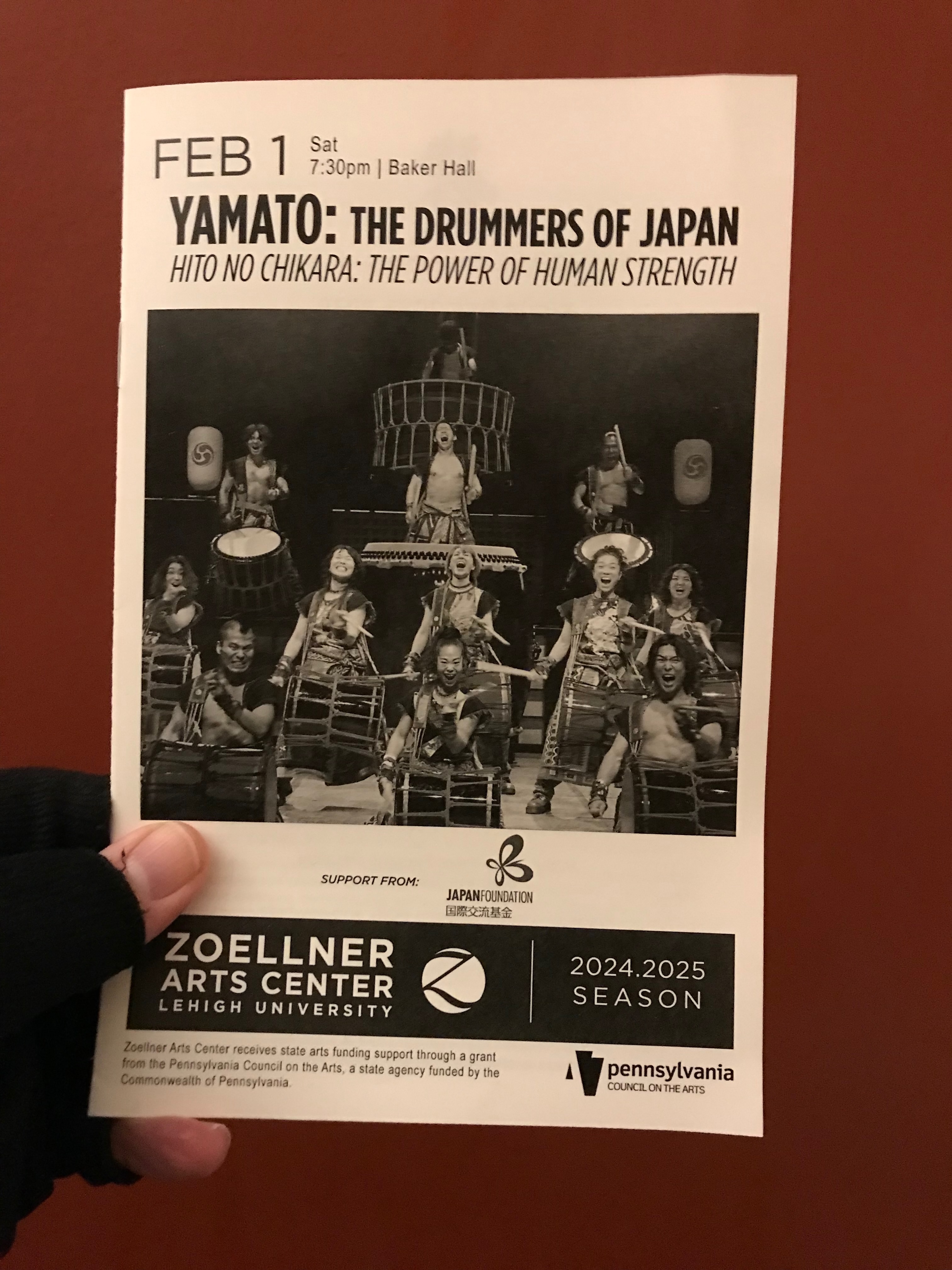
We don’t get out much.  Live shows can be expensive and these cold nights don’t exactly encourage going out after dark.  Living near a university, even if you can’t officially be part of it, has its benefits, though.  Over the weekend we went to see Yamato: The Drummers of Japan.  Our daughter introduced us to the concept while living in Ithaca, a town that has a college or two, I hear.  These drummer groups create what might be termed a sound bath, that is profoundly musical while featuring mainly percussion.  Now, I can’t keep a beat for too long—I’m one of those guys who overthinks clapping in time—but that doesn’t mean I can’t appreciate those who can.  The timing of the members of Yamato was incredibly precise, and moving.  At times even funny.  It’s a show I’d definitely recommend.

This particular tour is titled “Hito No Chikara: The Power of Human Strength.”  Now this isn’t advertising their impressively well-toned bodies, but is a celebration of human spirit under fire from AI.  The program notes point out some recurring themes of this blog: to be human is to experience emotion, and to know physical limitations, and to be truly creative.  Would a non-biological “intelligence” think to wrap dead animal skins around hollowed out tree trunks, pound them with sticks and encourage hundreds of others to experience the emotions that accompany such things?  I live in a workaday world that thinks AI is pretty cool.  Humans, on the other hand, can say “I don’t know” and still play drums until late in the night.  We know the joy of movement.  The exhilaration of community.  I think I can see why they titled their show the way they did.

Bowerbirds will create nests that can only be called intentionally artful.  Something in biological existence helps us appreciate what they’re doing and respond in wonder.  Theirs is an innate appreciation for art.  It spans the animal world.  Japan is one of many places I’ve never been.  I’ve never played in any kind of band and you don’t want me setting time for your pacemaker.  If a computer keeps such precise timing we think nothing of it.  It’s part of what humans created them to do.  When a group of people gets together, stretching their muscles and working in perfect synchronicity, we sit up and take notice.  We’ll even pay to watch and hear them do it.  Art, in all its forms, is purely and profoundly biological.  And it is something we know, at our best, to appreciate with our emotions and our minds.


Lost Decade

The nineties, it seems, got away from me.  Personally, they started with living in Edinburgh with my newlywed spouse. We had no television and no money, and limited time to finish my degree.  Then we landed at Nashotah House for the remainder of the decade.  Our daughter was born, and we settled into the role of new parents as the world went on around us.  The internet hadn’t made its way to that part of Wisconsin and television reception was quite poor.  Now bear with me as I’m trying to reconstruct things.  Twin Peaks ran from 1990 to ’91.  We were in Scotland at the time and had no television.  Northern Exposure (’90 to ’95) started a few months later, and was still running when we returned to the States.  We began watching it because family recommended it, mostly on VHS.  Some family members had watched Twin Peaks, but it was darker, and we opted for lighter fare when we could see TV.  (I hadn’t undergone my horror reawakening yet.)  Then came Picket Fences (1992 to ’96), which I still haven’t seen.  The X-Files, original run, broadcast from 1993 to 2002.  What a decade to lose!

Northern Exposure and Twin Peaks had some things in common, I noticed as we watched the latter, but then they ran at about the same time.  It also seems Twin Peaks and The X-Files shared some secrets.  I can’t say about Picket Fences, but it seems that speculative elements infiltrated these nineties shows.  What’s more, they all received critical acclaim.  I would feel like I lost much of the nineties, except that I was having a great time being a parent.  Although Nashotah House rubbed me the wrong way, I was employed doing what I had pictured myself doing.  Wisconsin was a beautiful state and offered lots of outdoor opportunities, particularly when it wasn’t forty below outside.  What I really lost was pop culture of the nineties, living in a monastic setting.

I recently discovered that I’d also missed much of the music of the nineties.  I’m not a radio listener.  Too many distractions—I can’t listen to music when I write, let alone with some announcer talking.  I don’t listen to music when I jog because I find the natural world so interesting.  It occurred to me just a few months ago that I had very little knowledge of 1990s rock. (Not the preferred genre at Nashotah.)  Some of it is pretty good, I’m discovering just now.  Like a typical academic, I began to shut out the outside world when working on my Ph.D.  Now I spend my time trying to catch up.  Not that I have much time to watch television, or listen to music, but I hate to miss something that everyone else seems to know about.  Then, of course, after the X-Files, Lost ran from 2004 to 2010 and we didn’t catch that either.  Maybe I missed the first part of the new millennium as well…

Photo by Everyday basics on Unsplash

For the Music

Believe me, I’ve tried.  I took a year of piano lessons but just couldn’t get it.  I married a musician.  I tried to learn guitar.  (I would still play with it, but I broke a string last time I tried to tune it and who has time to get to a music store where it can be restrung?)  I can’t sing—I’ve never been trained and I just don’t seem to have the voice for it.  (In fact, since I no longer teach those close to me say I speak so softly that it’s a strain to hear me.)  But the fact is I love music.  That’s why I don’t listen to it as background.  If there’s music playing, that I like, I find it difficult to concentrate on anything else.  It goes directly to my brain, it seems.

My memory is such that if a piece of music is too familiar I sometimes just don’t want to hear it.  I’m also out of touch with contemporary music.  I have strong tastes, and not too much appeals to me.  When something does, it’s transcendent.  It’s like I’ve fused with the performers.  It’s mystical and amazing.  Growing up, we couldn’t afford much in the way of records.  (I’m sure I need not say anything about cassette or 8-track tapes.)  I listened to the radio with my brothers from time to time, and enjoyed what we heard.  I secretly enjoyed what I heard coming from my older brother’s room.  Left to my own devices, however, I tend to pick up a book and I can’t listen to music and read at the same time.  I know that this is my own neurological issue, but I’m letting you in because anything transcendent is worth sharing.  

Photo by Jefferson Santos on Unsplash

Although the quality isn’t as good, services such as Spotify and Amazon Music Unlimited have slowly introduced me to music of the nineties and later.  Why the nineties?  That’s when I began teaching and my spare time was spent researching (reading) and I had little time for other diversions.  You see, music may just be what it’s all about.  It’s being absorbed and enjoying every second of it.  Humans are visually oriented, but when we focus on sounds something happens to us.  I can be in a crowded store and stop dead right in the middle of the aisle if one of my special songs comes on in the background.  I have to stand and listen, shopping forgotten.  Transcendent moments are few.  If we were in transport all the time I fear it would become ordinary.  And such things are worth pondering on Groundhog Day.


Christmas Silence

Christmas seems to have come too fast and not fast enough this year.  Like Halloween, it’s one of those long anticipation holidays.  The older I get, the more I appreciate the silence about it.  Not in a Grinch-like way, I hope.  More along the lines of “Silent Night.”  We spend so much of the year—so much of our lives—hustling about, barely having time to think.  Speaking personally, it takes about a week off work just to begin to get to that phase.  I need time to let the daily onslaught of work and capitalism and angst tune down.  There’s a quietness about Christmas that’s profound.  I suppose that’s why I like to spend it with my small family and not feeling obligated to go anywhere.  It’s like those precious moments before sunrise that I experience daily, only all day long.  That’s truly a gift.

The newspapers and internet sites have been summarizing the year for the last couple of weeks.  That always seems premature to me.  I understand why they do it, but Christmas and the days following are some of the very best of the year, and it makes sense to include those along with the stress, darkness, and ugliness that are the daily headlines.  I can’t help but think of Simon and Garfunkel’s “7 O’Clock News/Silent Night.”  Especially this year.  Christmas is for everyone, and the insistence that we make it exclusive (putting Christ back into it) makes it divisive.  Why some people have to be right all the time I don’t know.  I prefer Hamilton Wright Mabie’s take: “Blessed is the season which engages the whole world in a conspiracy of love.”  Simon and Garfunkel are both Jewish and I think they understood “Silent Night” better than many Christians did back in 1966.

I’ve been writing quite a lot about horror movies this year.  The months and days leading up to Christmas have often been difficult ones.  Such movies are therapy.  They can even fit into the beautiful silence of this day.  That’s my hope, anyway.  May this day include enough silence for you.  The rest of the year has no difficulty filling itself with trouble.  We need holidays.  Christmas has always struck me as the most peaceful of them all.  Ministers, and even those of us who never made the cut, tend to be holiday experts.  Those who don’t get caught up in the dogmatism of it all are the most blessed.  Christmas is for everyone.  And may it be peaceful this year.


Signal

It’s difficult to tell signal from noise sometimes.  Specialists in such things tell us that it’s easy to mistake noise for signal.  An exception to this seems to be music.  I don’t often write about music for a couple of reasons: one, it’s very personal, and two, I have little formal understanding of it.  Unlike my wife, who can sing well and who can play more instruments than I could ever dream of, I always struggled in music class.  The teachers I had seemed impatient when I couldn’t quite understand what pitch was, or when I had difficulty keeping a beat.  (Part of the problem is that I overthink such things.  I wondered about things like whether a beat represented the beginning, middle, or end of the sound.  Or how, since your voice sounds different in your head than it does on tape, could you tell if you were replicating the pitch of a note.)  I told you it was personal.

Photo by C D-X on Unsplash

None of this detracts from my enjoyment of music.  In fact, it means quite a lot to me.  Growing up I tended to consider it in the form of individual songs I liked.  Since we didn’t have much money I didn’t buy a lot of music, but the radio was free.  My choice of which albums to buy—starting in college, really—was based on whether I liked enough songs on them to justify the expenditure on an entire LP.  I already knew that the quality of 45s was inferior and that many albums were united by a theme.  Something I didn’t do was get to know a band by its “sound.”  That only started for me recently.

I still don’t have a lot of money.  I also object to paying money for MP3s that seem to disappear when you change devices and you have to buy them all over again.  Still, I’ve begun to discover some bands by their sound without being able to point to a specific song.  MCR (My Chemical Romance) was one.  The Pixies was another.  And recently Radiohead.  The voices of the lead singers speaks to me of youth and all its angst.  Although these bands all have quite different sounds, I find them mesmerizing if the mood is right.  I tend to discover bands once they’re beyond their peak popularity, but I’m personally pleased that I’m learning, in my own way, to separate signal from noise.  It reaps rich rewards.


Music Time

Although I love music I rarely have time to listen to it.  My work demands concentration and if I have music on I have trouble paying attention to the task before me.  I awake early to write, and if I try to listen to music while expressing my thoughts through my fingers I find myself conflicted.  I work until supper and the debriefing time that follows work is often fraught—we’re all experiencing frustrations with our new, pandemic reality.  By the time supper’s over, I’m ready for sleep and one of the things that can keep me awake is an ear-worm.  Awake predawn the next day and repeat.  On rare occasions when I have a thoughtless task to complete on my job, I’ll be able to put on some tunes.

Photo credit: Al Aumuller/New York World-Telegram and the Sun, from Wikimedia Commons

When that rare syzygy came the other day I put on MCR, or, for those who like to spell things out (such as me), My Chemical Romance.  Every time I listen to MCR I wonder why I don’t do it more.  I suppose it’s because I have only two of their albums and I don’t want to wear them out.  What struck me as I listened to The Black Parade was how religious language sometimes creeps in, even when the band is secular.  This is important because rationalists have long been trying to dismantle religious thinking, falsely associating it with only certain amorphous groups such as “Fundamentalists” or “extremists.”  Religion, however, is very much a part of being human.  If we deny it, it simply crops up in another form.  It may take some time for the new shape to be recognized, but when it is it’ll be called religious.

I often wonder why universities, which are supposed to be such curious places, tend to show so little interest in religion.  It’s like that embarrassing uncle at a family gathering—the one everyone else avoids.  Still, our political system is run by religious ideology—take a look at the Supreme Court and try to deny it.  Our daily life is suffused with it like the air in a room with a scented oil diffuser.  Religion is all around us and the academic response tends to be “meh.”  I might be less distressed by this lack if it could be demonstrated that people are becoming less religious, but they’re not.  MCR doesn’t (in the albums I have) exude religious thoughts often, but they are there.  They also appear in other secular music, almost as often as sex and drugs.  If only I had more time I might be able to listen for more examples.  Right now, however, it is time to get to work.


The Sound of Musik

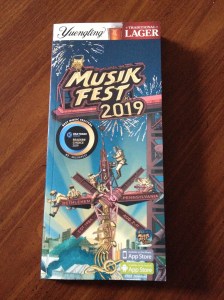
“Why is there so much people here?”  The words aren’t mine, but those of a random stranger I heard in Herald Square.  Not only was it grammatically offensive, I always find “much people” in Manhattan, but this was the occasion of the Pope’s visit a few years ago, so more of us were crowded into that area than normal.  It was a feeling that returned last night as my wife and I wandered around Musikfest.  If you’re not from around here, Musikfest is the largest free music festival in the United States, and it takes place in Bethlehem each summer.  Ten days of free, live music and tents hawking wares and all kinds of comestibles, as well as that strangely satisfying feeling of being lost in a crowd.  We ended up there more or less accidentally.

I was an experimental subject.  Those of you who know me will probably not find this odd, and you may well come up with many reasons to find me in the psychology department, some involving locked doors.  This was, however, a voluntary research project that required participants and it had been literally decades since I’d volunteered to be one of the “much people” who was not not part of the university crowd.  It felt good to be on a campus again.  The Lehigh Valley hosts several colleges and universities, and that draw is perhaps related to why Musikfest is held here.  When we got to town my wife realized we might have trouble parking.  Sections of downtown Bethlehem are closed to traffic and there are people everywhere.  I finished my experiment and we became part of the crowd again.

Music and religion, I’ve noted before, hang out in the same crowd.  They both have the ability to be transcendent and people seek out such experiences.  Since we hadn’t planned on attending—accidental musicologists we—we had no groups as targeted hearing while we wandered.  Mostly we marveled at the size of the event.  The city of steel transformed to the city of music.  And the religious feelings music brings.  As I walked from the college back to downtown, a couple strangers accosted me.  “Hi, brother,” they said.  “Heading to Musikfest?”  This, I realized was a congregation.  I was an unknown brother.  Music brings peace.  Dona nobis pacem, sisters and brothers.  Like those crowds a few years back hoping for a glimpse of the pontiff, an entire city had kicked off its shoes for a Friday night of potential transcendence.  Why is there so much people here?  Simply listen and you’ll have your answer.


Sixes and Sevens

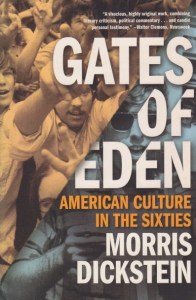
Few eras conjure mental images as readily as the sixties.  As the first decade of my life, I idealize them a bit, I suppose.  I wasn’t old enough to appreciate the truly wonderful and troubling things going on around me, and being raised in a Fundamentalist family I probably couldn’t have enjoyed many of them in any case.  Morris Dickstein’s Gates of Eden: American Culture in the Sixties was written in the seventies.  Since he’s a literary scholar much of the culture he analyzes is print culture, emphasizing the works of Jewish novelists and African-American writers.  That fits the sixties image pretty well.  He also looks at the music, but not as much as I had anticipated he might.  For me the music of the decade conveys what it really was about.

At one point Dickstein describes the political situation in the fifties that led to this incredible decade.  I had to remind myself that this was written forty years ago, for he seemed to be describing, with eerie prescience, the world of Trump and his followers.  Repressive conformity and the superiority complex of that era led to a breaking point where individual expression tumbled long-held rules and regulations that had tried to repress women and those that didn’t fit the WASP mold.  Most of us thought those controlling, catatonic days were over for good.  It seems we underestimated the will of those who lack imagination of where things might go if freedom were allowed to be free.  Some people, it seems, believed the sixties were a disease to be cured.

Historians who have a wider grasp than I do say that time has to pass before accurate pictures can emerge.  Instant potted histories tend to miss much of what becomes clear only with the slow passing of further decades.  To me the music defines them.  I only started to become culturally aware in the seventies, and that was in a small town.  When I learned to look back, largely in the eighties, I could see, and hear, that I’d lived through an extraordinary time.  The nineties, largely spent at Nashotah House, were again isolated from culture.  Who knows how this new millennium will be assessed?  Has a new music emerged that will help define us?  Or will it be, as Dickstein unwittingly projects, a new era of acceptance, love, and peace?  Or did the world really end at the millennium?   It could be, we might dare to dream, that a new decade as remarkable as the sixties is waiting to usher in Eden again.


Southern Turn

In America’s ever roving commercial eye, Día de Muertos has become an extension of Halloween.  Retailers have realized that people will spend a lot on their fear, and the autumnal holidays delve into that primal territory.  Since the Day of the Dead, being a mix of indigenous Mexican religions and the Catholic celebration of All Souls’ Day, comes two days after Halloween why not blur them together with greenbacks?  So capitalist thinking goes.  While certainly not free of monied interests, the Disney/Pixar movie Coco has the virtue of addressing Día de Muertos as the separate holiday that it is.  A form of ancestor worship—a religion extremely common around the world—the thought-world of the film shares in common with Tim Burton’s Corpse Bride this idea that the afterlife is colorful, if not joyous.

I realize I’m jumping the gun here, but I just saw Coco for the first time over the weekend.  Not just a culturally sensitive treatment of an indigenous holiday, it is also a celebration of music.  In a very real sense, music is life in the film, and even the dead continue to thrive in its presence.  Again, the connection with Corpse Bride suggests itself.  The key difference, from a religionist’s point of view, is that Coco is based on, to an extent, actual religious traditions.  An irony of this is that, together with the worship of Santa Muerte, the focus on death sometimes makes the Catholic Church nervous.  Focus should be on resurrection, not death.  But what if death isn’t seen as evil?  Where is thy sting?  This can be a real challenge when your organization is offering escape from death.

The fear of death is natural enough.  It’s the ultimate unknown.  It fuels both religion and horror.  In that sense films like Coco that show a joyful aspect of the hereafter do an end-run around traditions that base their wares on ways to avoid the consequences of death.  Hell becomes a threat to be avoided—the forgotten dead in Coco face annihilation, a fate that Héctor notes comes to everyone eventually.  Eternal torment isn’t in the picture.  I have to wonder if this view doesn’t present a form of salvation that is unwelcome among rival religions.  Although Catholics don’t have the hostility toward Halloween that many Evangelicals display, there is a challenge of rival faiths here.  Stores have already begun offering this year’s Halloween wares, and increasingly among them are Day of the Dead decorations.  The holidays are quite distinct, although related, and movies like Coco suggest what we fear may be more a matter of perspective than of the decree of an angry deity.


Tintinnabulation

On a summer’s day when I can work with the windows open, I hear the bells of a local church.  We haven’t been in our current location long enough to know for sure, but they seem to come from the direction of the United Methodists.  Around noon each day they ring out hymn tunes to which I often find myself filling in the words.  These are traditional hymns that I’ve known from childhood, and there’s an easy familiarity about hearing them, although my own spiritual journey may have taken me in different directions.  The sound of bells is so pleasant, I think, that nobody really objects.  Then I wonder about what I thought.

Music in public places does impact other people.  Consider the heavy metal or rap booming out of a passing car with the stereo turned up too high for human consumption.  Or jazz in the park.  Music impacts other people.  What, I wonder, is the message those of other religions hear along with these old hymns?  Do they suggest more than the praise of the locals for their version of the Almighty?  Is there some subtle proselytizing going on?  Is the music for members of the parish only, or can outsiders hear it and be free of obligation?  In many ways this encapsulates, I believe, the conflicts rife throughout our nation.  Traditionalists who see nothing wrong with “white” Christianity spreading its message but who object to a mosque being built in their community would likely find church bells comforting, even if they personally don’t attend.  Those from the outside, meanwhile, hear a message of cultural superiority.

Some sects feel compelled to praise God vocally, often and enthusiastically.  Their religion insists they do so.  Hymns ringing from the steeple, even if they’re not exactly your brand, participate in that mandate.  The deity likes to be adored.    (Think Psalms.)  This specific divinity, however, isn’t alone.  Perhaps beyond the bounds of where these sound waves flatten out to inaudibility, there are others with religious beliefs often older.  They too have rules about how to behave.  They may not be friendly to those who come bearing a new message of a new truth.  Globalization follows in the wake of technology and no god beyond the laws of physics oversees tech.  Our smartphones have made the world a much smaller place.  In such tight quarters, sounds carry.  Church bells, innocent as they seem, may be heard as a war cry.  But I wouldn’t suggest such things on a day so pleasant that I can work with my windows open and listen to the bells.


Situation Norman

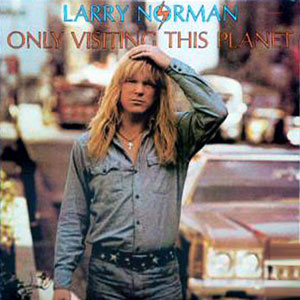
It was in a locker room. I couldn’t believe I was here. First of all, at Gordon College—that bastion of conservative Christianity. Second of all, in the same room as him. A friend had offered to drive me up here from Boston, where we were both in seminary. I was a little saddened to see less than 200 chairs set up on the gym floor, carefully arranged on a tarp so as not to mar the shining wood beneath. Larry Norman came onto stage to great applause, and was remarkably intimate with his fans. He’d been a big name in the 1970s, almost single-handedly starting the Christian rock genre. After the concert was over, my friend said “Do you want to meet him?” Here he was, in the locker room, taking the time to speak with fans, individually. He refused to sign autographs, preferring to give the glory to the Lord. But he listened, he responded, and, it was clear, he loved.

While the sections of the brain that process religion and music may not be the same, we know that our gray matter is intricately interconnected. Analysts have noted that the most famous religious leaders of modern times have quite often been deeply affected by music. Religious services without some form of music are in the minority for a reason. And it really doesn’t matter what style said music takes, it moves people. Instead of apologizing for my own musical tastes, I’ll simply note that I was exposed to Larry Norman at a young age. Although his religious perspective and mine had parted ways before I had the chance to meet him, I’ve never disparaged his music. It is authentic, innovative, and above all, sincere.

Gregory Alan Thornbury has just published a biography of Larry Norman. I will surely read it. Although Christian rock has grown insipid and cloying since it began, it is still a remarkably lucrative business. Evangelicals will pay good money to get those rock rhythms with unthreatening words and praise of Jesus thrown in. Norman’s songs, however, were complex and nuanced. Equal parts love and social justice, they might not even mention Jesus. Or when they did, they might suggest he was a UFO. Unconventional. Blasphemous to some. As the ‘70s faded into the ‘80s, Larry Norman was considered old news. He had, however, started something that was bringing other people lots of money. And he looked me directly in the eyes late one night in the locker room of a conservative Christian college, and told me to keep on believing. Obscurity, he showed by his life, is no measure of a person’s actual importance. And music and religion can never be separated.


Blood Brothers

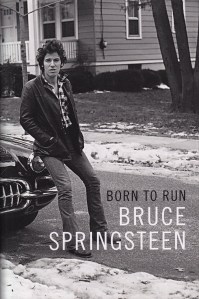
Every once in a while I take a chance and write about music. I don’t do this too often since it’s a very personal thing, and as open as I may be on this blog, I’m not as accessible as I seem. We all need a place to retreat in this world, and Bruce Springsteen’s music is one of those places for me. Late last year, just after it was published, Springsteen’s Born to Run—his philosophical and revealing memoir—sold briskly for several weeks. Since it made its way into my stocking I’d been intending to read it since then. And putting it off. There’s something disillusioning about finding out your heroes are only human. The best among mine are heroes precisely for that reason. Gods need not apply. Overcoming my fear, I dove in.

Two things stood out in this autobiographical account: religious imagery looms large, and depression mingles liberally with it. I recall reading an early review where the writer expressed surprise that the Boss suffers from depression. I responded (perhaps out loud), “have you ever listened to his songs?” I became a Bruce fan because he sang about working class people. Bruce and I share that background. He knows that your roots never let you go. Indeed, roots are what keep you grounded. Many of my academic colleagues, I learned, were simply carrying on the family business—and a privileged business it is. Those of us who had to overcome poverty to get in the door were never really welcome in the ivory tower. You can’t help where you’re born, but you can sure be punished for it. Bruce understands that.

I’ve never been to one of his concerts. I don’t even like to listen to his music when someone else is in the room. There’s something deeply personal about communing with someone you feel understands you. Of course I’ve never met Bruce Springsteen. I probably never will. He won’t know the kind of influence he’s had on my life and I feel that I’m risking an awful saying so here on this blog. There aren’t too many heroes in my life. I’m not inclined to idolize people. In this memoir, however, Bruce won’t let himself become an idol. He’s not perfect and he takes pains to make sure that you know that. We were, nevertheless, raised in situations not dissimilar from each other. Unlike Bruce, I have no musical gifts. No, I’ll never likely meet him—and if I did I wouldn’t want it to be with other people around. Some things are just too personal that way.


Pay Attention

hiddenplainsightIt happened in seventh grade, but I remember it vividly. It was music class. I’ve always enjoyed music but have never been able to make it without the assistance of a device that plays recordings. This particular day, however, Mr. Butler gave us the assignment to write down whatever we heard for about ten minutes. He told us to start and I began listening. Hard. I didn’t want to miss a thing. When time was up he asked some people for their answers. The first person said the sound of Mr. Butler’s footsteps as he walked to his desk after saying “start.” I was utterly shocked. How had I missed that? More answers emerged and my sense grew that I was completely inept at hearing things—well nigh deaf—since I had only heard the sounds that I was listening for. Hidden in Plain Sight: The Social Structure of Irrelevance, by Eviatar Zerubavel, makes me feel a little better.

A lot has happened since seventh grade. I have now realized that I’ve missed most of it. We filter out stimuli constantly. What is really interesting about a sociologist’s look at what we fail to notice is that we often miss important things in life by assuming that figure is more important than background. Or that space between things is less important than the objects themselves. Or that we can indeed listen for silence instead of sounds. It is a matter of how we perceive things. There are millions of stimuli bombarding you right now. I’m flattered that you’re even bothering to pay attention to my musings here. Are you also feeling the clothes you’re wearing? The shoes on your feet? The taste of either your last meal or the toothpaste that might have followed it? We shove things into the “background” all the time, including other people. We can’t pay attention to everything.

Interestingly, Zerubavel raises the issue of moral inattention. We do sometimes consider things outside the realm of moral consideration. But should we? What are morals if not an indication of what society has taught us to value? Indeed, social attention, or inattention, teaches us from our earliest days what is safe to ignore and to what we must pay attention. It helps us survive. Reading this little book, however, has left me wondering about all the things I have habitually missed through the years. Some of them may have been important. Sitting in a silent room, after all, I failed to notice the sounds of my own pencil scratching on paper, writing down all the sounds I was hearing.


Defying Labels

I don’t know much about the music industry, but I do know that as in publishing, labels make a difference. Who doesn’t conjure up a certain sound when they see Motown? Companies jealously sign artists to their label, with a close eye on the bottom line. Labels. Branding. Marking our territory. People like to give things labels to make them easier to understand. By now it’s no longer news that David Bowie has died. The tributes are coming thick and fast, and one recurring theme seems to be that nobody really knew how to label him. Bowie was an original, a creator. Like many truly creative people, he was seldom at the top of the charts, but his fan-base grew over decades and those who listened to him knew that he defied labels. Labels are for convenience, and life is, well, not convenient.

There’s been speculation about his final album, Blackstar, released an iconic two days before his death. The song “Lazarus” has flagged the attention of many, but here we are after the third day and he hasn’t come back. I think of my childhood and tween years in the 1970s, seeing Bowie’s album covers in my brother’s room and wondering if he was a man or woman. His transgressions frightened the young conservative that I was, accepting the label given to me by those who thought they knew me. I heard his songs coming through the open door. I couldn’t understand them, but somehow they remained with me until I was mature enough to learn to listen. Some sounds are too subtle to hear, except with experience. Here was a man telling the world “don’t label me.” And yet label we did.

“Lazarus” is a haunting song. I may be no music critic, but here is a piece by a man who knows he’s dying. The video shows him emerging from a tomb-like wardrobe (in itself significant) and simultaneously lying on his deathbed. He’s in Heaven, but in danger. Still, he knows he’s free. Like the biblical Lazarus from the Gospel of John, resurrection is only temporary. Lazarus has come back, but he must die again. As the frantic Bowie scribbles his final words on the final page, he backs up once again into the tomb from which he emerged. David Bowie may not have been a Bible scholar, but his song is prophetic. The three days have now gone past. He may not have come back, but it just may be that he never really left.

HunkyDory