
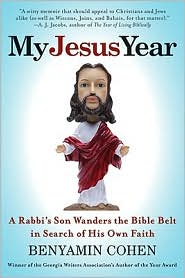
 There’s been a trend in the last few years of journalists following a religious lifestyle not their own to learn something of another faith. This often leads to whimsical—occasionally funny—books that generally sell well. I appreciate the effort of those who try to open their minds to other belief systems, but the truly funny thing about religions is that they are very difficult to study objectively. There is a universe of difference between studying the papacy and being a Pope (I am only guessing here). This aspect of the religious explorer came through quite clearly in Benyamin Cohen’s My Jesus Year. Cohen, an Orthodox Jew, without compromising his faith, spent a year of Sundays attending various churches with two goals in mind: to learn more about Christianity and to appreciate his own Judaism more. The result is, for someone raised in the Christian tradition, a little disorienting.
We seldom tell children about other religions since such information would imply that religion is a choice, a marketplace. We prefer to tell our children that our brand is the right one—the only right one—because that is what we believe. By the time most children encounter those of other faiths, the indoctrination of their childhood has congealed. Many Christians will send their children to Christian daycare, often followed by parochial schools. Where would they expect to meet their first Muslim? Unfortunately, it is often on the battlefield. By protecting our children from the dangers of foreign faiths, we endanger everyone involved. So, reading a book written by a Jew, I felt a little strange—as if maybe Christianity wasn’t the majority faith after all. Given the wide diversity of Christianities Cohen cites, this is not so strange after all. Am I more like the evangelical Ultimate Christian Wrestling crowd or the Roman Catholic doing crossword puzzles during mass? Or none of the above?
Cohen notes that evangelical pastors (or laypersons, Christian or not) will sometimes share their secrets of success with those of other religions. Tellingly, he quotes Bernie Marcus, co-founder of Home Depot, explaining to rabbis how they might drum up more excitement: “You’re in the marketing business; you’re selling a product. You’re selling religion. It happens to be something that’s good for people. But you can’t get to them to sell them the religion because you’re in the marketing business and you don’t realize you’re in the marketing business.” Is that what it really comes down to? Religion is frequently described as a marketplace; it is the only paradigm available for the true capitalist. We’ve seen it take over higher education, and now those who give advice to religious leaders are the captains of industry. We have become victims of our own success. There was a time when religion stood outside the ordinary, but now it can be packaged and marketed and sold. An excellent exercise on your way to the store, however, is to stand back and listen to the other customers. If you are lucky, one of them will be Benyamin Cohen.
 Steve A. Wiggins