Elementary, Academia

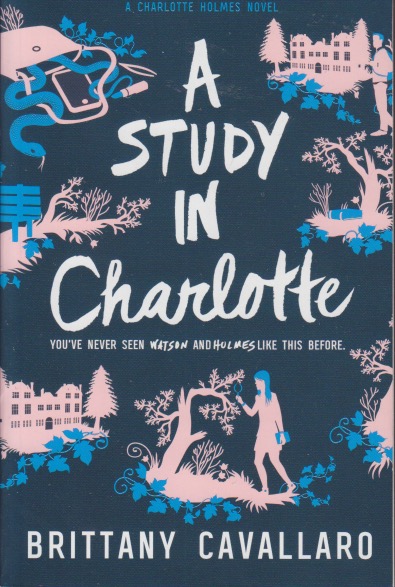
Continuing my dark academia streak, I enjoyed Brittany Cavallaro’s A Study in Charlotte.  Although I’m not really a Sherlock Holmes fan, I know enough of the lore to appreciate how deeply steeped this novel is in Sherlockiana.  In the world of the novel Sherlock Holmes and John Watson were real people.  Watson wrote the books authored by Sir Arthur Conan Doyle in real life.  The books are well known and widely read in the universe of A Study in Charlotte.  The adventures in those novels and stories are, here, factual.  The book is narrated by Jamie Watson, a descendant of John Watson.  While at Sherringford Academy in Connecticut he finally meets Charlotte Holmes, descendent of Sherlock.  They become friends and have a campus murder to solve (thus, dark academia).  I have to confess that I had the image of Jenna Ortega, of Wednesday, in my head as Charlotte.  The two (Wednesday and Charlotte) are similar in many ways.

Although flawed, Charlotte is an inherently likable character.  The story contains enough fun to prevent it from being too grim, even with the death of a Sherringford student and the violent attack of another.  The murderer goes to great lengths to frame Charlotte, and the novel introduces some of the Moriarty descendants as well.  Watson tries to get close to Holmes, but she holds everyone at a distance.  The story includes some family dynamics—the Holmeses rational to the point of being cold, Watson’s mother constantly warning him to stay away from Holmeses while his father eagerly observes how Charlotte works.  Putting the action in Connecticut allows for a trans-Atlantic element since both families are, naturally, British.  The story is well told.

The novel should appeal to those who enjoy detective stories and who appreciate a smart, if troubled female lead.  In this latter aspect, Cavallaro shows herself a perceptive Doyle fan.  Sherlock Holmes isn’t always a perfect character.  He uses drugs and is an eccentric.  This story transfers all of that to Charlotte but making her a young woman while Watson is a rather love-lorn young man, opens the potential for a relationship unlike the classic Holmes and Watson.  I don’t say “romantic” relationship, because Charlotte isn’t really receptive to romance, although her strict rationalism wears thin when something goes seriously wrong.  We all like to believe that there are people a few steps ahead of everyone else, as long as they’re good.  The Moriartys are also masterminds but the novel doesn’t allow us to decide that they’re all bad.  This is an intriguing tale that fits into dark academia in an elementary way.

No Ordinary Picnic

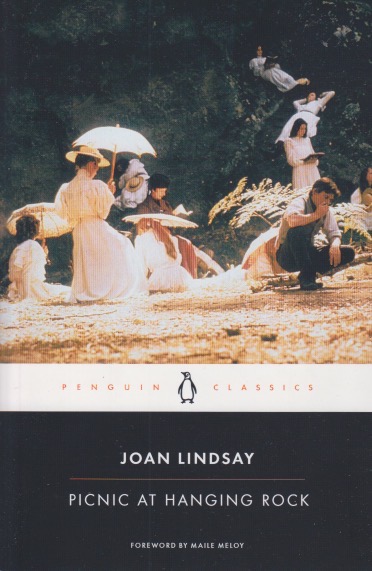
I will be including spoilers in this review, so please be advised!  Joan Lindsay’s Picnic at Hanging Rock is a novel that began as speculative but then turned naturalistic.  Mostly, anyway.  Born in 1896, Lindsay published the novel just after she turned 70.  Since she was Australian, it stands to reason that the story is set there.  Hanging Rock is an actual place and, according to multiple sources, Lindsay ended the book with a speculative chapter that explained the mystery.  What is the mystery?  On Valentines Day 1900, the girls at Appleyard College set out for a picnic at, well, Hanging Rock.  While there, three of the girls and one of their chaperones disappear.  Since everyone travels by literal horse power, getting back and forth from the scene of the mystery takes hours.  The head mistress of the college is frantic, mostly because she’ll be losing tuition because of this.

Eventually one of the girls is found, somewhat mystically, by a young Englishman with whom a romance starts and seems to end abruptly.  The found girl remembers nothing of what happened that day.  Further investigations are held, but the mystery is never solved.  Meanwhile, Mrs. Appleyard, the mistress of the college, takes a strong dislike to one of the girls who was devoted to one of the missing.  After one of the girls’ governesses, recently dismissed, burns to death, the headmistress appears to have murdered the girl she disliked (or she fell/jumped from a window; the novel isn’t explicit on the point).  Mrs. Appleyard, realizing she is ruined, goes to Hanging Rock where she dies by suicide, throwing herself down the rocky side of the outcropping.  The speculative ending—no longer part of the novel—had the missing girls disappear into a kind of time warp.  Lindsay’s editor had her remove that chapter.

The novel became quite well known in Australia, and to the wider world when a movie was made from it.  The interesting thing is that the novel presents itself as describing factual events, like the Blair Witch Project.  This is so much the case that the rumor grew that the events really did happen.  A book was even written, suggesting a solution regarding what happened to the missing girls.  Had the excised chapter been published with the book, it would’ve been clear that this was a fictional tale.  Lindsay had a savvy editor, however.  Nothing sells like a dramatic story that readers believe to be true.  Witness The Amityville Horror.  Even though naturalistic, a bit of the speculative still hangs about the story, making for a good gothic novel without a firm resolution.


Still October

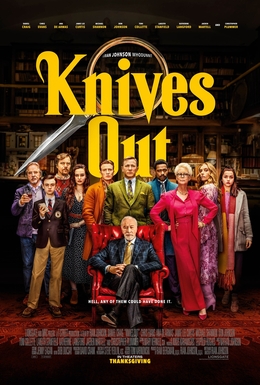
Before October was over, I wanted to watch Knives Out.  Not horror, it’s more of a murder mystery but it’s funny and it makes just about every list of movies to watch in October.  I’m pretty sure that list compilers don’t really understand what I mean by typing in “October movies.”  Or maybe the kinds of movies I’m thinking of simply don’t exist.  More on that later.  Knives Out is the story of the death of a famous writer.  (Given the fantastic house in which he lives, a very famous writer—the majority of us only ever modestly supplement our day job incomes with book sales.)  But this fantasy of being paid enormous sums for what is really hard work is, well, a fantasy.  This writer, who has/had three children, altered his will before his 85th birthday celebration and on this hangs the tale.

The two surviving children, and spouse of the third, have been cut out of the will.  Their means of support—they all relied on their father’s largess—is gone and so when the writer dies on the night of his birthday, by suicide, some questions arise.  There are many twists in the story, and I won’t give away the ending, but the main question that the private investigator asks is why he was hired in the first place.  All the forensic evidence confirms this having been a suicide, and although the adult children’s stories disagree in any particulars, the events surrounding the death seem clear enough.  At the center of all of this is the writer’s private nurse.  She’s an immigrant and she stays out of family squabbles.

The protests over the will bring out the true character of the children, or, in some cases, their spouses.  And although the viewer is clued in early as to what actually happened, like a mystery novel, a vital clue is left out that ties the whole together.  It’s quite well done.  It’s an October movie like Clue is an October movie, or perhaps Murder by Death.  There are some nice shots of trees in color, but it lacks the haunting, melancholy feel that I associate with October films.  Will I watch it again?  I should think so.  Movies like this bear re-watching, if for no other reason than to try to spot “donut holes” (the private detective’s phrase) in the plot.  It’s also a reflection on how money can corrupt.  But also how desperate people can become when their support system is withdrawn.  And that’s truly scary.  Knives Out would work on any dark and stormy night, but it’s not horror.


Mirror Gothic

I have a soft spot for gothic novels.  I get the sense that Rebecca James set out to write the most gothic novel ever in The Woman in the Mirror.  Although the supernatural persists in the background throughout the novel, it’s mainly the reflection of two women who encounter the mysterious Winterbourne Hall, high on a cliff over the Atlantic in Cornwall.  Rachel Wright, in the present day, is a self-made woman.  Overcoming the life of being raised an orphan, she has opened a successful art gallery in New York City when she receives an unexpected letter informing her that she’s inherited an expansive property in England.  Not knowing who her parents were, this is a world-changing surprise, so she heads to Cornwall to find her past and to figure out what to do with her inherited property.

Her story is intertwined with that of Alice Miller.  An English woman from two generations past (I’ll come back to that), Miller grew up with a bully for a father and a desire to make it on her own.  She’s hampered, however, by a past secret.  She takes up employment as a governess at Winterbourne where a Rochesterian Jonathan de Grey is lord of the manor.  His two children, fraternal twins, require keeping and the last governess threw herself off the cliffs—you see what I mean by most gothic—so Miller takes the post.  The massive house, however, has a strange effect on her.  Not only on her, we learn, but on most of the women who live there.  The final housekeeper, however, does seem to be immune, perhaps because she’s older.

The story is slow paced, with a fair amount of romance thrown in.  Both Rachel and Alice have lost lovers and are coping with their pasts.  They never meet, of course, being from separate generations.  Perhaps this is just the perspective of an old geezer, but putting Alice Miller in, presumably, her twenties in 1947 doesn’t really seem long enough in the past for the story to unfold as it does.  I couldn’t help but think that this makes her about my mother’s age and I would have to admit that my own daughter is old enough to inherit an estate while having already become a successful artist in Manhattan.  The timing just seemed a little off to me.  The perfect gothic novel seems to require some Victorian aspects, in my opinion.  Nevertheless, this story becomes quite gripping toward the end.  If you want a modern-day gothic romance, you’ll likely enjoy The Woman in the Mirror.


Your Mystery

Few things glaze the eyes of others like somebody else’s genealogy.  That’s not what this is, so unglaze those peepers!  As with most of my posts, there is reflection here and that contemplation applies to just about everyone.  We don’t know our parents very well.  It’s only been when trying to connect the dots for my progenitors that I came to realize just how poverty-stricken that knowledge is.  I could (and did) talk to my mother frequently, until recent days, but even to her my father was a mystery.  I knew he was in the military for at least six years, so I filed a military records request with the National Archives.  You can do this if you’re next-of-kin.  That’s when I learned of the National Personnel Records Center fire of 1973 when at least 16 million records were destroyed.

National Archives fire, public domain (via Wikimedia Commons)

My father is a mystery to me.  The National Personnel Records request brought back a few hits, all documents partially consumed by fire (for which the administer apologized) that contained just tiny bits of information.  All of this makes me reflect on our limitations in knowing others.  Parents, spouses, children, siblings—they all remain mysterious in some ways.  And some more than others.  We go through life knowing only ourselves, and not even that person fully.  Consciousness brings these things to a new level, but we still really find ourselves bound by our minds.  That’s why, I suspect, some of us keep trying to cram new things in there—wanting to understand others as well as ourselves.  All it takes is a fire in the National Archives to wipe out entire lives.  Or parts of them.

Now that her earthly time has ended, I realize my mother is also a mystery to me.  It will take some time before I can sit down to write out what I knew of her life.  We grow up distracted by our own needs and wants.  Does a baby bird ever wonder at the enormous energy and strain on its parents as they bring food to their open beaks?  Even those of us who write leave gaps—some intentional—in the records of our lives.  Other people are mysteries.  Wouldn’t the world be a better place if we treated them as such?  Instead, we often act as if their roles (store clerk, accountant, electrician) are their lives, their essential selves.  It’s all we can do, I know, to take care of our own lives.  But it would be a more wonderful world if we could see others as doing just the same.


Electricity

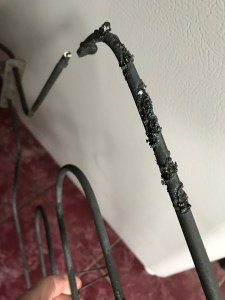
After the oven incident (see last Monday’s post), I took some time to examine the burned out bake element from the range.  Clearly a break in the piece led to some arcing like you might get in Frankenstein’s laboratory.  By the time I’d arrived on the scene (I always seem to be behind my time), the fire was snaking along the element itself and now that the piece is cooled and removed I was fascinated by the damage it caused.  I suspect this is why I leave any electrical repairs to experts.  This is dangerous stuff.  Interestingly, in the realm of monsters electricity is most frequently associated (in my mind, anyway) with Frankenstein’s creature.  Mary Shelley’s novel isn’t explicit about how galvanism resurrected the patchwork human, but it was clearly part of the tale.

Electricity retains a certain element of mystery for some of us.  If we stop and reflect on how recent our understanding and harnessing of it is, that further adds to the drama.  People have been thinking about and trying to understand religion for thousands of years.  Like early electricity, religion involves invisible forces.  Of course, lightning and sparks and arcing oven elements can be seen, but seeing isn’t the same as comprehending.  We are a curious species and we want to understand.  Being inside the situation, however, our understanding will never be complete.  We can get a pretty good grasp, a functional one even, but our brains will always limit just how much we can understand.

It should come as no surprise that those of us who chose to study religion are intrigued by mysteries.  The divine, the transcendent—no matter what you want to call it—can never be fully understood.  Thus the impatience with evangelicals and others who pretend they’ve got all the answers.  No, we’re all still attempting to get to the bottom (or top) of this mystery.  Like electricity, religion can do an enormous amount of damage.  Motivating those who have only a cursory understanding how it works has historically led to debacle after debacle.  It has generated wars and perpetuated human misery.  Like electricity, when used properly religion has done a tremendous amount of good in the world as well.  The thing is, as my bake element shows, we have all come to learn that electricity should be handled by those who know what they’re doing.  Ironically, religion has never gathered the same level of respect for the specialists.