Life in the Laboratory

Nancy Gibbs’ essay “Creation Myths” appears in this week’s Time. Leaping off from Craig Venter’s “creation of life” in the laboratory, Gibbs asks who the final arbiter might be in this world we’re creating in our own image. The more I ponder the question, the more I realize that no person really decides how far we will go and the implications will only grow more and more unanswerable. We all attempt to construct the world according to our idea of how it should look; it is not a question of if we create the world in our image as much as it is whose image will prevail. As I noted in a recent post, no one person has all the answers. What each of us does impacts all the others just as a wave influences everyone in the sea. We fear science taking the prerogative of creating life because we are fully capable of imagining where it might go, but we just don’t know.

As an individual who has often been on the receiving end of other people’s visions of how this or that institution or company should look, it is my humble assessment that we have already lost control. We never really had control in the first place. At the end of the day, who will really be able to prevent another Gulf oil spill from occurring? Make what laws we will, other creators will find ways around them. And as in Gibbs’ article, the rest of us will simply have to react. No one is really in control.

Perhaps this is the real reason that religion is so appealing. It is terribly, terribly convenient to have an omnipotent divine entity on whose anthropomorphic shoulders we might cast our worries and burdens. Whether we believe in predestination or not, it is comforting to suppose that when it is all over God will somehow sponge up all that oil (preferably squeezing that sponge back out into BP’s great, sturdy tankards of crude), or stop that evil clone we’ve engineered, or stomp out that hyper-aggressive virus we’ve unleashed. We may make laws against creating life or human clones in the laboratory, but it will happen nevertheless. Gibbs wonders if scientists are about to cross some moral Rubicon. My answer is simple: we crossed that Rubicon long before the river itself flowed, when we first put our webbed feet out onto dry ground and began our still uncertain journey to the future.
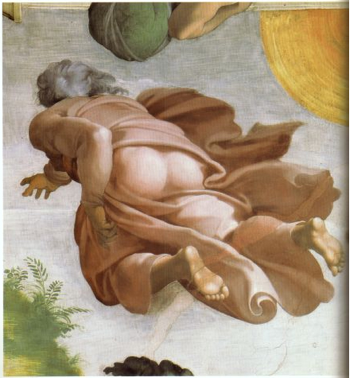
God exits, stage left


Be Careful Little Hands

“Time is always against us,” Morpheus informs Neo in The Matrix. Of course, this is a paradigm for life spinning out of control, an allegory of having been taken over by forces against which there is no defense. It surprises no one that as time continues its inexorable march there will be generations that see the same phenomenon in very different ways. In last week’s Time, Nancy Gibbs’ essay addresses the differences between the millennial generation and those of us who are, well, not to put too fine a point on it, older. Her observation on their religious sensitivities is worth noting: “millennials” are just as religious but less conventional, with 1 in 4 having no religious affiliation. They nevertheless remain a deeply spiritual bunch.

Neurologists continue to study the “hardwired” aspect of religious belief, finding that human brains possess a genuine need to believe in something. Why not god? It is, after all, our cultural matrix. As I read this I reflected on ancient religion. Often students ask me what ancients believed. We don’t really know. Religion as a belief system only arises when monotheism emerges: if only one religion is correct, then it is possible to believe in the wrong one. There is no empirical way to test religious claims (yet) and so modern people equate religions with belief systems.

Ancient folk were much more practical. Religion was a matter of praxis, not belief. If you did what your local gods demanded, you’d get along for another day. Modern people peer deeply into the divine realm and make long-term plans based on the assurance of correct belief. Neither method, however, ultimately works. The millennial generation may be on the right track back to that old time religion. According to Gibbs what they’ve lost is faith “in the institutions that claim to speak for [God].” The idea of an all-powerful guy out there purposefully keeping us guessing while refusing to demonstrate the truth plainly for all to see is strangely outmoded. Religion becomes a matter of correct practice, as the old children’s song goes, “Be careful little hands, what you do – for the father up above is looking down in love, be careful little hands, what you do.” Millennials may rightfully wonder who this “father” is, but there is no question that there is someone out there watching what they do. Or else our own neurons conspire against us. The more we learn about the nature of religion, the less we know.