Migration

Since the American Academy of Religion and Society of Biblical Literature annual meeting (AAR/SBL) is coming up soon, I got to thinking about my experience of the event.  I went to some memorable meetings and missed a few for various reasons.  I’m at the point where I don’t really crave attending anymore, but when I should go, I do.  My first experience was in 1991, in Kansas City.  I flew back from Edinburgh for that one.  It was the last time it met in Kansas City.  It was obvious, however, that this would become an annual pilgrimage for me if I ever landed in academia.  My first couple of years teaching were part-time with a full-time load of courses but Nashotah House had some faculty development funds to help pay my way.  My wife would go and we’d stay with friends whenever possible.  It became an academic addiction.

I skipped the year my daughter was born, but when AAR/SBL met in New Orleans we drove down from Wisconsin.  In 1998 I attended the infamous meeting at Disney in Orlando.  Then in 2000 we met in Opryland in Nashville.  This was an experimental phase, I’m guessing, but themed locations weren’t popular with serious scholars and soon we were back to major cities without theme-park vibes.  Having lost my toehold in academia, I missed the 2005 meeting in Philadelphia, but was back for the Washington meeting, representing Gorgias Press.  The three-year separation that started in 2008 I missed, except for the first lonely year in Boston.  I was back for San Francisco in 2011, working for Routledge.  Two years later I was in Baltimore, staying off site, with my current employer. I drove down for that one.

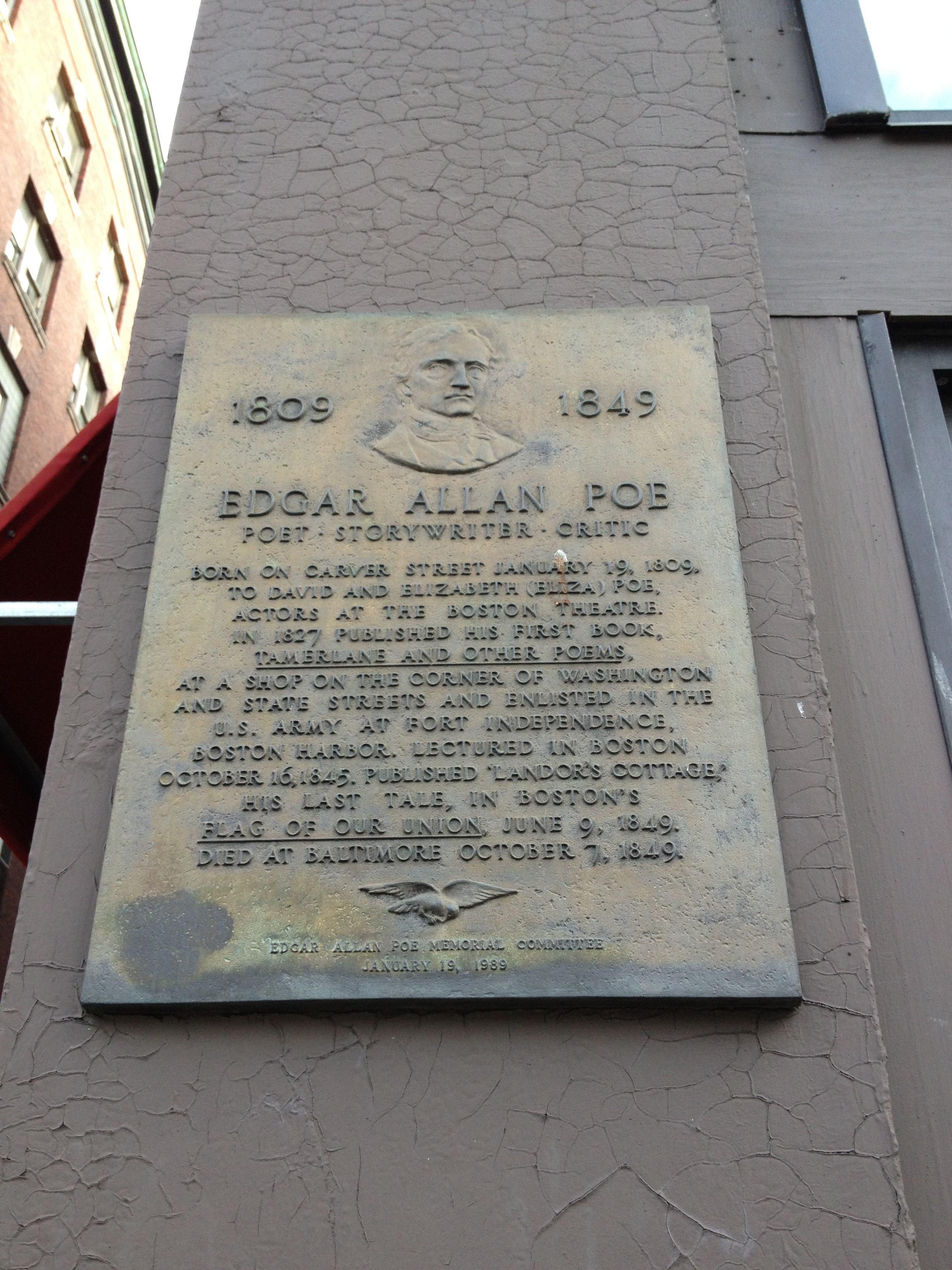
In 2018 I missed the Denver meeting because of a snowstorm panic in Newark, after sleeping the night on the airport floor.  Then the pandemic kept me away for a couple of years, but one of those was virtual anyway.  The last one I attended was 2022 in Denver.  This year I’m scheduled to be in Boston.  Even when my career has slipped off the academic rails, this meeting has been a rather constant touch-stone for November.  Now that I no longer give papers—the last one was on Sleepy Hollow in Atlanta, I believe, ten years ago—the spark has gone out of it for me.  I am glad to be heading back to Boston, however, on somebody else’s dime.  I’ve got some Poe sights to see in my off hours there.  And some 33 years of history to recollect.


Alchemy

While reading about alchemy (surprised?  Really?), I found myself learning about Jakob Böhme.  His name was familiar—he’s one of those many people I know vaguely about but having been raised in an uneducated household really knew nothing concerning him.  In any case, Böhme is considered a mystic who began as Lutheran, but who came to trust his own spiritual experience (the latter being more or less the definition of a mystic).  I read about how one day he experienced a vision while staring at sunlight reflected off a pewter dish.  Now, I have had visions but you’ll need to get to know me personally if you want to hear about them.  But at that moment Böhme believed the spiritual structure of the world had been revealed to him.  I couldn’t help but think of what had happened to me at the foot of the Mount of Olives.

It was 1987 and I was a volunteer on the dig at Tel Dor.  Visiting Jerusalem one weekend with friends, we came to the Church of All Nations, built around the traditional garden of Gethsemane.  It was hot and I was feeling tired and I went inside the church to sit.  I spied a purple stained-glass window high overhead with the sun shining through it, in a shadowy alcove.  In an instant of rapture, everything made sense to me.  It was as fleeting as it was shocking and to this day I cannot articulate the certainty I experienced in that one brief moment alone in a church.  It was an assurance that, despite all outward appearances, this does indeed make sense.  This experience has never been precisely replicated in my life, but those who know me know that there is a certain color of glass that, if I see the sun through it, instantly brings me serenity.

Sunlight can do such things.  One morning while out jogging at Nashotah House, the rising sun struck me directly in the eye.  Immediately stopped running, holding my head against a migraine that had suddenly developed.  I was sick the rest of the day, lying in a dark room with a damp washcloth over my eyes, head splitting apart.  I’ve been cautious with the sun ever since.  Some things are so full of glory that to see them directly is to invite danger.  Yet we’re compelled to look.  I felt that I understood Böhme.  And I know that if the sun is right, and a certain color of glass is at hand, and if I’m brave enough, I can almost get back to that place.


Night Fears

Have you ever had one of those dreams?  The kind where your subconscious turns on you brutally?  I’ve often said I’m my own worst critic but this one took it to a whole new level.  In real life I’m working on novel number eight.  One through seven haven’t been published (and at least two don’t deserve to be).  I’ve kind of been thinking that this one might see the light of day.  I finished a very rough draft about a couple months ago and I’ve been working on revisions since.  Meanwhile I keep reading novels and seeing how well they flow compared to my story.  That must’ve been on my mind because in my dream I was in a room with five or six publishing moguls.  In the way of dreams it seems that perhaps an agent had arranged this.  I was in the room with them and when they finished, each took their turn telling me how awful it was.  Their critique was brutal.  So bad I couldn’t get back to sleep.  I found tears on my cheek.

Of course, my writing time is early morning.  Work is uncompromising.  So I had to get up and work on what my subconscious had just told me was, in the words of Paul, skubalon.  (Look up the commentaries on Philippians 3.8, if you dare.)  Like any writer, I have my doubts about my own work.  This particular novel I’ve been working on, off and on, for almost three decades.  It’s an idea I can’t let go.  Just a couple months back I was proud of myself for finally finishing a draft of it, and this morning I’m tempted to delete all the files.  Why does one’s subconscious do this to a person?  My very first attempt at a novel, as a teen, was torn up by my own hands.

The other dream that has been recurring, in various forms, is where I’ve been hired back by Nashotah House.  I taught there for a decade and a half, and I wasn’t very happy toward the end, but I did my job well.  In real life I wouldn’t go back, but in my dreams I’m always overjoyed.  I wake up happy and optimistic.  Some version of that dream comes to me at least once a year, I suppose.  Sometimes several times.  Dreams are mysterious.  They’re telling us something, but they’re coy about exactly what.  That’s what made last night’s dream so bad.  There was no ambiguity.  This was pure, unadulterated self doubt in the room with me and it gave me no quarter.  I got up and continued work on the revisions anyway.  Who’s afraid of omens?


Little Things

Those on anti-clutter campaigns (whose lives I can’t imagine) claim that we have too much stuff.  That may be true, but when you reach a certain age these realia can serve to remind us where we’ve been.  How we’ve become who we are.  We moved to our house in a whirl.  Neither my wife nor I had enough vacation days to take any time off and we had to move 55+ years of stuff over a weekend.  Lately I’ve been going through some of the boxes of little things you keep.  They were generally mixed in with papers I didn’t have time to file, bits of hardware, and a few things I’m not sure why I kept.  In the archaeology of my life, the layer labeled Nashotah House retains a prominent place.  It took many years before I could look at my little Nashotah House things without being overwhelmed by emotion.  Nearly twenty years on, I hope I’m beginning to get over it.

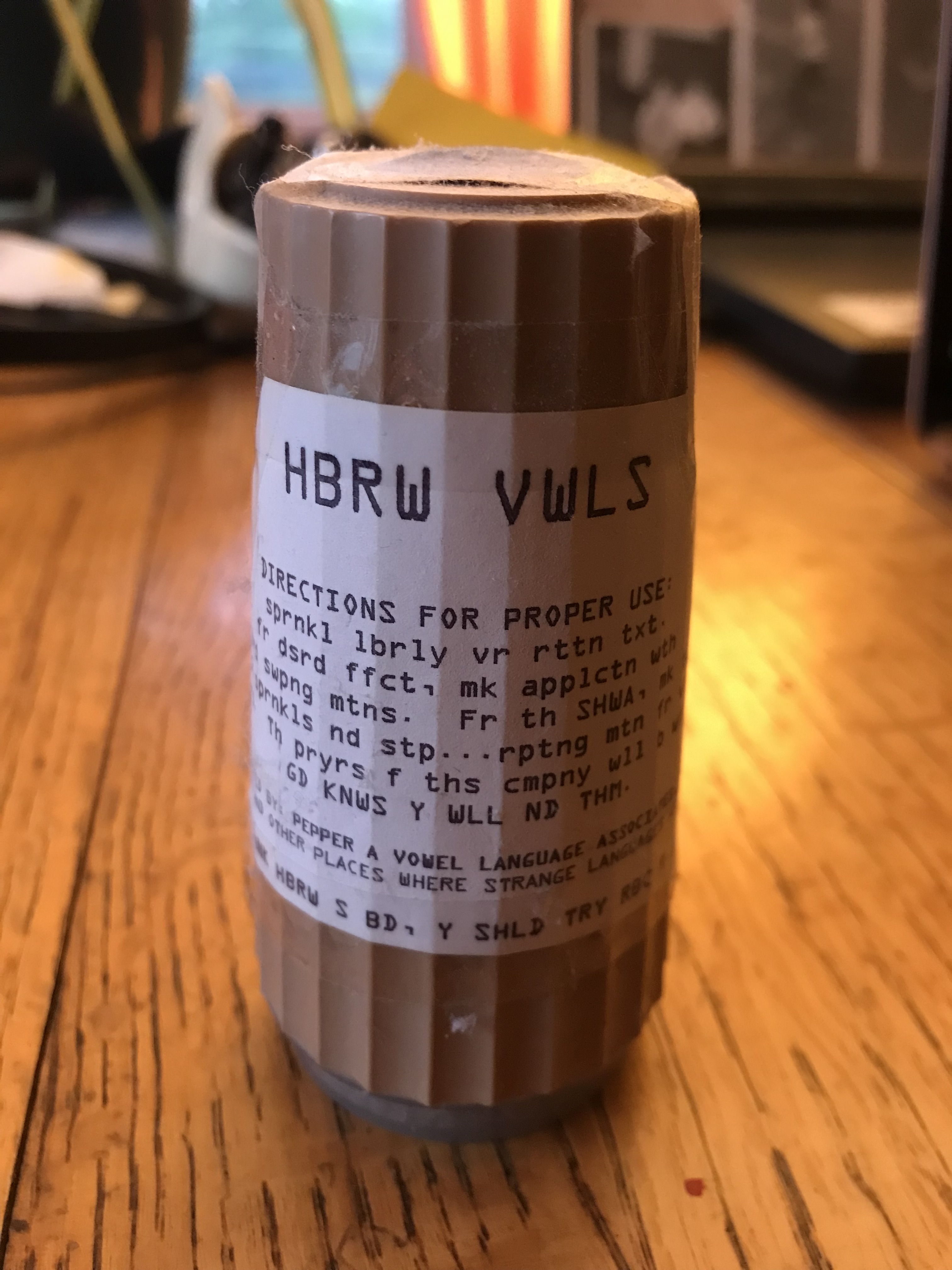
One of the little things I unearthed was a pepper shaker.  One of my students (now sadly departed) had made a label to express her frustration and humor at trying to learn Hebrew as a mature woman.  I’m probably now the age she was then.  This little artifact has been with me through a great number of momentous changes in my life.  It can still bring a little smile, however.  I see it and I remember Judy giving it to me with a laugh.  I probably shared it with the class.  Even now it has two-decade-old pepper in it.  The declutter experts would say it belongs in the dumpster.  They’re wrong.

Nashotah House was the only job on offer following those intense Edinburgh years.  As all of these things recede further and further into the past, they become more valuable.  No matter how small, these objects played a part in what I remember and rubbed me in a way that influenced my shape.  I don’t know what that final shape will be, but I jealously guard my little things, these boxes of years.  They are points of contact between my life and those of others.  I found many other pieces of myself in these miscellaneous boxes.  I know that someday, all things being equal, this stuff will probably end up in some landfill somewhere, waiting for some future archaeologist wondering what realia we kept back in the years when the world went insane.  And if s/he is really brave, they might even try some of the pepper on their future lunch.


Pet Theory

We don’t have any pets.  At least not beyond the spider near the sink that I don’t have the heart to release outdoors in winter temps.  But I have had.  I think the reasons our pets mean so much to us is that they’re like people in so many ways, but nonjudgmental.  They accept us with all our quirks and despite occasional—generally unintentional—neglect.  A recent family text chain about the sad occasion of having to put a dog down got me musing about my history of pets.  We get remarkably attached to them.  Growing up we had dogs, cats, birds, turtles, guinea pigs, fish, and we tried a short-lived attempt at hamsters.  My wife grew up with a cat but became allergic after leaving home, so we had to avoid furry pets when my daughter was young.

We had fish, hermit crabs, and a bird.  The bird, a parakeet named Archie (short for Archaeopteryx), was with us at a difficult time.  Things weren’t going well at Nashotah House, but I had no idea that I was in the cross-hairs.  Archie was a suspicious bird.  We tried to get him to talk (mostly “nevermore”) but he wouldn’t.  I tried to get him to perch on my finger—my Mom could get birds to do it—but he only ever bit me.  Still, he was part of the family.  When the seminary axe fell, he moved to two different apartments with us, remaining solitary but stolid in tumultuous times.  In the second apartment he stopped singing.  My daughter thought something was wrong, but we knew from a previous trip to the vet that we couldn’t afford another.  I was unemployed and my wife had to look for a better-paying job.  Then I found Archie dead.  That day is still, all these years later, very difficult for me to think about.  How we cried.  How we snuck back onto land owned by the seminary to bury him in the woods.  How empty our small apartment felt.

Emotions are difficult things, but they’re what bind us together as humans.  We all know loss and sadness.  Many of us have poignant memories of pets who, although we supposed we’d outlive them always thought they’d be there at least another day.  Is there anything that brings us more together?  We think anyone who doesn’t shed a tear at Old Yeller is somehow not really human.  Certainly less human than our adopted animal family members.  How wonderful not to be judged by someone who knows us perhaps better than we know ourselves.


Those Who Know

I felt a little bit odd being asked.  A local school invited me to be consulted on classroom decoration.  I took a total of one class in interior design as an undergrad and that hadn’t been my highest collegiate grade.  So why were they asking me, of all people?  Let me put this into context for you.  It was in Wisconsin.  I’d been the Academic Dean at Nashotah House for a few years and had served for a few on the Parent Teacher Organization, one as president.  While at Nashotah I’d been tasked with making the three classrooms more appealing—choosing paint colors and replacing drapes that had been falling off their hooks since I’d arrived a decade ago.  But I believe the real reason that I was asked for a consultation was that I was a professor.  Yes, a professor of Hebrew Bible, but a professor nonetheless.

Such requests, no matter how mundane, ceased immediately when I had to take a job in publishing.  People don’t turn to an editor as an expert.  (Not even most academic authors—trust me on that.)  We like to put people in neat categories.  Boxes.  Professors are smart, so when we need advice we seek them out.  Whether or not they know anything about the topic.  I was even assigned to teach accredited courses in fields that I’d never studied.  It was a heady feeling, I have to admit, being treated like my position qualified me to speak on “ships and sails and sealing wax” and everyone listened.  What has always struck me as odd is how abruptly this stopped.  Even among church folk.

When I was teaching I was frequently asked to address adult education classes on Sunday mornings.  I had arcane knowledge that priests and ministers wanted me to share.  Once I began working as an editor I had someone from a church in Princeton contact me to ask if I could recommend someone else to do such a course.  They were somewhat taken aback when I suggested that I had some expertise in the area.  I’ve even had other academics, in the same field in which I taught, react with total surprise that I know something about the discipline.  I have a sneaking suspicion that the ease of categorizing people has been substituted for actually getting to know someone.  It’s easier to call, or email, the local university—or even, in my experience, a small, obscure seminary—to find the expert you want to consult.  You’d like to think that we might be able to ponder a little more deeply.  But trust me, you don’t want to ask me about interior design.


Dark Academia

Dark academia is the new gothic.  It’s all the rage on the internet, as I found out by releasing a YouTube video on the topic that quickly became my most popular.  Still, I was surprised and flattered when Rent. asked me my opinion on the dark academia aesthetic.  You should check out their article here.  What drew me to dark academia is having lived it.  Although the conservatism often rubbed me the wrong way, Nashotah House was a gothic institution with skeletons in closets and ghosts in the corridors.  Tales of hauntings were rife and something about living on a campus isolated from civilization lends itself to abuses.  An on-campus cemetery.  Even the focus on chapel and confession of sins implied much had to be forgiven.  The things we do to each other in the name of a “pure” theology.  Lives wrecked.  And then hidden.

I entered all of this naive and with the eagerness of a puppy.  I was Episcopalian and I had attended the pensive and powerful masses at the Church of the Advent on Beacon Hill in Boston.  I was open to the mystery and possibilities even as I could see the danger in the dogmatic stares of the trustees.  It was a wooded campus on the shores of a small lake.  A lake upon which, after I left, one of the professors drowned in a sudden windstorm.  I awoke during thunderstorms so fierce that I was certain the stone walls of the Fort would not hold up.  Disused chapels full of dead black flies.  Secret meetings to remove those who wouldn’t lock step.  This was the stuff of a P. D. James novel.  Students at the time even called it Hogwarts.  They decided I was the master of Ravenclaw.

Fourteen years of my life were spent there.  I worked away at research and writing in my book-lined study painted burgundy.  Is it any wonder that I find dark academia compelling?  I’ve often written, when discussing horror films on this blog, that gothic stories are my favorites.  Even the modern research university can participate.  Professors, isolated and often unaware of what’s happening outside their specializations, still prefer print books and a nice chair in which to read them.  And, of course, I’d read for my doctorate in Edinburgh, one of the gothic capitals of Europe.   Even Grove City College had its share of dark corners and well-kept secrets.  What goes on in that rarified atmosphere known as a college campus?  The possibilities are endless.  On a stormy night you can feel it in your very soul.

That article again: Dark Academia Room Decor: Aesthetic Secrets Revealed


History Lesson

This blog, which has come to define me in many ways, wasn’t my idea.  A niece started it for me when Neal Stephenson suggested I should have a place for podcasting.  I still have ideas for podcasts, but finding the time to put them together (and a place to host them) has proven quite challenging.  In any case, the title, “Sects and Violence in the Ancient World,” reflected where I was at the time.  I started posting when I was 46, and now I’m over 60.  Things are bound to change a little.  From the start, I wrote about books.  Indeed, for things I’ve read since summer of 2009, I check the blog to find out when.  I also noted significant movies.  In the early days I tried to limit the posts to religion-themed topics since, well, I have three degrees in the field.

As I gradually grew comfortable discussing pop culture (generally horror), I gradually addressed movies and books without a religious bent.  It could be that I didn’t record everything I read or watched here, and that makes things before 2009 kind of a muddle.  While the muddle really began before 2005—my last year at Nashotah House.  That period was a kind of maelstrom of desperation to find a job, teaching classes, pretending to be an editor, making my way in a world unfamiliar to me and certainly unchosen.  Eventually this blog came to focus on horror movies more than religion.  Now, like my life, it’s a jumble of conflicting impulses trying to make sense of the world as an existentialist with a bit of faith.  I’m still aspiring to that mustard seed.

I’m not sure when it was that I began commenting on most movies I watched.  I’ve used movies as therapy since 2005—for some reason horror made me feel better.  Even now, when I want to remember when I saw a movie I check this blog.  Or if I want to know when I read a book.  My wife pointed Goodreads out to me in 2013, and that became another place to post on books, even if they didn’t qualify for “Sects and Violence.”  But that slushy period between 2005 and 2013 was full of books, I know.  In addition to movies, I read incessantly.  If I want to remember when I read what, however, I’ve only got the last decade really covered.  Goodreads says I’ve read about a thousand books since 2013.  For movies, I have no way of knowing how many I’ve seen.  Or where, for the most part.  Maybe I need to start keeping a proper diary.  Maybe one with a lock and a key.


Personal History

Being an historian by disposition has its own rewards.  I relate to the chronicling monks of the Middle Ages and their eagerness to record things.  On a much smaller scale, I try to keep track of what has passed in my own small life.  As we all know, most days consist of a stunning sameness, particularly if you work 9-2-5.  Although your soul is evolving, capitalism’s cookie-cutter ensures a kind of ennui that vacation time, and travel in particular, breaks.  Travel is expensive, however.  A luxury item.  It’s also an education.  My wife and I began our life together overseas, living three years in Scotland.  We traveled as much as grad students could afford.  Gainfully employed in the United States, we made regular summer trips to Idaho, and often shorter trips closer to home in Wisconsin.

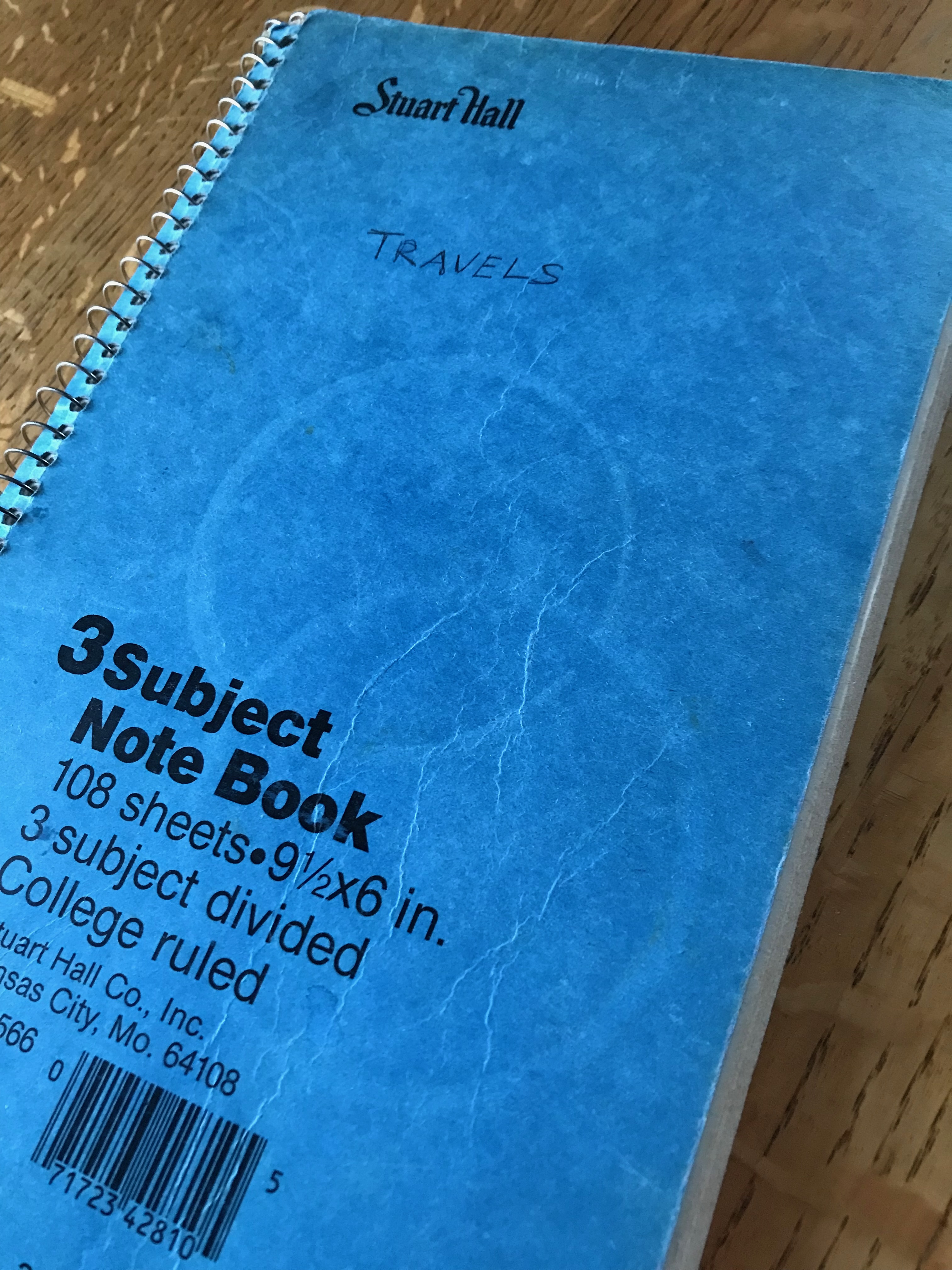
We repurposed an old, spiral bound, three-subject notebook to record our adventures.  It spanned twenty-two years.  When we moved to our house in 2018, this notebook was lost.  (A similar thing happened with an Historic Scotland booklet where we’d inscribed all the dates of properties visited.  It vanished somewhere in central Illinois in 1992.)  Recently, looking for an empty three-ring binder for my wife to use, I unexpectedly came across our old three-subject notebook.  The relief—maybe even ecstasy—it released was something only an historian could appreciate.  Here were the dates, times, and places that I thought had been lost from my life.  In that morass of years after Nashotah House my mind had gone into a kind of twilight of half-remembered forays to bring light to this harsh 9-2-5 world.  I carried the notebook around with me for days, not wanting to lose sight of it.

Those of us who write need to record things.  I’ve never been able to afford to be a world traveler.  The company’s dime sent me to the United Kingdom a few times, but overseas after Scotland has been more a reverie than a reality.  But now, at least, I could remember our domestic trips.  The notebook included ventures I’d forgotten.  You see, when you get back from a trip you have to begin the 9-2-5 the very next day, particularly if your company isn’t fond of holidays.  (This explains why I write so much about them.)  Pleasant memories get lost in the mundane cookie-cutter problems of everyday life.  And yet I could now face them with that rare joy known to historians.  I had a notebook next to me, ready for transcribing.  It was going to be a good day.


Horror History

Trying to make sense of life has perhaps been my only real vocation.  As I continue to work on horror-themed books, reasonable people ask why I keep doing this.  It’s a question I ask myself.  The other day, while working on one of these projects, I had a realization.  The narrative I’d been playing in my head is that I grew up watching monster movies and then, apart from a few slip-ups, fell off the wagon again after my career malfunction.  That’s largely true but I suddenly remembered that seminary was actually another period of my life when I watched a lot of horror.  Regular readers know that I’m intrigued by the connection between religion and horror, but I’d forgotten how early this started with me.

A friend, nameless here, was a fellow seminarian and a total cinephile.  He and I would watch movies together quite a lot.  As I was recollecting which ones, it suddenly struck me that many of them were horror films.  And it wasn’t just this unnamed friend.  Another anonymous comrade frequently talked me into theatrical horror.  He’d go with his girlfriend (something I lacked at the time) but he liked to chat about the movies with me and often invited me along.  So it was that I was watching horror into the mid-to-late eighties.  I stopped, pretty much cold turkey, when I married.  It seemed that the therapy horror was offering was no longer needed.  Life settled into a happy, if weird existence stretching several years into Nashotah House.  This was the locus of said malfunction.

Losing my only full-time teaching post led directly to watching horror again.  My wife had to take a job out of state.  We crammed ourselves into an apartment after having a four-bedroom house.  Jobs were not coming my way, no matter how low I aimed.  Horror was cheap therapy.  What’s more, it’s remained a hobby ever since.  (Read into that what you will.)  People who know me personally (but who don’t frequent this blog) are often surprised to learn that I watch horror.  I don’t act like someone who does.  At least according to this usual, prejudiced image of the horror fan.  What’s more, the friends who share this fascination are nice people.  I was recently asked to speak about Holy Horror to a senior seminar at Transylvania University (it’s in Kentucky).  The students all seemed to be upstanding, bright young people.  They, however, like horror.  I don’t know their stories, but I’m guessing that they’re probably quite interesting.  They’re just beginning to try to make sense of life.


Conference Voice

“Conference voice” is a phenomenon that began with my career malfunction.  While teaching I attended the AAR/SBL annual meeting every year but one.  Even the year that Nashotah House fired me I attended, through the generosity of a seminary colleague who’d left for a parish and who used discretionary funds to help me afford it.  (Churches can actually help people from time to time.)  In any case,  I always met many colleagues at the meeting itself, and had many conversations.  Besides, I taught a full docket of courses every year.  Then the malfunction.  I was eventually hired by Gorgias Press but I had to do adjunct teaching to make ends meet.  I taught up to about ten courses per year at Rutgers, all in the evening.  Then I was hired by Routledge.  The commute to NYC precluded any adjunct work, so I settled into the quiet world of editing.

I also began attending AAR/SBL again.  I came home with “conference voice.”  After going for days, or even weeks, with no substantial conversation, I’d lost my lecturing vocal stamina.  At the conference I had five days of back-to-back meetings, often in a crowded and noisy exhibit hall.  I’m a soft-spoken individual (I can project when teaching) and my larynx was stressed by the concentrated five days of constant conversation.  My voice had dropped in pitch by the time I got home and it took a few days to get better.  I would lapse into cenobic silence for another year.  After the conference I’d return every year with aching vocal cords.  My family sympathized, but I really just don’t talk that much.  Especially at work.

Recently I met a friend for lunch.  I hadn’t seen him to chat for a few years so we spent over two-and-a-half hours talking.  Part of it in a restaurant where I needed to raise my voice.   I awoke the next morning with conference voice.  This bothered me because I’d been invited to do a podcast episode about a horror movie and I faced an existential crisis: what does my real voice sound like?  In my mind, my profession is teaching.  The voice I had at Nashotah House, University of Wisconsin Oshkosh, Rutgers University and Montclair State, was my real sound, such as it was.  Life has landed me in a situation where I seldom speak, and almost never to groups where I need to project.  Conference voice is a reminder of what I was meant to do and what I, of necessity, must do.


No Agency

I’ve worked in publishing since 2006.  That seems like a goodly time, but the industry is a complex one.  I started trying to publish again around 2010—losing my job at Nashotah House sent me into a tailspin in that regard, although I wrote a novel or two in the meantime.  My first post-dissertation book was published in 2014.  I soon learned that academic publishers each have their strengths and weaknesses.  Most have trouble with marketing—people just don’t know about your books.  (And can’t afford them if they do.)  If the publisher won’t advertise, well, the voice of one ex-academic isn’t very loud.  So I wrote on.  My sixth book has existed in draft form for a few months now.  I know that to get a publisher who knows how to market you often need an agent.  I also know that as an unknown writer it’s difficult to get an agent’s attention.  I finally found one, however.

Agents change books.  Mine asked me to rewrite yet again.  All of my books have been rewritten multiple times, so this was par for the course.  I had to leave out a lot of the stuff I liked.  Then the agent changed his mind.  Hey, I get it.  Agents live off the advances their authors get so if they don’t see enough zeroes they shy away.  That’s just how it works.  I’ve found what looks like a good publisher (not an academic press) but I couldn’t simply go back to the version I really liked—I’d made improvements for the agent—so I had to blend the two versions together.  The problem is, that’s difficult to do on a computer.  I know from working in publishing that side-by-side comparative screens in word processing programs are difficult to find.  Of course, if you just print both versions out all you need is a table and a red pen.

I wasn’t born into the computer era.  Flipping between two screens doesn’t come easily but printing out two three-hundred-page manuscripts is time and resource consuming.  So I’m flipping screens.  I hope to finish this book soon because the next one is already brewing and I really can’t wait to start getting the ideas out.  And I even have a publisher in mind—one that doesn’t require an agent.  I don’t think agents really get me.  Or maybe I’m just not a “commercial” enough thinker.  There are plenty of presses out there, however, and if you do your research you can find a home for this project that’s taken years of your life.  It’s just difficult to do the screen flipping.  But then, I’ve only been doing this for about a decade.  I’ll get the hang of it soon.


Thinking Teaching

I am a teacher.  Although no longer employed as one, my entire mindset is geared toward the profession.  Those hiring in higher education have no clue about this sort of thing.  Apparently nobody else does either.  I’ve worked in business now for over a decade and a half.  During that time only one employer has shown any inkling of understanding the importance of clear teaching.  Instead, most promote busy people trying to explain things in sound bites that lead to confusion, compounded daily (sometimes hourly).  The immense waste of resources this entails is staggering.  It is the most inefficient system I can imagine: in the rush to convey sometimes important information, necessary pieces are left scattered on the floor like seeds under a bird feeder in migration season.  In our rush to do our jobs, we settle for half-baked rather than paying a baker to make proper bread.

This is a constant frustration for someone who has the soul (and mind) of a teacher.  Our society undervalues educators of all stripes.  And, yes, many people go into teaching without the requisite gifts or motivation.  I’m certain I’m not alone in having had a high school or college course where the teacher was completely disengaged or perhaps in out of their depth.  Students shut down, hate school, and then spend their lives making uninformed decisions on everything from politics to profession.  Teachers—good teachers—are the future of any nation.  I know our young are our future, but if they’re inadequately taught, take a look at the headlines and see what happens.  Why is it so difficult to see that if children aren’t taught well, institutions will perpetuate that model until everything is a barely contained pandemonium?

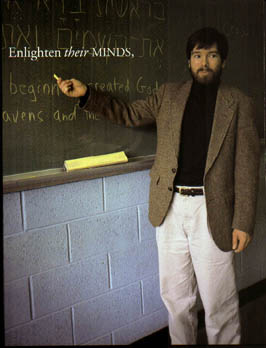
We see this happening in history.  A people or culture gets to a point where they just begin to implode.  Too many things that just don’t make sense have been built on top of other things that just don’t make sense.  The whole thing begins to collapse.  I see this happening all the time—the hurried email that simply doesn’t explain anything, sent in haste before moving on to the next sophomoric task just to get the job done.  When businesses take a look at budgets and feel a little scared, some of the first positions to go are those of trainers.  “People will figure it out,” they seem to say.  And we see the results.  Evolution has made teachers of some of us.  Many of us, of necessity, are doing something else for a living.  If only all jobs came with a blackboard.


Old Oak Tree

Trees have much to teach us, if only we’ll pay attention.  They are fascinating plants in their own right, living longer than just about anything else.  During our years in New Jersey we made pilgrimages to two ancient trees in that state: the Basking Ridge White Oak (unfortunately cut down in 2017), and the Great Swamp Oak in Lord Stirling Park, also in Basking Ridge.  Naturally enough, then, when in Charleston last month we had to visit Angel Oak.  Our Charleston visit was not a solo venture, therefore our timing was somewhat off.  Our flight to South Carolina was delayed by about three hours, cancelling our plans for that Saturday afternoon, one of which was to see Angel Oak.  When we arrived at the oak on Sunday we discovered the venerable tree had visiting hours that started after we had an engagement on Sullivan’s Island.  We had to see it through a fence.  (In our defense, several others arrived at around that time, equally surprised to learn they couldn’t get in.)

Regardless, there’s something awe-inspiring about being next to a being four-or-five-hundred years old.  Unlike its departed cousin, the Basking Ridge White Oak, Angel Oak is of the live oak variety.  (Live oak is the rather awkward name for a type of oak tree, not necessarily a designation that the tree is alive.  People sometimes have strange ideas about naming things.)  Like many ancient things, folklore has accumulated around this tree.  Although the name derives from former estate owners, lore has it that ghosts of slaves appear at the tree in the form of angels.  Folklore has a way of saying something important in this materialistic era.  There can be something spiritual about trees.

Although we had only a few minutes outside the fence to appreciate what we were seeing on John’s Island, the experience is one that sticks.  One of the most hopeful things a person can do is plant a tree.  Back at Nashotah House I planted an apple tree that I’d grown from a seed.  I planted it the year my father died (2003) and I often wonder if it’s still there.  After buying our first house we planted a scarlet oak.  A local nursery indicated that oaks help the environment by providing the habitat for the highest number of species here in Pennsylvania.  We used A Tree to Remember after my mother’s passing to plant a memorial.  (Other trees I’ve planted have been snipped off by squirrels before they can live on their own.)  Although outside the fence, I reached up and touched some of the outer leaves of Angel Oak and connected, if only for a moment, with something great.


Friendly Bug

The Beetle and I go way back.  I’m unapologetically a child of the sixties and I’ve always loved Volkswagen Beetles.  My second car was a used Beetle, one of the older kind before they were discontinued.  I had to sell it to pay for seminary.  Since things tend to happen in cycles, I was teaching in seminary when we could finally afford car payments and we bought one of the New Beetles before they discontinued them.  That was back in 2003.  I mentioned in a previous post that I had to trade in a twenty-year old car for a new one.  That was the Beetle.  Cleaning it out was an exercise in history.  And it brought a few tears.  We’d only put 113,000 miles on that car—it had electronics issues that kept it in the shop a lot—but it was more the years than the distance.  There were memories.  It wasn’t unlike having your dog die.

I remember buying the Beetle on Blue Mound Road.  This was back in Wisconsin.  Waiting for it to arrive (only a matter of days instead of months).  Driving a stick-shift again.  It was basic driving.  Each little artifact I pulled out from under the seat, or tucked away in the trunk, triggered another memory.  A tear or two escaped, I confess.  We were unaware that just a couple short years after buying it that Nashotah House would turn savage and we would have to drive the Beetle halfway across the country to find work.  Registering a car in New Jersey is a surreal experience.  I used it for commuting to Gorgias Press until that ended, then commuting to Rutgers and Montclair State.  Then came the long, long years of commuting by bus to New York when the Beetle sat mostly neglected in the driveway.  All those trips up to Binghamton, then Ithaca.

The move to Pennsylvania involved yet more paperwork, since cars are more complicated than any other commodity.  The Beetle became our short-trip car.  I love shifting gears manually.  Feeling a sense, however illusory, of control.  Of longevity.  We kept the car for two full decades, making memories along the way.  It was alas, aging.  At twenty it was like fifty in dog years and the check engine light was on again although it just passed inspection.  It felt wrong pulling all the accoutrements out, getting ready to hand an old friend over to a stranger’s care.  We’d been the car’s only owners in three states.  Through four presidential administrations.  There was a lot of personal history there.  It’s the end of an era.  Goodbye, old friend.