Is Golden

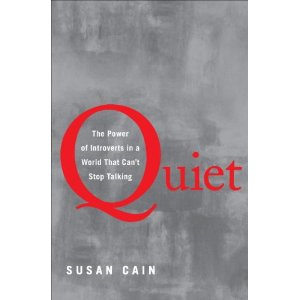
quiet When I grew up I sometimes thought I’d join a monastery. It’s a funny idea since I’m not Catholic and I am happily married. I think what appealed to me most about the idea was the quiet. We don’t choose jobs any more than we choose our own names. My first “real job” was teaching at Nashotah House, a seminary founded on the principles of a monastery—once all male, meals eaten together, and lots and lots of quiet. Many parts of life on campus drove me crazy, but I liked the silence. Yes, I am an introvert. Anyone who knows me knows that. Until I read Susan Cain’s book Quiet: The Power of Introverts in a World That Can’t Stop Talking, I had figured there was just something wrong with me. I put the book down feeling strangely ebullient, as if I’d just read my own biography and it turned out happy. Here was someone finally speaking up for the quiet among us. The world wasn’t quite so lonely any more.

My only fear about Quiet is that not enough people will read it. Here I learned that a large part of the population, although still a minority by a considerable margin, is introverted. The label is often used like a swear word. How many times have I been told at work that I must assert myself more, make more noise? How many times have I been made to feel shame at being what I am? I lost count years ago. Ironically, I have no fear of public speaking. Teaching (and once upon a time, preaching) came as naturally to me as breathing. But don’t expect me to get in somebody else’s face. I don’t do cold calls. I like to think things through. I can’t praise the insights of Cain’s book enough.

In addition to my natural disposition, I also grew up believing the world owed me nothing. We lived in humble circumstances, and I tried hard not to make more noise than necessary. Sure, as a young child I “rared” with my brothers, but I preferred the quiet play even more. Religion taught me that silence is a special kind of gift. Most days I arise at 3:30 a.m. to spend the first two hours of the day in quiet contemplation. I write, I think. I live. For me the day has already begun to slip into chaos as soon as I climb onto the roaring bus. I silently read my book, but conversation picks up around me as more and more people stomp on. By the time we reach Manhattan, the peace is gone for another day. I felt strangely empowered holding Quiet before my face on the bus. For once, it seemed, someone approved of a silent man and welcomed him to the human race.
Ancient of Days

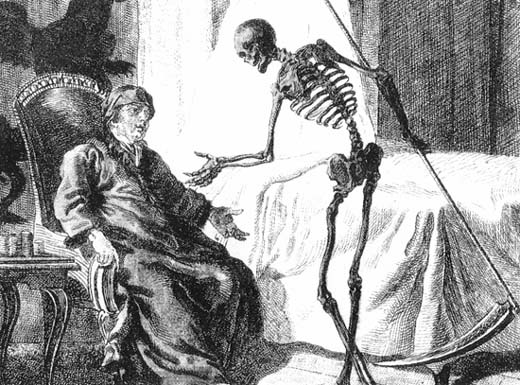
I’ve never been one to deny my age. I think of myself as a rather young 50 since my brain still reacts like an 18-year old’s much of the time. I try to keep as fit as my job allows, and the only thing I really overindulge in is books. But I am 50, and that means the AARP has had me in their cross-hairs for the last couple of years. The phone rang the other day and I was foolish enough to answer it. The young man on the other end of the line asked me if I could hear him okay. I almost hung up; if someone doesn’t identify him or herself in the first sentence, I know they’re wanting me to contribute to something. Instead, I tried a new tactic: “you’re not coming in very clear,” I fibbed, hoping that he would offer to call back and I wouldn’t answer. Instead, he adjusted the volume. It was the AARP calling with a survey. My hearing is still pretty keen—without it, walking across Manhattan in rush hour everyday would be downright dangerous. Nevertheless, my encounter with AARP made me think of a recent conversation I had about death.

I am not afraid of death. As long as I can remember, I have never really feared it. Not that I want to go anytime soon, but perhaps because of my childhood fears of Hell, I believe I might have contributed enough to the treasury of merit (like the AARP, or Social Security) to get me out of a few scrapes. I attended mass nearly every day for twelve years at Nashotah House—that has to count for something! My conversation partner the other day was incredulous; “how can you not be afraid of death?” I’m not sure what comes after, if anything, but I’ve always tried to keep on the good side of the divine. Those questionable things I’ve intentionally done were all executed with good reason, or so it seemed at the time. If they were truly naughty, I’ve asked for forgiveness. And if there’s nothing after life, well, I feel like I could use the good long sleep of annihilation for a while.

Several books I’ve read recently have been advocating reincarnation. I’m not sure that it makes sense, but sometimes I wonder. The idea is a bit more frightening than death itself, in many ways. So many things I don’t want to go through again—sorry Friedrich, but I guess I’m one of those who says no to exact repetition—so much physical pain and mental anguish. I can see why Buddhists want to break the cycle. Although, if I’m reincarnated as a human being, and a literate one, I might be able to get a few more books read next time around. Perhaps that’s the silver lining. Or perhaps that’s why I should just hang up the phone if the caller doesn’t tell me who it is in the first sentence.

"I'm not quite dead yet..."

“I’m not quite dead yet…”


Secular Oaths

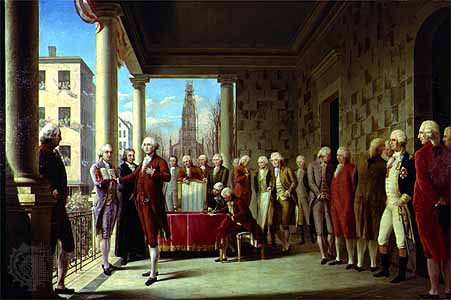
“I do solemnly swear that I will faithfully execute the Office of President of the United States,” so begins the story. With President Obama’s second inauguration so fresh in the public mind, an article in the Sunday New Jersey Star-Ledger raised the question of using Bibles for taking this secular oath. As A. James Rudin points out, not every president has laid a hand on the Bible to take the oath—John Quincy Adams preferred a law book to do the job. Rudin points out that commentators have started to question the practice of using any religious book for taking a vow for a government position. As I read this article I had to pause for a thought. It was the particular turn of phrase “the Bible, and by implication all other religious writings,” that stopped me at this brain crossing.

Washington's_Inauguration

Anyone who has taken time to study the phenomenon of religion seriously (admittedly not a large cohort) has stumbled upon the blue whale in the room: what exactly is religion? We all know, but nobody really knows. Many scientists equate religion with superstition and claim that we are evolving out of it, but we still seem preternaturally powerfully attached to it, if that’s the case. While religious writings have been around for ages, the idea of a sacred book seems to have its origins in the societal reception of the Bible. There are older religious books, but the Bible seems to have defined the category. What’s running rampant in my mind is where the line is drawn between a religious and a secular book. For some, it would seem, Fifty Shades of Grey, or Twilight would fall into that category. Some thinner, more glossy and heavily illustrated literature favored by teenaged boys might also qualify. What makes a book religious?

In current understanding, religion is a matter of belief. Not all religions insist on belief, but in the United States, in any case, it’s not properly religion without it. In our secular society belief is atomized into millions of varieties, even within the same religious family. Step outside the church, synagogue, or mosque, and the sheer varieties of religious experience would make even William James blush. “All other religious writings.” Those might include just about every pen stroke on paper (or electron on whatever it is that I’m typing this into). Those of us who venture to write know that at some level it is a sacred activity. I would swear it with my hand on my dissertation. (At graduation at Nashotah House students are hit on the head with a Bible. Perhaps this might be more appropriate to swearings in?) We lay our hands on that which is sacred, otherwise there’s no vow involved. Whether it be Bible, law book, or saucy literature, we pledge on it because all books are religious, regardless of definition.


Accidental Abortion

There comes a time in life when you realize that if a small town you know makes it into the news headlines, it is likely tragic. So it was when I read this morning that a man in Mercer, Pennsylvania—just a few miles from where I grew up—shot and killed his 7 year-old son, by accident. I grew up in a part of the country that has a love affair with guns. This may have been understandable in the days when a stroll to the outhouse could mean chancing a bear or cougar encounter, but these days bear sightings are rare and cougars, well, almost unheard of. The man was trying to trade in a couple of guns at Twig’s Reloading Den. Climbing back into his truck, the handgun discharged, killing his son. This is very tragic, yet the officer making a statement said something chilling. The man thought the gun was unloaded but, “This happens all too often where people think the gun was empty.” All too often. All too often.

I grew up in western Pennsylvania, and if Facebook is anything to go by, it has become consistently more Evangelical since I left. And that is saying something. In my younger days I wore a large cross around my neck and took my fair share of ribbing for being religious. Now I see those with whom I attended school posting on all manner of conservative causes, including the contradictory anti-abortion and loosening of gun control. This is not a phenomenon restricted to western Pennsylvania. At Nashotah House it was alive and well. Several students kept guns in their dorms, protested against the violence done to the unborn, yet called killing heretics “retroactive abortion.” It was their smiles when they said such things that frightened me. Wait until they grow up to kill them.

Like any insecure person I sometimes think a gun for protection might be good. I especially think this when I’m in the grizzly bear habitat of the Pacific Northwest, miles from civilization. I picture myself shooting into the air with a rifle that out-Thors thunder itself, a mighty man. Yet the only time I actually saw a grizzly bear I immediately jumped out of the car to snap a picture or two. I dream of going back to the days before guns were invented, but this evil genie has been let out of the bottle. There’s no getting it back in. Are we vulnerable without guns to “protect” us? Yes. But my reading of the Bible my Evangelical friends so often cite insists that turning the other cheek is the way to show that you believe it. A seven-year-old is dead not far from my hometown. His father was trying to sell guns at a store that doesn’t even buy guns. The boy died in the gun store, and yet my fellow Americans feel safer knowing they’re armed. I hope your hometown stays out of the news.

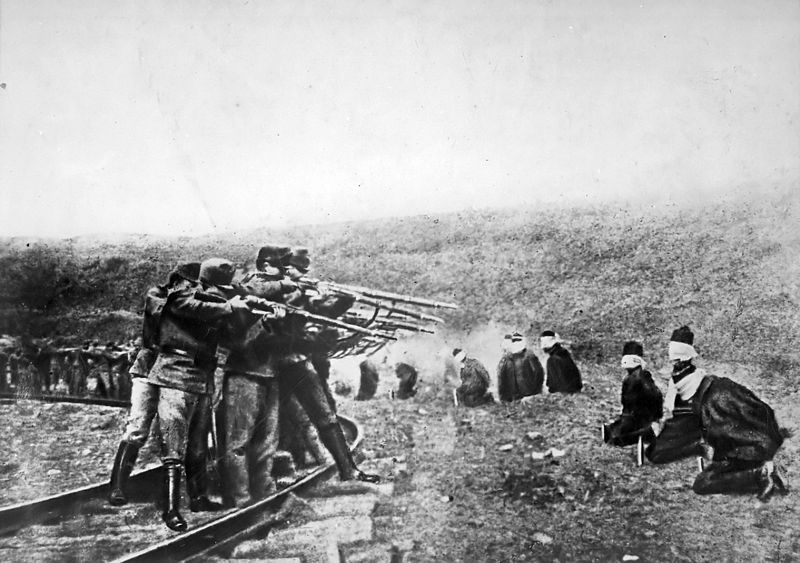
Feel safer?

Feel safer?


Rock Hard Cafe

IMG_0518

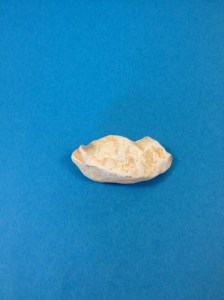
At first glance it may not appear to be much. A small chunk of rock, probably limestone. Hardly large enough to be used in a sling against a giant in a pinch. Still, it is special. What makes this rock special is the context from which it was removed. A friend has recently returned from Israel and he brought this rock for me. It is from the Mount of the Temptation, atop which sits a lonely monastery cared for by a single, elderly monk. The thought of someone thinking of me in such a (literally) God-forsaken wilderness is touching. My brief travels through the desert of Judea offered plenty to occupy my restless mind. I’m pretty sure we zoomed by the base of the Mount of Temptation in an air conditioned bus one day on our way to somewhere less desolate. Or more. The sharp-voiced little skeptic in my head immediately kicks in: if Jesus was alone when tempted, how could anybody possibly know where it happened? I can’t picture him leading a tour there later—“and this is where I almost turned stone to bread; don’t those pebbles look like challah to you?”

But then, it’s not about historical accuracy. This little stone in front of me is a symbol. Broken off of the karst geography of the rocky spine of the Holy Land, this shard is meant to remind me to avoid temptation. A nearly identical piece of stone from Israel sits among my teaching trinkets. One of my students went to Israel back in my days at Nashotah House and returned with a bit of limestone for me. She said, “you can keep it as long as you put it on top of my gravestone when I die.” This was a custom I’d observed long before I’d even heard of Nashotah House. Long before religion grew flinty and unyielding. Stones bear remembrance. Although Israel is not as arid as many people believe it to be, rock is a natural resource of uncommon abundance. We age and die, but the rock remains. The rock remembers.

My six weeks in Israel were spent among the rocks of an ancient settlement known as Tel Dor. Archaeology, I learned, is mostly just removing the dirt from the rocks in the ground—at least at the entry level. Those stones tell a story. They were once a city, a district administrative center. Now they lie in dusty profusion, and only the most ardent of Bible readers will recall ever seeing Dor’s name in the pages of Holy Writ. Built by Solomon, the Bible grandly claims. Now all is ruins. The grandeur of a king toppled with the passage of time. My mind is drawn back to a treeless stretch of a mountain devoid of even the hardiest plants. A person can grow mighty hungry there. Mighty hungry indeed. Temptation comes, unbidden. Life is an unbroken chain of temptation, for those willing to be honest in the desert. That little stone is, in truth, bread.


Gonad Make Disciples

The funny thing about authority is that when it counts those who have it are often afraid to use it. So yesterday the “mother church” (if that honorific still applies) of the Church of England voted not to allow women bishops. According to Reuters, the voting breaks down into three parties: the bishops, the clergy and the laity. The bishops and clergy both approved the motion while the laity fell short of approval by only four votes. My regular readers will know that I normally shy away from coarse language, but I wonder, along with the Joker, “what happened, did your balls drop off?” In a church built around hierarchy, where there is tremendous authority—according to official teaching, the very power to let one in or keep one out of Heaven itself—vested in the clergy, can they not say, “this is the right thing to do” and just do it? In a Protestant milieu where Methodists, Presbyterians and Lutherans have all overcome centuries of chauvinistic stain, why does the Church of England not do what the collected bishops and clergy have decreed correct? Are the laity now running the show?

I have had a long history with the Church of England. As laity I know that when the clergy want to throw their considerable weight around they are not afraid to do so. My entire career was thrown into turmoil because just such tonnage was shifted. And I had met the Archbishop of Canterbury (before he ascended to the throne) as he received an honorary degree from Nashotah House. When a layman could still shake his holy hand. It is time for the church to drop its magical infatuation with testicles and get on with the business of making the world a better place. Otherwise Heaven may include too many football games and deer hunts to really make all of us comfortable. The gender divide should be dropped and the church should be getting on to matters that really could use some compassion, both human and divine.

It seems that the staid laity of the C of E didn’t follow the fortunes of the radical right very closely in the recent elections this side of the big water. The day of exclusivism is over. It should have been long ago. Many have been the times when I was informed that doctrine is not a matter of democracy. Perhaps in an issue so basic, so fundamental as the equality of humankind, this should be one of those instances. The titular head of the Church of England is a woman. Has been for decades. Before Elizabeth the Second, for six decades of the nineteenth century Queen Victoria held that role. I think I speak for the majority of sensible laity when I say, in the spirit of the departed monarch, “We are not amused.”

She’s got the whole world in her hand.


Secret Life of Apples

Considering that the story of Eden fits the pattern of many an ancient myth, modern writers still occasionally argue about what the fruit on the tree of life might have been. The favorite with medieval theologians seems to have been the apple because of the similarity of its name in Latin and the presumed badness of the act. Apples, however, are nutritious and make up a large part of autumn’s outdoor appeal. While at a local orchard over the weekend, apple picking, my daughter pointed out a tree with what might be termed biblical properties. A tree full of ripe apples yet to all appearances the tree was dead or dying. Perhaps that is nature’s way with apples, but it also seemed like such a resurrection symbol that I just couldn’t let it go. Would the apples carry on the line of the dead parent tree? Was there life after death?

I’m not sure why I’ve associated apples with new life. Shortly after my father died, I planted an apple seed in a plant potter in our Wisconsin home. To my surprise, the seed germinated and began to grow. We did not own our house, but we lived on a wooded campus and two large shade trees had been blown over in the past few months, so when the young tree was large enough, I planted it outside. The lawns on campus were rather aggressively mown with students who sometimes had anger issues, so I put up a little fence around the young tree to keep it safe from accidental mulching. By the time I was asked to leave Nashotah House, the tree was taller than me (not such a feat, but the fact that it survived so well was pleasing). No apples had yet appeared, but the tree is a symbol of new life. No one on campus knew its meaning, and I doubt very much that anyone thought much about it one way or the other after I left.

I often wonder if that little tree is still alive, and, if so, whether or not anyone enjoys its apples. Every year when the trees begin their long journey into a winter’s sleep, the apple trees send forth the own message of resurrection. Some will associate the fruit with sin while others will find pleasant autumnal memories. And a very few, I should suppose, will always think of trees as a symbol of someone they wish they might have known a little better. Far from being a sign of sin, the apple can be a sign of forgiveness and self-giving. Whether it is a myth or not, the northern hemisphere has begun its inexorable turn away from the sun. I look at a tree that is dead and full of life at the same time, and to me it seems to be a very different kind of fall than some suggest the Bible intends.


Life After Mirth

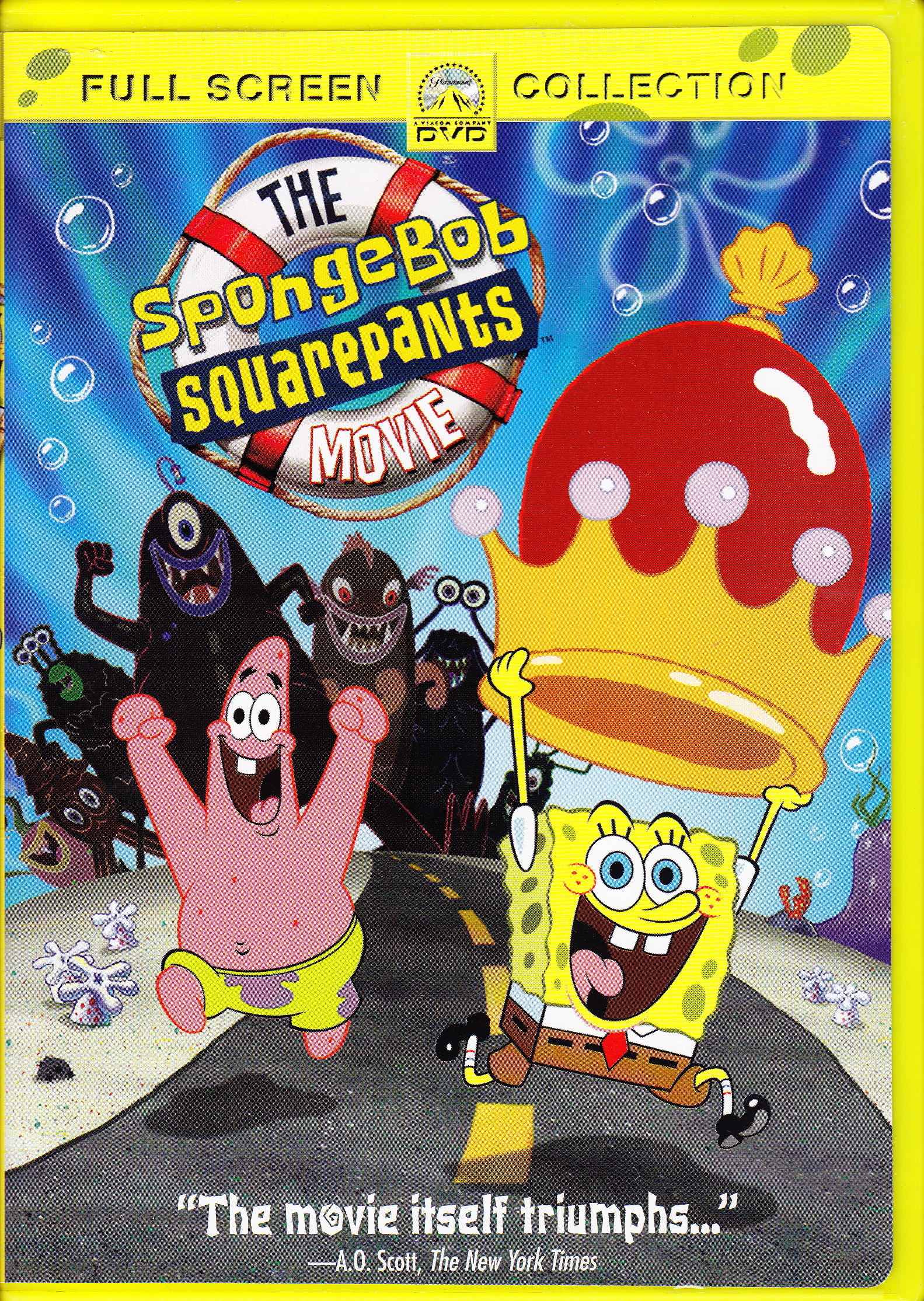
Who lives in a pineapple under the sea? In this era of fast-paced technological change, I’m probably displaying my terrible penchant for the passé when I confess to having watched Spongebob Squarepants with my daughter. I even went to the theater, back in Wisconsin, to watch the much hyped Spongebob Squarepants Movie. We eagerly awaited its release on DVD. Well, maybe not eagerly. In any case, after repeatedly watching it for several months, it was shelved and forgotten. Until recently. Playing archaeologist in our apartment, I sometimes unearth artifacts that have been hidden since our hurried and harried move from Wisconsin to New Jersey. We have never really fully unpacked since leaving Nashotah House, and opening a dusty box in a corner can feel like Christmas sometimes. Or, maybe you just discover the Spongebob Squarepants Movie.

It was a rare three-day weekend. School was about to start, and the commute to work would begin to take longer now that the leisured class had to admit to summer’s end. A little silliness seemed just the prescription I needed to face the work week. A little softness before hard reality.

I have noticed for several years now that American movies (and this may be true of movies from elsewhere, but I can’t say for sure) frequently make use of the death and resurrection theme. I suspect that a country that identifies itself so closely with Christian ideals finds this reiteration reassuring. Sure, the scenario is cathartic on a very basic level, and yet, it lies at the very heart of a central Christian belief—death is not the final word. So as Spongebob and Patrick are laid out on the drying table in Shell City and the water vapor rises from them like their departing souls, the viewer is left with a desiccated porifera and echinoderm and a profound sense of loss.

Of course, resurrection is right around the corner. The fire alarm goes off, showering down life-giving water from above, and our stars pop back to life. Resurrection in nature is limited, by appearances, to plants. With the annual cycles of death and rebirth, an individual plant may attain that for which animals only hope. This is a most robust religious symbol and movie viewers would be bereft without it. Even if the next time you see a sponge is when using it to clean the toilet, remember that resurrection crops up in the unlikeliest of places.


Danger de Nuit

I am on a boat—maybe it’s the Titanic. Far from land. For some reason, vaguely unclear, the ship is sinking. There’s panic—people are running and flailing, trying to save themselves. I’m frozen with terror as the icy water encroaches. I can’t swim. I prepare to die. So goes a nightmare I had several times in association with a former place of employment. Nashotah House felt traumatic to me with forced liturgies and daily reminders of my inferior status. The terror of the nightmares was very real, and the day I was fired did nothing to improve them. As a child I was plagued with phobias and frequently experienced horrific nightmares. They still come once in a while, but since I’ve left the employment of the church, they have become, gradually, less frequent. Nightmares are just dreams gone bad, and I’ve always been a dreamer.

Last month Time ran a story on nightmares. The subject of nightmares has now caught the attention of the military because of cases of Post-Traumatic Stress Disorder. When the military decides to show its humane side, it doesn’t fear backing it with big bucks. Soldiers confess to frequent nightmares after witnessing the atrocities of war. (One psychologist said that many at Nashotah House seemed to be suffering from a similar phenomenon.) Theorists now suggest that nightmares might lead to mental illness, and sleep deprivation, as we all know, can lead to bad judgment. Not a good thing on the battlefield. Or behind the wheel of a car. Or, in a recent real-life nightmare, while flying a jet.

In many ways nightmares seem like minor annoyances—they don’t physically hurt anyone, and they end when you wake. Time probably wouldn’t have reported on them if it hadn’t been for the military angle. This seems a paradigmatic situation. A common problem goes ignored until it affects the military, then it is deemed worth research funded by tax-payers. I am well acquainted with nightmares. As a child they became part of my identity. I am heartened that serious research is considered worthy of federal money. It seems, however, that perhaps a better way to end battle-induced nightmares would be to stop the horrors of warfare. When war ends, some nightmares will cease. Of course, I’ve always been a dreamer.

Is all that we see or seem
But a dream within a dream?
-Poe


Double Exposure

Back when I was teaching full time, one of my favorite television shows was Northern Exposure. In fact, the fictional town of Cicely, Alaska, had quite a lot in common with Nashotah House. Both were populated by quirky characters in a relatively remote location. Both were small, insignificant places with visions of grandeur. Both were effectively run by conservative forces that liked to imagine themselves as benign or downright noble. Both distrusted outsiders with ideas that might challenge the status quo. One of my favorite characters was Maggie O’Connell, the woman in a man’s world who refused to let the male establishment set the limits to what she could do. A strong woman character whom the men all respected served as an antidote to daily life at the seminary. My wife and I liked the program so much that we even stopped in the town of Roslyn, Washington, where the outdoor scenes were shot, a couple of times on our way out west.

We don’t have television now, so we have to watch Northern Exposure on DVD. While at a hotel recently, however, the name of Janine Turner on the television made me look. I had known that the actress portraying Maggie O’Connell was a political conservative in real life, but here she was advocating an “anyone but Obama” type campaign or some such nonsense. I felt as if I’d been sold a false bill of goods for all these years. Like Margaret Thatcher, Turner believes in socially conservative causes. Margaret Thatcher, that contradiction of a woman who felt that females belonged in the home, had undue influence on a once great Britain. Where was the woman who played such an ardent feminist in a male world? How could anyone pretend that kind of passion in front of a large audience for six years and spent her real life trying to deconstruct a cause that has everyday ethical implications? It’s all an act.

Women have been relegated to positions of lesser prestige for millennia for the crime of caring for their offspring. Men have been free to abandon responsibility and seek selfish ends, if so inclined. No matter what our gender, we pursue in life what is most meaningful to us, and it amazes me when strong women support a structure that has consistently shown itself interested in keeping them down. Vaunted as a show where diverse characters come into constant conflict but always “strive to accept their differences and co-exist,” Northern Exposure displayed depth without eschewing what is laughable about the human condition. Real life, I suppose, it is much more like the small town of Rosyln, Washington. For a few years it was an out-of-the-way tourist stop where actors could play characters they really didn’t believe in while living in a fictitious town where everyone at least attempted to tolerate everyone else.

Do you recognize this character?


Do Not Enter

“Sign, sign, everywhere a sign, Blockin’ out the scenery, breakin’ my mind,” so runs the chorus of Five Man Electrical Band’s only hit, “Signs.” It is hard to imagine a more righteous hippie classic. When I was a younger man, I believed in signs. It made sense that if the world were unfolding according to a divine plan laid out for good, Christian folk, signs should be scattered throughout the world, pointing us in the direction we should go. I used to look for them assiduously. As I grew a bit more cynical with the years, and learned a bit more about science and probability, the idea that coincidences bore anything more than incidental meaning became a fixed paradigm. Every now and then something happens to make me question my assessment.

On my way into New Brunswick recently, I passed a sign. I used to drive this road several times a week when I was teaching at Rutgers, but I hadn’t been this way in a few months. I knew there had been construction going on, but a new road sign caught my attention:

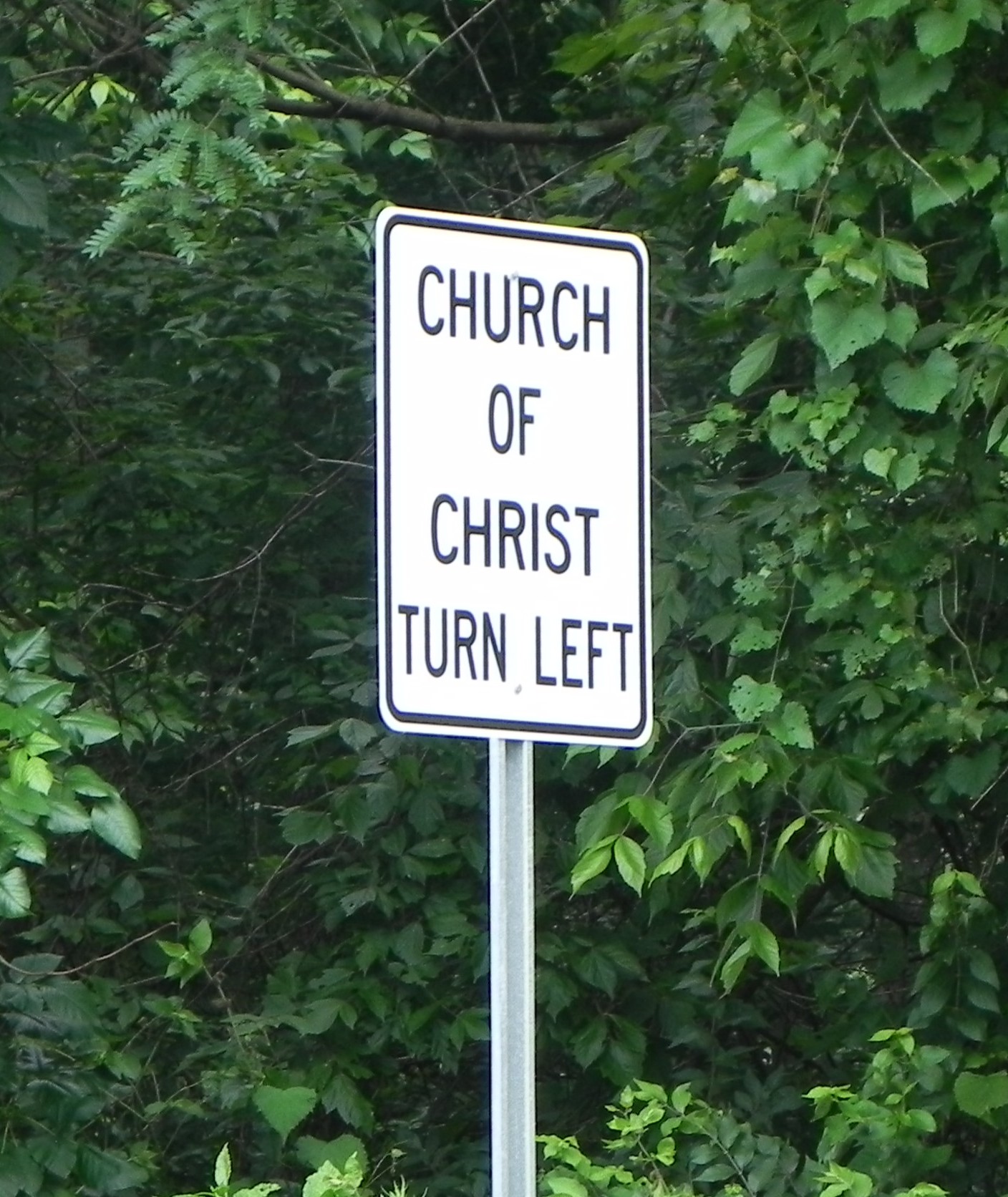
Now, I’m one for finding the significance of buried statements. Here was a bold-face declaration that seemed to come directly from the almighty. In a day when Christianity is portrayed as an intolerant, bigoted institution, the simple truth of a road sign might actually bear considerable significance.

Throughout my life I’ve taken road signs a little too literally. When I worked at Nashotah House and I spied an orange sign on the road toward the seminary reading “Detour Ahead,” I knew that it was personally meant for me. The fundies from my college days frequently exploited the One Way signs liberally scattered across our nation, pointing their arrows into the mythological air. Anybody, of course, can make good use of a stop sign. A sign miraculously appearing that spells it out: Church of Christ Turn Left, can be nothing other than a divine message for a weary world. At least for those who still remember hippie bands with a certain fondness, and who don’t take themselves too seriously.


Lunchtime in Midtown

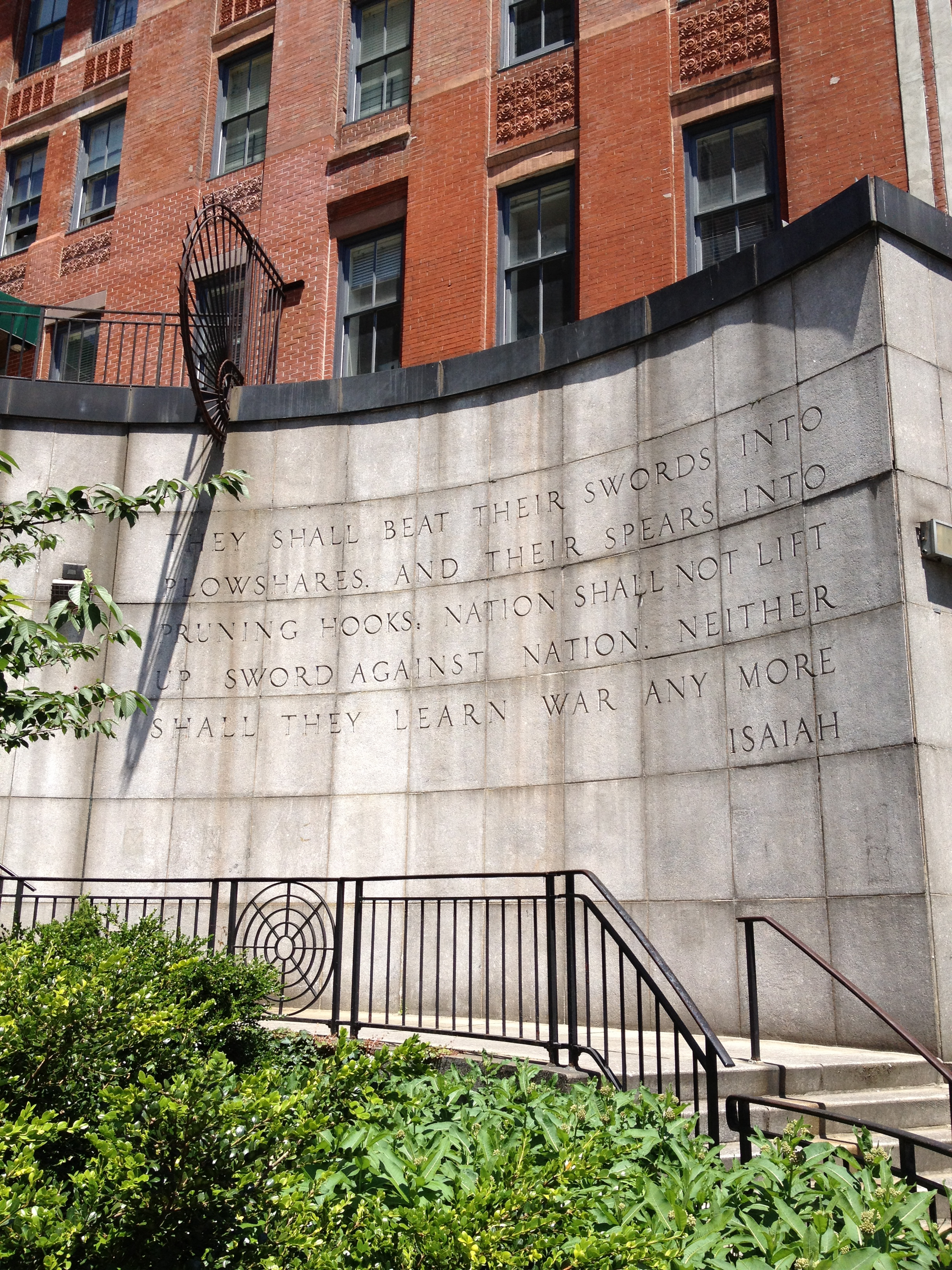
It was a brilliantly sunny day and there seemed to be rain nowhere in sight. It wasn’t even hot. Days like this have been rare this spring, so I went out for a lunchtime walk in my neighborhood. I’d been by the United Nations with some visiting family the day before, so I went down again and pondered the words attributed to Isaiah carved in the wall across from one of the largest intentional organs of peace in the world. I was reminded that a copy of the Edict of Cyrus resides in the UN; as a historical text it is often considered to be the first document promoting religious tolerance among lesser powers allowed by a greater power. The world could use a few more like old Cyrus the Great these days. I think Deutero-Isaiah would agree. So with biblical thoughts in my head, I strolled back toward Grand Central.

Along the way I saw a phrase from the Eucharistic Prayer on a building and it was like meeting someone from college that moved halfway around the world to disappear from your life. I saw that I was standing outside 815 Second Avenue. To the majority of the world—even the majority of Christians—this will mean nothing. At Nashotah House, however, “815” was regarded as the source of all evil. It is the headquarters of the Episcopal Church in America. It is hard, as a disowned son, to describe the feelings that assailed me there. Those good Christians who intended me such harm did not seem to realize all I had sacrificed to join them. Some of the clergy whose daggers remain in my back are well-paid priests right here in New York. Yon Cassius has a lean and hungry look, I thought.

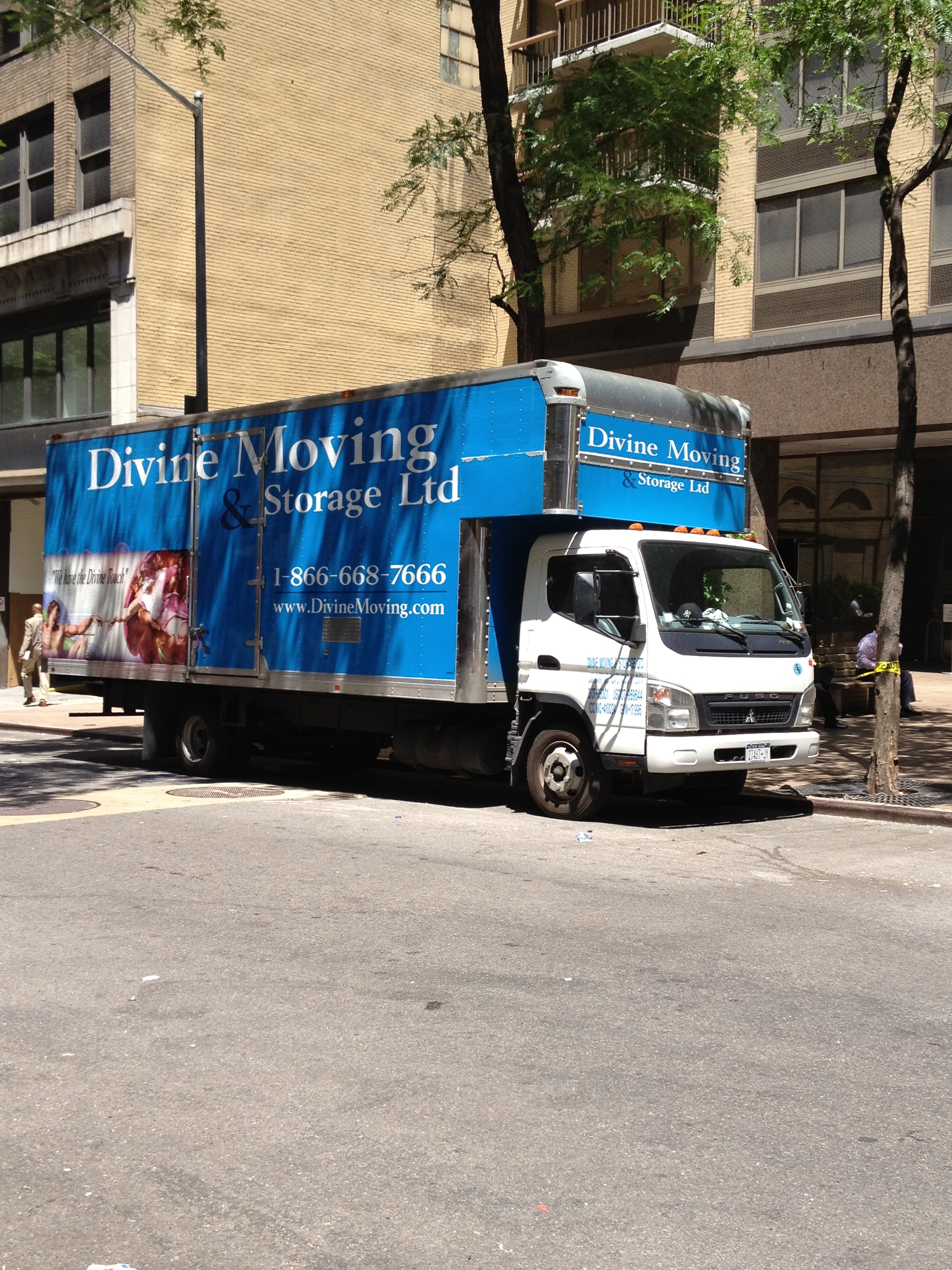
With that cloud in my sky, I turned the corner back to work. Parked in the street was a truck labeled “Divine Moving & Storage.” That sounded an awful lot like a trope for my life. The reproduction of Michelangelo’s God reaching to Adam contrasting with a phone number ending in 666, this bundle of contradictions might just have been a small sample of the human experience. Caught constantly between Heaven and Hell with doleful prophets and profit-loving dolers of sacramental grace living one next to the other. New York is a religious city in every sense of the word. Somewhere off in the shadows I think I hear Isaiah whispering, “I make weal and I create woe…” I love a sunny day in Manhattan.


Haunted Pilgrim

No visit to Providence is complete without a tip of the hat to H. P. Lovecraft. As someone who dabbles in the noble art of writing, I have great appreciation for those who somehow made an impact (often only after they’ve died) on the literary world. I discovered Lovecraft only after I left Nashotah House, which was probably a good thing. Nevertheless, I have come to appreciate his breadth of vision, populating the earth with ancient gods who emphasize the powerful and heartless side of divinity. His vivid images of Cthulhu pervade popular culture to a level that few of the uninitiated would ever expect. And yet, deep in the depths he lurks. So when I was in Providence over the weekend for my niece’s graduation, I spent an afternoon seeking out some time with H. P.

Place inherently partakes of that we term holiness. Where something happened matters. There is no science to explain it, but it is something people know. It is for this reason that I try to visit the homes and resting places of classic writers. Over the years we’ve visited the haunts of Mark Twain, Laura Ingalls Wilder, Edna St Vincent Millay, Washington Irving, Edgar Allan Poe, and others, as well as H. P. Lovecraft. Simply standing in or near the places they once frequented provides a form of inspiration unavailable in any other way. So it was that I found myself at 598 Angell Street in Providence. It is a house still occupied, with no indication of who once called this building home. Lovecraft lived here from 1904 to 1924. If it weren’t for the Lovecraft walking tour I found on the Internet, I would have never known.

In many ways a provincial man, Lovecraft was born and also died in Providence. Apart from a stint in New York City, he spent his time in his hometown. I walked to 454 Angell Street, the address at which he was born. I knew the building had been razed in the 1960s, but I wanted to see what society deems more important than preserving those places that sequester the holy for haunted pilgrims. Although I couldn’t tell for sure, since house numbers change, I believe his birthplace is now the Starbucks that sits pleasantly in a small commercial district. I wonder how many of the thirsty realize where they’re sitting. Have they read any of Lovecraft’s stories? If so, are they uncomfortable sipping coffee in such a spot? Or perhaps it has become a kind of secular sacrament—a toast to all artists whose pasts have been obliterated.


Brown Out

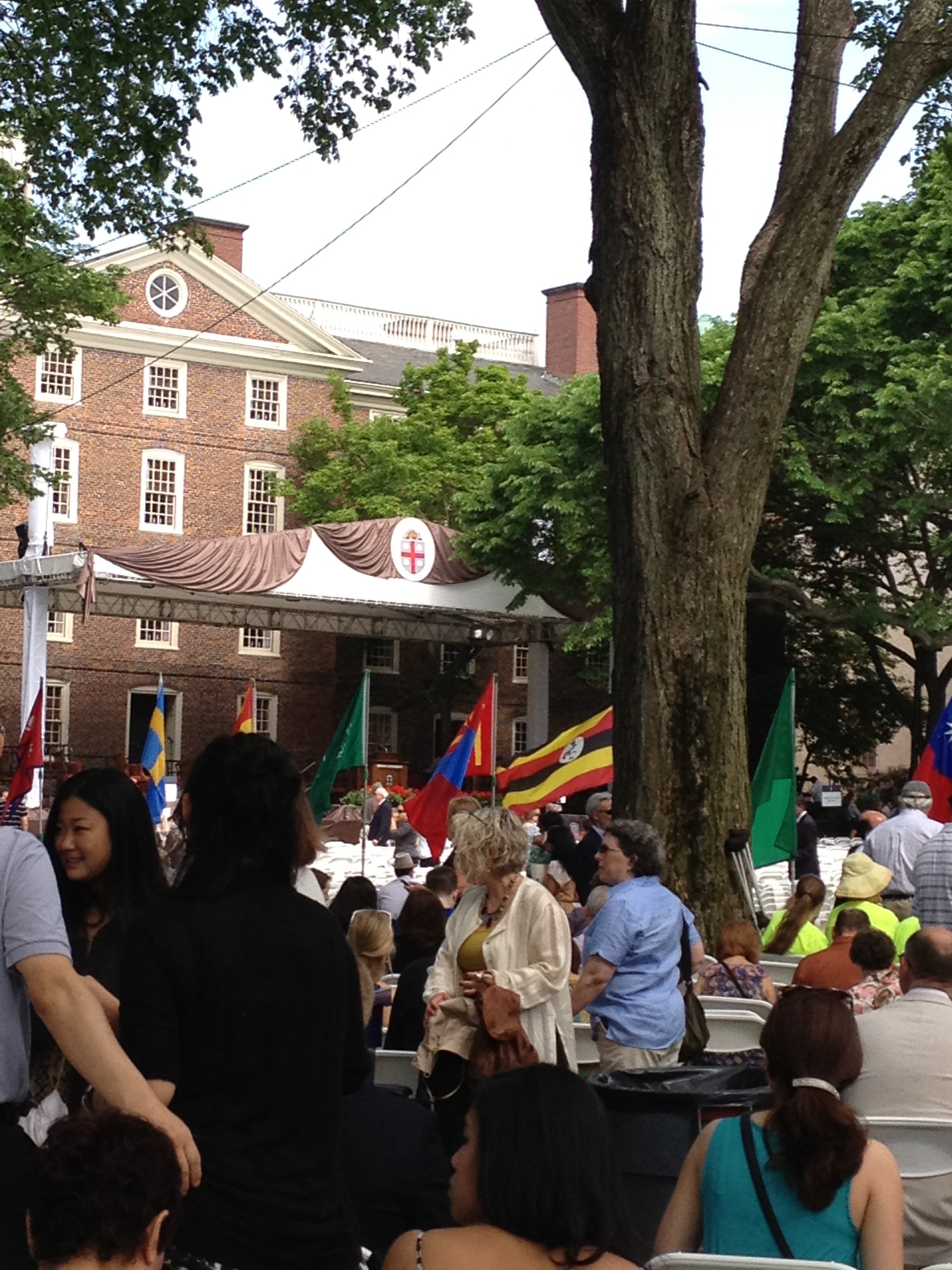
Brown University’s commencement ceremonies include a deluge of academic mythology. The curse of my chosen field of academic study is the tendency to see mythology everywhere. Some individuals see dead people, others see myths. I always feel an inordinate sense of pride in the graduates, especially those who are related to me, but the whole arrangement takes part in the mythology of higher education. Who wouldn’t feel awe in the presence of the illustrious recipients of honorary degrees? There on the Jumbotron, Viola Davis, Marilynne Robinson, Diane Sawyer, and John Lewis. In the program book the seemingly arcane symbols of academia are explained. These are the scriptures backing the mythology. I always wondered why some old professor always carried a mace in academic processions.

But the mythology of higher education runs deeper than the symbols and ceremonial. Education itself is under intense fire for participating in the realm of finance that it helped to create. Despite constant affidavits to the opposite effect, there is more to life than money. The cost in educating our young requires a greater input than becomes obvious in the immediate return on the investment. Often I hear concerns expressed over the cost of higher education, and there are certainly excesses that must be addressed. The real profit in this transaction, however, is our future. Who can look at the ocean of mortarboarded potential and not feel, deep down, a sense of optimism, no matter how guarded?

The mace is a symbol of violence. Education, if done right, is violence against ignorance and ossified old ways of prejudice, discrimination, and selfishness. For those of us who have tried—and some of us have not been successful—to shed some light on future generations, commencement is a humbling experience. While at Nashotah House I sat through many of them, and sometimes the mythology mingled with hypocrisy as I saw raw hunger for power and the lust to control the lives of others. It was refreshing to experience the mythology anew in a setting where genuine hope seemed to linger among faces full of optimism and pride of achievement. Perhaps it was the obvious inclusiveness instilled by outgoing president Ruth J. Simmons, but prayers by women clergy, and honorary degrees conferred across the spectrum of humanity are signs of hope. The mythology of academia is one myth worth believing in, if it is truly a commencement.


Convergent Evolution

Back when my opinion mattered—in higher education, you must realize, a scholar’s outlook only matters when s/he has a teaching post, no matter how abysmal the school. Once that post is gone you just become another guy with an opinion—I was invited to a conference. This is quite an honor for someone consigned to the bargain basement of academia, and for my paper I read from a burgeoning book that died a sudden death along with my academic career. In that stillborn tome I argued that many aspects of ancient mythology—including some in the Bible—made better sense in the light of science. I suggested that some of the infelicities in ancient texts might be the signs of continuing evolution of the human brain. Ancient people were able to believe what we find troubling. By the end of the conference many respectable scholars were looking askance at me when I stepped into the room. Honestly. I heard the word “Wiggins” uttered as if it were an archaic curse. Shortly after that I found myself working out of some guy’s basement for a salary fit for a knave.

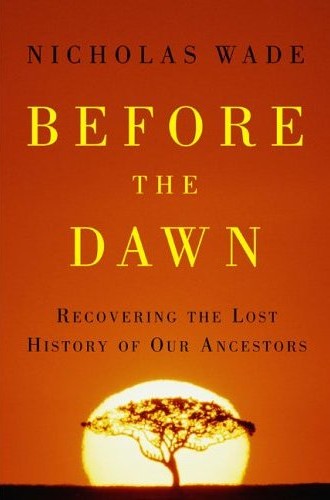
Imagine my delight, then, at finding a reputable scholar who argued that the human brain indeed continues to evolve. In fact, it has speeded up the pace as new challenges have emerged. Before the Dawn: Recovering the Lost History of Our Ancestors by Nicholas Wade was recommended to me by my brother-in-law. As I was updating myself this week on how we became human, I was surprised to see Wade suggesting what I had suggested in my paper—the patterns of human behavior (we both have an interest in religion, it seems) are tied to the evolutionary state of our brains. Sitting on a bus next to many other drones commuting like ants to New York City, I felt strangely vindicated. I had an idea scorned by my colleagues that is being suggested by science. Not that everyone will accept Wade’s conclusions. Many scholars of ancient religions will never even read them. When I explained my thesis to a colleague after losing my academic status, he said, “I don’t give much credibility to science.”

Convergence is the phenomenon of two species evolving an adaptation independently. Often it is difficult for people to believe that a trait shared by two populations is simply nature’s way of trial and error that happened to work twice, in different situations. Nicholas Wade and I experienced convergence on this point. He, of course, is a famous writer and I am nobody. Nevertheless, my unpublished idea was presented at a conference the year his book must have been in production. We had both been reading about evolution and wondering what its effect on religion might have been. I will comment more on Wade’s specific ideas about religion in the book in another post. He, of course, went on to write The Faith Instinct, which was widely acclaimed. At that time I was struggling to find work and it seemed that natural selection hadn’t selected me at all. I am glad, however, that my idea made it into print, even if it was evolved by someone else who is far more fit for survival.