Job’s Jobs

Many years ago, after Nashotah House decided it no longer required my unique outlook, I bought a book.  (That’s my default reaction.)  This book was on how to write killer cover letters.  I don’t remember the title or the author, but I followed the advice, well, religiously.  It got me nowhere.  Business tricks, at least historically, don’t work in academia.  Sitting at home, pondering my sins, I flipped to the chapter on advice to take if none of the rest of this was working for you.  Here’s where the human side began to show through.  Have you been eating onions or garlic before your interviews? it asked.   Do you need to lose weight?  Try dressing nicer.  It occurred to me that the business world lacks the imagination required for denying jobs.  And besides, who was getting any interviews before which I shouldn’t eat garlic?

Business advice is, in a word, shallow.  It assumes that if you’ve got the goods there’s no reason you won’t get hired.  Reality is a bit more complex than that.  I often ponder how people simply go for what they want.  They reach for the biggest piece without pondering the repercussions of their actions.  I see it in my small world of publishing all the time.  Those who are “hungry” (read “greedy”) succeed.  Those who wait behind to help others simply can’t compete.  So the cover letter book did get that part right.  Is it possible, however, to devise a society where everyone fits?  Not all are created equal, perhaps, but do we have to reward those who seem to care only for themselves?  Let them eat garlic.

The cover letter book, in the end, never really did me any good.  I found my way into publishing by being willing to aim low.  I’ve written many cover letters since leaving Nashotah House, and only two ever led to a job.  Those who work in business, what with their concerns about readers’ aromas and weights, seem never to have considered the intricacies of the intellectual job market.  What strikes me as particularly odd is that there are plenty of smart people out there, and yet they haven’t organized to offer alternatives to the greed-based structure on which our work lives are based.  They can’t, it seems, gaze beyond capitalism as a mechanism for helping individuals lead productive lives.  Business operates on the principle of replaceable parts, many of which happen to be human.  And even those who know how to write can’t hope to compete against those who prefer cogs that know to avoid onions.

Speedy Delivery (SD)

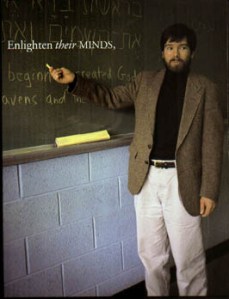
Ritual, no matter what scientists say, is deeply woven into the fabric of human psyches.  It may be either the warp or the weft, but it’s downright basic.  I was reminded of this on my hurried and slow trip to San Diego yesterday.  I always wear the same shirt when I fly to this conference.  This isn’t superstition, but rather it’s a case of sticking with something that works.  I don’t often wear turtlenecks, and one reason is that they seldom fit well.  More years ago than I care to admit (I’m wearing the shirt in the photo below, which was taken at Nashotah House nearly two decades in the past) I found a navy blue turtleneck from Land’s End (this is not a sponsored post, although it probably should be) that works perfectly.  Even today it fits snugly around the neck after hours of wear.  Maybe ten years back I bought a black turtleneck from the same company and after pulling it over my head, it gaps something awful.  I tend only to wear it around the house.  The original still does the job.

I was ready to drive myself to the airport yesterday and I grabbed a quick lunch at home.  Part of said lunch involved opening a ketchup bottle probably nearly as old as the shirt I was wearing.  (I’m sure you can see where this is going.)  I ended up looking like a murderer, which is not something you want to try to explain to a TSA agent.  I quick threw said ritual shirt into the washer and the drier buzzed at the same time as my phone did for when I had to leave for my two-hour-ahead check-in.  This remarkable shirt was dry and ready to serve.  Maybe you can see now why I’m so ritualistic about clothes.  I also opt-out of those Star Trek scanners at the airport.  This means I get lots of governmental pat-downs.  It feels more authentic when you have actual hands running down your body—at least it’s honest.

The TSA agent commented that you don’t see many turtlenecks these days.  I explained that it’s good for flying because I’m always cold on planes.  As this stranger’s hands were rubbing down my chest, I was wondering how many times this shirt has been felt up by the US government.  It has no pockets to pick, and besides, at airport screenings everything is stowed in my carry-on, including wallet.  At midnight San Diego time, I checked into my hotel.  East coast time said I’d been awake 24 hours because who can really sleep on a plane?  Once my patted-down body reaches 3 a.m., Eastern Time, it wakes up.  In these circumstances it’s good to know I can rely on that shirt in my drawer.  That’s what rituals are all about.


The New Light

Sometimes you meet kindred spirits in books.  Barbara Brown Taylor’s Learning to Walk in the Dark has been waiting patiently.  It’s one of those books that I suspected would meet me where I live, and regarding this I was correct.  Brown Taylor, a former Episcopal priest and professor of religion (both of which I attempted but failed to achieve), has the courage and insight to suggest that darkness might just be a friend.  The darker half of the year settled hard on me this year.  As its black wings gathered about me I reached for this book.  I’ve been struggling with a question I’m sometimes asked: why do I let my thoughts linger in what must be considered darker corners?  I watch horror and write books and stories about monsters.  What’s wrong with me anyway?

One accusation may be fairly leveled at much of American religion is that it is shallow.  Light is uncritically accepted as good and dark becomes somehow evil.  There are biblical prooftexts that can be used to “prove” this, but they change color when you wrestle with them.  Learning to Walk in the Dark contains many ways of reflecting on realities which are inevitable.  Brown Taylor visits museums that give the sighted the experience of being blind in a safe environment.  She spends time in caves.  She stretches out beneath the stars and contemplates the dark night of the soul as well as the cloud of unknowing.  These latter two are, of course, spiritual classics.  There’s quite a bit that can be learned from experiencing darkness and listening intently.

My own predilections toward subjects called “dark” are forms of therapy.  My religion simply can’t be shallow.  I need enough water to swim.  And yes, I’m afraid of deep water.  Darkness perhaps comes more naturally to those of us who are awake for every sunrise.  If I move far enough north that may cease to be the case, but for the last decade or so my internal alarm goes off a couple hours before the first sliver of light creeps over the eastern hills.  And I seem to have assimilated to it.  As I read Learning I could imagine the accusations flying from my former Nashotah House context.  Looking at that patriarchal theology of sin and misery, however, I think there’s no question whence true darkness comes.  Without the dark we could never tell that it was light.  Since we need both, it seems wise to follow the sage advice here offered and get to know the dusky side a bit more intimately.


Quiet Now

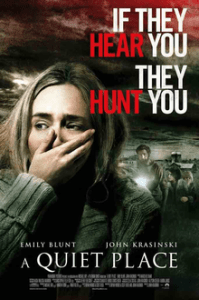
The funny thing about my movie watching is that it’s a reflection of my scattered lifestyle.  While I was teaching my career progression was linear with a goal of moving beyond Nashotah House to a college or university that shared my values better.  Publishing was a fallback, and I’ve learned a lot but I haven’t unlearned my academic leanings.  So, like the rest of my life, my movie watching is piecemeal.  I found a copy of A Quiet Place in a Halloween sale.  My wife bought it for me and on a weekend on my own I watched it.  I had no idea what it was about, but I’d read that it was an intelligent horror film, and that was good enough for me!  There may be spoilers here if you live in a cave, like I do (metaphorically), so be warned.

The backstory isn’t fully spelled out, but the monsters in this movie are blind and attracted to their victims by sound.  The focus is on a family in upstate New York that’s trying to survive without making any noise.  Since there are kids involved, you’ll see how tricky this could be.  John Krasinski’s film builds the suspense wonderfully.  Borrowing from M. Night Shyamalan at his best, and Alien and even Stranger Things, the movie has a odd effect.  When it’s over you don’t want to make any noise.  I watched it while my wife had to work over the weekend, and I put the DVD away as quietly as I could, and then went to bed.  Awaking alone the next morning, I continued the vigil.  Critics praised the movie for its silence, perhaps what we’re most afraid of in this noisy world.

I spend a lot of time saying nothing.  Editing is a quiet job.  Telecommuting is a quiet lifestyle.  At Nashotah House we had mandatory quiet days, which, if they weren’t mandatory I would’ve loved.  I’d seriously considered a monastic lifestyle when I was younger—there’s great value in being quiet.  A horror film that teaches that lesson, despite many obviously unanswered questions, is worth paying attention to.  Horror films have continued to grow more intelligent over the years.  This one is rated PG-13 and will have you on the edge of your seat (or under the bed) anyway.  And it’s got an important message.  For those of us who don’t say much (maybe that’s why I write all the time) a movie like this acts, if you will, as a loudspeaker.  Does anybody hear me?


Anthropocene

The word “Anthropocene” has been showing up quite a bit lately.  For a period of many years I was an avid, self-taught amateur geologist.  In my dreams I still am, I guess.  My interest in the ages of rocks began when I, like Charles Lyell, began to consider the implications of their extreme longevity.  The Bible, of course, famously intimates we live in a comparatively new neighborhood.  Having grown up believing that literally and firmly, and also having started a modest fossil collection, I failed to see the conflict.  I mean, there were fossils right down there by the river.  Tons of them.  Some Young Earth Creationists had already begun, by that point, to suggest they’d arisen because of Noah’s flood, but dinosaurs still seemed to be a problem.  In many ways rocks broke me out of my fundamentalist stupor.

While at Nashotah House I taught electives on Genesis 1-11.  I read about the geologic ages of the planet and would fall into Devonian dreams of a world entirely different from ours—a world in which there was no Bible for there were no humans to make God in their image.  I knew that we lived in the Quaternary Period of the Holocene Era.  I don’t think the term Anthropocene was in wide use then.  Parsing it is simple enough—it is the “human age.”  The age in which the planet was, has been, and is being altered by human behavior.   There’s no agreed-up start date for the Anthropocene, but it will likely be set in the twentieth century; the twentieth century in our way of counting.  There have been millions of centuries before that.

A couple of weekends back I attended a church program on plastics.  These useful polymers are deeply, deeply integrated into our lives and are promoted by the far too powerful petroleum industry.  The problem with plastics is that they break down and invade the bodies of animals and humans.  And although they do decompose it takes many centuries for them to do so.  Naming the Anthropocene is an effort to get us to see that a human perspective is far too brief to deal with the many issues we raise.  Our practices on this planet will likely not destroy the earth, but they may very well make it uninhabitable by us, or by creatures we like to see.  Life is persistent, and rock lasts for eons.  Even stone’s not eternal, however, and the idea of the Anthropocene is to get us to look at ourselves and realize that our use of this planet, as toxic as it is, is shortsighted.  We will someday be the fossils under a bridge long crumbled to dust for those in the future who know of no such thing as Genesis.  Perhaps we should act like it.


Belonging

You never know where you might find yourself, but wherever it is it’ll cost you some money.  Well, at least in this instance it did.  Nashotah House sent me packing just as we were thinking about college for our daughter.  It took several years to find any kind of full-time position again, and when university time began I had had a full salaried job for a total of one year of the last seven.  Not ideal, of course.  I remember sitting (again) in the financial aid office, explaining the situation and, as it often goes in higher education, receiving no mercy.  As much as I remember the conversation, I don’t recall a photographer in the room.   There must’ve been, though, since I recently showed up on the Binghamton University website.

I had, of course, applied for a job or two there.  When out of state tuition is riding on such a deal, however, I doubt there’s any way to get considered.  I actually like Binghamton University quite a lot.  I appreciate the fact that it doesn’t pour its money into a football team and that it has the reputation of being a “Public Ivy” school.  I even like the campus removed from city bounds—just like Nashotah House.  I did end up paying them quite a bit of lucre through the years, even as my own alma maters were asking alms.  Higher education is a funny world.  Standing somewhere between a money-making venture and a site of education for its own sake.  Many professors don’t realize just how privileged they are to have jobs like that.

Upstate New York, although I’ve never lived there, is one of my ancestral homes.  My grandfather and his family had lived in the area at least as far back as the 1770s.  I tried to convey that sense of connection in my application, many years ago now.  Academia doesn’t put much stock in the idea of belonging, I guess.  It has become far too businesslike for that.  Binghamton was also the town in which Rod Serling, one of my childhood heroes, grew up.  There seemed to be so many reasons to be in that area.  Eventually I settled for life in my own native Pennsylvania.  People sense, although academics less than others apparently, that they belong in a place.  And if you can’t actually be there, you can still spend your money in any location.  I’ve now got a picture to prove it.


Born Once More

Every once in a while a reader, either here or on other social media, asks me what my religious beliefs are.  The expected answer to such a question is the standard label of a denomination of some sort.  My response, however, is that knowing the group I belong to (and I do) should not effect the way my thoughts are viewed.  With the exception of some groups suspected of mind control, standard religions are generally trusted as being motivated by pure intentions.  Having both attended and taught in seminary settings, and knowing a great number of clergy, however, it becomes clear that denomination is less important than one might think.  In short, I answer this question in the public forum of neither classroom nor blog as I truly believe there’s nothing to be gained by readers/students knowing where I personally seek meaning, denominationally.

It’s no secret that it was once the Episcopal Church.  (I could not have taught at Nashotah House otherwise.)  It was made pretty clear after being at said seminary for many years that the Episcopalians had no official place for me.  Even when I worked a few blocks from the church’s headquarters in New York City I could find no one willing to listen or consider my credentials.  Its Church Publishing branch wouldn’t consider me in their book wing.  Were it not for some former students who still minister to me, it was clear they did not miss me.  So it was with some surprise that I found myself in Nativity Cathedral in Bethlehem on Saturday for their Celtic Mass.  The Cathedral itself is lovely with a négligée of wrought iron tracery for a reredos, appropriate for a city built by steel.  Eight angels with outspread wings stood atop it.  Like most sanctuaries, it was a place of refuge from the busy, noisy street outside.

The reading from Amos 7 stood out to me.  Lectionaries, by definition, take pericopes (selections) out of context.  Amos’ vision of the plumb line is actually part of a series of visions, but here stands alone with the episode of Amaziah trying to send Amos back to Judah.  The prophet responds by saying he’s not a prophet, but just a guy who’s received a message from God.  In ancient times there were prophets paid for their services.  They supported the government positions and governments made sure they were cared for.  The situation hasn’t much changed, at least among conservative religious groups under a Republican administration.  There were other parallels here, but saying too much on them might end up giving too much away.


Tyranny of Plants

Notwithstanding what I wrote yesterday, there is a tyranny of plants.  Specifically those which make up lawns—in my case, mostly weeds.  A friend recently reminded me that weed is just a name for a misplaced plant, and I confess that I’m fine with weeds but neighbors may not be so open-minded.  Non-conformity is still a virulent stigma.  If an observer from outer space were to observe us during the spring and summer, they might well conclude that we were in the service of our yards.  The irony here is that yard care is perhaps the ultimate sign of success.  You have really made it if you can keep it neat and trim.  And you’ve excelled beyond that if you can pay someone else to do it for you with their tractor full of buzzing implements.

Because I’m concerned about fuel consumption, we purchased a reel mower when we bought our house.  I never mowed the lawn as a child.  First we rented, and when a stepfather came into the picture he didn’t let the kids mow.  (It wasn’t to be kind—it was a control thing.  If he saw a snake he’d race across the yard to dismember it.  More than once I’d be out playing only to find snake suey, with flies.)  College at Grove City involved carefully manicured lawns done by others, and after grad school we lived on campus at Nashotah House where the students cut the grass.  From there it was back to renting.  In other words, I never had the opportunity to learn how to mow lawns.  My lines aren’t straight, and I’m tempted to sneak out at night, when the grass is high, and leave crop circles at which the neighbors might wonder.  I don’t like being a slave to plants.

The reel mower is like pushing the grim reaper in a baby carriage.  Or at least it must seem so from the perspective of the grass and weeds I call my lawn.  The suddenness with which constant lawn care becomes a major concern has tightened my focus on the fealty we owe to ground cover.  We’ve had a break from the rain for a couple days and after work I find myself pushing that mower like a deadly thurible, releasing the scent of newly shorn grass.  Our particular town retains the right to fine those who let the grass get too long.  As I go along cutting back both grass and weeds indiscriminately, I wonder at the biblical nature of even this.


Theofantastique Interview

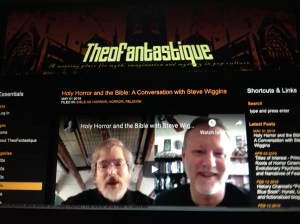
Two times.  In my “professional” life I’ve been interviewed only twice (not counting, of course, far too many job interviews).  The first time was as a talking head for Nashotah House.  This was in the days before the internet really caught on, so it was done in DVD format.  If you come over to visit I’ll dig it out and we can have a good laugh.  The second occasion was much more fun.  Although I write about horror a lot, I don’t mention Theofantastique nearly enough.  Back in the days when I started blogging, I discovered this site that featured all kinds of interesting stuff on religion and horror (and actually on all kinds of genre pop culture).  I always enjoyed the insights and got more than a few books for my own research and reading from tips I found there.

When I finally got brave enough to contact John W. Morehead, the curator of the blog, we both quickly realized we had some things in common.  John very kindly offered to post an interview with me on Theofantastique about Holy Horror.  It’s live now and it was really fun to talk to an actual person about my book.  You see, I work alone.  I knew that, leaving the classroom, I was departing my chosen career.  On those high school aptitude tests they told me that I should be an entertainer.  What professor isn’t?  I pity their students if they’re not.  I’ve been posting videos on YouTube for a few weeks now.  It’s immediately obvious how much having a live audience helps.

Unfortunately, Holy Horror isn’t exactly priced to move.  In fact, local bookstores have turned me down for free presentations based on the price alone.  It is, however, a fun book to read.  At least I intended it that way.  When life give you horror, make Bloody Marys, I guess.  By the way, John has been coming out with some interesting books also.  I posted on his The Paranormal and Popular Culture recently.  Theofantastique is often the place where I first learn of new horror films (I don’t get out much) and new books that I should read.  Of these two things there’s never a shortage—horror is a thriving genre—and talking about why you wrote a book helps to clarify things a bit.  Horror may seem a disreputable genre to many, but it has redeeming values.  To hear about them, please watch the interview.


A Saint Lent

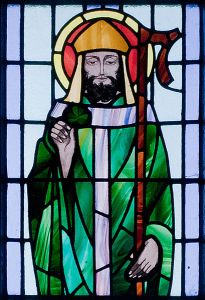
Photo credit: Andreas F. Borchert, Wikicommons

Lent, among the denominations that observe it, is intended as a time of intense reflection.  Beginning on Ash Wednesday the fact of one’s own mortality becomes a foremost consideration as the faithful are reminded that they will die.  It has always struck me as paradoxical that St. Patrick’s Day always falls in Lent.  Those who abide by the liturgical calendar readily acknowledge that Lent is a punctuated season; saints’ days and feasts can still occur, temporarily disrupting the heavy contemplation.  While at Nashotah House we never celebrated St. Patrick beyond a brief mention during a collect of the seventeenth.  His day, rich in Celtic mythology, it seems, was inappropriate to the mandated gloom so highly valued by the soul-sick.  Having some Irish ancestry, I always felt a little slighted by this aloofness regarding a saint most people can actually name.

College campuses, I later learned, tend to schedule their spring breaks to include Saint Patty’s Day because of the damage drunken students may exact.  The stereotypical besotted Irish have become an excuse for excess during Lent, although, I suspect the forty days have little to do with it.  A saint becomes a justification for sin, it seems.  And Lent continues the morning after.  There’ll always be Lent.  The tray holding the ashes of last year’s palm branches is never empty.  Two once religious observations clash in mid-March of each year.  During a brief spell the historically oppressed Irish are celebrities for a day.  Such are the vicissitudes of liturgical calendar clearing.

Today many people celebrate a saint they wouldn’t otherwise recognize.  One that mythically drove the snakes from the Emerald Isle, and who perhaps hid a pot of gold at the end of the rainbow.  A holy man who has made it possible for anyone to be Irish for a day.  Leprechauns and clovers are in fashion as the ironic luck of the Irish closes down major thoroughfares for parades in the midst of ashes and dust.  Outside there may be snow or budding trees.  Perhaps both at once.  There’s a richness to these conflicting symbols that belies the commemoration of a missionary with alcohol.  The day is part of the complex of equinox holidays, whether intentional or not.  The green man of yore begins to awaken as light starts to outstrip darkness for half a year.  We’ve had enough of dusk.  Anticipate the light.  The rules state that Lent will still be here tomorrow.  But the light is beginning to grow. 


Christianity sans Christ

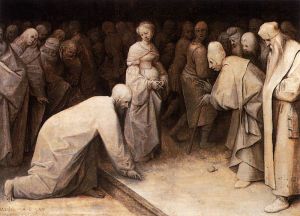
Pieter Breughel the elder

“He that is without sin among you, let him first cast a stone at her.”  (Please pardon the sexist translation, but the King James is in the public domain.)  That verse, and many others, have been going through my head since my former United Methodist Church decided to close its doors to those who are different.  The reason this verse sticks out is pretty obvious—according to the Good Book we’re all sinners.  The “Christianity” that the UMC has embraced is that of Paul, not that of Jesus.  In fact, Jesus seems to have exited, stage left.  You see, only with a great deal of casuistry of exegetical caliber can anyone claim that Jesus (aka God) said anything about homosexuality.  Not a single word.  His response in the famous story of an adulteress (what of the adulterer who partnered in her crime?) caught in flagrante delicto, he gave our opening quote.

At one point Peter, exasperated with his master’s kindness, sputtered how many times did he have to forgive—seven times?  More like seven times seventy.  The one without sin has itchy fingers where stones are abundant.  Once at Nashotah House we had a student from Kenya.  He was already a priest, and he had a family back home.  At one point I asked him about his wife.  He informed me that his brother now had her as wife while he was gone.  It was the way of their culture.  This same student—for we are all students all the time—had harsh words for American sexual practices.  He later tried to find a way to stay in the United States, leaving family behind.  The Bible may turn a blind eye to polygamy, but polyandry is definitely stone-worthy.  Who is without sin?

Ironically the UMC has lined up against the Gospels.  Christianity’s sexual hangups began with the apostle from Tarsus, not the carpenter from Nazareth.  We have been forced to see, time and again, what comes of making priests remain celibate.  It’s against nature, and none of us has a free hand to grope for a stone.  Instead, we queue up ready to judge.  Love, the church says, is wrong.  God, says the Gospel, is love.  There’s a mansion with many rooms above our heads.  We’re not told if the doors come with locks or not.  Unless this seem unnaturally profane, anyone who has truly loved another knows it is more than just a physical act.  Such spiritual intimacy is difficult to spread too thinly without cheapening it to the point of a tawdry sit-com.  Even then, however, we shouldn’t judge.  There aren’t stones enough in the world for that.


Sixes and Sevens

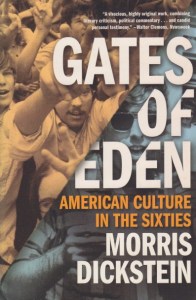
Few eras conjure mental images as readily as the sixties.  As the first decade of my life, I idealize them a bit, I suppose.  I wasn’t old enough to appreciate the truly wonderful and troubling things going on around me, and being raised in a Fundamentalist family I probably couldn’t have enjoyed many of them in any case.  Morris Dickstein’s Gates of Eden: American Culture in the Sixties was written in the seventies.  Since he’s a literary scholar much of the culture he analyzes is print culture, emphasizing the works of Jewish novelists and African-American writers.  That fits the sixties image pretty well.  He also looks at the music, but not as much as I had anticipated he might.  For me the music of the decade conveys what it really was about.

At one point Dickstein describes the political situation in the fifties that led to this incredible decade.  I had to remind myself that this was written forty years ago, for he seemed to be describing, with eerie prescience, the world of Trump and his followers.  Repressive conformity and the superiority complex of that era led to a breaking point where individual expression tumbled long-held rules and regulations that had tried to repress women and those that didn’t fit the WASP mold.  Most of us thought those controlling, catatonic days were over for good.  It seems we underestimated the will of those who lack imagination of where things might go if freedom were allowed to be free.  Some people, it seems, believed the sixties were a disease to be cured.

Historians who have a wider grasp than I do say that time has to pass before accurate pictures can emerge.  Instant potted histories tend to miss much of what becomes clear only with the slow passing of further decades.  To me the music defines them.  I only started to become culturally aware in the seventies, and that was in a small town.  When I learned to look back, largely in the eighties, I could see, and hear, that I’d lived through an extraordinary time.  The nineties, largely spent at Nashotah House, were again isolated from culture.  Who knows how this new millennium will be assessed?  Has a new music emerged that will help define us?  Or will it be, as Dickstein unwittingly projects, a new era of acceptance, love, and peace?  Or did the world really end at the millennium?   It could be, we might dare to dream, that a new decade as remarkable as the sixties is waiting to usher in Eden again.


Weaponized Scripture

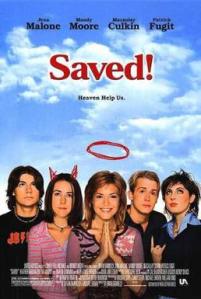
One of the many questions that haunt evangelical Christians is whether it is okay to watch horror films or not.  The same applies to whether it’s okay to listen to rock-n-roll (even as it’s reaching its senior years).  Cultural accommodation is often seen as evil and evangelicalism, as a movement, is frequently offered as a culture all its own.  I recently rewatched Brian Dannelly’s Saved!, a coming-of-age comedy about a group of teenagers at American Eagle Christian High School.  Gently satirical, it portrays well how evangelicals try to redefine “cool” in a Christian mode.  Taking tropes from pop culture and “baptizing” them, Pastor Skip—the principal—assures the young people that they’re every bit as cool as secular culture icons, only the Christians are going to heaven.

The film came out when I was teaching at Nashotah House.  That seminary also had problems with secular culture, but in a completely different way.  Its method was basically to ignore that culture.  Isolated, Anglo-Catholic, one might even say “Medieval” but for the sanitation, it was likely not a safe place for a professor to be watching such films.  Evangelicalism and right-wing Catholicism were beginning to find each other.  Once the cats and dogs of the theological world, they were becoming more like goldfish in their bowl, watching a strange and unnerving world just outside the glass.  A world in which they couldn’t survive.  Now, Saved! is only a cinematic version of this, but it has a few profound moments.  Mary, the protagonist, comes to see the hypocrisy of both the school and her former friends when she supports a boyfriend who is gay.

At one point her friends attempt an intervention.  They try to exorcize Mary, and when that fails one of them throws a Bible at her.  Picking it up, Mary says “This is not a weapon.”  Since this movie isn’t by any stretch of the imagination horror, I didn’t address it in Holy Horror.  As I rewatched it in the light of that book, however, I recognized a motif I did discuss in it.  The use of the Bible in movies is extremely common.  That applies to films that don’t have an overt Christian setting such as this one does.  The iconic Bible is a protean book.  Despite what Mary says it can indeed be a weapon.  It often is.  Many of us have been harmed by it.  Christian separatist culture has its own dark side, even if it’s carefully hidden, its adherents think, from the secular world outside the fishbowl.


Servants and Such

At Nashotah House I met my first real-life servant.  This was a student—a candidate for the priesthood—who’d formally been a “domestic.”  Now, being Episcopalian one doesn’t bat an eyelash at that sort of thing but I was secretly in shock that servants still existed.  I’m woefully uninformed about aristocracy.  Having grown up poor I resent the idea of a person being placed in the role of fulfilling the whims of someone just because they have money.  My wife has more of a fascination about this than I do, and she was recently reading a book about servants.  This post isn’t about domestics, however.  It’s about foreign gods.  In the book she was reading my wife noticed one of the servants writing that old-fashioned stoves were like Moloch.  Were it not for Sleepy Hollow, I suspect, many modern people wouldn’t know the name at all.  Who was Moloch?

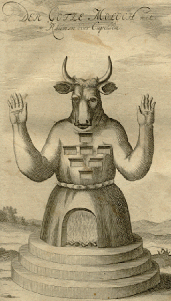
Moloch, according to the Bible, was a “Canaanite” deity.  Specifically, he was a god that demanded child sacrifice.  The phrase the Good Book uses is that his worshippers made their children “pass through the fire” for Moloch.  Very little is known about this deity, and the question of human sacrifice is endlessly debated.  Theologically it makes sense, but practically it doesn’t.  Deities want servants and living bodies do that better than dead ones.  Although it’s been suggested that “passing through” could be a symbolic offering, by far the majority of scholars have taken this act as an actual sacrifice.  The ultimate servant is a dead servant.  Moloch, you see, comes from the same root as the word “king.”  And kings are fond of having many servants.

Image credit: Johann Lund, Wikimedia Commons

So how is a stove like Moloch?  The classic image of the god, which looks like a scene from The Wicker Man, holds the answer.  Well circulated since the early eighteenth century, this engraving has captured the imagination of modern people.  A massive, multi-chambered statue intended to consume by the raging fire in its belly.  This is the way in which a stove might resemble a Canaanite deity.  The servant who described cookware thus knew whereof she spoke.  Archaeological evidence for the “cult of Moloch” is slim.  It is almost certain that nothing like this fanciful image ever existed.  Moloch, in other words, lives in the imagination.  One aspect, however, rings true.  Like most tyrannical rulers the deity wants unquestioning obedience on the part of servants.  And this is a viewpoint not limited to deities.


Nature’s Bible

When you’re writing a book, many strands in your mind are weaving their way into what you hope will be whole cloth.  Well, at least if you write books the way that I do.  In writing Weathering the Psalms, for instance, one of the threads was the question of science and religion.  I was teaching at Nashotah House at the time, and I read a lot of science.  As I told colleagues at the time, if science is how we know things, shouldn’t what we know of the natural world apply to the Bible?  I don’t claim to be the first to ask that question—back in the days of exploration there were many people (mostly the genus “white men” of the “clergy” species) who went to what is now and had used to be Israel, to find out what the world of the Bible was actually like.  Their books still make interesting reading.

Quite unexpectedly a colleague, Dalit Rom-Shiloni of Tel Aviv University, told me she’d just ordered my book.  She’s leading up a project called the Dictionary of Nature Imagery of the Bible (DNI).  Over a decade after my teaching career ended, someone had deemed my work relevant.  Dr. Rom-Shiloni recently sent me the link to the project website where there is a video of her interviewing three Israeli scientists about the possibility of lions, leopards, and bears living in Israel.  They’re all mentioned in the Bible and no longer exist in the area.  The video is on this link and won’t take half an hour of your time.  It’s quite interesting.

One of the surprising facts to emerge is that leopards, in small numbers, may still exist in Israel.  This assertion is based on lay observation.  I contrasted this with the United States where, no matter how often a cougar (aka mountain lion, puma) is spotted in a state where it’s “known” to be extinct, it is claimed to be mistaken observation.  A departed friend and mentor of mine once saw a mountain lion in West Virginia.  I’d grown up in neighboring Pennsylvania where they are officially extinct, so I wondered if said beasts knew to observe the Mason-Dixon line.  The fact is, despite all our best efforts to destroy our environment, animals often find a way to survive.  Growing up, one of my cousins in Pennsylvania (now also unfortunately deceased) showed me a puma print in the snow behind his rural house.  Now Pennsylvania is a long way from Israel, and this topic is a long way from the DNI, but remember what I just said about how my books are written.  Tapestries only make sense from a distance.