Mustard Monster

Speaking of mustard seeds, as a child something troubled my literalist brain.  Mark 4.31, “It is like a grain of mustard seed, which, when it is sown in the earth, is less than all the seeds that be in the earth…” According to subsequent translations after the KJV “less than all” reads, “the smallest.”  Of course, in Elizabethan English that’s what “less than all” denotes.  Since these words came from Jesus, and since the Bible was factually true on every point, I wondered how this error had crept in.  The mustard seed, I knew as a child, wasn’t the smallest seed.  Not by a long shot.  I knew, for example, that poppy seeds were smaller.  Why had Jesus said the mustard seed was the smallest when it wasn’t?  I was too young for the casuistry called exegesis, so a small crisis of faith emerged.

Pardon the resolution: I don’t have a macro lens any more. Mustard (left) meets chia seed (right).

The mustard seed has other roles in the gospels as well.  I still frequently recite “If ye have faith as a grain of mustard seed, ye shall say unto this mountain, Remove hence to yonder place; and it shall remove; and nothing shall be impossible unto you” (Matthew 17.20).  All of this made me curious as to the history of mustard.  While in Wisconsin we used to visit the Mustard Museum in Mount Horeb.  It’s now the National Mustard Museum and is in Middleton.  It seems that mustard, in its familiar paste form, was developed in China centuries before Jesus.  And people had been using mustard seeds as a spice long before that.  Jesus, like earlier prophets, used nature to make a point.  The problem wasn’t Jesus, it was literalism.  

Jesus also said “For as Jonas was three days and three nights in the whale’s belly; so shall the Son of man be three days and three nights in the heart of the earth” (KJV) in Matthew 12.40.  Modern translations of “sea monster”—for the Hebrew says it was a fish—forced me to dust off my Greek New Testament.  So Jesus said “in the belly of Cetus.”  Cetus was mythical sea monster, not unlike the mythical Leviathan God describes in Job 40.  Good thing I couldn’t read Greek or Hebrew as a kid!  Well, it seems we’ve gone from mustard to monsters.  If you’re familiar with the history of this blog, that shouldn’t surprise you too much.  I wonder what literalists believe about the Loch Ness Monster?  But don’t get me started on that or we’ll be here all day.

Faith of a Lusty Monk

Wisconsin is so much more than its iconic cheese. I was reminded of this fact when my wife sent me an advertisement from the latest edition of the National Mustard Museum catalogue. I have to confess that while living in Wisconsin we became fans of the earlier incarnation of the institution when it was a roadside attraction called the Mount Horeb Mustard Museum. In addition to the perk of the biblical namesake of the town, the museum itself was the kind of place you instantly fall in love with. Quirky, pungent, and informative. The museum was nevertheless dominated by the shop that spoke for most of the actual floor-space. You could sample most mustards either by pretzel or by little sample spoons – no double-dipping please! There were only a few hard-core patrons there at our first visit, but as we continued to stop in over the years, the clientele seemed to be growing.

The ad my wife brought to my attention is for “Lusty Monk Altar Boy Honey Mustard.” The title begs for exegesis: Lusty Monk is the brand. The concept on many of the mustards we saw at the museum was to emphasize humor and shock value. Apparently the venial sin of enjoying mustard is enhanced with a decorous dollop of naughtiness. I suspect many people buy the products for the cleverness of the labels alone. Altar Boy is the title of the specific mustard blend. One must be careful to separate the word “Honey” from “Altar Boy,” otherwise an inappropriate picture might emerge. Of course, no one need admit they were thinking that anyway. “Honey Mustard” is familiar to condiment connoisseurs as a slightly sweet version of the dressing made with a generous infusion of industrious bees’ work (and there are many honey bees in Wisconsin as well). Thus read, there is nothing suggestive of mendicant malfeasance in this mustard.

On Wisconsin!

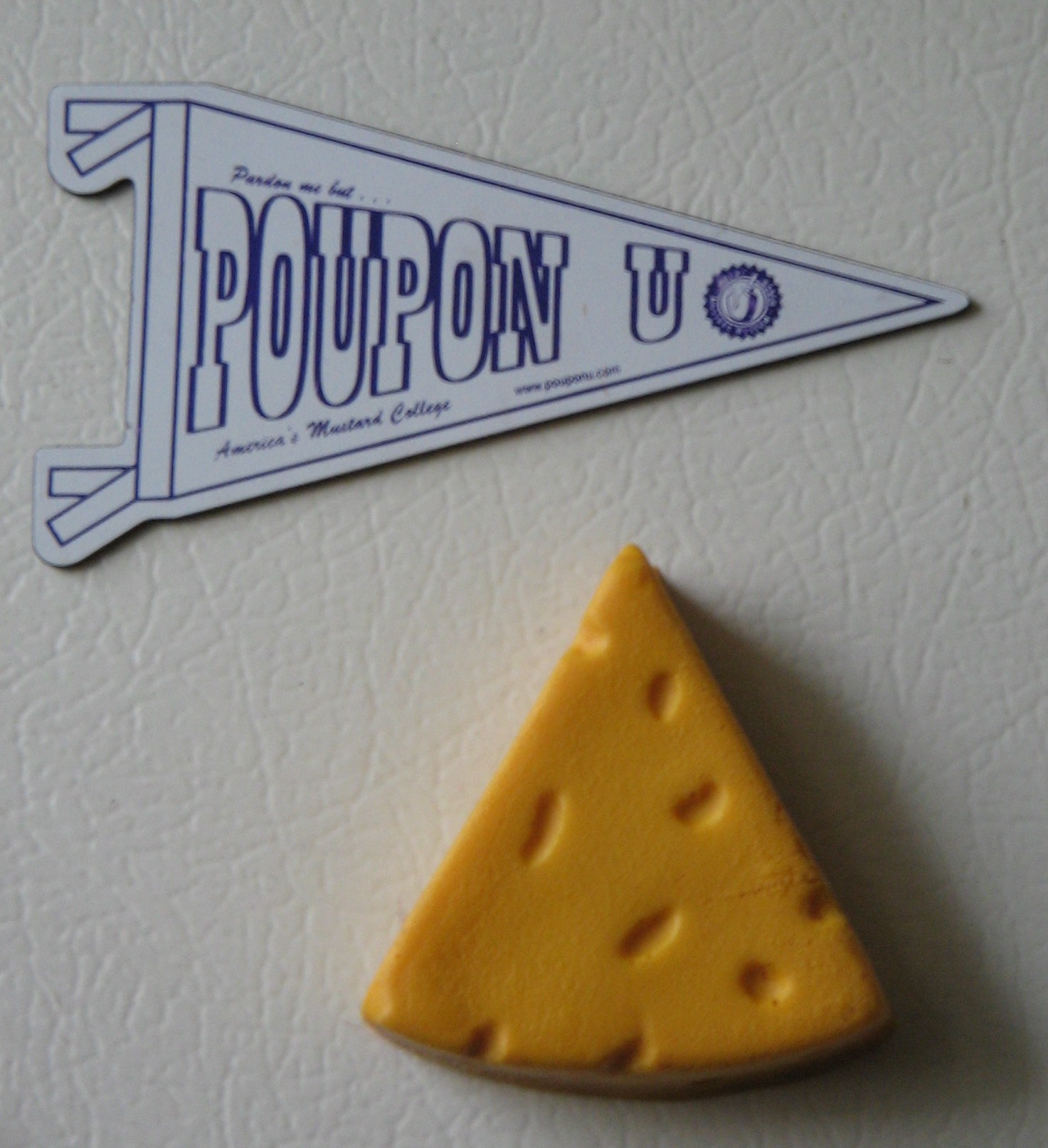
An entire blog could be devoted (and there may be one for all I know) to the slightly unsavory names of various mustards. A good place to do research would be at Wisconsin’s own National Mustard Museum. We still receive their catalogues, but since moving to New Jersey easy access to one of our favorite free museums has sadly become an empty jar of dreams and memories. We still proudly display a Poupon U. banner in refrigerator-magnet format to remind us of the tasty hours we spent sampling the very plant whose seed Jesus compared to faith itself. And the many off-color titles temper this faith with fun.