
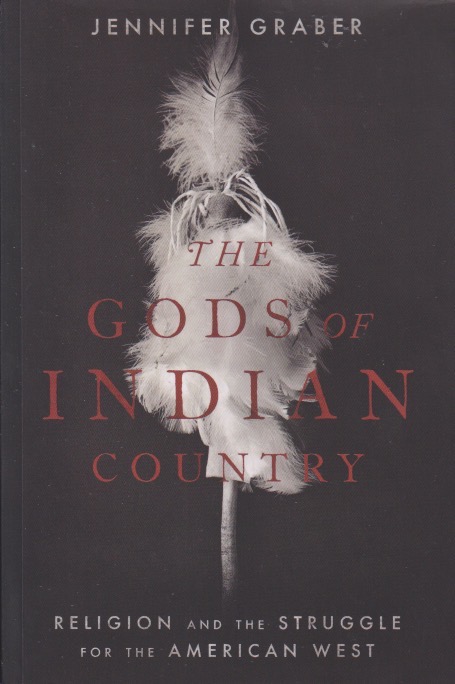
Engulfed by capitalism, it is too easy to ignore the indigenous population of this country. I grew up thinking, in some way, that American Indians were extinct (this was small town America, after all). Then we visited a place—in upstate New York, I think, but the recollection’s hazy—where there were real Indians. This was before exoticism was a bad word, and I thought them quite exotic. Maybe it was the way I was raised, but I’ve never thought of myself as better than anybody else. Certainly not on the basis of race or gender, or even personal worth. In any case, there were still Indians. I’ve always been an admirer of their culture. Jennifer Graber’s The Gods of Indian Country is an informative monograph on, as the subtitle says, Religion and the Struggle for the American West.
My interest in American history is relatively recent. Growing up, I always found European history of greater interest, and then, for many years, the ancient history of the states along the eastern coast of the Mediterranean. It was the antiquity of it all. History feels safer when it’s at a great distance. American history is not old. When hearing that some of the events discussed by Graber took place in the 1910s, I kept thinking, “were we really that naive just over a century ago?” Or was our nation willfully blind to the plight of the people who lived here before the Europeans arrived? The narrative has changed. And if it hasn’t, it must. How would we like it if, say, aliens landed and assumed the right to take over capitalistic America? It’s only our arrogance that prevents us from treating Indians better.
Religion, particularly Christianity, fueled many interactions with the Indians, as Graber ably demonstrates. The assumption was that Indians had to assimilate to capitalistically-fueled Christianity. Private ownership. Free trade. Otherwise the cultures could not share the land. Treaties were broken because the “Christian” rules of the new overlords demanded it. Graber also explores some Native American religious practices as well, chiefly among the Kiowa. Since the book is fairly brief, it doesn’t include any kind of comprehensive coverage of Indian religion, nor, of course, of early American settler religion. What happened is that religion and politics joined forces to justify stealing what belonged to someone else. Those who study the history of religion recognize this pattern. It isn’t a rarity, unfortunately. Although my interest in American history is recent, it is growing. What happened in your own backyard determines so much of how we’ve become who we are.
 Steve A. Wiggins