Water Bears

Since we should all be busy planning on alternatives to planet earth, my mind has turned to tardigrades. Known as “water bears” these very simple animals are amazingly complex. Don’t go looking for them in your drinking water, however. They’re microscopic. So why am I thinking about tardigrades at a time like this? Because they’re one of the few organisms that scientists believe could actually survive the destruction of the planet. Who knows? They might even be able to survive in Washington, DC. Maybe that’s why they’re in The Washington Post.

You have to look closely to see one.

Able to cling to life at the cusp of absolute zero, in conditions with no oxygen, and at doses of radiation that would leave the human race—among most other species—fried, these micro-organisms are truly remarkable. No wonder scientists are playing with thought-experiments as to how to wipe them out. Hey, scientists are only human after all. Don’t worry—nobody’s really trying to kill these little guys off. The question behind Ben Guarino’s story seems to be what makes these tiny creatures so amazingly resilient. It raises an issue that I often ponder. The will to survive. Evolution is, according to standard theory, without purpose. Natural selection works in a “logical” way: the most successful organism survives long enough to breed and its traits become standard options in the next generation. Nobody needs to want anything (except to mate) and chance takes care of the rest. But that doesn’t explain the will to survive. The “eye of the tiger,” if you will. I’m sure this wasn’t what the Washington Post was intending to trigger, but doesn’t it seem strange that even “non-conscious” micro-organisms “want” to survive?

The desire to exist is dangerous territory. It has a whiff of the divine about it. One of the characteristics of life, if my high school biology isn’t completely outdated, is the ability to reproduce. What it didn’t address, for fear of teenage snickers, I’m sure, is the desire to reproduce. Why does life insist on its own continuation? Is it truly just an eons’ long succession of one-night stands that results in creatures capable of even asking that question? Or is there something more to it? Tardigrades have segmented bodies, legs, and claws. All at less than 40,000 cells per individual. They lack a neocortex (which doesn’t necessarily disqualify an individual from being president). They can’t answer the questions we put to them. As individuals they are remarkably easy to kill. As a species, however, their resilience carries the answers to some very deep questions. If only we had the will to ask them.

Neander Valley

Because we can—but should we? This is technological ethics in a nutshell. While we are still debating what it means to be human and the majority of people in the world address that question in religious terms, is it right to play with our own genetics? This is an unavoidable question when considering George Church’s search for a volunteer. Church, currently at the Harvard School of Medicine, would like to grow a Neanderthal baby. With DNA extracted from fossils, it is theoretically possible to clone a Neanderthal with a loving mommy. The usual argument against human cloning is, well, it’s human. Neanderthals are often considered not-quite-human, although our common ancestors hung together in the biological family tree much longer than our chimpanzee cousins. I still recall from my school days that a Neanderthal dressed in a suit and put on the streets of New York City would pass for a large, barrel-chested human. I think I may have seen him on my way to work once or twice, in fact.

Genetics are ethically frightening because they go down to the level of what used to be called essences. Some scientists today dispute that there is anything called an essence; all we have is building blocks. What you make of those blocks contains no essence—you can’t see it in a microscope or cyclotron, or spin it out of DNA. Therefore it must not exist. If there is no human essence, what is the problem with experimenting around a bit? Funnily enough, the question of natural selection enters into this equation. In the arboreal climes of Pleistocene Europe Homo sapiens sapiens bested their big-breasted cousins in the struggle for survival. Would the same be true in our technological era of easy obesity where work is considered tapping on a keyboard all day? After all, Neanderthals had bigger brain capacity—are we ready for that kind of competition? Neanderthal economics might take care of the one percenters even.

I have no insight to offer on such a thorny ethical issue. I do, however, believe in essences. I’ve never seen or measured one, but even concepts like good and evil are meaningless without their essences. What is the essence of a Neanderthal? I suppose it is such a question that leads Dr. Church to seek a volunteer to bring one back into the twenty-first century world. I have to admit I’m a little curious too. Just think of all the opportunities for cute commericals. Still, if natural selection already vetoed the race, maybe we should abide by that decision. This time around we might find ourselves on the losing end—who knows what Neanderthal ethics consist of? Secretly I think their essence might just be trickle down economics and they’ve been among us all along.

Me, on the way to work.

Me, on the way to work.


Ape Versus Primate


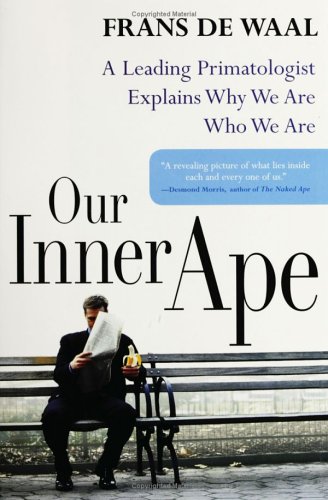
I have just finished reading one of the most important books I’ve found in quite some time: Frans de Waal’s Our Inner Ape. My attention was first drawn to the author when Rutgers University sponsored a talk he gave in the fall that I was unfortunately unable to attend. Simultaneously I saw his book footnoted in a text I was reading and decided to follow up on it. In addition to containing fascinating, documented anecdotes concerning ape behavior (he tells of a bonobo that attempted to help an injured bird fly!) de Waal holds a mirror up to the great apes and sees humanity reflected back. His discussion of the origins of morality makes far more sense to me than any theory I’ve seen a professional ethicist concoct. Our sense of empathy, de Waal notes with considerable evidence, derives from our common ancestor with the apes.

After discussing the understudied trait of kindness in the apes, de Waal writes: “With morality firmly rooted in sentiment it’s easy to agree with Darwin and Westermarck on its evolution and to disagree with those who think culture and religion contain the answer. Modern religions are only a few thousand years old. It’s hard to imagine that human psychology was radically different before religions arose. It’s not that religion and culture don’t have a role to play, but the building blocks of morality clearly predate humanity. We recognize them in our primate relatives, with empathy being most conspicuous in the bonobo and reciprocity in the chimpanzee. Moral rules tell us when and how to apply these tendencies, but the tendencies themselves have been in the works since time immemorial” (225).

These might just be platitudes if ample evidence did not demonstrate their veracity. Apes plan ahead, recognize fairness, and can even see issues from the point of view of others (something Gorgias Press might benefit from learning). They are clearly inheritors of the moral sense that evolution has crafted among all cooperative animals over the eons. Religions like to lay claim to the origins of morality: we behave this way because our god told us to. In a sense that may be true, but only if the “god” is nature itself and the instruction it gives is the way for a species to thrive. Caring for one another, all religions aside, is the formula that evolution presents as the most successful choice of natural selection.