Name Recognition

Some two and a half years ago when my brother-in-law Neal Stephenson suggested I start a blog (primarily for the podcasts to which I intend to return), he asked me what I would call such a site. “Sects and Violence in the Ancient World,” was my attempt at a witty, non-committal riposte. Since I was unemployed at the time and still hoping some deus ex machina might put me back into a full-time university post, complete with an Ancient Near Eastern religions component, the title seemed apt. I determined that I would not exploit my relationship to a best-seller author since I wanted to earn my own readership. Sects sells, does they not? Since then I’ve had a number of curious readers wonder why I tend to address modern religious issues, unlike my title suggests. The reason goes back to what I want to be when I grow up.

How many eighteen-year olds really know what their lives will hold in store? Our society asks them to select majors and pick a career path far too young. I had visions of clergyhood in my head so I majored in religion. Like many children of alcoholics, I tend to be addictive in my devotion, so after completing a Master’s in religion, I had to have just one more degree—then I’ll stop—and a doctorate in religion finished ossifying my career track. Having been weaned on the Bible, I’d stuck with it for three degrees and found that during that time the job market had evaporated around me. As I watched society from the sidelines, I saw so many people at the place I had started out, staring wistfully at the Bible, looking for answers. Uncritically, magically expecting a miracle. Just like Oral Roberts said. Once my teaching career had been derailed by misguided Fundamentalists, I realized my interests were much more in the effect religion has on people. It was too late, however, to go back to school.

My way of dealing with any dilemma is to parse its history. That’s why I studied pre-biblical religions along the way to my doctorate in Bible. A couple of things had become clear along the way: religions are very fragile and easily splinter into sects. And most of the large-scale violence in the history of the world has a religious basis. (Probably much of the small-scale violence does as well.) Its origins are literally more ancient than history. What is religion in today’s world if not the direct descendent of sects and violence in the ancient world? And since my idiosyncratic musings have passed the 200K hit mark, it seemed all right to acknowledge the role my brother-in-law has played in all this. So, in good academic fashion, I’d like to acknowledge the suggestions and support of Neal Stephenson in starting this blog, but any errors are, of course, my own.

Metaphor

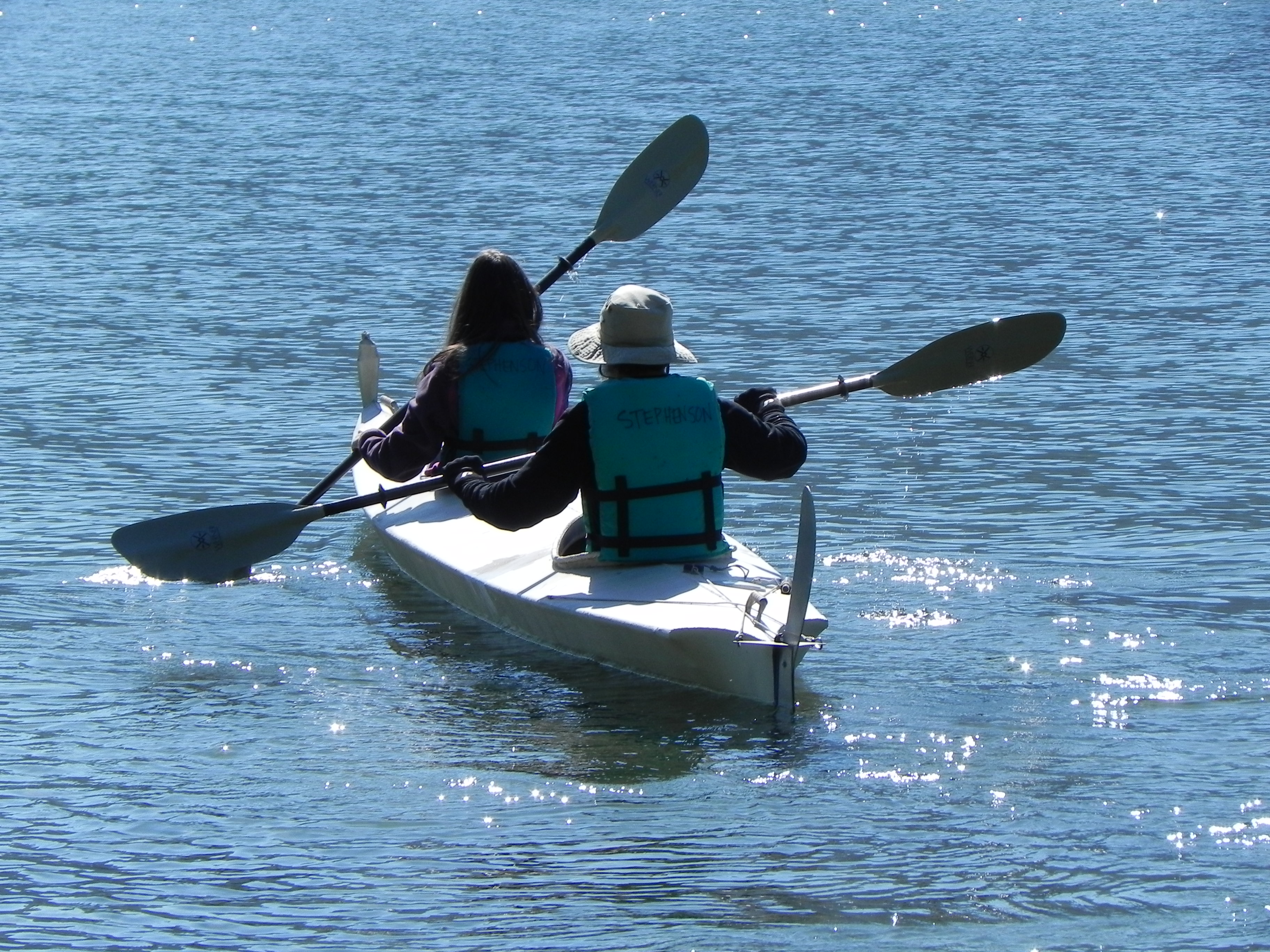
Author Neal Stephenson, inspired by fellow author George B. Dyson, built a baidarka a few years back. The baidarka, an Aleutian version of the sea kayak, was such a necessity of life among the Aleut that it was treated as a living being. Whenever I find myself at the same latitude and longitude as the baidarka Neal built, I like to take it out for a relatively safe lake voyage. I’m not much of a swimmer, and taking boats out on the big water always chills me before the water actually touches my skin, but this is a kind of ritual that I feel compelled to observe. It is a participation in the mythic world of the Aleut. As spiritual beings, kayaks were a necessary part of life for island dwellers. In their own way, I suppose, they are saviors.

Author and partner in the baidarka

Traveling by water, I find, is a spiritual experience that eschews scientific quantification. It is a feeling, not a measurable commodity. To quote the great sage Rat in Kenneth Grahame’s The Wind in the Willows, “There is nothing—absolutely nothing—half so much worth doing as simply messing about in boats.” We are born of water, mostly made of water, and ineluctably drawn to the water. Rachel Carson suggested in her classic, The Sea Around Us (always one of my favorite books), that having evolved from the sea we are forever yearning to get back to the sea. Water is life as much as blood is.

broken water

When water breaks by being forced into an unyielding shore or by being thrown over a cliff to become a waterfall, flinging refreshing spray into the air, its great energy is released. Although its flow may be interrupted it will break apart granite and basalt, literally moving mountains and carving coastlines. Water that is placid in the morning may be raging by the end of the day. Water is life, and if life is anything more than a metaphor no one has yet convinced me of it.


Prophets in Disguise

Yesterday I decided to take a break from austerity and take my family to see Avatar. Not just on the big screen (a rare enough treat), but in 3-D Imax format. In my zeal I had forgotten about my debilitating congenital problem with motion sickness. I have had trouble since I was a child sitting in the backseat, or riding backward on a train, or even turning my head around too fast. Once I was talked into riding a county fair ride by some high school friends and found myself still getting nauseous two weeks later. I have learned to live with this embarrassing problem, but sometimes I forget that the mere suggestion of motion will send me over the edge. I managed the first twenty minutes of the movie before having to close my eyes and bow my head for the rest of it. It is an interesting experience to listen to a movie. Following the basic plot wasn’t too hard, at least when I wasn’t thinking about all the talk of great special effects and the money I’d spent to see them.

Like most science-fiction movies, Avatar makes substantial use of biblical and mythological themes. The planet is named Pandora, after the “Greek Eve,” and I could hear traces of the hero quest throughout. When the indigenous people were introduced, however, my ears pricked up (as I understand those of the characters do). The Na’vi, it turns out, share the name of the prophets of the Bible. The Hebrew title for prophet is nb’, pronounced the same as the movie characters. I thought about this as I wondered what was going on during the action sequences that I could not see. Those who guard the traditional ways are the prophets, silenced by the grinding machinery of modernization.

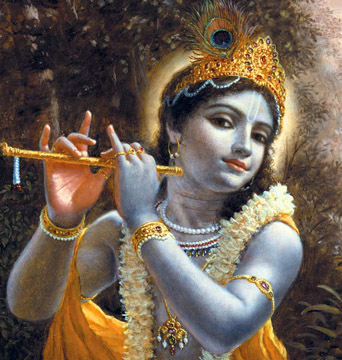
Even avatars have their origins in religion. The first I had heard of avatars in science fiction was in Neal Stephenson’s Snow Crash. The idea felt so fresh then that I had to remind myself that Hinduism had given the world avatars as earthly manifestations of deities centuries ago. Placing oneself in another form ultimately stimulates the question of which is the true self, the ultimate reality. It is an inherently religious question.

The morning after, the room is still swaying about me, I can’t scroll down on the computer screen, and I am asking the questions of reality again. It cheers me that Avatar is doing so well at the box office. Any movie, even if unseen, that causes the viewer to question a frequently painful reality is worth the price of admission.

Another blue avatar