Kings of Israel

Eating out is something that has become more of a habit than it should. Still, when we get together with friends it’s a cause for celebration, and a restaurant is usually somehow involved. You only live once. Well, maybe. In any case, while waiting for a seat at a new place I happened to glance over at the bar. Two huge bottles of wine stood there. I asked our friends if they knew what they were called. I can’t recall how I’d learned, but the proper name for them is “Jeroboams.” Jeroboam, in case your reading of 1 Kings is somewhat rusty, was the first king of Israel when the “United Monarchy” split into Israel v. Judah after Solomon’s reign. The curiosity of my friends led me to research the subject a bit. What I found was alcohol of biblical proportions.

Another name for the same size bottle as a large Jeroboam is Rehoboam. Rehoboam was Solomon’s son, the king of Judah while Jeroboam took over Israel. Moving up to a 6 litre bottle the name becomes Methuselah. Methuselah, of course, is the Bible’s oldest man. Symbolically, if you do the math, he drowned in the flood. Nine litres will be called a Salmanazar, also known as Shalmaneser, a king of Assyria who attacked Samaria. Twelve litres, and perhaps the namers were getting a bit tipsy here, is either Balthazar or Belshazzar. The former, while not biblical, is the name of one of the three Magi from the visit of the wise men. Belshazzar was, according to Daniel, king of Babylon and is somehow scripturally mixed up with Nebuchadnezzar. Nebuchadnezzar, by the way—famous for his madness in Daniel—denotes 15 litres. An 18 litre bottle, depending on which line you’re following (if you can) is either Melchior—another of the Magi—or Solomon, the father of Rehoboam and one time boss of Jeroboam. The 27 litre bottle is called Goliath, for obvious reasons. And if you’re still standing, the 30 litre bottle may either be Midas or Melchizedek. The latter is the mystical king of Salem, later to be called Jerusalem.

I’m personally no fan of wine, so much of this was news to me. Not all bottle sizes are biblical, but many of them are. Spirits, in all seriousness, were taken to be related to the spirit world in ancient times. And the Bible, a book most familiar to those engaged in the industry of wine, was a natural place to find often ironic names. According to John, Jesus’ first miracle was changing water to wine at the wedding at Cana. Prohibitionists shudder to read that the carpenter from Nazareth changed six jars, each holding between 20 and 30 gallons, into free spirits. Wine bottles, perhaps to society’s benefit, never grow so large. But it’s time to go, our food has arrived.

Where Would Jesus Park?

The walls of the Old City of Jerusalem may not go back to the time of King David, or even Jesus, but they have become one of the iconic symbols of a legitimate site of world culture. As a young man my first sight of those walls was almost enough to bring me to tears. I had read about Jerusalem since my earliest days after graduating from Dick and Jane, and to see the Holy City firsthand was the experience of a lifetime. Too bad it is some of the most hotly disputed real estate in the known universe. Sacred to the three major monotheistic faiths that seem dead set on destroying this or that portion of it, Jerusalem is unlike any other city on earth.

The problem, as any urbanite knows, is where to park. According to Matt Beynon Rees of the Global Post, Jerusalem’s city planning committee is considering literally undermining the sixteenth-century walls of the Old City to construct a parking lot. Just a few short years after U.S. troops drove heavy military machinery atop Nebuchadrezzar’s Babylon in order to satisfy Bush-family oil lust and personal revenge, once again one of the irreplaceable monuments of the past may come under the contractor’s gaze. I teach at Montclair State part-time, so, believe me, I know about parking headaches! There have been times when I thought I’d have to drive the fifty miles back home without stopping for class since every space on campus was full. Yet I wouldn’t suggest tugging down historic University Hall to make room for more cars.

The problem seems to be that in our disposable culture we’ve lost sight of what can never be replaced. Immediate urge takes precedence over what our ancestors left for us to ponder and marvel over. A great hue and cry went up when Yellowstone burned in 1988, a lament that the former beauty would never be restored in a lifetime. Damage to structures from centuries past may be repaired, but the wonder of their staying power will forever be lost. It cannot grow back like Yellowstone, no matter how long we wait. Yet, parking meters under the Wailing Wall might save locals from having to take a bus. Regardless of theological conviction or absence thereof, some sites are simply sacred to the human story. The human story, however, has become one of convenience. Where else might Jesus park his Holy Esprit without having to walk (not on water) to get to the temple?

Sure, it's a nice view, but where do we leave the car?


Nebuchadrezzar’s Dream

One of history’s great ironies is that, despite being visually oriented creatures, we often do not know what famous people looked like. The further back in time we go the more difficult the reconstruction is. Ancient people practiced portraiture, although their efforts may have been hampered by stylistic conventions. Egyptian artwork is recognizable at a glance, and Mesopotamian art, with its weightier, angst-laden form is easily distinguished. Their stylized images generally do not allow for direct correlations to Renaissance portraits. When searching for specific individuals, even famous ones, however, the likeness may be completely absent.

Among the most notorious (from a biblical viewpoint) ancient emperors was Nebuchadrezzar. Demonized for his role in the destruction of the sacred temple in Jerusalem, Nebuchadrezzar becomes the hypostasis of Antiochus IV Epiphanes in Daniel and even worse in Christian apocalypticism. For all that, Nebuchadrezzar seems to have been a jolly good fellow. An able emperor, he was noted for his building an empire and the loveliest gardens in Iraq. Yet no images of him survive. They may be out there, buried, waiting to be found, but we do not know what this emperor looked like.

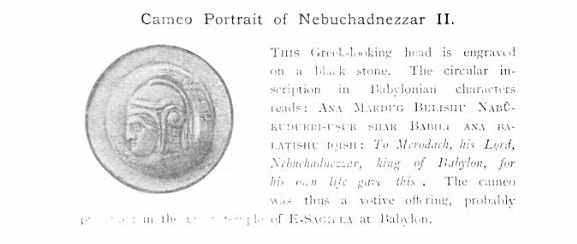
A recent web search nevertheless turned up the clearly Greek version of that famous, if forgotten, face on an onyx cameo. It even appears on Wikipedia’s page for Nebuchadnezzar II as an actual image of the man, the legend; this despite the fact that William Hayes Ward, in the American Journal of Archaeology in 1887, explained how the cameo was an early forgery. Originally an “eye of Nabu,” the proto-cameo was the eye of a statue, the pupil of which was carved by a reconstructionist Greek artisan into what he supposed Nebuchadrezzar looked like – a Greek warrior – centuries after the fact.

From Ball's Light from the East

This might be a simple historical curiosity were it not for the fact that evangelical websites and wikis are quick to claim that this clean-shaven, Olympian-profiled vision of masculinity is an actual image of Nebuchadnezzar. Why? He occurs in the Bible and therefore must be “proved” to have been historical. Not only for the real Chaldean Empire, but also for the fictional one concocted by Daniel. Seeing is believing. While history did not see fit to leave a lasting image of Nebuchadrezzar, evangelical websites will use the tried and true god-of-the-gaps methodology to show us what he actually looked like (not).