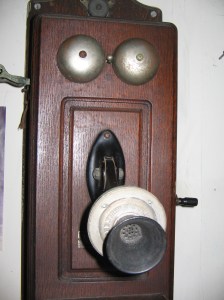
Just the Fax

Like most people I have a cell phone.  If I use it to take a picture, I can send that photo any number of places with a tap, swipe, and tap.  It works that way with scanned documents as well.  Using a hand-held phone, I can scan important papers, convert them to PDFs, and send them via email, text, “AirDrop” (whatever that is), Facebook, Twitter, Instagram—you name it.  Except fax.  That I cannot do.  The other day a company wanted me to send them a document by fax.  Within seconds I had scanned it with my phone and was ready to send it, but instead experienced electronic constipation.  The company had no email; it had to come by fax.

Now, like most reasonably modern people, we have no fax machine at home.  We still have some in the office in New York, but they are clunky, noisy, and seldom actually work.  The technology to receive documents has improved beyond the photostatic smear that facsimiles represent.  I worked for a company where the warehouse insisted on orders by fax.  You’d fax them the order and wait for the phone to ring.  They couldn’t read the fax and you had to tell them what it said.  Well, this particular company I was dealing with wanted a fax.  I downloaded two or three “free” fax apps.  They suspiciously wanted my credit card info.  Besides, if you send more than one page they wanted at least ten bucks for a “package” deal.  I had to send a three-page document.  I checked to see if my laptop could do it.  The manufacturer’s website said it could, but the menu option it told me about didn’t appear.  Who insists on faxes any more?

This is the dilemma of mixed technologies.  It’s like those movies where the streets of some exotic city are filled with rickshaws, cars, bicycles, and pedestrians.  The fax, in this analogy, is the pedestrian.  My mother doesn’t have email, let alone the capability to text (or fax).  Ours is a telephone relationship.  Yet in my hand I hold a device that can send this document anywhere in the world with a tap, swipe, and tap.  I recall my first trip to Jerusalem where hand-drawn carts, cars, and yes, camels, shared the streets.  This was in the days before the internet.  To contact home even by telephone was cumbersome and costly.  Yet somehow we survived.  I’d arranged the trip utilizing a travel agency and funded it by a letter-writing campaign.  The Ektachrome slides I took are now a pain to look at because technology has so improved our lives.  Unless, of course, you need to send a fax.  Delivery by camel can at least be arranged via the internet.


Wired for Good

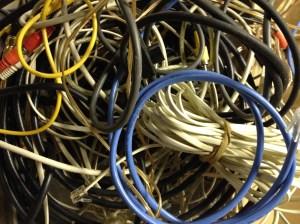
I spend entirely too much time untangling wires. Recently I read a survey asking whether you’d rather face a robot uprising or a zombie apocalypse. There’s no question that the devices have already taken over. And they’re eager for your source of power. The work laptop, the home computer, the aging iPhone, the iPad—they all want feeding, like a nest of hungry chicks. And their cords get tangled. It’s up to the human servant to come along and try to introduce some order into this chaos. Then there are the devices that go the way of the iMac, and yet their cords somehow remain. We have boxes of cords that look like an octopus orgy—uncertain to what device they once belonged we’re afraid to send them to the recycling plant because you may have accidentally rid yourself of one you still need. If there was a robot uprising, they’d be tripping over their own umbilical cords.

We used to go camping. Completely unplugged. These days of state parks offering wifi, even a trip to the wilderness isn’t really wireless. I’m a little afraid of this new dependency. The joy of memorizing has been replaced with the internet in my pocket. Life has become much easier in some respects, no doubt, but it’s not a one way street. Technology has its price, as this tangle of cords I’m facing reminds me. There’s no cutting this gordian knot without going back to the Stone Age, it seems. What would I do if I couldn’t post on this blog daily? What would remain of me?

If electricians are the acolytes to this new religion, then programmers are the priests. Each keystroke produces a recognizable letter because of their prayers and supplications to the great god Internet. Without it my job would be impossible. It knows how much money I have and where. What I’ve spent it on. It even flatters me when I search for something I wrote. The robot uprising, you see, need not be violent. It’s subtle and gradual. When you can’t live without something—when you adore it and depend on it constantly—it’s become a deity. The god, however, depends on us for providing it the constant sacrifice of power that it demands. It hasn’t figured out how to extract electricity from the air, or suck it from our fingertips as we type. And for its needs it requires cables. Like a good servant, I’m going to sit down and sort them all out again.


Down the Road

First of all, thank you to my regular readers. I’ve been making daily posts on this blog since July 2009—nearly nine years of illustrated commentary. It seems, however, that I’ve reached my limit. My storage limit, that is, on Word Press. As a result I’m going to be upgrading my account. Now, I’m enough of a Luddite to be uncertain of how this might impact any auto-updates (I flatter myself to think there are some) or links to this blog. I’m planning on continuing Sects and Violence in the Ancient World, but it will be but one page on a website that will offer the opportunity for me to go into more detail about my books. I don’t know how it will look yet, but it shouldn’t be disappearing from cyberspace.

Timing, as they say, is everything. It’s never been my strong suit, however. My current book still has no final title, so it’s a little difficult to promote it properly. Oh, it’s finished, and in the hands of the publishers, and although I can give it its own page, I can’t really title it yet. Perhaps in the height of hubris, the new layout will have pages for my previous two books, A Reassessment of Asherah and Weathering the Psalms. These were both academic titles with very limited sales, but they represent a significant portion of my life and I’d rather not have them completely forgotten. My latest book is for a more popular readership, but I don’t have the platform to interest agents (not for lack of trying), so I’m incorporating it into a website that will allow for its self-serving promotion. So embarrassing. You can imagine how red my face must be.

By the way, there’s another book about half-written. (Actually, there are several, but this one looks like it might actually appear.) A new series has been announced—I’ll write about it once I learn if my proposal has been accepted—that follows my own aesthetic closely. In conversation with the series editors, I’ve put together a proposed book based on my current work. If it happens, a new page will pop up on this future website I’m envisioning. Since I’m no Luddite, I can see possibilities for these pages. The blog will continue with its daily babbling. I’ve been doing this so long I wouldn’t know any other way to start my day. Combined with the hubris of those who spend too much time in supernatural headspace, this could be interesting. If you’re search brings you to what looks like the wrong page, please persist. Sects and Violence will be only a click away.


Ned Ludd and Company

I’m sure you’ve seen them too. Maybe in the movies, or on a newsreel, or maybe on a filmstrip in school. I’m referring to those scenes, usually in some foreign location, where bicycles, ox-carts, cars, buses, and pedestrians all crowd the same streets in a holy confusion of conflicting human intentions. Some can afford no transportation at all beyond their own feet. Others can own, and use, automobiles. On a scale like this I’d put myself around either the bicycle or ox-cart-driver level. I’m referring to technology, of course, and not actual transportation. At a recent family discussion I was left completely in the dust and exhaust fumes of new technology, trying hard to comprehend the words that other family members were speaking so fluently. Software names, devices that do things I can’t divine, and what is a dongle anyway? I’ve fallen behind not only on my movies and books, but on technology as well.

Tech develops quickly despite how slowly the rest of the world moves. Some members of my family don’t have computers or use the internet. Others have devices so advanced that they might’ve been salvaged from Roswell, and I wonder how all this happened when I thought I was paying attention. I’m a late joiner when it comes to tech. Although I’d been warned, I made it through my Master’s degree having barely touched a computer. When I took a decidedly low-tech job teaching at a medievalizing seminary, we couldn’t afford television service and we haven’t really watched TV since. Now I hear that you don’t need to pay for the privilege. If you have the time, black boxes, sticks, and even software downloadable on your phone can be your television. I look at our flatscreen at home and wonder where the on/off switch might be. How have I fallen so far behind the times?

The real problem, from the view on my bicycle seat, is that in order to maintain some level of expertise in my field of study, I have to dedicate quite a bit of time to it. While others tickle their devices on the bus, I’m reading my books made of genuine paper. I’m thinking such activities will make me better informed. Most of these books address the past. If I want to upgrade from to an ox-cart, however, I have to learn a whole new language and the nouns that accompany pieces of hardware that look an awful lot alike to these antique eyes. Perhaps we have become cyborgs after all, and I just missed the introductory session. I wouldn’t know; I’m too busy trying to keep this bicycle out of the path of that speeding lorry.


Confessions of a Luddite

I am not now, nor have I ever been, a techie. I learned my computer skills on a Mac, and I have been an adoring follower of Apple ever since. Every time I see Windows at work, I sneer at how they try to emulate the real thing: the Mac operating environment. Only clunkier. It is like watching hand-drawn cartoons in high-definition. Regular readers of this blog expect a daily post, but my valiant laptop, alas, had what is akin to a religious experience and I’m losing it. I’ve done my blog posts from that laptop for nearly two years. I sometimes work on them during the long commute to New York City. When my Mac Book encountered the plethora of signals from a Manhattan office building, it froze up. At home it no longer recognizes my base-station router. With my limited technical knowledge I’ve tried every trick on the Internet that doesn’t involve some Geek God going off into jargon that a humble reader of ancient languages can’t understand. I am grieving.

Yesterday, thinking about my plight, I saw the parallels with religious experience. My laptop in my eighth-floor office is like Moses climbing Mount Sinai, but less robust than the 80-year-old prophet. Having encountered a higher being—signals from the heavens, hundreds of them—it has bowed in acquiescence. It has received an epiphany that I missed while going about my daily editing duties. When it returned home, it was not able to recognize the one signal that has been its lord and master since it was first booted up. Nothing from restarting the router to reinstalling the entire factory-set system to clearing and restricting the access to the one true network has helped. My computer, to borrow a phrase from Atwood, has gone into a fallow state. That is a kind way of saying it is a mere paperweight or doorstop.

According to the standard interpretation, that is similar to an encounter with the divine. It leaves you marked, transformed. Sometimes incapacitated. Or perhaps the correct analogy is that of idolatry. My computer has gone on after foreign gods and no longer recognizes the one who gave it birth. I have suffered through two sleepless nights because of it. I even visited the local Apple store where they suggest I clear the AirPort history. Like I know what that means. Perhaps I have the analogy all wrong. Maybe my computer is the deity and I am the acolyte. It is mysterious and powerful and I am left in tears after an encounter with it. But really, it feels like a friend has died. I haven’t been able to post my quirky observations. I have to borrow a friend’s computer. Am I a prophet or just another Luddite awaiting my own theophany?