Telling Vision

My wife and I don’t watch much television.  In fact, we had very poor television reception from about 1988 (when we married), until we moved into this house in 2018.  That’s three decades without really watching the tube.  As we’ve been streaming/DVDing some of the series that have made a splash in those three decades, I’ve discovered (I can’t speak for her) that there were some great strides made in quality.  We began with The X-Files, then moved on to Lost.  We viewed Twin Peaks and started to watch Picket Fences, but the digital rights have expired so we never did finish out that series.  (Don’t get me started on digital rights management—the air will quickly turn blue, I assure you.)  Of course, we did manage to see Northern Exposure when it aired, but it should be mentioned for the sake of completion.  These were all exceptional programs.

Netflix (in particular) upped the game.  We watched the first three seasons of Stranger Things (and I’d still like to go back and pick up the more recent ones we’ve missed), and I watched the first episode of The Fall of the House of Usher (I didn’t realize until writing this up that it was only one season, so maybe I should go back and finish that one out too) and was very impressed.  Since we couldn’t finish Picket Fences, we turned to Wednesday.  Now, I was only ever a middling fan of The Addams Family.  I watched it as a kid because it had monsters, as I did The Munsters, but neither one really appealed to me.  Wednesday’s cut from a different cloth.  In these days when escapism is necessary, this can be a good thing.

Photo credit: Smithsonian Institution

Like most late boomers, I grew up watching television.  In my early memories, it’s pretty much ubiquitous.  We were poor, and our sets were black-and-white, but remembering my childhood without TV is impossible.  It was simply there.  The shows I watched formed me.  Now that I’m perhaps beyond excessive reforming (although I’m not opposed to the idea), I’m looking for brief snippets of something intelligent to wind up the day before I reboot to start this all over again.  We save movies for weekends, but an entire workweek without a break in nonfictional reality seems overwhelming on a Sunday evening.  It seems that I may be warming up to my childhood chum again.  This time, without network schedules, and limited time to spend doing it, we just may be in a golden age for the tube.


Who’s Pretty?

Movies come at you from all angles these days.  People love stories and streaming companies make enough money to create their own content.  I Am the Pretty Thing That Lives in the House is a notable effort for a Gothic film, financed by Netflix.  The pace is fairly slow and there’s little in the way of jump startles or bloodshed.  The story isn’t fully explained, but then it revolves around a horror writer, so that’s not unexpected, I suppose.  Lily is called in as a hospice nurse for Iris, although what Iris is dying from isn’t specified.  The estate manager supposes the stay won’t be long, but Lily remains in the house for eleven months, not leaving at all.  A few creepy things happen, but nothing terribly threatening.  Meanwhile, Lily, who admits to being too scared to read horror, decides to investigate Iris’ best-known book because Iris keeps calling her by the name of one of the characters (Polly).

After several months of this, Lily comes to believe that Polly was a real person and that she was murdered in the house.  Up front the movie announces itself as a ghost story and lets us know that Lily won’t survive the year.  That’s technically not a spoiler, since it says so at the very beginning.  The question becomes, what has happened to Lily?  Iris remains pretty firmly in the background, but she is the one who initiated the story.  The movie strongly implies, without outright stating it, that Polly was a real person who somehow channeled her story to Iris.  Iris, however, when she talks about Polly, seems to take the point of view of her murdering husband.  I won’t say how Lily fails to survive the year because that might actually be a spoiler.

This is one of those movies that relies on mood more than plot.  In that it manages to approach Gothic sensibilities with the very premise being, from the start, that ghosts own a house.  I live in an old house.  Apart from the previous owners, who both left alive, I have no idea who might’ve lived here since about 1890.  I haven’t seen any ghosts but I often do wonder what has happened in this place.  There are those who prefer modern houses with shiny surfaces (and generally no books),  but some of us prefer to take our chances with history.  We may never unpack that history but living among it makes us feel connected.  That’s kind of like the experience of watching I Am the Pretty Thing That Lives in the House.  Only we hope that are good guests in what may be somebody else’s dwelling.


Holy X

It took several years, but we finally closed the X-Files.  It was shortly after we bought the house, I believe, when we decided to watch the series the whole way through.  This was prompted by my wife giving me season eleven as a present, and I was wondering if I’d lost track of the thread.  We recently finished the last episode of the last season, with the movies interjected into the correct locations.  It was an impressive franchise.  I didn’t watch The X-Files when it originally aired.  We didn’t watch TV in those days (Nashotah House didn’t have cable and reception was awful), but another reason was that I was unmercifully teased for being interested in such things as a kid, and now it was trendy.  Once I got started, though, I was hooked.

Copyright: FOX; fair use screen capture

A few things struck me this time through, but one of the bluntest instruments to hit me was just how profoundly religion was interlaced with the series.  Many episodes involve religion directly, and others address faith and belief, even if outside the confines of established religion.  Since I tend to pause to reflect, I come a bit late to the table most of the time.  If I’d been on the ball, and if I’d begun writing books on horror sooner, I might’ve found a project in the religion of the X-Files.  As it is, several books have been written analyzing the series.  Maybe that’s where I’ll turn next.

You see, the original projected end for the series was season seven in 2000.  The mythology was wrapped up, and David Duchovny was leaving the show, which was, in essence, the story of Fox Mulder.  Two more seasons were ordered, however, with Fox on the run.  Things again were wrapped up in season nine.  Season ten came to air in 2016 and we watched it in real time, with primitive streaming.  In 2018, however, moving ended up being chaotic, and any watching would have to wait.  It seems pretty clear that, even with endless resurrections of the Smoking Man—Mulder’s Darth Vader—that the crisis of the world’s end (on which season ten ended) had finally been resolved.  That season, however, was eerily prescient regarding the pandemic.  Season eleven was a strong pushback against the Trump presidency with its “fake news” and constantly shifting facts.  Many of the episodes note how dangerous this is.  At the end it seems that the miraculous son, dead and resurrected, immaculately conceived, survives, as do the father and, if it’s not reading too much into it, a holy spirit.


Ushering In the New

I’m not at all certain I’ll finish it, but at my daughter’s suggestion I watched the first episode of Netflix’s new series, The Fall of the House of Usher.  This isn’t set in Poe’s day.  The action is in the present and it opens with a funeral for three of Roderick Usher’s children.  What’s particularly striking about this funeral is that the priest’s homily is composed of lines from Poe.  I think we all know that Poe is undergoing a great surge of popularity these days, but this series seems not content just to name characters and companies after Poe’s names, but it also weaves his thought deeply into the fabric.  It uses his images in literal ways that add depth to the plot.  I’m not sure that I can spare the time to watch it the whole way through, but I’m sorely tempted to do so.

With C. August Dupin as the Assistant District Attorney, the series ties Poe’s ratiocination stories in with his horror tales.  Like most recent media efforts, the cast reflects diversity in many ways.  This diversity isn’t the reason the house of Usher is falling, but it’s because of disloyalty.  The family owns an unscrupulous company that has shown disregard for the suffering it causes, buying its way out of legal difficulties.  (This part is quite realistic and one can’t help but to think of Trump and others like him who simply buy injustice.)  But someone in the Usher family has decided to speak out.  Dupin won’t reveal who it is, so Roderick and Madeline Usher put the family up to the task of rooting out, and killing, the informant.

Perhaps with some time off over the holidays I’ll be able to catch more of the series.  It intrigues me, however, that Poe is being used essentially as scripture.  Literally.  The priest’s homily fades into the background as the surviving family members check in on each other, but his words are drawn from a variety of Poe’s writings.  I’ve long felt that our canon of scripture is too small.  Inspired literature did not cease to be written in the second century.  As someone who has listened, and still listens to sermons, it’s clear that the Bible alone isn’t a source for knowledge.  I haven’t read all of Poe—he left a massive paper trail through his life—but what I’ve read sticks with me and hearing him as sermon material makes me think I need to try to find time in coming weeks to pick up another episode or two.


Horror Deprivation

Is there such a thing as horror deprivation?  Life has been so busy that I haven’t been able to carve out the time to watch any horror movies for several weeks now.  That steady diet has given me blog topics and a strange kind of personal comfort in this all-too-scary world.  More than that, it is often a coping mechanism.  I sometimes think more people might read this blog if I “rebranded” it as horror-themed, but perhaps there’s a different way to go about it.  Some writers, with enough shares and likes, have their daily observations become part of the national wisdom.  The rest of us, it seems, are simply background noise.  I’ve also been told blogs are passè and that may be the case.  I have trouble keeping up.  I don’t even have time to watch horror!

As with most things in life, I keep a list of movies I need to see.  Like claws such a list continues to grow unless it’s trimmed once in a while.  A movie is a couple-hour commitment and when even weekends are programmed to the last minute it’s difficult to squeeze them in.  I always welcome the more pleasant weather of spring, but so does the yard.  I’ve always thought, like good haunted house owners, that I would let the yard go.  Here in town there are ordinances, though.  It doesn’t look tidy—right now dandelions exceed the tolerated grass length a mere day after mowing.  Like triffids they pop up and won’t go away.  I could be in, watching a movie.  My credibility’s on the line here!

The pandemic, from which horror movies will arise, led many people to having too much time.  Netflix soared.  For whatever reason, it had the opposite effect on me—is this a special effect?—I had even less time than before.  I had to cancel my Netflix account because I had no time to use it.  Horror is a coping technique.  Real horrors spill from the headlines daily.  Sometimes the antidote is in the poison itself.  The way to be less scared is to watch more horror.  We’re still in the pandemic and Putin decides to start a war.  Republicans confess that Trump tried to take over by force and then backtrack.  Global warming continues apace.  There comes a point when the only therapy is to watch something worse unfold, as long as it’s fiction.  It’s Saturday.  It’s raining.  What can one possibly do?


All You Sea

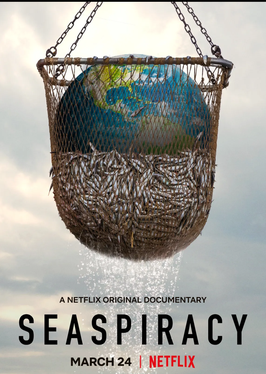
Speaking of large ships, in honor of World Ocean Day, which was June 8, I had planned to watch Seaspiracy.  A Netflix original documentary, this really is a must-see film.  Not to pass the buck, but I’ve long believed it will be the younger generation that will take the initiative to improve conditions on our planet.   I’ve seen my own insanely selfish and aging generation (with even more aged and selfish senators) continue to exploit this planet like there’s no tomorrow.  If you watch Seaspiracy you may see that it’s closer to true than you might think.  There may be no tomorrow if we don’t change our ways right now.  Borrowing its title from Cowspiracy, another important documentary, Seaspiracy looks at the fishing industry and its devastating effects on our oceans.

There’s a lot of sobering stuff here.  It begins with plastics.  Single use plastics, and even recyclable plastics, are everywhere.  They kill sea animals, they break down into micro-particles and infiltrate everything.  Chances are you have lots of plastic in your body just from living in an environment where it’s everywhere.  Ali and Lucy Tabrizi take you on a very disturbing journey where governments keep secrets about their roles in depleting the oceans and where large corporations kill observers at sea where there’s no chance of the truth being discovered.  They take you to the claims behind “dolphin safe” tuna and other fish.  They take you to where the market price on illegally caught blue fins can bring in three million dollars per fish.  And they’re caught in great numbers.

The oceans, according to current projections, could be empty in 27 years.  If current practices don’t change, there could be basically nothing left by 2048.  Why?  Because humans are hooked on consuming.  Some critics complain the date should be 2072, as if that isn’t just kicking the can down the road.  I became a vegetarian many years ago, after leaning that way many years before that.  It took Cowspiracy to make me go vegan. We eat without thinking about where our food comes from.  Our industrial food practices are literally destroying our planet.  Having given up fish along with other meat, I didn’t think much about fishing.  Seaspiracy shows why fishing is everyone’s concern.  It’s largely unregulated, unenforceable laws apply, and companies try to make consumers feel better in their acceptance that some fish is safe for endangered species.  This documentary shows once again how the price of eating animals, and doing so on an industrial scale, is simply not sustainable.  My generation is perhaps too lazy to change its ways.  Our only hope is that the younger generation takes the state of this mess far more seriously than we do. And perhaps thinks before putting things in their mouths.


Learning from Nature

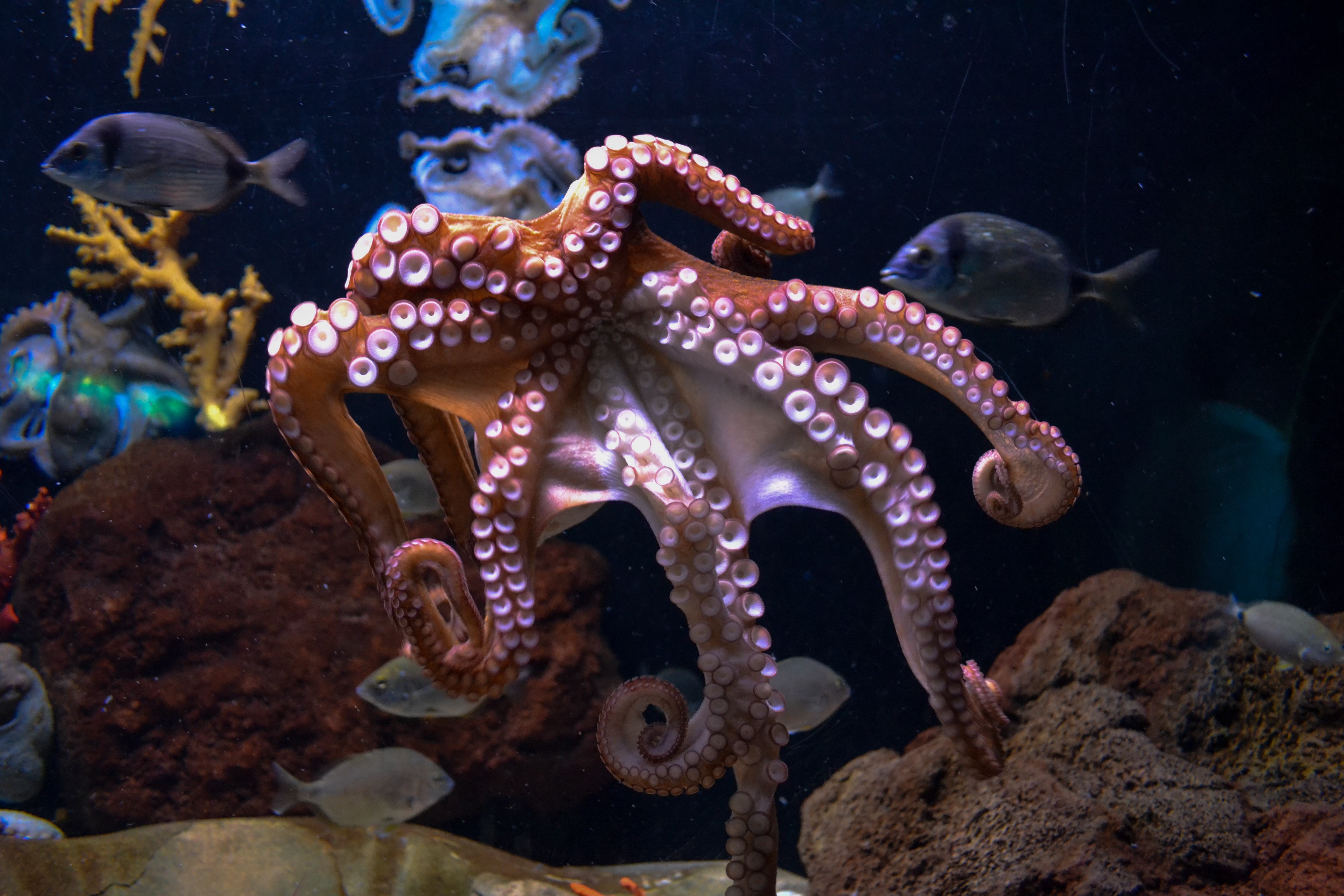
Netflix is one of those companies that has shown that new models for providing both television and movies are emerging.  Of course there are many subscription services, but Netflix rose to the top of the pile during this pandemic.  I don’t watch it much, since my time is generally otherwise spoken for, but I did have a chance to watch My Octopus Teacher, a documentary about Craig Foster’s relationship with an octopus.  The story unfolds over a year in which Foster comes to know, and to be recognized by, an octopus.  Quite apart from the Cthulhu references that may come to mind, octopuses are often skittish, highly intelligent mollusks.  Perhaps what made this movie such a surprise hit was just how emotionally attached viewers become to the cephalopod through Foster’s relationship with her.

Photo by Serena Repice Lentini on Unsplash

Almost immediately in the documentary, the viewer is struck by just how intelligent octopuses are.  The particular personality—and there is no other word for it—featured in this film is able to think and solve problems.  Not only that, but she is capable of forming a relationship with a human being she came to trust.  For many decades we’ve been taught that animals are like automatons, reacting with stock behaviors, because they can’t think.  Any claims to animal intelligence were chalked up as “anthropomorphism,” or inappropriately allowing animals to share in that coveted human trait of being “intelligent.”  The idea comes from the Bible and not even scientists would question it for the longest time.  Spending part of each day with one octopus, however, gives the lie to animals being subject to programmed behavior.  Like both Heisenberg and Schrödinger demonstrated, being involved in the scenario necessarily changes it. 

Animal intelligence has great implications for religion, of course.  This is perhaps why it is such a taboo subject.  What does it mean if animals can think and act intentionally?  Does it imply morality?  Foster implicitly raises that very question as he tries to decide whether to keep the pajama sharks away from the octopus he’s befriended.  Is he watching nature or has he become a part of it?  Our religions are often our ethical signposts.  In more recent years ethics has been shifted to the philosophy department since many people outwardly distrust the obviously mythical aspects of religious stories.  Nevertheless, the implications are clearly there.  Doesn’t it make a difference that our world is filled with other intelligent beings apart from those of us with opposable thumbs?  Watch My Octopus Teacher before deciding on an answer.