Routine Weirdness

I’m weird.  Nobody has to tell me that.  Like most people, I suspect, with my mental condition, I value routine.  Although the time I post on this blog varies, that’s usually due to one of two factors—the wobbling of the earth, and whether I get wrapped up in something that makes me forget.  The wobbling earth changes the time of sunrise rather dramatically, of course.  I jog at first light and my routine before that jog is pretty solid.  Then something comes along to interrupt it.  I have to begin planning the day before how to make it all fit.  So, routine bloodwork.  The lab where I have it done is within walking distance.  Of course, you have to go in fasting so everybody wants to get there first.  The lab opens at 6:30 a.m. and this time of year vampires are still safe out and about at that time.  

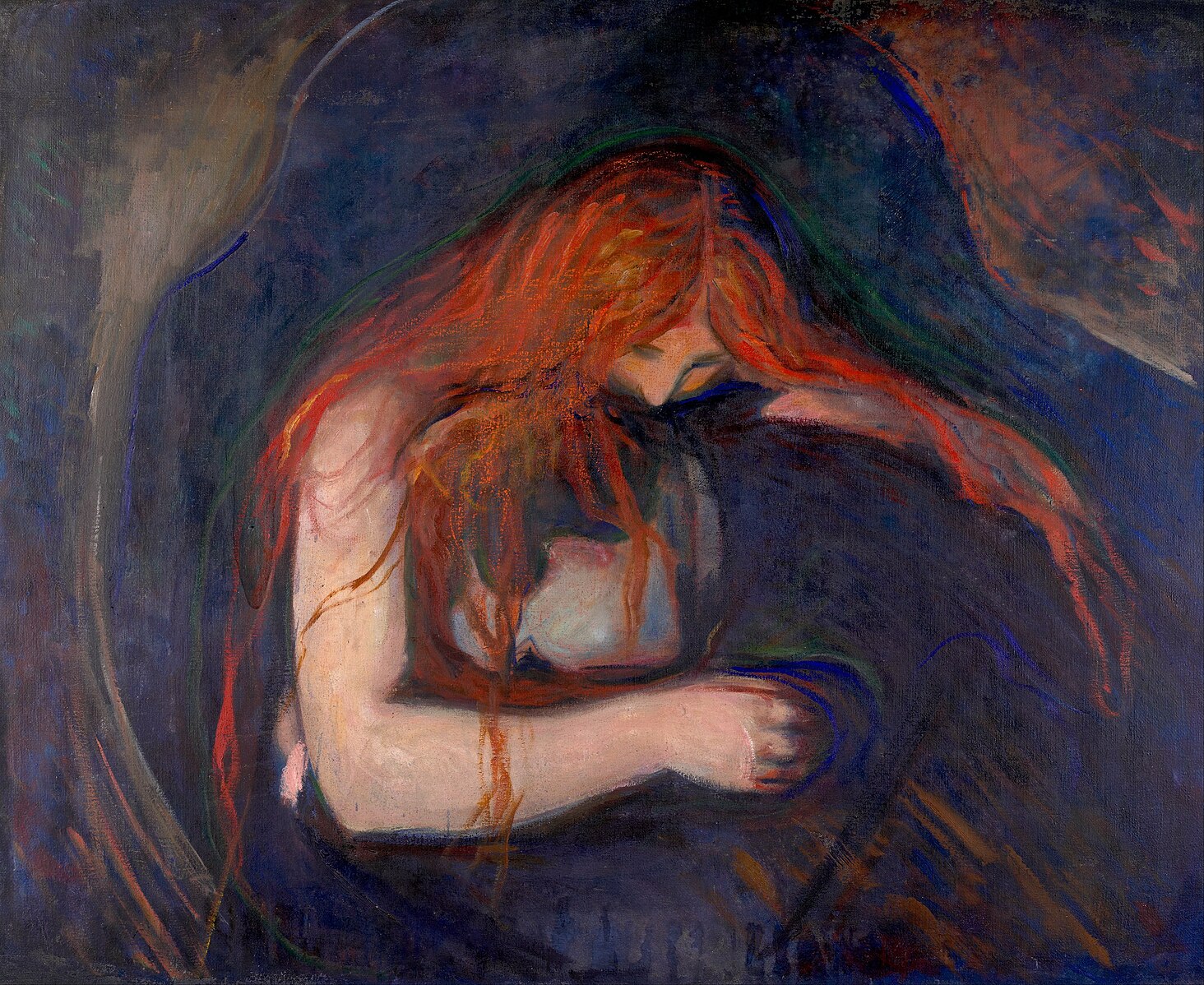
Edvard Munch, Vampire. Image credit: Google Art Project, public domain via Wikimedia Commons

But by 6:30 I’m usually dressed for my jog.  I’ve been writing and reading, typically for three hours.  I forgot to wash my jogging clothes this week and this was a Friday.  Hmm, better think about that.  Then there’s the whole question of my eating routine.  If I’m going to have something it has to be a couple hours before I jog—can’t do that with anything on my stomach.  Will I be too weak with nothing until afterwards?  After all I’ll be missing a vial or two of blood.  And there’s the matter of my shoes.  I only wear my jogging shoes on the local rail trail.  It’s pea gravel and it’s been raining lately which means they get a bit muddy.  All the rest of my shoes are in the bedroom where my wife’s (sensibly) still asleep.  Besides, I need to be on the trail right after giving blood, and changing shoes takes too long.

I’ll need to change my shirt when I get home.  The jogging tops are a bit too much to expect even a phlebotomist to put up with.  Besides, the under layers are tight-fitting since it’s only in the thirties today.  Why all this fuss about going to the lab before work?  That’s the magical word.  Work.  Also, lines have always been a problem for me.  Although I take a book I dislike waiting in line.  I need to get there before the doors open.  Be first in line.  There’s already a car in the parking lot, but standing beside the door in the cold has to earn you something, doesn’t it?  I’m back home just as the sun is rising.  Throw on my under layers and out before anyone else gets on the path.  I know I’m weird.


Making More Monsters

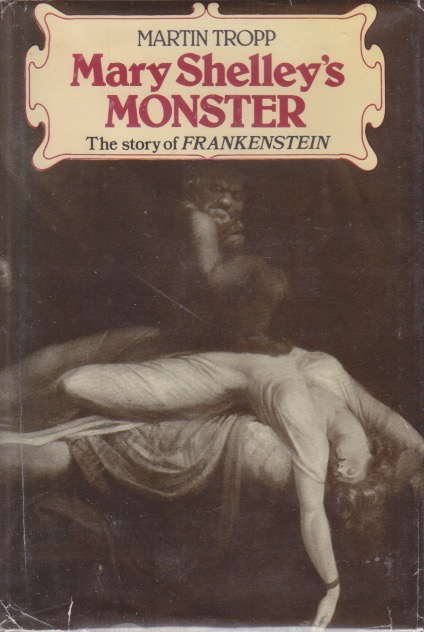
It’s endlessly frustrating, being a big picture thinker.  This runs in families, so there may be something genetic about it.  Those who say, “Let’s step back a minute and think about this” are considered drags on progress (from both left and right), but would, perhaps, help avoid disaster.  In my working life of nearly half-a-century I’ve never had an employer who appreciated this.  That’s because small-picture thinkers often control the wealth and therefore have greater influence.  They can do what they want, consequences be damned.  These thoughts came to me reading Martin Tropp’s Mary Shelley’s Monster: The Story of Frankenstein.  I picked this up at a book sale once upon a time and reading it, have discovered that he was doing what I’m trying with “The Legend of Sleepy Hollow” in my most recent book.  Tropp traces some of the history and characters, but then the afterlives of Frankenstein’s monster.  (He had a publisher with more influence, so his book will be more widely known.)

This book, although dated, has a great deal of insight into the story of Frankenstein and his creature.  But also, insight into Mary Shelley.  Her tale has an organic connection to its creator as well.  Tropp quite frequently points out the warning of those who have more confidence than real intelligence, and how they forge ahead even when they know failure can have catastrophic consequences for all.  I couldn’t help but to think how the current development of AI is the telling of a story we’ve all heard before.  And how those who insist on running for office to stoke their egos also play into this same sad tale.  Perhaps a bit too Freudian for some, Tropp nevertheless anticipates much of what I’ve read in other books about Frankenstein, written in more recent days.

Some scientists are now at last admitting that there are limits to human knowledge.  (That should’ve been obvious.)  Meanwhile those with the smaller picture in mind forge ahead with AI, not really caring about the very real dangers it poses to a world happily wedded to its screens.  Cozying up to politicians who think only of themselves, well, we need a big picture thinker like Mary Shelley to guide us.  I can’t help but think big picture thinking has something to do with neurodivergence.  Those who think this way recognize, often from childhood, that other people don’t think like they do.  And that, lest they end up like Frankenstein’s monster, hounded to death by angry mobs, it’s better simply to address the smaller picture.  Or at least pretend to.


Dangerous Driving

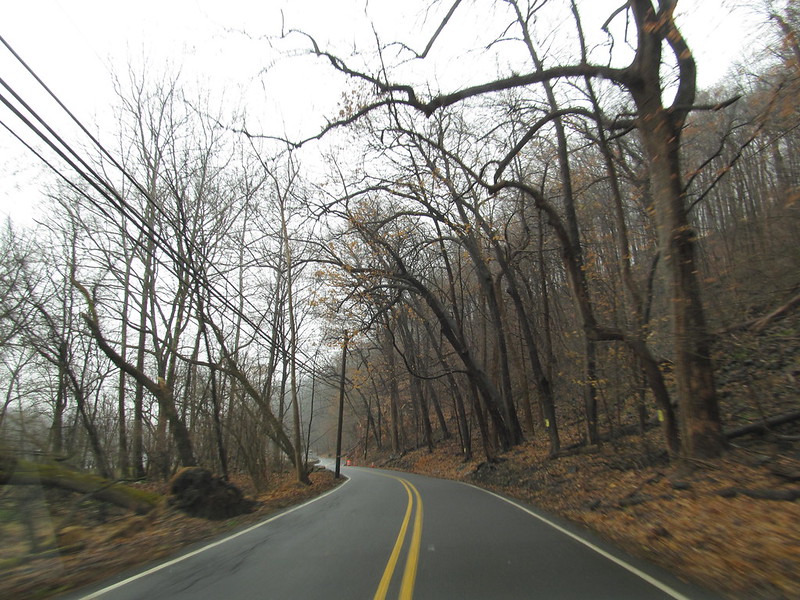
It reminded me of the time my manager fell down into the basement.  It also makes me think I must be neurodivergent.  Yesterday we were helping my brother in New Jersey get some things in order in his house.  He lives about an hour and a half from us and when the GPS showed us our options to get home we decided to go shunpiking.  I find something atmospheric, and maybe a little haunted, about driving along roads next to a river.  We crossed into Pennsylvania just north of Trenton and followed “River Road” home.  This stretch of road, mostly highway 32, is almost impossibly quaint.  I’d driven sections of it before, but not the whole stretch.  It was a pleasant day but we’d just come off of a period of rain and high winds.  The winds were still up, and have been gusting for about a week now.

After somewhere over an hour on this pleasant drive, we saw a motorcycle stopped in the road.  I slowed way down, unsure of what I was seeing (this starts the neurodivergent part), and I saw a man staggering across the road to lay down on the berm.  I could see branches on the road.  Unsure what to do, I pulled up next to him and offered to call 911 (my wife actually suggested that, since I didn’t know what to do. She’s better in a crisis than me.).  By then the people in the cars behind us had gotten out and one of them indicated they had medical training and that help was on the way.  The man indicated he’d been driving his motorcycle and the branch came down on him, or right in front of him—he was pretty dazed and confused.  Not wanting to throw my own ignorance and ineptitude into the mix, I pulled over, and my wife and I got out of the car and started clearing branches from the road.  Kay and I, and by now others, had pretty much cleared the road and, unsure what to do, and since there were many people attending the man, I drove off.

Image credit: Doug Kerr, Attribution-ShareAlike 2.0 Generic license, some rights reserved, via Flickr

That incident made me very reflective.  When I worked at Ritz Camera in Brookline, Massachusetts, one day my manager didn’t see that the cellar door (inside the store) was open.  We heard a scream and a thud and I ran to the door and pulled it back open.  The door had to be held by a hook and eyelet being joined and while I was trying to do that, one of my coworkers brushed past and down the stairs to help our manager.  Later, my co-worker ribbed me for being more concerned about the door than the person.  I was actually trying to help our manager, but in my mind, going down the stairs only to have the door fall on my head made no sense.  It turned out the manager was fine; a trip to the ER showed nothing seriously wrong with her.  I don’t know about that man by the side of the road.  I was only glad that, as my wife noted, so many people had stopped to help.  I just hope he, like my manager, was okay.


Mad, Bad

Although epic poetry holds an important place in literary history, I tend to read prose more.  Like most wordsmiths, I do write poetry—more like dabble in it.  Unlike my fiction writing, the poems aren’t intended for publication.  They are too deeply personal for that.  Still, my recent post about Gothic (the movie) had me thinking about Percy Shelley and Lord Byron.  They were known for their poetry, of course.  I can’t pretend to have read a ton of it, but their free-spirited personalities are intriguing.  Back in 2012 I read Edward Trelawny’s account of Shelley and Byron’s last days—neither lived more than six years after the summer when Frankenstein was born, both dying before forty.  I was recently reading about Byron in another context and was reminded (I’d read it before) that an acquaintance once described him as “mad, bad, and dangerous to know.”

Authors, I suspect, are often neurodiverse.  There’s a reason I think this.  The size of the population that reads for pleasure is depressingly small.  It stands to reason that writers are a subset of that small population.  The writers I know tend to have some quirks.  They function just fine in society, but they do seem to operate on a different level.  I’m naturally drawn to them.  I have been trying to get to know writers locally—there are quite a few here in the Lehigh Valley—and sometimes they will let you in.  Often not.  It’s tricky to befriend writers, in my experience.  I suspect I might be one myself.  In the published side of things, I’ve produced six non-fiction books, but I also publish short fiction (and have completed six unpublished novels).  Still, I’m not part of the “mad, bad, and dangerous to know” club yet.  If there is a club.

Over the years I’ve joined three different writing groups.  Their meetings are interesting since many of us are introverts.  One thing we all have in common is that we love to talk about writing.  Perhaps it’s because mainstream success is so difficult to come by.  Publishing houses have consolidated and the “Big Five” are responsible for by far the majority of books the reading public—that most rare group—buys.  One thing that’s true among the writers I know is that most would keep writing even if publication, or hope of publication, was off the table.  It is what we do.  For many years, perhaps too many, my writing was academic.  What nobody knew in my teaching days, however, was that I never stopped writing fiction.  It was there I put my thoughts that I’d classify as “mad, bad, and dangerous to know.”


A Theory

Do you remember that crazy college professor you had?  Chances are there was more than one.  As a late friend used to say, that’s why we pay good money to go to college.  I have an idea, perhaps even a theory, that the neurodiverse used to be largely institutionalized.  And I don’t mean in mental hospitals or “insane asylums.”  I mean in two well-respected social institutions: the university and the church.  Before you can object to the latter, consider that ministers, and before them priests, derived from shamans.  Nobody would doubt that shamans think differently than most people.  So, my theory is that when neurodiverse people came along in capitalist societies, they were shunted toward jobs in higher education and religion.  Out of sight to most people most of the time.  Then capitalism grew.

Both the church and the university became businesses.  Again, if you doubt me about churches, get to know a few bishops.  You’ll soon see.  In higher education, business people were hired as deans and presidents.  Not knowing how to handle their neurodiverse employee pool, they began hiring more “normal” people.  Those who, with no real insight or ambition, figure teaching is a cushy job.  It pays well, and it’s respectable.  But to do the job right you might just have to be neurodiverse.  Now, I don’t have the means to test my theory, but I suspect if you surveyed students over time as they graduated, you’d find fewer and fewer crazy professors.  As my departed friend would likely have said, they’re not getting their money’s worth.

Money doesn’t compromise.  Many people are driven by it without ever asking themselves why.  Do they want to be able to build private rockets to take them to Mars when capitalism finally destroys this planet?  Do they want private jets and the endless headaches of having to worry about getting even more money?  Studies tend to show that wealthy people are far from the happiest on the planet.  In fact, many of them are privately miserable.  They don’t have to work, true, but what do they think about?  Deeply.  I’ve never been driven by money.  I would like a bit more than I’ve been able to manage with my background and specialization.  Enough not to have sleepless nights over whether we can afford to fix the roof.  And still buy books.  It may be crazy to still read like a professor when I’m no longer in the guild.  I like to think I’m participating in a very old tradition.


Iron Man?

As a vegan, I sometimes end up thinking more about nutrition than I used to.  Back when I first became a vegetarian colleagues wondered how I got my iron.  I’m one of those apparently rare individuals who really likes broccoli.  I could eat it nearly every day of the week without tiring of it.  In any case, iron is important for health.  I’ve known people with iron deficiencies and it can be a real problem.  Doctors recommend ferrous gluconate as a dietary supplement since the body absorbs iron better from it.  (It’s best on an empty stomach, I’m told, followed by orange juice.)  But I’m no physician.  In fact, I’m quite squeamish, which may seem strange for someone who watches horror.  Still, thinking about iron took me back to my childhood.

I was a sickly child.  Couple this with a tendency to think too much and I must’ve been a handful for my mother.  I remember trying to explain to her once that I didn’t believe reality was real.  I was maybe twelve at the time.  She prescribed ironized yeast.  Now, Mom’s no doctor.  She didn’t even finish high school.  So thinking about broccoli made me wonder about ironized yeast.  First a web search revealed it’s not sold any more.  Further, it was a health food fad beginning in the 1930s.  Although I remember the taste and scent distinctly, I couldn’t find a website saying what it was or how it was made.  More to the point, why did my poor, frustrated mother think that it would help me couple reality with what was happening around me again?  (And was that even such a good idea?)

Questioning perceptions seems to run in my family.  I’ve long known that my thought process is very different from that of other people.  My saintly wife still says the reason she was attracted to me is that she’d never met anyone who thinks the way I do.  My thought process has had plenty of opportunities to drive her crazy since those early days, I suspect.  My brother and I sometimes talk about what it’s like being, I suspect, were we diagnosed, neurodiverse.  It’s easy to fall into the perception that others think like we do.  I suspect all people do that.  Few, at least among those I’ve met, question the reality that their senses tell them really exists.  Physics tells us it’s mostly empty space.  And yet although I still don’t know what it is, maybe I’d better find someone with an old stockpile of ironized yeast to get back to business. It is, after all, a work day.

Who knows what goes on in the mind of others?

Higher Learning?

I was reading, as one does, about a mental institution.  In the last century they were often called, rather insensitively, “lunatic asylums.”  The neurodiverse were often shunted away so that the rest of society could get on with business as usual (as if that’s sane).  There were any number of reasons sought for such individuals thinking differently.  The source I was reading had a short list and I was surprised to see on it, “over study of religion.”  It really said nothing more about it but it left me wondering.   First of all, it brought Acts 26.24 to mind: “Paul, thou art beside thyself; much learning doth make thee mad!”  Religion, from the very start, it seems, had the reputation of driving people insane.

Image credit: Published by W. H. Parrish Publishing Company (Chicago), public domain, via Wikimedia Commons

As someone who’s spent well over half a century thinking about religion, reading about religion, and analyzing religion, I can see Festus might’ve had a point.  This way much madness lies.  I don’t think religion evolved to be thought about.  It was largely a fear reaction to being, in reality, rather helpless in a world full of predators and other natural dangers.  Although we’ve managed to wipe out most of our large predators, we’re still under the weather, as it were.  We can’t control it, and what messing around we’ve done through global warming has made it less hospitable to our species and several others.  And also the small predators, those that evolve quickly, such as Covid-19, are now the real challenge.  Facing fear was the real evolutionary advantage of religion.

Being story-telling creatures, we made narratives about our belief systems.  Then we started taking those stories literally.  Believing too seriously, we used those stories as a basis for hating and killing those with different stories.  We still do.  Can anyone deny Festus’ accusation?  I’m sure religious mania has, historically, led to some institutionalizations.  It was kind of a trope in the seventies, for example, that too much Bible-reading could lead to criminal behavior.  It’s not difficult to see why those trying to classify what might make an individual off balance might look to religion as an explanation.  Nationally, and very publicly, we can see strident examples of this promotion of irrational ideas on a daily basis.  Many of the large mental institutions have been closed down and many of the neurodiverse have been turned out to the streets.  Ironically, it is often the religious who try to care for them.  Understanding religion, it seems to me, might be a great public good.


Human Agency

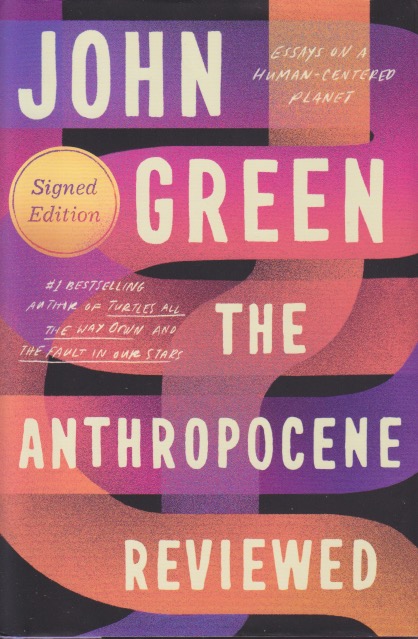
Goodreads Choice Awards elected John Green’s The Anthropocene Reviewed as the Best Nonfiction for 2021.  It’s easy to see why.  Green has long been known both as an internet personality and as a fiction author.  His fiction tends to fall into the Young Adult category, but I’ve read a couple of them as an adult and found them compelling.  Green has an uncompromising way of writing about difficult topics and evoking what it was like to be young.  His main fan base is probably much younger than me, but I always enjoyed his fiction, so why not non?  To understand the context of The Anthropocene Reviewed, it’s important to realize that it is a podcast.  Some of the segments have been written up into a five-star rating system that has been done with quite a bit of humor and some very real tears.  That’s the book version.

For me personally, reading this book was quite a bit like walking the mental paths already in my own mind.  Although we’ve led very different lives, John Green and I share many of the same anxieties, the same love of writing, and similar theological backgrounds.  I don’t know him, of course, but I get the sense that we both still wonder what we want to be when we grow up.  The selection of topics in this book represent Green’s interests well.  Topics are researched and fascinating stories emerge.  It takes quite an author to make me keep reading when sports are invoked.  Some of the topics are sentimental and some of those must be so.  In fact, some of the topics he addresses are things I’ve blogged about.  Some of them even use similar phrases to describe our experiences.

The book is subtitled Essays on a Human-Centered Planet.  From Green’s point of view, this human-centricity isn’t always a good thing.  He nevertheless never loses sight of the fact that humans are fascinating creatures.  Fascinating and disturbing.  We destroy our own environment and each other.  Yet we’re capable of such incredible feats and loving and caring.  Green wrestles with his own neurodiversity here.  He doesn’t shy away from the difficulties that mental illness can present.  He’s also an example of one of us who succeeds despite this liability.  Indeed, our neurodiversity is one of those unacknowledged things that make us so very human.  We expect a world to obey the laws of logic, which it stalwartly refuses to do.  When we notice this we can either cry fowl or we can think about it and invite others to do so.  Read this book and think.