No Whine

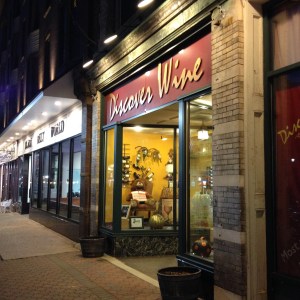
Sneaking in a grocery run to Wegmans before church one Sunday awhile back, I was in line behind a distinguished looking gentleman. “I’m sorry,” the clerk told him, “we can’t sell alcohol before 11 a.m.” She set aside an expensive looking bottle of Glenlivet as he nodded solemnly. From behind me a woman called out, “Is that true, I can’t buy my wine?” Like Paul Masson, it seems, in New Jersey they will sell no wine before its time. Many, I suspect, have supposed that blue laws would’ve lapsed by now. What most people probably don’t realize is that this is yet another instance of how the Bible continually impacts our lives. Although the weekend has become enshrined as relief from jobs that most of us find tedious, blue laws were biblically based to keep us in line.
The Puritans did all within their power to enforce their views onto larger society. Sunday was not only “the sabbath,” it was a time for no fun—read Laura Ingalls Wilder for getting a sense of what this was like even on the frontier—and church attendance. Nothing potentially more attractive than church was to be on offer on Sunday morning. Here in over-populated, wonderfully diverse, secular New Jersey, those doing their weekly grocery shopping were learning the Bible has a very long reach indeed. Even if many people don’t realize that the Good Book’s behind it, they must abide by Puritan standards. I suspect many have no idea why blue laws remain in force. The Bible doesn’t loosen its grip easily.

As we pushed our cart past the ends of the other check-out lanes I noticed that several of them had bottles purloined at the point of egress. I suspect that most of the would-be buyers weren’t hurrying home to get ready for church. Instead, they were probably annoyed that they’d have to go out again later to continue their purchases. The Supreme Court has upheld blue laws on the basis of giving time off to those of certain professions that work by the hour. Those of us who don’t punch the clock are, according to the logic of such a decision, given exemption from the law of the land (but not to make immoral Sunday morning purchases. Indeed, in some professions attendance at church is part of the job expectation). It is perhaps bewildering for those raised in different religions. The idea of time off, although it probably wasn’t intended for humanitarian reasons, has also become one of the hidden blessings of the Bible. Without the sabbath, our weekends would also be an opportunity for others to make more money by the usufruct of our precious time. Holding off a few hours to buy alcohol seems like a small price to pay, in comparison. The Bible giveth, and the Bible taketh away.
After Dark

So many spooky things happen at night. If you’ve read much on this blog you’ll know I blushingly confess to a horror movie addiction. So much so that I wrote a book about it. Friends occasionally feed this fear by sending me stories of strange, nocturnal happenings that are frequently posted on the internet. All kinds of odd creatures roam the night: dog-men, goat-men, lizard-men (and they mostly seem to be male, for whatever reason). It’s enough to keep you inside once the sun sets. Of course, if you read this blog you know that I’m an extreme morning person. Sleeping in, for me, means getting out of bed at 4 a.m. instead of 3:00. Yes, it’s often dark at that time of day, and horror movies teach us that demons are particularly active around 3 o’clock. But then the sun comes up, and everything’s okay. Until the next twilight.

Now that December’s here, I find myself out in the dark more than usually occurs for a guy who gets up so early. After the time change—for which there exists no logical reason—it’s dark by the time I climb off the bus from my day job in New York City. The other day I was compelled to drive after dark. It was only just after 6 p.m., but that’s getting late for me. I scan the road looking for deer. A thought occurred to me—what if I see something weird cross the road? What would I do? A few moments later I was startled to see a woman and child beside the street. I was prepared to stop since—and this is apparently an unknown fact—it is the law in New Jersey to stop for pedestrians in a crosswalk. The young boy then made a dash in front of my car. The woman grabbed him and yelled. They weren’t crossing as they struggled at the roadside, so I slowed down but drove on. “That was weird,” my wife said, “that boy was in his bare feet.”

It was 40 degrees (Fahrenheit) outside. This wasn’t one of New Jersey’s famed haunted roads, even. It was a comfortably affluent suburban street. The image stayed in my mind. There’s only so much you can do when driving in traffic. Yes, it was night, but this is New Jersey—there’s always traffic. Did anybody else see what we saw? What was happening here? Why was I so afraid? Fear is the most honest of our emotions. Without it no organism could long survive in this hostile world. After nightfall even governments are at their worst.


Guns and Ghosts

The irony of a nation that has gun laws made by those with body guards is especially cruel in the shadow of Sutherland Springs. Just a month after the worst mass shooting in United States history, another cohort of corpses receives only empty answers from DC. The solution to all the shooting deaths, 45 asserts, is more guns. This from the same White House that can find no credible alternative explanations for global warming, yet continues to break down any emissions barriers it can. The real noxious emissions are coming from the greedy mouths of the chicks in the feathered GOP nest. What is the word for what lies beyond insanity? We need it now.

Like many thinking people I’m very pleased with the results of the gubernatorial elections in New Jersey and Virginia. It seems, temporarily, as if reason has found its voice. The mistake at this point would be to relax and feel as if the job were done. We have raving lunacy at the national level, gun violence out of control, and politicians who just can’t live without NRA blood money. The story of Sarah Winchester’s ghosts may not be true, but it doesn’t have to be. We have a nation full of ghosts. Barely elected candidates claim a mandate to destroy the infrastructure that has allowed them to become rich. The wealthy, you’ll notice, are those who want to take all the marbles and go home. And they live in houses with guards to protect them from all the firearms they’re handing out like candy on Halloween.

Stop and think about this. The White House admits that climate change is human caused. The conclusions are quite dire for those who own property in New York City, let alone entire nations that will be underwater in a few years’ time. The response? Ignore the facts. Boast a bit more about how great we are. Give tax cuts to the wealthy and guns to the poor. Why doesn’t this equation add up? Pardon my jeremiad on what is the first hopeful morning a reasonable person has had in a long time. We have to start taking back local politics and let the national government know that it no longer speaks for the people that somewhat giddily gave it power just a year ago. Otherwise there are bound to be many more ghosts about. And one thing we know for certain, Washington doesn’t believe in ghosts.


Not Devil’s Tower

The Sourlands, apart from being the setting of Joyce Carol Oates stories, are one of New Jersey’s characteristic features. Although the Garden State brings visions of heavy industrialization to many imaginations, there are also lots of outdoor options for getting back to nature. One is the Sourland Mountain Preserve. No one’s sure of the origin of the name—was it named after a person, or was the land poor for farming? Could it have come from another language? No matter what the source might be, these areas are today criss-crossed with hiking trails—some of them quite rugged. On a sunny September weekend my wife and I decided to take a walk. The sunshine and cool temperatures made the opportunity beguiling. Although it’s not far from where we live, we’d never been there before. Time to look at a map.

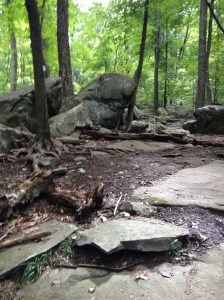
The most distinctive point listed was the Devil’s Half-Acre Boulders. Geonyms, or place names, can be quite evocative. New Jersey and Pennsylvania along the Delaware both lay claim to some impressive boulder fields. The Devil’s Half-Acre was clearly a place for rock climbing, as chalk dust on the trail indicated. It’s not territory that you can get through quickly. But why devilish? Across the Delaware may lie the origins of the name. Near another boulder field, Ringing Rocks, is the site of a tavern along the Pennsylvania Canal. Said to have been the locale of lawlessness, haunted by the ghosts of dead canal workers, the location earned the same diabolical sobriquet in the early nineteenth century. What we found on the Jersey side, however, was an impressive jumble of massive stone and a rather popular hiking path.

“The map is not the territory” Alfred Korzybski once famously wrote. His expression was borrowed and adapted by religionist Jonathan Z. Smith in a book that’s still required reading for those starting out in the field. The point of the saying is that a map is an abstraction. The experience down here on the ground is very different from that projected from a bird’s eye-view. We can easily adjust to the concept however, using maps to tell us what lies ahead. The difficult work of digging a canal, or the unyielding nature of boulders, may symbolically point to the devil. At several points on the trail we had to pull out our map to make sure of our bearings. Trails are hard to follow over rocks. There was no literal devil there, but territory might just help to explain the name on a map.


Surface Tension

Montclair, New Jersey, is distinguished by having two bookstores. On Saturdays when my wife has to work there, I sometimes come along. Apart from the pleasant company, it isn’t every day that one can visit two bookstores. By supporting such shops, I am protesting the ignorance rampant in this nation. One, the Montclair Book Center, specializes in used books. Not always competitively priced, I nevertheless seldom leave empty-handed. It’s a healthy walk from there to Watchung Booksellers, a compact indie up by the train station. For a small store they always have an intriguing selection and I’ve never seen it empty on a Saturday. As I was walking the distance between the two, I noticed that Montclair’s downtown (and I’m not picking on Montclair, which I love) focuses on appearances. This is true of almost all shopping malls as well. Salons, clothing stores, eating places, tattoo parlors, health clubs. Places you go to help hone your image. Where are the stores catering to the mind?

Don’t get me wrong, I also have a body. I like to keep healthy too. I jog when I can, and I’m a vegetarian of nearly twenty years. Yes, there are the necessary places like drug stores and specialty shops where you can get your vacuum cleaner repaired, but few places to go explicitly to encourage mental growth. Hot, I stopped into a coffee shop for a bottle of juice. Patrons were busy at their phones and laptops. I recalled how there was a time when intellectuals hung out and conversed in coffee shops, exchanging ideas over mugs long grown cold. Even those sitting outside on the sociable, colorful chairs were busy texting, Instagramming, or tweeting away their weekends. I closed my book and walked on. I felt a vague but pressing need for intellectual engagement. I headed to the second bookstore.

On the way home one of those industrial-sized lawn-care vendors cut us off on the highway. Lawn-care is big business around here. It’s all about appearances. What has happened to the life of the mind? Allow me my curmudgeonly years—I recall walking downtown as a child and seeing the office supply store with actual paper, smoke-shops with their abundant magazines and wire spinner racks full of questionable paperbacks, and even the Christian bookstore with its tracts and Bibles. I didn’t have the benefit of living in a university town, but people I saw were talking to one another. Exchanging ideas with someone actually present. Self-consciously I look down. I’ve had these cargo pants for many years. This shirt I’m wearing I purchased in Wisconsin in another decade. Even these shoes haven’t been replaced after all these miles. This hat on my head is almost older than my college-graduate child. I can’t be bothered with my appearance right now, though, because there’s another bookstore just ahead.


Fishers of Cars

The car was drunkenly weaving across lanes in substantial traffic along Interstate 80. Erratic driving that, although not breathalyzer confirmed, suggested impaired operating. It’s something you never like to see. We stayed behind the vehicle, knowing that it was safer to keep such a car in view rather than attempting to overtake it when the driver veered into the left lane. Since the same muted colors recur on vehicles these days, we needed a quick way to identify this driver at a glance. The Jesus fish on the rear served the purpose well. This situation struck me as a kind of parable, although it really did happen. One of my brothers is a driver by profession. He often tells me that if someone cuts him off in heavy New Jersey traffic, more often than not the car bears a Jesus fish. WWFD?

The ostensible purpose of the Jesus fish is to witness to the world “here is what a true Christian does.” While the New Testament, if I recall, indicates that the true believer puts others before him or herself, the rule of the road is somewhat less spiritual than that. None of us are saints when we get behind the wheel. We’ve got places to go and the drive isn’t really much fun with thousands of other cars bunging things up constantly. Still, if you take the extra effort to put that Jesus fish on your car, aren’t you signaling that this driver holds her or himself to a higher standard? Or maybe the fish is a talisman, like “Baby on Board,” that will somehow protect from the careless, aggressive driver thinking only of self.

The irony here is not that the driver is making poor, or aggressive decisions behind the wheel—let the one without sin cast the first stone—but rather that s/he implicates Jesus in the act. There’s a ready, steady market in evangelical paraphernalia. The WWJD bracelet keeps the question within sight much of the time—but keep your eyes on the road! One of the main problems with the Ichthys symbol is that it is generally on the rump of your car. Out of sight, out of mind. As you finish that last drink before climbing in behind the wheel, the fact that your personal Lord and Savior is being announced to the world may just slip your sodden mind momentarily. The real question is whether a car is the best place to announce your religious commitments. It was the the man in front of the fish, after all, who said “do unto others as you would have others do unto you.” Except in heavy traffic, of course.


Weather Vain

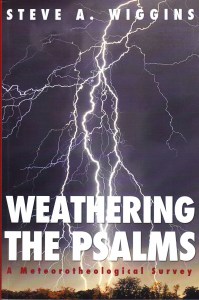
The other day I was awakened by a severe thunderstorm. It’s been quite a while since that’s happened. Unlike when we lived in the Midwest, thunderstorms in New Jersey tend to be widely scattered and somewhat uncommon. (It’s all a matter of perspective, I know.) My basis of comparison is how often I notice such storms. I’ve never been able to sleep through one. Thankfully this one came at around 4:30 a.m., past when I’m usually awake on a weekend. I’d forgotten the raw power of just how loud and bright such a storm can be. Danger seems all around. The feeling is primal and urgent. As I got out of bed and walked into the dark kitchen, windows filled with electric blue followed by and tremendous blast, I thought once again of Weathering the Psalms and the story behind it.

By the way, when I speak to young scholars about publishing I tell them this isn’t the way to go about finding a topic. That having been said, my book was born in the Midwest. Life at Nashotah House revolves around required chapel twice daily. Weather does not stop it. In fact, holding the daily office by candlelight because a storm had knocked out the power was not uncommon. Morning and evening prayer—indeed, all of the canonical offices—are built around the recitation of the Psalms. Reading the Psalter in slow, stately tones while thunder raged outside, rattling the ill-fitting stained-glass windows, left an indelible impression. It was only natural in such circumstances to notice how often the Psalms mention the weather. Thus a book was born.

I’m currently at work on a new book. I can’t say the topic just yet because someone might be able to beat me to it. (Knowing the way I come up with book ideas, however, I doubt it.) Sitting in my darkened living room, in my writing chair with the fury just outside, I was strangely inspired by the storm. Then it was over. Silence followed by birds singing, just like in Beethoven’s sixth symphony. The thunderstorm is one of nature’s psalms. As at Nashotah House, in the Midwest we had perhaps too many of that particular kind of psalm. Nevertheless, in the silence that followed I was left strongly in touch with my muse. These are the states that lead to poetry and song. Every great once in a while they might even lead to a book idea. As I tell students, just don’t expect that anyone else will get it.


The Big Chill

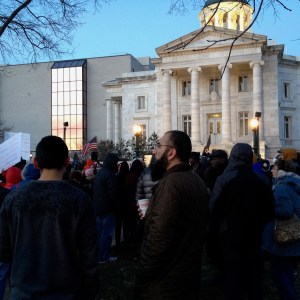
It’s cold. It may not be Alaska, or even Wisconsin, but I can’t feel my fingers and the temperature hasn’t risen above freezing all day. New Jersey doesn’t get the incredible chills we used to experience in Wisconsin, but I’ve been outside going on two hours and I really need some warmth. And it’s not just me. At least a couple hundred of us are out here and it’s not for the Super Bowl. It’s for justice. We’re rallying at the beautiful courthouse of Somerset County, in solidarity with our Muslim Americans, protesting the latest actions of our own government. Some of the people here are old enough to remember Hitler. Others are young enough that they have to be held. We are from countries all over the world. We are saying “No!” to the evil that is coming out of Washington.

img_3191

Those who voted for Trump out of a sense of fiscal conservatism were sorely misguided. This was a hostile takeover of what used to be a democracy by people who rely daily on alternative facts. Who make up massacres that never happened. Who claim that their personal billions have made them victims. Who believe that men have a God-given right to determine what women can do with their bodies. Who state that men who aren’t attracted to women or women to men are somehow deviant. Who openly mock the disabled. Who resist Black Lives Matter. Who can’t tell you one of the five pillars of Islam but can tell you that they’re all wrong. A government that’s over the people, despite the people, and against the people. Self-serving, self-enriching, and self-satisfied. A government where party has become more important than the welfare of the nation. A government that lost the popular vote by nearly three million, and those were only the ones who bothered to get out to vote. A government that lays its hand on the Bible and lies. That prays for itself, not for the good of its people.

That’s why I’m out here in the cold. I’m standing in a crowd that, like those who gather at airports, courthouses, and city streets, is saying “Enough!” The abuse of power is taking advantage of what you can “legally” claim without regard for the will of those you represent. Representative government fails when it fails to represent the people. We don’t want to be out here freezing our fingers, noses, and toes. We’d rather be comfortable and warm at home. As chilly as it may be in New Jersey tonight, it’s colder in the heart of this country and unless we the people do something, Hell itself is in real danger of freezing over.


Giving Trees

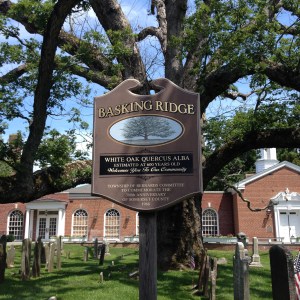
They’re not exactly worshipping the tree, but the Basking Ridge Presbyterian Church is holding a memorial service for the old oak tree. I’ve written about the Basking Ridge oak before. I learned about it only in January, and I visited it this summer. Some say it’s the oldest tree in the state, while others make that claim for the Great Swamp oak, which isn’t too far away. The climate change we’ve introduced, as well as natural aging, appear to have doomed the tree. It had leaves this summer, but not in the profusion that signals health to botanists. The decision has been made to take the tree down before any massive branches fall and cause injury or damage. In the light of these sad developments, holding a service seems perfectly natural. The tree is older than the church over which it presides, after all. It’s even older than John Calvin who started the Presbyterian tradition.

img_2878

My first book was on Asherah, the goddess often associated with trees by scholars. As those who’ve read my book will know, I’m a bit skeptical, on the basis of the actual evidence, that Asherah was a “tree goddess,” but it is also clear that trees are ancient objects of veneration. From the human perspective, they can live a very long time. There is a bristlecone pine in this country that dates back to before Noah’s flood (something the creationists conveniently ignore). With that much life-force, which, we’re told, is really a fiction, these trees deserve special respect. After all, they were in the neighborhood long before we got here. Still, the Basking Ridge oak has been artificially preserved before. It’s been on life support for years. Concrete was poured to support the massive trunk, and many ponderous branches are shored up by support rods. We respect our elders.

Maybe it’s not tree worship. Maybe it’s worship beside a tree instead of worship of a tree. Prepositions can make all of the difference. Nevertheless, it’s an occasion to stop and consider our place on the planet. The fear many of us feel regarding this week’s election is a mere second in arboreal memory. The independence of this country came after the oak had been here centuries already. It may not be tree worship, but we should respect the memories of such a tree. A country young and optimistic rather than old and jaded. Maybe this tree knows a secret that it’s willing to bequeath to those of us whose lives are but a few leafing seasons in length. Good-bye, Basking Ridge Oak. It was a pleasure to meet you.


Reveries of the Fall

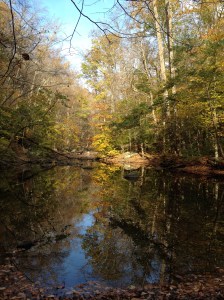
Just a quarter of an hour, studies show, of time in the woods can reduce stress. I suspect that if those fifteen minutes are spent running from a bear the opposite might result, but in general time in nature is an incredible solace. The weather hasn’t been particularly cooperative for October walks in the woods around here, but yesterday my wife and I managed to spend some time, along with many others, in Hacklebarney State Park, one of New Jersey’s gems. Living in the most densely populated state, to gather from the number of hikers we saw, encourages time in the woods. It was good to be reminded of the compelling scent of autumn leaves, the wonder of seeing their colors in the daylight when daily commutes begin and end in the dark. When work days are spent in the grayness of the city. Being out with nature, to borrow words from the Good Book, restoreth our souls.

img_2989

I suppose there’s nothing really logical about it. We’ve built civilization to protect ourselves from nature. Solid walls to keep predators out. Heat, running water, and electricity so that we can surf the internet without ever going outdoors. Permanent settlement always within reach of cell phone service and work email, we are the scions of civilization. Being unplugged just for an hour or two—even fifteen minutes—can feel like salvation. If that fifteen minutes is spent among rocks, trees, and the peculiar light that reflects off a lazy river. The internet will always wait, won’t it? Thoughts of work can be suspended until Monday, can’t they?

Hiking among the other expatriates of civilization in what used to be the Garden State contrasts so sharply with the image we project to the world. The Chris Christies and Donald Trumps who bluster that nature is there to be exploited. They may not say so with words, but lifestyles speak so much louder than syllables. Gaining wealth requires putting one’s own agenda first. We’re out here picking our way carefully over a rocky path. We have to stop frequently to let others go by the other way, or to let those faster than us pass by. But we’re all out here for the same reason. It’s a beautiful autumn day and spending it indoors feels wrong. I know that even getting online now feels like my time is being demanded by a million distractions. Unplugging, walking at a moderate pace, feeling the cool air and breathing the aroma of fall deeply into tired lungs, I can feel the stress draining away. If only for a day.


Colorful Leaves

Weekends, it seems, are incomplete without being among books. You might think that someone who works in publishing might want to get away from books in the off hours, but quite the contrary. I love a good walk in the woods in autumn. Especially if it’s followed by a trip to the local independent bookstore. It just feels right being among books. I realize that I’m in the minority by expressing such an opinion, and that the book buying (and book publishing industry) is (are) small compared to other forms of passing one’s time, but they are significant beyond their size. My wife and I have scoped out the various indie book sellers all around. When we have to take the car in for service, we drop it off, have lunch at a diner, and stroll down to the bookshop. It’s a pleasant way to spend an afternoon.

img_2984

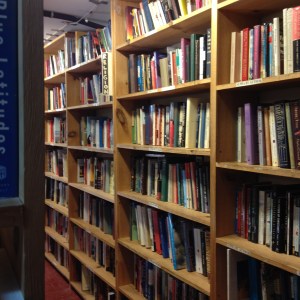
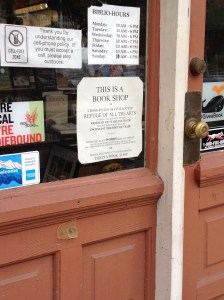
Here’s the sign on our Clinton indie. In case you can’t make it out, the legend says “This is a book shop. Cross-roads of civilization. Refuge of all the arts. Against the ravages of time. Armoury of fearless truth. Against whispering rumour. Incessant trumpet of trade. From this place words may fly abroad not to perish as digital waves but fixed in time. Not corrupted by the hurrying hand but verified in truth. Friend, you stand on sacred ground. This is a book shop.” I especially appreciate the sentiment of sacred ground. Indeed, sanctuaries of all sorts often house books. As libraries experience funding difficulties, civilizations are in the throes of collapse. Just to have books around me makes me feel secure.

Some months ago we had to have a refrigerator replaced. Our apartment has a strange, offset back door that makes getting anything of size in or out difficult. The front door is a fairly straight shot, but just beyond the entryway I had set up a bookshelf after we moved in. The appliance guys came in, jaws literally dropping. “I’ve never seen so many books in one place,” one of them said. They then complained and told me they couldn’t get the old fridge out as the landlord had said they’d be able too. “Your books are in the way,” they complained with accusatory tones. I had to unload the books from two shelves and move them while they watched. I, the lover of books, was duly chastened. I’m afraid my love affair with reading has only become more passionate since that day. The books are back on their shelves and they’ve been joined by more friends. What is a weekend without books but a wasted opportunity?


Fictional Fact

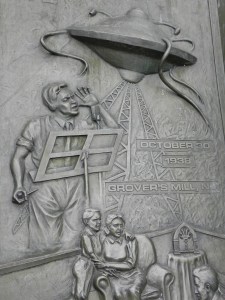
Do you remember that tragic sinking of a Staten Island ferry when a giant octopus pulled it under? Sounds vaguely familiar, but I wasn’t living near New York at the time. A story in The Guardian tells how Joseph Reginella, a sculptor, made his commemorative piece of art for Battery Park for a fictional incident. Like the memorial for War of the Worlds in Grover’s Mill, New Jersey, this is something we remember that never really transpired. We remember what never happened. It’s easy to forget that memory evolved for specific purposes. Mainly we remember for survival. Our brains evolved to keep us alive. If we don’t recall where we found water, or where that hidden cliff edge is, we don’t last for long. But we remember other things as well. The time that Oog borrowed your stone axe and didn’t give it back. Our social memory made us human, so we’re told.

dscn4239

No doubt it is possible to develop a keen memory. Precise recollection of events just as they happened, in sequence. It’s also possible, even collectively, to misremember things. We tell stories. We make myths. There was no giant octopus incident. Maybe we saw such a thing in a movie one time. That movie, paired with the plausible evidence of a public monument commemorating the event becomes a modified reality. I’m just sure I can remember it happening, can’t you?

Studies of such phenomena tell us that memories aren’t what they seem to be. To make distant recollections Holy Writ, for example, we have to rely on divine inspiration. Without it we might just be remembering a story somebody told once upon a time. And where did I put the car keys? Yes, our memories are open to manipulation. Things that never happened become real this way. George Washington did not chop down a cherry tree and confess to his father because he could not lie. And yet we believe. We make myths because they give our lives meaning. Face it, evolution is a pretty boring explanation for why we’re here. Natural selection has no goals in mind. Things that work best tend to survive in the gene pool. And in some people’s memory there may be a giant octopus in that pool as well. Did the the Cornelius G. Kolff get pulled under or not? Would a ship with such a name ever be made up? Myths are still born every day, even as the octopuses cower in their caves, awaiting the next naive ferry to transcend reality.


Colorful States

red_state_poster

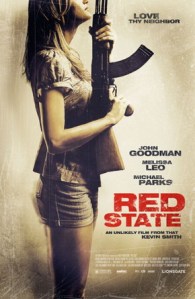
Kevin Smith is one of New Jersey’s own. I’ve always considered it one of life’s great ironies that Loki and Bartleby, the fallen angels in Dogma, move from Wisconsin to New Jersey, the exact same route my career took. (Feel free to read into this.) I was therefore curious when I heard, a few years back now, that Smith had come out with a horror movie. Now I’m not a fan of horror for its own sake as my sensibilities are more towards the ambiguities of gothic, but I finally decided to view Red State. I had no prior idea what the movie was about, but it speaks volumes that the title suggests quite a bit with just a simple adjective and noun. If there’s anyone out there even slower in getting to movies than me, and who is hoping to watch Red State, consider this a spoiler alert. Read further at your own risk.

Red State deals with religious fundamentalists—the Five Points Trinity Church, to be exact. The group is loosely based on the Fred Phelps gang, and the film actually makes reference to Phelps to say that Abin Cooper’s group is even worse. They’re weaponized. You’re probably starting to get the picture already. Cooper’s congregation is his extended family, and they’ve been protesting against homosexuality and other forms of what they consider immorality, but in an extreme way. They lure sinners into one of their sting operations, incapacitate them, and then murder them during church ceremonies. When the Feds discover evidence of a murder, a Waco-like Branch Davidian stand-off occurs with the predictably bloody gun fight that follows. There are moments of humor, but it is a bleak parable—yes, there is a wholesome message here—that speaks loudly about intolerance.

Analysts, well actually just some analysts, have realized that horror movies and religion are very close compatriots indeed. Reading the Bible may be a little easier on the eyes, but even some parts of the Good Book can inspire nightmares. Indeed, as Adin Cooper’s sermon emphasizes, fear of God is very important. As is fear of fear of God. The regression can go back as far as you wish. Religions develop in response to fears. Not only in response to fears, but clearly this is part of the mix. Horror movies show us what we fear the most. Is it any wonder that they cross paths with religion so often? The only unusual aspect for Red State is that it is so explicit about it. It is a traumatizing film in many ways. Maybe because (spoiler alert) the one who concocts the whole religion is alive and well at the end and is the last character that we see. Such are parables.


Banned Books

I feel short-changed. Cheated, if you will. This is Banned Book Week, and a story in Publishers Weekly over the summer touted the benefits of the local independent bookstore. Owners of indies know that these stores are centers of community. Gathering places for those who love literature. I feel cheated because my local town has no independent bookstore. Neither did any of the towns where I grew up. For a year when money was almost as scarce as it is now, I lived in Ann Arbor, Michigan. There were bookstores there. For a couple happy years before that I dwelt in Boston—a city in which books are never difficult to locate. Edinburgh is known as one of the literary capitals of Europe and my days in that magical city were inundated with books. Even Nashotah House, with its somewhat backward facing eyes, had a little bookstore. And there was another indie over in nearby Oconomowoc. I now live in the desert.

Oh, there are bookstores nearby. Independent ones, I mean. When’s the last time you saw a chummy conversation among locals at Barnes and Noble? Princeton has the Labyrinth. Bernardsville has the Bookworm. New Hope (while across the river in Pennsylvania) has Farley’s. There’s an indie in New Brunswick and I discovered Watchung Booksellers in Montclair just a couple of weekends ago. Clinton has a tiny little shop where my daughter once met a children’s author doing a book signing and I picked up some Ray Bradbury. These are my happy places. All of them require a drive of at least half-an-hour. I’m not a local. I don’t see anyone I know, except some of the clerks.

Analysts have been saying for decades now that we live in unhealthy isolation from our neighbors. I get up and jump on a bus before most houses show any lights in the morning. I stumble off and fall into bed after eating supper following the return trip. I’m not alone in my attempt to survive in this late capitalist purgatory. One thing that would help, I believe, is a local bookshop. There used to be a used bookstore in my town, called Chapter Two. I used to walk there of a Saturday morning, just to browse. Rent grew too high and it moved to the next town over and its name changed to chapter eleven. My local town is affluent. There are signs for Trump everywhere. What’s obviously missing is a local independent bookstore. I, for one, would be a regular patron.

img_2968


Becoming the Past

Back home for a flying visit over the final dregs of the summer, I find myself in a hotel in my hometown. It’s an odd place to be. As I’ve often remarked to those who know me, I remember living in three houses in this area and all three have been torn down. Looking over the vacant lot where my elementary school once stood, I have a feeling of being erased. Just up the hill from my hotel is a blank space, like when a molar has been removed, where my junior high school once stood. Even the seedy shops I remember from childhood are gone, an entire block of buildings torn down. Wal-Mart opened up just a couple miles away outside of town, and all small businesses got down on their knees and prayed before dying. Being from somewhere is more than just a matter of going away. It’s also coming back.

IMG_2930

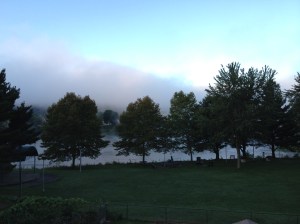
Standing outside in the misty morning sipping my coffee, I watch the river flow. There’s a fog rising over the Allegheny this morning and it makes this place look mysteriously beautiful. I think back to New Jersey, where I was at this time the day before, and how I can’t step outside without seeing other people. I go jogging at 4:30 in the morning sometimes. I’m never alone. On this balcony over the river I see no one. That person down by the river is really just a statue. Maybe I am too. What is left of a person when their hometown disappears? My fascination with ghost towns is catching up with me. Once someone said they thought I disliked small towns from the way I talked. Quite the opposite, the statue whispers. Quite the opposite.

If it weren’t for the people I know, would I ever come back here, I wonder. The warm coffee through the styrofoam cup reminds me of Judas. Even he knew how to kiss. This town, shrinking with age, gave me life. When I stamp the streets of Manhattan on my way to work, I know I’m a different man than I was back in this town. I would’ve found it difficult not to want to help anyone in need, back then. This homeless guy’s been sleeping in the same spot all week while millionaire wannabes look the other way. There’s a mist on the water this morning. The Allegheny flows on to the Ohio, and the Ohio on to the Mississippi. Down into the gulf that’s part of the ocean than encompasses us all.