Personal Heroes

I’m not inclined toward hero worship. Sometimes I think it must be a personality flaw on my part. The cult of celebrity is so pervasive that I feel desperately behind the times when I read what web-savvy authors write. Or maybe the truth is that my heroes live closer to home. Or lived. I grew up in a small town as the child of a working-class couple, both of whose sets of parents were not educated beyond high school. We were simple folk. We didn’t have much money and we didn’t have elaborate demands. My mother put up with an alcoholic and then absentee father, raising three children largely on her own for the better part of a decade. (She eventually remarried and the three became four, but I want to focus on the early part of the story today.) She had a rough life. Her hero, not surprising for an only girl with four brothers, was her father. Her admiration for him, whether genetic or via learning, passed on to me. I can’t claim to remember him since my grandfather died just before I turned two and just before he turned 75. As I grew up, however, he became my hero.
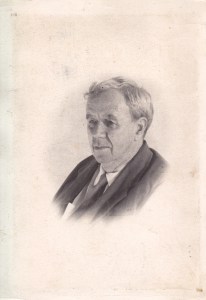
HomerSitterley

Today would have been his birthday, and I’m thinking about Homer Sitterley, my hero. He grew up on a farm in upstate New York and tried to better his circumstances. He taught in a one-room schoolhouse, which you could do in those days without a college degree. He also met my grandmother in that schoolhouse, which you could also do in those days. He had to change careers and became a civil engineer—still with no degree. He started and supported a family of five and moved around the country trying to keep his spouse happy. Back in the 1920s and ‘30s they moved from Virginia to Montana and back to the east, eventually settling in New Jersey, where my mother was born. They finally moved to Pennsylvania where my three brothers and I were born. He died there in August of 1964.

Homer Sitterley may have never worn a cape like one of his silly grandsons did in college. He didn’t have any super powers beyond the strong will to survive in a hostile and thankless world. He never grew rich despite hard work and few outside his family knew his name. He is a hero nevertheless. His kids were upstanding people: religious, polite, and kind. Their children—my many cousins—are good people. In a world where superheroes are shown increasingly as flawed, the real heroes are simply human. And my personal hero, although he never knew he was—and is—was a man who cared for his family to the very end. He was only human. And all the more heroic for being so.


Holy Oak

IMG_2876 copy

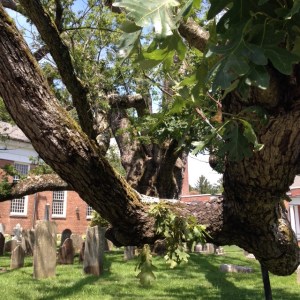
It was already ancient when first discovered by the early European colonists of New Jersey. The Basking Ridge oak is a well-known and time-honored New Jersey denizen. Over six centuries old, the white oak, it seems, is dying. Like it’s cousin, the Swamp Oak that I mentioned back in January, this tree is dear to many in the state. It is also historical. An article in the New Jersey Star-Ledger begins with some religious associations: George Whitefield, one of the evangelists responsible for “the Great Awakening” from which we’re still trying to awaken, preached under this very tree. George Washington also knew it. It has been tended and cared for by the town for so long that there is a reluctance to let it go. In the words of another New Jerseyan, “well everything dies, baby, that’s a fact.” Job, in a more optimistic moment, declared, “there is hope for a tree.” Like the Good Book, the good folk of Jersey wax religious about this sexcentarian, and for good reason. The human outlook is far too short.

Think, for example, of what was happening when the Basking Ridge oak was a mere acorn. In the early 1400s there were no Protestants yet. That didn’t stop Jan Hus and Joan of Arc from being burned at the stake, however. Although the Vikings, and perhaps others, had ventured here from across the ocean, North America was blissfully unaware of those waiting to claim for their own any land they could set foot on. Good thing too. The Inquisition was still underway and witch trials lingered on, flying in the face of enlightenment. Cambridge and Oxford University Presses were, in some sense, neophyte businesses. This Eurocentric view overlooks the great achievement of Machu Picchu down south. As the Dark Ages were beginning to lighten, this oak began its life’s journey. We who are a mere blink of its slow eye are still spouting hate for those who are different and are determined that nobody should outlive us.

The Holy Oak, as it is known, stands beside a Presbyterian Church. One of the trustees of the church is in charge of the tree. In the article he stated that this is about eternal life. From our perspective, trees seem to live forever. That’s because we are so dreadfully short-sighted. It’s surprisingly easy to become nostalgic for a tree so old. In terms of accomplishment, we think humans are exceptional for surviving a century of all the misfortune we dish out for one another. The tree, however, seems innocent by comparison. We’re changing the climate even now, making it more difficult for trees to thrive. We continue to shoot people for the color of their skin and although we don’t call it witch-hunting any more we still find ways of oppressing anyone who is different. At this rate we may need six more centuries to come to our senses. If only we had the perspective of a tree.


Virgil’s Vigil

IMG_2798I can never keep Virgil and Beatrice straight. I blame Dante. Allegories can be so tiring. So, sitting under a tree in Princeton, enjoying a root beer float prepared at The Bent Spoon, I ponder the empty bottle before me. Virgil’s root beer. So good, it states, that I’ll swear it was made in Heaven. It is good, I must say, but didn’t Virgil lead Dante through the other place? You see, I’ve just spent a pleasant morning at Grounds for Sculpture, the outdoor museum set up by Seward Johnson, a sculptor that some accuse of kitsch. Others come by the busload to see what it’s all about. Johnson’s cast sculptures of people are so lifelike that it isn’t unusual to find yourself staring at an actual person sitting on a bench, wondering if they’re real or not. I spend a lot of time pondering reality, and this place makes that question explicit.

Descartes said “I think therefore I am,” but what if I am really the thought of another? How would I ever know? As I wonder around among the sculptures, a different face of reality shows itself. Many of Johnson’s pieces are sculptures based on paintings. To get behind the surface you have to imagine what the unshown side must’ve looked like. That which the original artist left out. Any art is a matter of perspective. Unseen realities—isn’t there something Dantesque about all this? Is Virgil the guide through Heaven, or is that Beatrice?

These statues, in quotidian poses, are so real. If they’re cast from actual persons, maybe they are. After all, this camera I carry is capable of capturing souls. And if you don’t make it through the first time around, there’s always Purgatory as a safety net. This bottle in my hand causes me confusion. Is my tipple divine or diabolical? How much difference is there between them, really? Princeton is a place that needs no one, after all, except those who have already made a success out of life. A place with expensive root beer on offer. A vice for which I’m willing to pay. Maybe life is a divine comedy after all.


States Slights

States, at least the united kind, can have personalities. Some of us move after the diminishing herd of jobs and so end up in places we hadn’t really planned to live. In each state where I’ve made by domicile (six, as of the present), I’ve met people born and bred, down home and with no intention of ever leaving their native land. To such people, I imagine, state symbols may be important. I always felt unjustly proud of Pennsylvania’s Keystone status. I was born there, but neither of my parents and none of my grandparents were. I don’t live there any more myself. I was pleased and just a little surprised to learn that New Jersey has a state dinosaur (the hadrosaurus), discovered right here in the Garden State. This past week, according to an NPR story my wife sent me, Tennessee is trying to garner its own state dinosaur, in the form of the Bible as the State Book. I think it would be a great idea for each state to have an official book, but I would think that it might be a book written by someone from that state.

IMG_1363

Senator Steve Southerland, according to the story, put forward the legislation due to the Bible’s importance in the Volunteer State. The problem is, of course, the Bible is a religious book and that by choosing a religious book you’re getting dangerously close to choosing a state religion. “There used to be a wall here,” you can almost hear the constitutionally minded saying. The Bible is important. Whether we want to acknowledge it or not, no well-informed individual can deny that the United States has had a long and complicated love affair with the Good Book. As I try to show in many of my posts, the Bible still permeates our society in unexpected ways. Nobody’s trying to erase that history, but really, which state is going to select the Rigveda for its own book? Or the Qur’an? The Analects?

States are justly proud of their contributions to the whole. We have state flowers, mammals, trees, and birds. Tennessee’s is the Mockingbird. We have state slogans and mottos. But can any single state claim the Bible more than any other? I have to be just a little suspicious about claims that there’s no religious jingoism at play in suggesting it should be any state’s book. Yes, many Bibles are printed in Tennessee. Many writers have called the state home as well. Wouldn’t the more distinctive contribution come from a book that Tennessee actually had a hand in producing? Bibles, like it or not, can be claimed by all. I can see a tug-o-war coming with Texas, should this state symbol be canonized.


Foundational Books

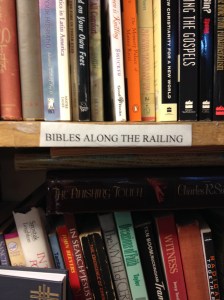
Over the weekend I visited one of my favorite used book stores, The Old Book Shop in Morristown. It’s neither huge nor fancy, but it has the feel that is so important to the restless mind. The feel of not knowing what you may find. The mystery of discovery. As I browsed, it occurred to me that although books of all varieties lodge here, the predominance of the old books tends toward the religious. The books associated with the church have survived for their centuries, closely followed by the classics—what was once considered the purview of the educated. I suppose one might argue that the breviaries, hymnals, and Bibles indicate overprinting on the part of overzealous presses, but I know that’s not the whole story. In fact, until quite recently the educated were expected to be religious as well. There was a kind of humility at work here. Even scientists respected the God who’d put all of this into place. This was not so much overprinting as it was meeting a prevalent need.

In early America, for example, if a household owned a book, it was more than likely a Bible. Bibles existed in profusion due to—putting it most crassly—demand and supply. People wanted to have a Bible. Particularly Protestants who’d been taught that it alone held the key to their salvation. There are some things you just don’t leave to chance. As that era continues to fade and people unload the books they no longer need or want, the Bibles and hymnals and prayer books make their way to antiquaries and I spend my weekends browsing among them and pondering how we came to be in this place.

Education—books—is/are foundational to our society. Books may be messy and lend to clutter, I’m told. In our apartment they climb in stacks alongside overfull bookshelves like ivy up the side of a tower, and yet I find them difficult to release. There’s knowledge here for the taking. The visit to the used bookstore inevitably leads to finds I hadn’t expected. There were no Bibles in my hand as I checked out, but no matter. I’ve got many Bibles at home. I’m aware that building requires foundations. Architecture may change over the centuries, but old foundations remain for millennia. To be educated is to be aware of them and appreciate them for what they are.

IMG_2732


Measuring Religion

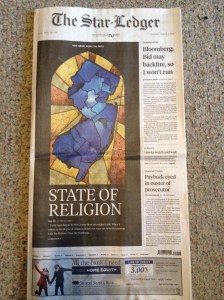
How do you measure the religiosity of a people? While the boundaries of the United States are somewhat porous, internally, we nevertheless still consist of somewhat self-governing states. One measure of religious belief is to take your metrics by state. Of course, some people—perhaps many—owe their state of residence to their work and not their natural choice. You’re judged by the company you keep, regardless. So when the New Jersey Star-Ledger ran a front page piece about religion in the Garden State last week, I was intrigued. I do spend quite a few of my waking hours in the neighboring New York, but for statistical purposes (and taxes and tuition) I’m considered a New Jerseyan. So what’s the damage?

IMG_2702

The story is actually about a Pew survey undertaken last year. New Jersey, it seems, ranks 19th from the top when it comes to religious states. Ranging from Alabama as the most religious to New Hampshire as the least, the measures of devotion are four: do you attend worship, do you pray frequently, do you believe in God, and do you profess yourself religious? Each of these questions provides its own set of problems when it comes to being an actual measure of someone’s commitment to religion. I maintain, as I often declare on this blog, that religion is one of those non-quantifiable aspects of life. It cannot be measured accurately because the tangibles are immeasurable. Deep commitment may be found among those who don’t frequently attend worship. What if your religion is a very private affair? And besides, doesn’t all of this measuring sound like a locker room contest?

As a nation, we spend a lot of time worrying about how religious we are or aren’t. Since such events as presidential elections have hinged on candidates’ piety since I’ve been old enough to vote, that’s understandable, I suppose. Nevertheless, such surveys are about surface belief. I recall in college being told that if your living space didn’t have enough evidence to convict you, you weren’t really religious at all. I know I’ve got quite a few Bibles laying around, and although we rent, we do have some religious artwork on our walls and mantle. I blog about religion daily. Still, I wonder where I might fall on some survey designed to tell me how religious I am. Such things can’t be measured with surveys, but in situations where the stakes are so high, we will do what we can to understand the imponderable.


Used Bookends

There’s nothing like spending a Saturday in a bookstore. It is actually a rare treat these days with Borders gone and some of the smaller indies having trouble keeping up. I particularly like used bookstores. Unlike most durable goods, books—at least some of them—grow in character with renewed ownership. Like most academics, I have books that had previously been owned by big names in the field. Sometimes because I was a student of one of their students, at other times because their library went for sale and I found the tome in a second-hand shop. A few years back I had to go to Boston for work, and I stopped at the Boston Book Annex only to find it closed. It’s sad when even a used bookstore can’t keep up.

So when my wife told me she had to work on Saturday, and it was in Montclair, my thoughts turned to the Montclair Book Center. It isn’t the largest bookstore around, but it does have used books and it is a healthy walk from my wife’s office. I never go planning to spend much, but being in a bookstore, you see things you didn’t know existed. When the staff comes up to ask if they can help me find anything I just smile and say, “No thanks, I just want to browse.” Maybe it’s because I have no idea what I’m looking for. I’ll know it when I see it.

IMG_2685

I used to visit the Cranbury Bookworm. In a sprawling old house outside Princeton, I often found pleasant, used surprises there. Then the landlord evicted them. They sold off most of their stock and moved to a closet down the street. Even though it’s tiny, there are always others there. I’m never alone in a bookstore. Other patrons feel the draw. I wonder if everyone who reads doesn’t owe a debt of obligation to stop into their local bookstore and pitch in. I grew up in a town without any bookstores at all. The nearest one I knew of was thirty miles away. I know what it is to be book-deprived. It’s Saturday, and a little too cold to spend much time outdoors. It’s probably just an excuse, but you’ll find me in the bookstore nevertheless.


Hamilton

Religion and politics. It’s difficult to get over the wisdom instilled in your earliest years, and I was one of those who learned that religion and politics always cause potential friction in polite conversation. They are both, however, very important to people and knowing how to communicate about them irenically is a sign of maturity. While I can’t afford Broadway shows, I have read reports about the brilliance of a couple shows that feature—what else?—religion and politics. “Book of Mormon” has continued to be a success in the theater district, and, starting this summer, “Hamilton” joined the ranks of most popular Broadway shows. A hip-hop-inspired version of the story of Alexander Hamilton, the show offers history to audiences traditionally just out for a good time. I haven’t seen the show, but on a recent long car ride, I listened to the soundtrack and I have to admit that I haven’t stopped thinking about it since. Part of the reason is the sadness of the story—the dual between Aaron Burr and Alexander Hamilton ended up with one of the “forgotten founding fathers” dead, and another cast forever as a criminal.

IMG_2652

Although my interest in history has defined my career (such as it is), I don’t pretend to know much about the revolutionary period. One of the reasons is that I’m more than a bit ashamed by the treatment of American Indians by the colonials. It is hard to celebrate when you feel like a criminal yourself. Another reason has been that ancient history has always captivated me, and events two-to-two-and-a-half centuries ago feel too recent. Nevertheless, I find myself in New Jersey where much of the Revolution played out: Washington crossing the Delaware, the Battle of Princeton, the Battle of Monmouth, and many other famous episodes. The British of that time enjoyed the power of empire—keeping others down so that the privileged might see themselves entitled. In the musical, King George has a role, in my mind, similar to Pontus Pilate in Jesus Christ Superstar.

I can’t help but think that what Lin-Manuel Miranda has offered in “Hamilton” is an extended kind of parable. The show is noted for its multi-ethnic cast in a story that was almost entirely, historically speaking, one of white privilege. Who can hear the songs swirling around the shooting of Hamilton and not think of the equally insane shooting of young African Americans who, like Hamilton, have no intention of causing harm? There are writers and poets and lovers who still try to find their place in a country that bathes the uber-rich with adoration and tax breaks and far too much power. “Hamilton” may, if people actually pay attention, turn out to be revolutionary. Politics and religion share that feature in common.


Silent Light

One of the first things I notice during and after a snowstorm is the silence. Part of it, I suspect, is the dampening effect the blanket of snow has on ambient sounds, but another part of it is the lack of usual frenetic human activity. Here in New Jersey it often feels like being in a perpetual motion machine. People are always going some place. Movement is constant and even if I have to head to the airport at 3 a.m. there is other traffic on the road. We are all too busy. Snow has the power to make one stop and reflect.

We live on a fairly busy street since we’re just a couple blocks from the county hospital. Further along our street in the other direction are the county jail and social services offices. People are going by constantly. When yesterday’s snow began, the traffic died down. For once people seemed to take forecasters seriously—driving would be dangerous, and the snow would keep coming well into the night. By mid-afternoon we had more snow in my town that I’d ever seen at a single time during my decade in New Jersey. It was as if winter came in a single day. But it was quiet. Very occasionally a snow plow would rumble by, but most of the day our busy street was deserted. A few kids ventured out, but not many since this was a blizzard (the definition of which is that wind is strong enough to lift snow off the ground and make it airborne again). The silence was almost disorienting. It was like living at Nashotah House once again.

DSCN6193

Silence has long been understood to be a spiritual virtue. Both eastern and western religious traditions recognize the value of listening. The noise may be internal or external, but it is nearly constant. Taking time to try to shut it out, if only for a few minutes a day, can be a spiritual exercise. A snowstorm can help to quiet the constant reminders that we have to do this or that, or that we have to be here or there. During a snowstorm we only have to be where we are, and we only have to do what we’re doing. Soon enough the roads will be cleared and the traffic will begin again. Until it does, however, it is worth exploring what the silence has to offer.


Swamped

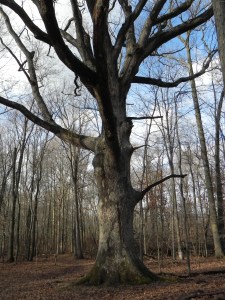
The word “venerable” is often applied with the connotation of age. Although the word in its own right really means to “adore,” or “worship,” objects of extreme age evoke that response. Perhaps the fact that “time-honored” is used as a synonym helps create that impression. As human beings, many of us experience an awe at being in the presence of something much older than ourselves. When I read about the Great Swamp Oak, then, I knew I would eventually need to see it. Reliable indications of a living tree’s age are difficult to assess for a non-botanist. Websites don’t give much thought to checking out the oldest tree in the state (although I did discover The NJ Big Tree Registry), but there are those who give that honor to the white oak of Basking Ridge, not far from the Great Swamp Oak. Others seem to indicate that the swamp denizen is older—somewhere in the range of 700 years. In the state of New Jersey, where things are constantly being reinvented and reconstructed, it is a source of comfort to find something so old leaving peacefully in a swamp.

DSCN6148

Now that I’ve used the words “tree” and “worship” together, I am inevitably brought back to the conceit of Asherah. As my academic writings have adequately demonstrated, I have doubts about the goddess’s association with trees. Nevertheless, there is something venerable about an ancient tree. If the Great Swamp Oak is 700 years old, it was already alive well before the “Age of Exploration” began. The only people to know of it, when there was as yet nothing to know, were First Nations inhabitants of the region. It was a time when, to American Indians, Europe did not even exist. Meanwhile across the ocean the plague could have been raging. A century or two later, Europeans would bring their plagues to these shores, forever changing the landscape. And not in a good way.

Trees, without human interference, can have tremendous life spans. In our short-sighted way, however, we have often understood them as nuisances in the way of some great shopping mall or industrial site. The “lungs of the planet,” trees have been wantonly destroyed in the name of progress. It is amazing that, especially on the East Coast, a few of them managed to avoid the axe and saw. Looking up into the branches of this great oak, I marvel at the changes that have taken place that, in its own way, this tree has “seen.” The world outside this swamp would be completely unrecognizable. Whether an asherah or not, I find myself reacting to the venerable nature of this sentinel of the ages. If only we could learn to keep our hands off young trees that nature plants, who knows what wonders future generations might experience in places even more unlikely than a swamp.


Thoughts in a Cemetery

DSCN6136

Being distinguished, indeed, getting noticed, is increasingly difficult to accomplish. When you read a lot of history, you realize that anyone who managed to write coherently in the past few centuries seldom had difficulty getting a publisher, for instance. The key to getting noticed was publishing books, or being lucky enough to have landed a highly visible job. I was reminded of this, and was given a slight inferiority complex, by a recent visit to the Nassau Presbyterian Church’s cemetery in Princeton. I’ve gone by this cemetery dozens of times, but only recently took the time to get out and explore.

DSCN6129

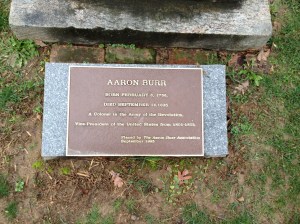
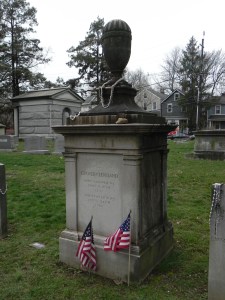
History buffs will know that Aaron Burr is buried there. Burr was from a family of privilege; his father Aaron Burr, Senior, was one of the founders of the College of New Jersey, better known by its current name of Princeton University. The vice-presidential Burr was also the grandson of Jonathan Edwards, who also rests in this very graveyard where one hopes God is somewhat more forgiving of sinners than rhetoric might suggest. Although he was the third Vice-President of the United States, Aaron Burr is now remembered for killing Alexander Hamilton in a duel not far from where my bus rumbles every workday. One kind of conflict exchanged for another. This odd and tragic duel ended Hamilton’s life and Burr’s career. As the bad boy “founding father” Burr has found a number of supporters posthumously. His grave is perhaps the most celebrated in Princeton. This despite the fact that President Grover Cleveland is only a few yards away.

DSCN6122

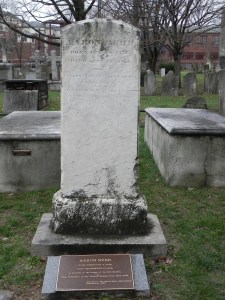
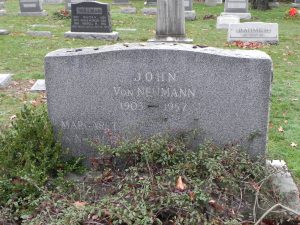
There are, however, more enlightened minds buried here as well. Being in the presence of Kurt Gödel and John von Neumann is a humbling experience. The presence of Albert Einstein, perhaps Princeton’s most famous resident, is, however, missed. Einstein was cremated and his ashes scattered at an undisclosed location. Standing in the cemetery in which so many of his compatriots rest on an overcast, damp December day, it felt like some slight compensation. Political power and ambition often lead to obscurity. I look to those who would be president and shudder. Here in this quiet cemetery, thinking of the common fate of us all, self-aggrandizement seems to be in such bad taste. Einstein, as so often, had it right. Those who are truly noteworthy seldom leave any traces in this world.

DSCN6123


Local Lore

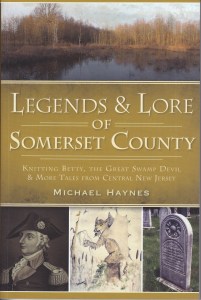
SomersetOne of the true joys of having more than a day off work at a time is the privilege to spend days reading. Although I read on the bus as a matter of course, it is a defined time, and editing isn’t as much reading as most people think it is. While doing research for my Sleepy Hollow paper, the question naturally arose: where did Washington Irving get the idea for the headless horseman? According to Irving’s biographers, the story was not an uncommon one. Headless ghosts are not unique, and he wrote the story while living in Europe as part of the serialized Sketch Book of Geoffrey Crayon, Gent. There is no practical way to know where he first heard the story. During my research I heard of a local source: Legends and Lore of Somerset County (New Jersey), by Michael Haynes. In this little compendium of stories of my current county, there is a claim that Irving learned about the story right here in New Jersey, where a traditional headless ghost rides. Again, it is impossible to say where he got the idea, but people like to feel that their local traditions are important enough to engage a major writer’s imagination.

Haynes presents several other regional tales that may rival the Jersey Devil and give ghosts a location just down the road. I suspect most places have tales of ghosts and mysterious beasts. It is always interesting to find out about those lurking in your own neighborhood. Scholars are now beginning to turn their attention to the sanctity of space. Location is very important to mobile beings like ourselves. The place where we find ourselves becomes “our place” and with the patina of time, often a personally sacred space. Tales of what happened here often take on the cast of the supernatural.

Local history has always held a deep fascination for me. Any region that I know, in a sense, intimately, is a region that has become part of my personal history. My region of Pennsylvania, for example, defines me although neither of my parents, or their parents were born in that state. And Massachusetts, Michigan, Scotland, Illinois, Wisconsin, or New Jersey, places I’ve lived, have become somehow alive with history. Legends and Lore of Somerset County contains tales that are not always believable in the workaday world we inhabit, but that’s the beauty of sacred space. Going beyond the mundane is entirely the point. Although Washington Irving may or may not have first heard of the headless horseman here, we have that legend, and there’s only so much that history can do to remove such a claim.


Deserted Village

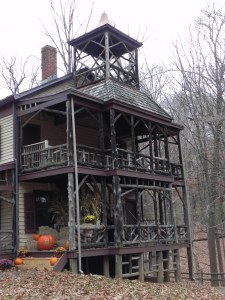
Hands up, anyone who’s heard of David Felt. Until just recently my hand would’ve remained down too. In his day, however, Felt was famous enough to have a town named after him (Feltville, New Jersey) and wealthy enough to leave it when it failed. Today the Deserted Village is a small tourist attraction, a wooded site on the National Register of Historic Places, and the residence of a few locals who prefer the quiet life. David Felt settled in Union County back in the days when it was rural, and established an industry around a mill. The available literature is frustratingly silent on what kind of a mill it was, but it was important enough for him to build housing to accommodate his workers out in the middle of nowhere. While many of the houses no longer stand, including that of Felt himself, the property has a few remaining buildings and a sense of history.

2015-11-06 22.16.35Upon walking into the park, part of the Watchung Reservation, the first building you meet, after a private residence, is the Union Church. Felt was a Unitarian. He nevertheless insisted that residents—his employees, remember—attend services weekly. The church, which is one of the few buildings open to the public, was a center of communal life. The timeframe here is the mid 1800s. Today employers are more likely to try hard to distance themselves from any religious activities, renaming any holiday gatherings with more neutral titles and hoping, rather than praying, that they won’t offend anybody. Of course, Felt’s business venture failed. Others that followed, sans church, didn’t fare much better.

The man that employees knew as “King David” went on to other ventures and has largely faded from history. Incredibly in this age of internet fame he doesn’t even have his own Wikipedia page. Symbolically, the only building that remains accessible to the public in the church—now a museum with a few artifacts from a century-and-a-half ago. Having lived not far from Feltville for nearly a decade now, I had no idea of its presence until a chance meeting held there brought it to my wife’s attention. We can build our own little kingdoms, it seems, and call them after our own names. They are no guarantee, however, that what we leave behind will not become a ghost-town as the interests of civilization move in directions we had never anticipated.


Legend Quest

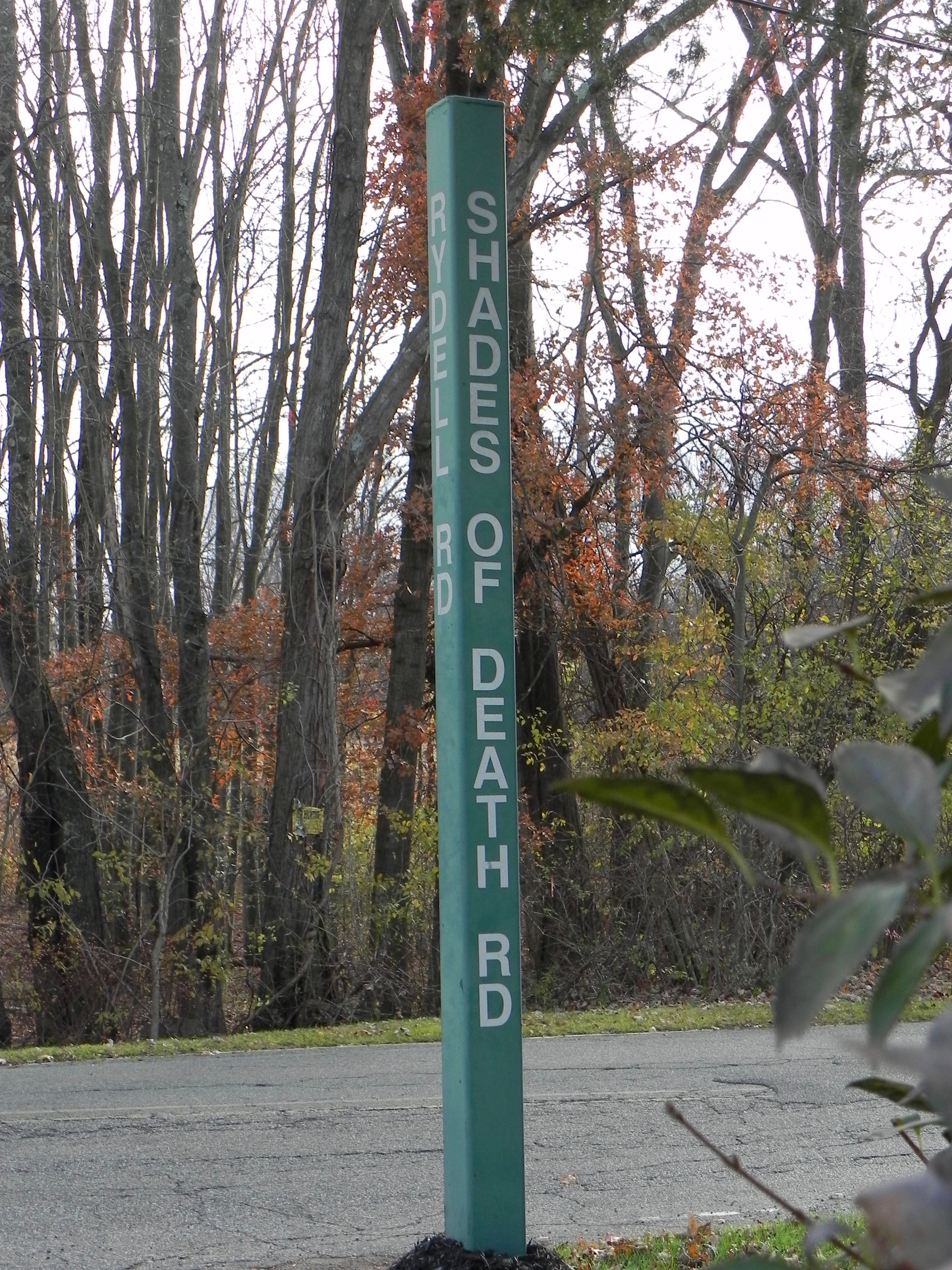
Legend questing is often considered a teenage pastime. Getting away from the mundane, or the oppressively normal, such road trips often lead to a place of spiritual significance, whether religious or secular. New Jersey, whose unofficial state song is about getting out, has its share of questing destinations. Reading Weird N.J. from time to time, one gets an introduction to such destinations handily served up in magazine fashion. The weird, as some scholars have noted, has roots in the religious—the uncanny. At times it is something about the physical landscape. Sometimes an historical event led to this status. Sometimes it’s just a name. Finding accurate information about Shades of Death Road, in Warren County, New Jersey, is somewhat of a fool’s errand. Although my wife and I aren’t teenagers anymore, on Halloween we decided to visit the reputedly haunted location.

2015-10-30 21.08.22

The area is not easy to locate, even in a state with as much road cover as the Garden State. Still, it is a beautiful road, once found. Huge boulders from the nearby Jenny Jump State Park—a place with its own legendary past—interspersed with old trees come right down to the edge of the road. A gorgeous lake, called Ghost Lake, also delights the passer by. The road signs, which are frequently stolen, were nowhere to be seen on our trek. It is, however, easy to see that in days before hermetically sealed cars with auto-lock doors that practically drive themselves such a locale may have brought danger to mind. Local legends claim it as a haunt of highway men, not a few of whom were hanged among its many trees. It was a partially sunny afternoon as we drove along, and lawns were decorated with faux graveyards and ghosts floated down from trees. It was a pleasant way to be haunted.

The typical legend quest involves getting out of the car and engaging in some kind of ritual to see if anything happens. Since this was a spur of the moment trip, I hadn’t done my homework to find out what manner of incantation should’ve been said. Had I prepared, I would’ve had to have selected from the many disparate legends that circulate around the road. Even in the sunshine with little traffic, the place could easily stoke some unexpressed fear. Although the road was named long ago, for reasons that no one truly knows, it maintains its mystique. Curvy, and in places with the roadsigns heavily vandalized, it is clear that a more modern sort of danger might lurk here after dark. Nevertheless, as we emerged back onto a road with a less dire name, I couldn’t help but smile. Shades of Death Road ends at Hope Road. And that, surely, is no accident.


The State Demon

It’s the time of year for seeing things. I suppose that’s why there have been two supposed sightings of the Jersey Devil flying around the internet this past week. The credulous take these kinds of things for evidence, and the posters claim complete sincerity and who doesn’t want to believe? Still, the photos and videos fail to convince. It’s the time of year when we want to see monsters.

DSCN0128

While the origin story of the Jersey Devil is one of the main strikes against it for sheer impossibility: Mother Leeds, who had twelve children, finding herself pregnant with a thirteenth, wished that it would be born a devil. The cursed child, meeting motherly expectations, came out a devil, flew up the chimney, and has haunted southern New Jersey ever since. The folklore elements are thick in this tale: the thirteenth child, the exasperated mother, devils in the woods. This doesn’t, however, suggest much confidence in the literal truth of the story. This traditional tale circulated in the same region where legitimately strange things were seen, especially around the turn of the last century. Every now and again the devil reappears in a present-day venue. At one time the Jersey Devil was even the official state demon of New Jersey.

The ease of use of photo-altering software has taken us further and further from the truth. It is an impoverished world that has no mystery to it, but the easily hoaxed world of Photoshopped monsters will cast doubt on all contenders, I fear, forevermore. We can no longer trust the veracity of the lens. Our world has become an electronic illusion. The creature spotted in the Pine Barrens can be more readily believed without photographic proof. The sober, shaken witness who can’t explain what s/he saw one dark night is more believable than a goat with wings or a stuffed animal on a string. Our religious sensibilities urge us to believe in the impossible. Our cameras urge caution. After all, internet fame is often the only kind available to those whose videos and photos go viral. The devil, they say, is in the details.