Devil’s Food

One figure among the standard repertoire of Halloween characters has never appeared on my list of favorite monsters. I suppose it may be because as a child I fervently believed there was a devil that he never made my A-list. Satan was real, according to my church, in some almost biological, corporeal form. Even as a youngster I knew vampires, werewolves, Frankenstein’s monster, and the rest, really didn’t exist (even after I hid under my covers all night once, after putting my head down on a bat that had flown into my bedroom). The devil was, however, biblical. And I never felt tempted to dress up with red horns and pointy tail, carrying a plastic pitchfork. Halloween was always among my favorite holidays, but it was for pretend monsters and ghosts (which might perhaps be real, but which were not diabolical, according to my childhood economy of the spiritual world). The consequences of devil imitation seemed eternal, and even today, in the rational light of the twenty-first century, I can still be given pause even though I know the concept is a Zoroastrian one that morphed into early Christianity’s need for a kind of anti-Christ.

IMG_0276 copy

There are many who still believe in a real devil. Some branches of Christianity (and Islam) teach that a literal devil lurks about in our world. In western culture he is a figure instantly recognizable, although there are differences of opinion in his anti-iconography. Last weekend I visited a fine little restaurant in a New Jersey town that has a reputation for being haunted (the town, not the restaurant). It was a seat-yourself day and the table my wife and I ended up selecting had shellacked cards on top as part of the decoration. There in front of me was the devil. I pondered this. The cards, all captioned in Spanish, had mundane subjects: an umbrella, a musician, plants, a spider (okay, so that last one’s a little scary too), but only one supernatural figure. Perhaps the entire deck, had I seen it, might have had more. No doubt, for a world that postulates a good God, a devil covers, well, a host of evils.

The word “devil” is somewhat loosely applied these days. New Jersey has its own cryptid called the Jersey Devil, which has led to iconic names for sports teams and perhaps a public official or two. But even in the aftermath of 9/11 there were those who seriously postulated seeing the face of the devil in the tumbling debris of the twin towers. For a character of the religious imagination, the devil has managed to impress deeply on the human psyche. I know in my rational mind that I should simply dismiss all of this and get on with the business of enjoying the monsters that will show up at my door later this week. Nevertheless, when the waiter comes out with our food, I look down at the table and decide to pass on the hot sauce for today, just in case.

The Joy of Tech

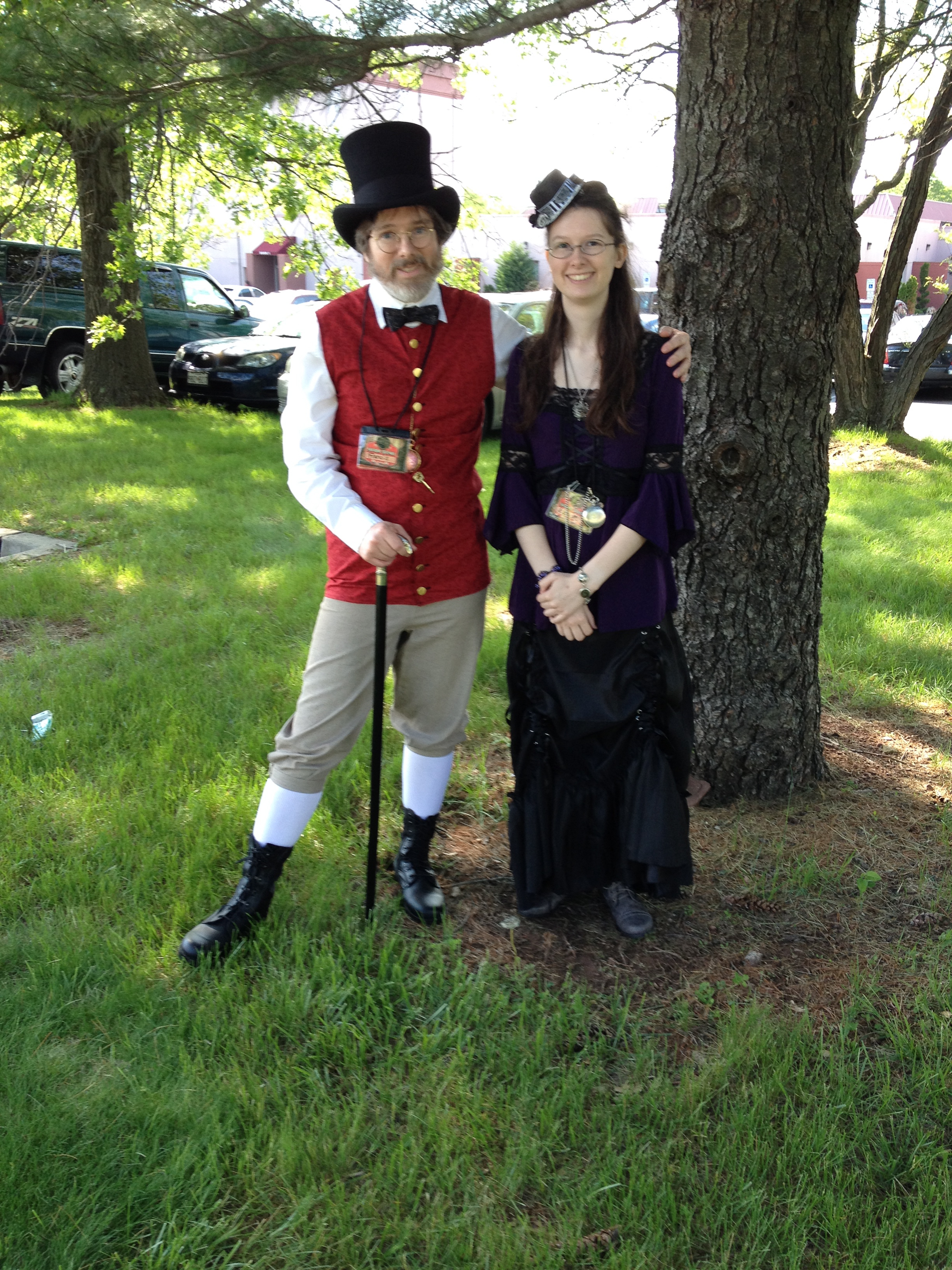
In the age of Steampunk, New Jersey is among the world capitals. Indeed, today is the second day that the International Steampunk City will be inhabited in Speedwell, home of the telegraph. For yours truly, Steampunk is an escape. Alternate realities often look better than the pedestrian one we’ve inherited, so we like to look at the world through steamy lenses and imagine how it might have turned out differently. New Jersey, in the spring, also hosts the Steampunk World’s Fair. Perhaps we have more pressures to escape here in the Garden State. Imagination is certainly in no short supply. I attended the International Steampunk City last year and decided that I’d like to be a part of it. Knowing a thing or two about ancient technology, I thought I might share a bit with the Steampunk crowd. What is Steampunk without tech? Some ancient technology, although not very well known, is perhaps of even greater influence than we might imagine.

One of the connections that is easily misplaced in this era of purely scientific advance, is that technology was devised in the service of religion. At least in the early days. The greatest architectural achievements came under the aegis of temple building. Domes, arches, and eventually flying buttresses that could hold tons of stone high over your head—these were to please the gods. We can’t imagine Stonehenge as anything other than a capitalist venture these days, a way of drawing in the money. Of course, ancient builders knew of the financial benefits as well; temples were often the equivalent of ancient banks. Still, beneath all the pride of accomplishment there was the belief that the gods were somehow pleased with our innovation. Perhaps we’ve just done away with the convenient myth. Steampunk often has a religious underpinning. Many of the stories I’ve read touch on our ancient mythologies. Only, in fantasy, there are different possible permutations.

We sometimes think that technology is a modern phenomenon. Actually, it is quite ancient, as far as human culture goes. The first “computer” was invented around about the first century. Since it didn’t have an obvious benefit to the control of the masses, however, no technological revolution took place. The steam engine was, in nascent stages, invented also in ancient times. Until we learned, however, that it could be enslaved to make certain industrialists rich, we had no need for it beyond a diverting toy. Technology does not take hold without a deeper purpose. Every now and again I get a little paranoid knowing that I carry a telephone that knows my exact location at all times. As if I were important enough for anyone to care. Then the feeling passes and I open my iBooks app and turn to my latest Steampunk novel. I am a slave. I wonder what innovations there will be at International Steampunk City this year that might change the world. Only the imagination will limit the possibilities.

DSCN4341


Historic Crossing

If Washington crossed the Delaware, I figured, so could I. Of course, I have a car and I was going from New Jersey to Pennsylvania, but history doesn’t always repeat itself precisely. In New Jersey, the landing side of the crossing, a modest park marks the spot, along with plenty of space for outdoor activities. Pennsylvania, meanwhile, has a tripartite park which includes sculptures, an historical village, and a tower. The tower was built from 1929 through 1931 in commemoration of the momentous crossing. My mother visited the site as a teenager, some few years after it opened. On a mission to recapture part of her childhood, I made a visit to see a bit of history, and also to experience the great views. As far as towers go, this one isn’t the tallest, but in Bucks County, it is among the highest points and you can see for many miles on a clear day. On the top of the tower I overheard a man explaining to his family that Washington built the tower in the 1700s and that it was used in the Revolutionary War. He lamented that it would be easy to be trapped on top of the tower, and urged his kids to imagine what it would have been like.

DSCN4865

My thoughts went to the Bible. We’ve come to know through archaeology and comparative sources that many of the events portrayed as history are about as accurate as having Bowman’s Tower built by a long-deceased George Washington. And yet we continue to teach children that stories for which no evidence exists are history. We don’t always have a good grasp on how to tell the difference. In the United States George Washington is nearly divine in reputation. His travels are attested on an almost omnipresent scale; even my childhood home of Franklin, a tiny burg near the Ohio border in Pennsylvania, saw visits from the general. I grew up knowing little of the history of the man who would become the first president. I did know, however, that he’d crossed the Delaware.

History is not so easy as it seems. What “actually happened” on the ground may not offer much meaning to those who seek it. Only when the events become story—sometimes sacred story—do we start to get a sense of why the Bible has such a grip on a large swath of the human race. It is story with no apology. Its historicity is far beyond recoverability: who saw the creation of the world? Even the events in the human timescale were written, for the most part, centuries after the occurrence, with all the liabilities that entails. Built by members of the Washington Crossing Park Commission, the park I’m visiting intends to demonstrate the importance of a singular event that led to the freedom of an entire nation. Indeed, the crossing of the water to free a nation has a distinctly biblical feel to it. And even if that first exodus never happened, we tell our children it did, and we have no less a figure than George Washington building a tower to prove it.


In Our Own Backyard

That monk walking towards me looks a little suspicious. Perhaps it’s that guy with a top hat and weird gun strolling next to him with a waxed mustache and carefully sculpted beard. Like a page ripped from ComicCon, the Steampunk World’s Fair draws people from all across the east coast (perhaps even further afield) to Piscataway, New Jersey, or some venue near Rutgers, every spring. In a world where work routinely stifles creativity, a weekend of subculture is about as good as it gets. As a veteran of over two decades of Society of Biblical Literature meetings, I’m used to large conferences. Only this is much more fun. The Steampunk World’s Fair draws some 4,000 people, most of them baroquely costumed, to a sleepy corner of an overly developed industrial corridor, courtesy of Jeff Mach and Widdershins LLC. I met Jeff Mach at Steampunk City last October. A natural promoter, he has a way of getting events noticed.

Steampunk is more than a literary genre. It has become an eclectic mix of the technical and supernatural, the scientific and the absinthe-laced dreams of fantasy. An element of H. P. Lovecraft fandom is clearly present at the World’s Fair, as is an interest in Victorian spiritualism. Indeed, it would not be difficult to concoct a religion out of this heady brew. Like most human cultures, there is no pure form here. Vendors will be glad to accept your money, but true artists put great effort into unique pieces of creativity and style. I’m here, not feeling entirely safe surrounded by such strangeness, wondering if this isn’t a natural outgrowth of what happens when a technically oriented society too long denies its emotional subtext.

Role-playing is catharsis. Many of us spend our days feeling relatively powerless in a capitalistic system that is overwhelming and stifling. Thomas Piketty meanwhile suggests that extreme economic inequality leads to a breakdown of a system that favors too few. Although restraining himself from the economic implications, Frans de Waal notes the same phenomenon among primates that we insist on calling lower than ourselves. Bread and circuses, we know, only kept imperial Rome going for so long before it collapsed under the weight of inherited greed. Under great pressure, the people will play. This feels a bit heavy for the Steampunk World’s Fair, however. I can’t recall the last time I saw robots rubbing elbows with bearded, cross-dressing nuns, and nobody thought any of this was out of the ordinary. Or maybe it’s just the absinthe-flavored truffles talking. I know where I will be, in any case, come next May.

A typical sight.

A typical sight.


Take Twice Daily

Once in a way, when I feel a dusty archaism settling over me, and I realize my eyes don’t focus as well as they once did and that sedentary life in front of a computer screen is slowly killing me, I betake myself to a book sale. In this particular part of the country the big sales are in the spring. I’m told that the book business is dying, but if I can get out of a book sale with no bruises or scary brushes with over-eager buyers, I count myself lucky. I confess, I’m a bookaholic. I spend too many hours a week on public transit, and I consider it a moral obligation to read in public. Even in a city the size of New York, I’ve had people on the bus plop down next to me and say, “You’re that guy who reads.” Public displays of literacy. While some of the books I read are common enough, others are difficult to find in even university libraries. I know that’s an excuse, but my vice is buying books.

I once read a children’s story about a house actually constructed of books. I want that house. Although new books aren’t cheap, there are ways of making them fit into a modest budget. And although you really can’t build with them, they insulate the soul. Reading is more than fundamental—it is the very essence of learning. When I glance at Publisher’s Weekly and read that print sales aren’t what they used to be, I am buoyed by seeing the strong market in young adult literature. We have at least raised a generation that likes a good story. The earliest literature was religious, and many religions developed around written words. It’s a mistake to take religion for gullible belief. If there weren’t power in these words, why would anyone believe?

photo 2

Local book sales can be huge events. Each year Bryn Mawr and Wellesley have a combined book sale in Princeton. If you get there after opening, there will be no place to park. The libraries of Hunterdon County in New Jersey hold a sale that, until this year, required off-site parking and a full three days of hiring a shuttle bus service to get hundreds of buyers back to their cars. And these venues are packed. People do buy books. And many of them are half my age. It is a seed of hope. Some people are surely looking for a quick read, maybe to take on vacation, but you can also see the seasoned, selective literati carefully examining the offers, backs bent, brows furrowed. For twenty dollars you can even get in early, before the goods have been picked over. The man checking me out said the sale gets bigger every year. Looking out over the sea of cars, I feel strangely ebullient, as if I’m atop Nebo looking over the promised land. Although it’s quite a drive, I’m already home.


Take a PAAS

Like so much of life, PAAS Easter Egg coloring kits were the result of an accident. To be more specific, a chemical accident in New Jersey, something which is far from rare. This particular accident, however, had a fortuitous side-effect: the brightly colored (but not radioactive) Easter Egg dye that many of us associate with childhood. Around 1880 Newark druggist William Townley spilled colored dye onto his suit, leading him to individually package holiday colors, according to a story in the New Jersey Star-Ledger. That individual packaging allowed for a full set of egg colors to be sold together and the PAAS brand was soon launched.

The idea of coloring Easter Eggs, like so many Christian traditions, likely has pagan roots. Eggs were a sign of new life with the coming of spring in many cultures (although boiling the poor things rather defeats the purpose). Christians adopted the egg as a resurrection symbol—the chick pecking out of its shell was like the resurrected Jesus bursting from the tomb, albeit somewhat less dramatically. Watching a newborn chick hatch is an emotional experience. At the 4-H Fair, standing around the incubator in the chicken tent, you can see wobbly, uncertain, tiny birds tentatively trying to assess this strange new world that is colder and somehow more compelling than life in the shell had ever been. The mighty son of God they’re not, but they are much more like us, looking for answers and taking small steps until they’re more certain of what they face.

DSCN4483

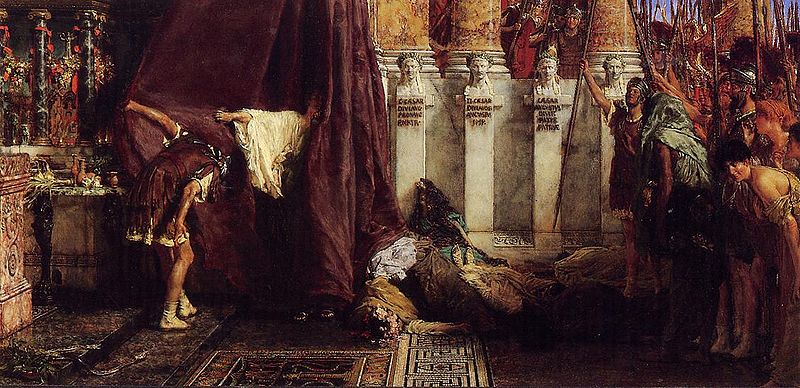
The coloring of eggs has origins lost in antiquity. Nobody’s quite sure why it was done beyond the fact that they look nice. Romans ate eggs as part of their spring celebrations, and Christians came up with a story to explain colored eggs. The legend claims that Mary Magdalene, in trying to convince the emperor of the truth of the resurrection, turned eggs from white (or brown, as they likely were in those days) to red in her open hands. This proof, however, failed to convince the Caesar. What seems certain is that pagans liked coloring eggs so this provided a new source of evangelism to the Christians who assimilated the practice. Like Christmas, the Easter Egg has become a thoroughly cultural symbol—since Easter comes on a Sunday employers aren’t obligated to give the day off, so everyone can celebrate. Children hunt eggs on the White House lawn and we can still expect everyone to be in the office on Monday morning. Resurrection, after all, can only reach so far.


The Lost Forest

DSCN4420

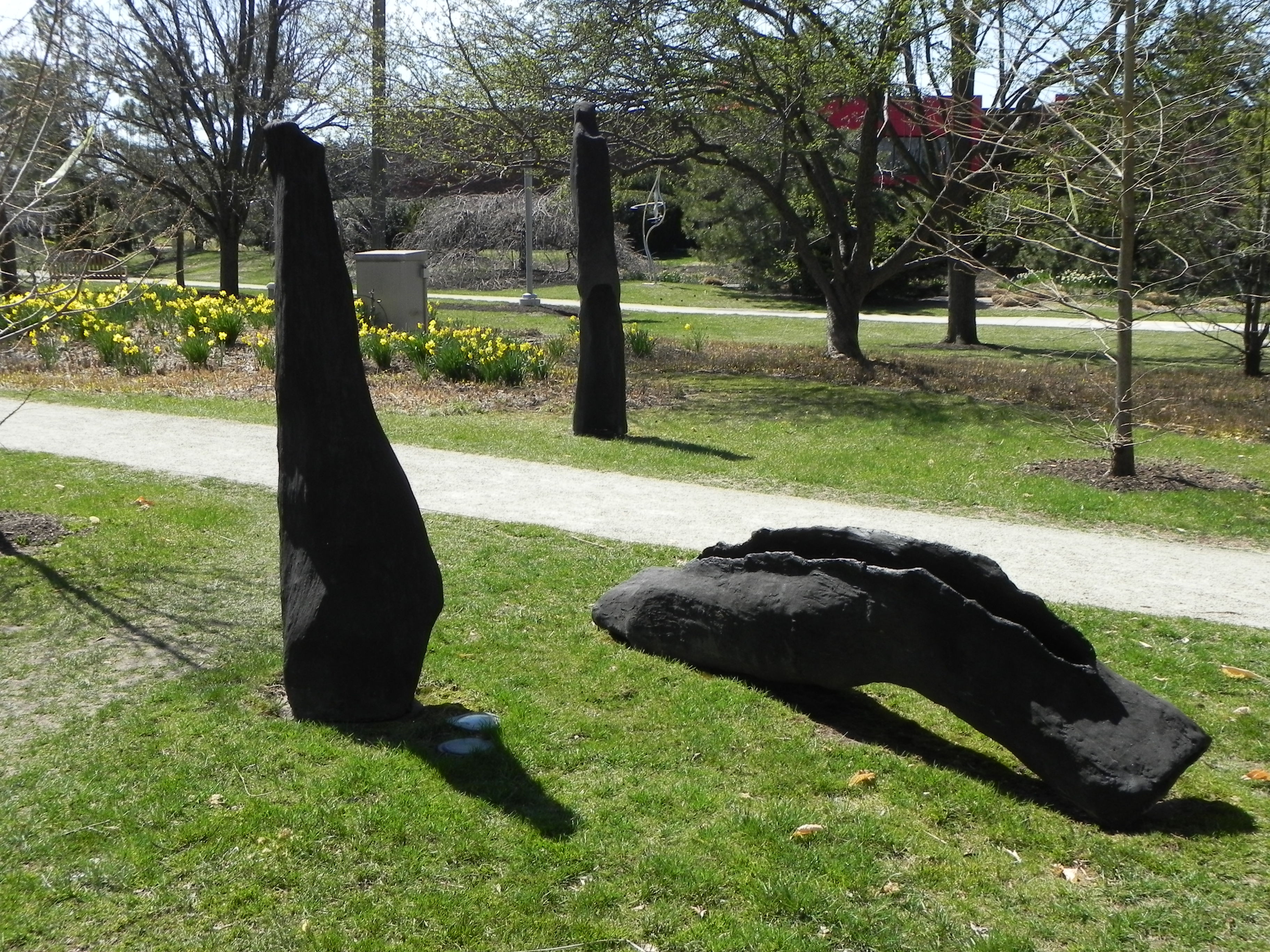
Asherah has, from lack of new material, fallen into a quiet retirement among the gods. For a while there no shortage of new books appeared, including my first, which explored many aspects of this shy goddess. While academia has pushed her to her logical limits, she has thrived in the world of popular imagination. I was reminded of this during a recent visit to Grounds for Sculpture, a whimsical park in Hamilton, New Jersey featuring the work of many artists. The appreciation of art works on many levels. A piece of sculpture can take on new meanings when viewed from different angles, and a piece that seems to make no sense can become imbued with meaning when new perspective is added. Sometimes it is the title of the sculpture. A friend had pointed out to me last year that one of the artworks was entitled, Excerpts of a Lost Forest: Homage to Ashera, by Tova Beck-Friedman. Ironically the sculpture is from the same year as my finished dissertation on Asherah, a continent away. I must have seen this sculpture many times, but without knowing what it was, had paid no attention.

DSCN4424

Asherah is often considered a goddess of trees. My research indicated, however, that such an association was premature. Of course, any discourse that has the Harvard University stamp of approval is decidedly fact, despite contrary evidence. Nevertheless, the dendrite nature of the goddess has persisted into popular culture and even into the world of abstract sculpture. The loss of a forest is, no matter whether goddesses are involved or not, tragic. Asherah has become the protectoress of trees.

DSCN4422

The nature of this particular lost forest isn’t clear. At first it might appear that a fire has gone through, claiming the vitality that once thrived in green leaves and mottled bark. I sense that something more is happening here. Asherah is, above all, the divine female. Here single-most constant role in antiquity was as the spouse to the high god. The loss of the forest still speaks to the on-going repression of women. We like to think that our society is headed toward equality, but progress is painfully slow. As usual with lack of momentum, religious institutions lead the way in conservatism. In the largest Christian body in the world, and in some of the fastest growing religions on an international scale, women are kept from leadership roles on the basis of gender alone. Monotheism declares there’s one god for two sexes. Those who experience life from the other side are like trees falling in the forest. We still don’t know if anybody hears.


Mad Charles

Moving to New Jersey was made easier by Weird N.J. I found out about the magazine while still domiciled in Wisconsin when the series of books produced a Weird Wisconsin edition. I read it cover-to-cover and learned about the magazine. When weirdness would have it that we’d be moving to that self-same New Jersey, I began reading the magazine religiously. Lately, however, it has become more mainstream and less weird, but still, it is a great source of local information. We landed in Somerville because of its educational reputation and closeness to Piscataway, where I worked. I’ve always had a thing about being able to pronounce the name of the town in which I live (and I’ve even resided in Oconomowoc), so Piscataway was out. In any case, Somerville High School has an engineering program and the expected robotics team that goes along with such pedagogy. When my daughter joined the team, the whole family was drawn into four years of endless fundraising and promotion for an underfinanced club. So it was weird when I saw a story called “Rock em’ [sic] Sock ‘em Robot: Somerville N.J. vs. Mad Charles, the World’s First Singer Songwriter Karate Robot” in the latest Weird N.J. In my four years in the club, I’d never heard of Mad Charles.

Robots and religion are topics I’ve often related on this blog, so I read with amazement that about two decades before FIRST Robotics ever got its start, there was a somewhat famous robot in Somerville. Eugene Viscione was the inventor of Mad Charles, a robot that was built to help improve karate moves. The robot, as often happens in small towns, went on to other things, such as cutting records that, according to the article by J. A. Goins, are quite rare. In the 1970’s, however, Mad Charles was a local sensation, now all but forgotten some four decades later. There were even Mad Charles tee-shirts available. While we sat dreaming up new ways to get money out of the locals, and even set up a booth for the Somerville street fair not far from where Mad Charles at one time could have been found, nobody mentioned the karate robot. I doubt anyone had heard of it.

History is a fickle friend. Of course, being from a small town myself, I know it is very hard to get noticed, and even harder to be remembered. So those sleepy, pre-dawn weekend bus rides to robotics competitions, it was sometimes easy to consider how one gets overlooked. This past November, many hardly noticed as NBC didn’t make a big deal of it, FIRST robots opened the Macy’s Thanksgiving Day Parade. Somerville’s latest robot was not among the horde (we have always had a problem keeping enough charged batteries on hand), but as the robots rolled through Herald Square, I was thinking of Mad Charles and a legacy that has been forgotten. Come to think of it, I guess that is weird after all.

A Somerville robot (center)

A Somerville robot (center)


Holy Ghost

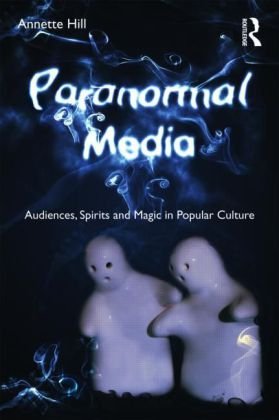
paranormalmediaOn a family trip to Cape May, New Jersey, some years back, a ghost tour caught my eye. My daughter was old enough not to be unduly scared, and appropriately curious. With a group of total strangers we walked the streets after dark, hearing tales of tragedy and woe. Little did I know at the time that I was being trendy. I just finished Annette Hill’s Paranormal Media: Audiences, Spirits and Magic in Popular Culture. The first point that really haunted me from her study is that the media has transformed the paranormal from religious to secular. I have always considered that paranormal belief and religious belief share an enormous amount of fuel—they are driven by similar engines. Then some media folk figured out that, like religion, the paranormal could become a revenant “revenue stream.”

Hill has other ghosts to hunt in her study—she is a media scholar after all—but I kept wondering about the cheapening effect of commodification. That which creates the most wonder becomes the most tawdry when it’s put up for sale. Life is terribly ordinary. There’s an ennui to much of human experience, so people turn to religion, drugs, or increasingly, the paranormal, for escape. But as any savvy media expert (or Heisenberg fan) knows, being involved in the experience changes the outcome. This applies to money just as it does to people. One is more evil than the other, however.

Experiences of awe are a dwindling resource. The frisson of many an adolescent night when something unexplained or holy lurked outside your window has now become just another CGI gag pulled on a gullible public. I used to watch Ghost Hunters on DVD. Then someone released debunking b-roll footage on the internet, making me feel like I’d wasted more than a few irredeemable hours on a fraud. Just one prank is all it takes. Why? The show has to make money, and who is going to watch if nothing is found? Don’t be offended, it’s only entertainment after all. Nobody said there really was anything that you couldn’t plumb yourself. Maybe it’s just me, but it seems nothing frightens a ghost away like money.


Bridge over Troubled Waters

“Let not many of you,” wrote the wise James, in a widely ignored admonition, “become teachers, knowing that we shall receive a stricter judgment.” The same could be said for politicians. Lord Acton, seconding James, noted “power corrupts,” and yet who is not drawn to its flame? The news has been awash in a flood over the George Washington Bridge scandal, something I could not appreciate until I joined the ranks of the myriads of commuters to Manhattan. The evidence is pretty clear that Chris Christie’s top staff (ahem) purposefully closed lanes on the George Washington Bridge to retaliate against Fort Lee mayor Mark Sokolich’s refusing to dance when the pipers piped for Christie’s reelection. I didn’t vote for Christie, and now I wonder if that is why my New Jersey Transit bus often comes so late that I’ve taken to calling it the Jesus Bus, since I never know when it might come again. Ah, the rush of power that encourages the grinding of the boot heel into the face of the smaller opponent. Could anything be more human?

Perhaps, in this world of infinite possibilities, Christie knew nothing of what his top aides were doing. The culture in New Jersey, however, as those of us who live here know, has been cast in the very large shadow of bullying. We spend taxpayer’s money to teach our children not to bully while our politicians give the lie to the teaching we purchase. “How the mighty are fallen,” lamented King David. But even he had his Bathsheba scandal. And many on the right claim their politics derive through their commitment to his great-great-great-great-great-great-great-great-great-great-great-great-great-great-great-great-great-great-great-great-great-great-great-great-great-grandson, if I count correctly. Let not many of you become politicians.

Manhattan is an island with limited access. The Lincoln Tunnel and the Holland Tunnel are for the troglodyte crowd, while the George Washington Bridge is the busiest bridge in the world. “He could have called,” the old evangelical hymn goes, “ten-thousand angels.” That’s roughly a forty-to-one ratio for New Jersey commuters to New York to angels. Somewhere along the line, the populace became the unwitting plaything of politicians. Stop a hundred-thousand people from getting to work? It’s just an arbitrary number. Never mind that trust used to be part of the social contract. As a citizen who spends approximately three hours a day on a bus, or waiting for one, I have to wonder whose best interest is in the mind of our elected officials. Yes, James, had I listened to you this might have all turned out very differently indeed.

Photo credit: Fly Navy from Wiki Commons.

Photo credit: Fly Navy from Wiki Commons.


Won’t Someone Think of the Gods?

The annual holiday tradition of fighting over peace on earth has begun. It’s difficult to attribute blame since the “Keep Christ in Christmas” crowd do have a certain historical parsimony about them. Still, it was with tongue frozen in cheek that the Freedom From Religion Foundation put up a billboard in Pitman, New Jersey, with the message “Keep Saturn in Saturnalia.” Won’t someone think of the gods? In just the short span of my lifetime (well, half-a-century is really not that long) many assumptions about American religiosity have come to be questioned. There are those who seriously believe the Greco-Roman gods exist and they do have a right not to have their religion belittled. Those who find all religions laughable, I suppose, have the right to belittle. Some are devoted to Saturn. Others take seriously the Norse gods. Belief is like that—rationality is not a huge part of it.

Megyn Kelly, an anchor on Fox News, boldly declared this past week that Santa is, by dint of historical fact, white. I suspect she wasn’t thinking of Nicholas of Myra, but rather the jolly (white) man with glandular problems and the magical ability to visit every house in the world in a single night. The historical Saint Nicholas was born in Turkey. Kelly also made an unequivocal claim for Jesus’ whiteness, although he was clearly Semitic and historical records about him are extremely dicey. Conservatism, it seems, can only be pushed so far. I tend to think the problem is with making people into gods. Once a person becomes divine, in a monotheistic system—apart from all the theological casuistry than ensues—the nature of godhood is irrevocably associated with one race only. Of course Kelly, and many Fox News fans, have co-opted Christ from Judaism and suppose he was rather Nordic, as an article on CNN’s Belief Blog notes. Kind of like Thor, for what carpenter doesn’t know how to use a hammer?

To keep (white) Christ in (white) Christmas does betray a lack of familiarity with the Christmas story. Apart from angels appearing to some shepherds, the event was obscure—in the part of town across the tracks. Even the wisest men in the world had to stop and ask directions because they couldn’t find the place. The first Christmas, in as far as we can reconstruct it, was a silent affair with only the sounds of birth and the quiet desperation of a working class family far from home. No malls stayed open late that night.

The solstice is literally the darkest day of the year, the time when the slow return to light begins its weary trek over the next six months. We think of the cold, the dark, and hope for peace. No matter the holiday tradition, you’d think that peace would be one thing we could all agree upon. But gods are jealous beings, and, technically, they belong to no human race at all.

O holy night?

O holy night?


World War 1.2

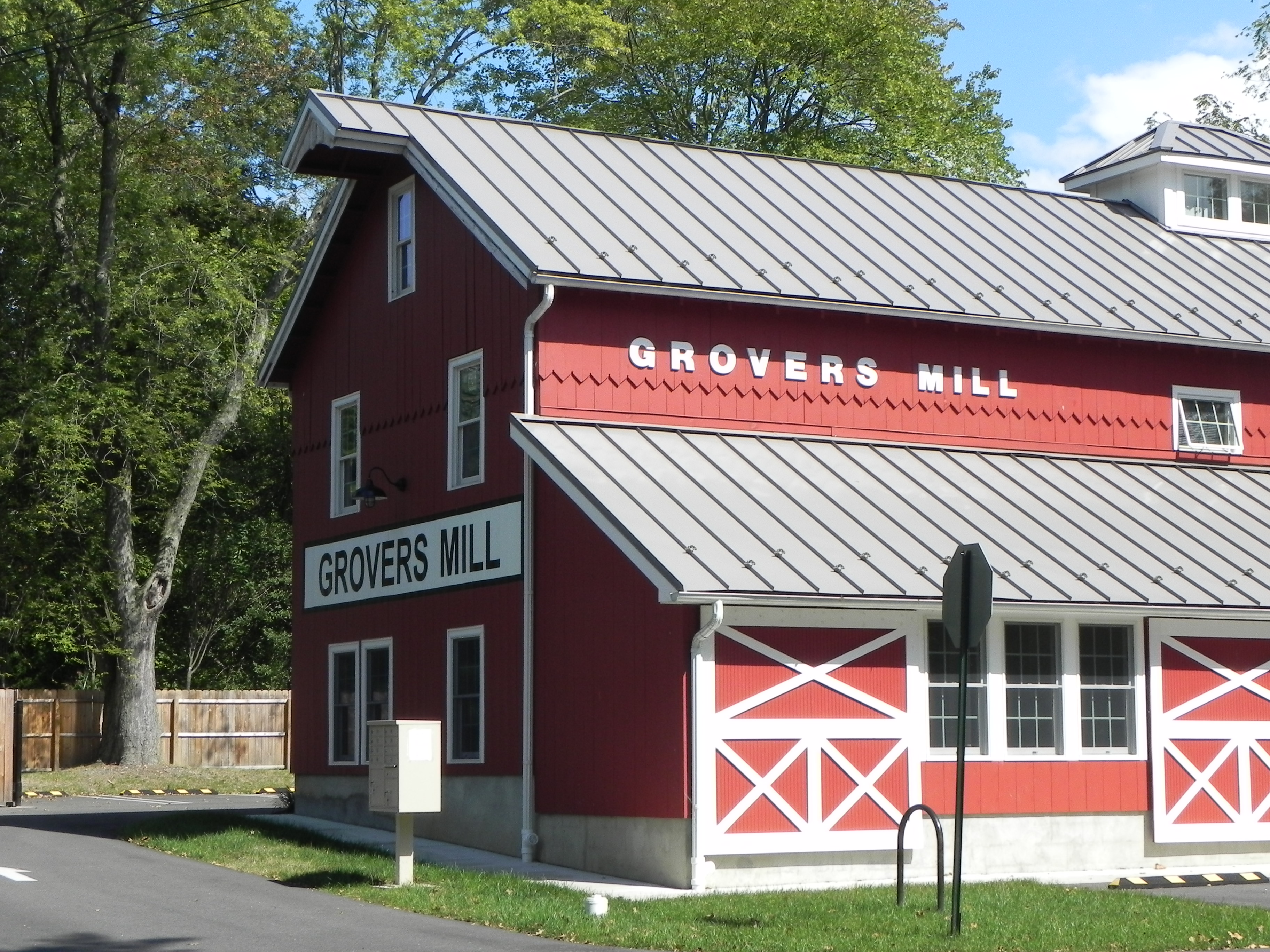
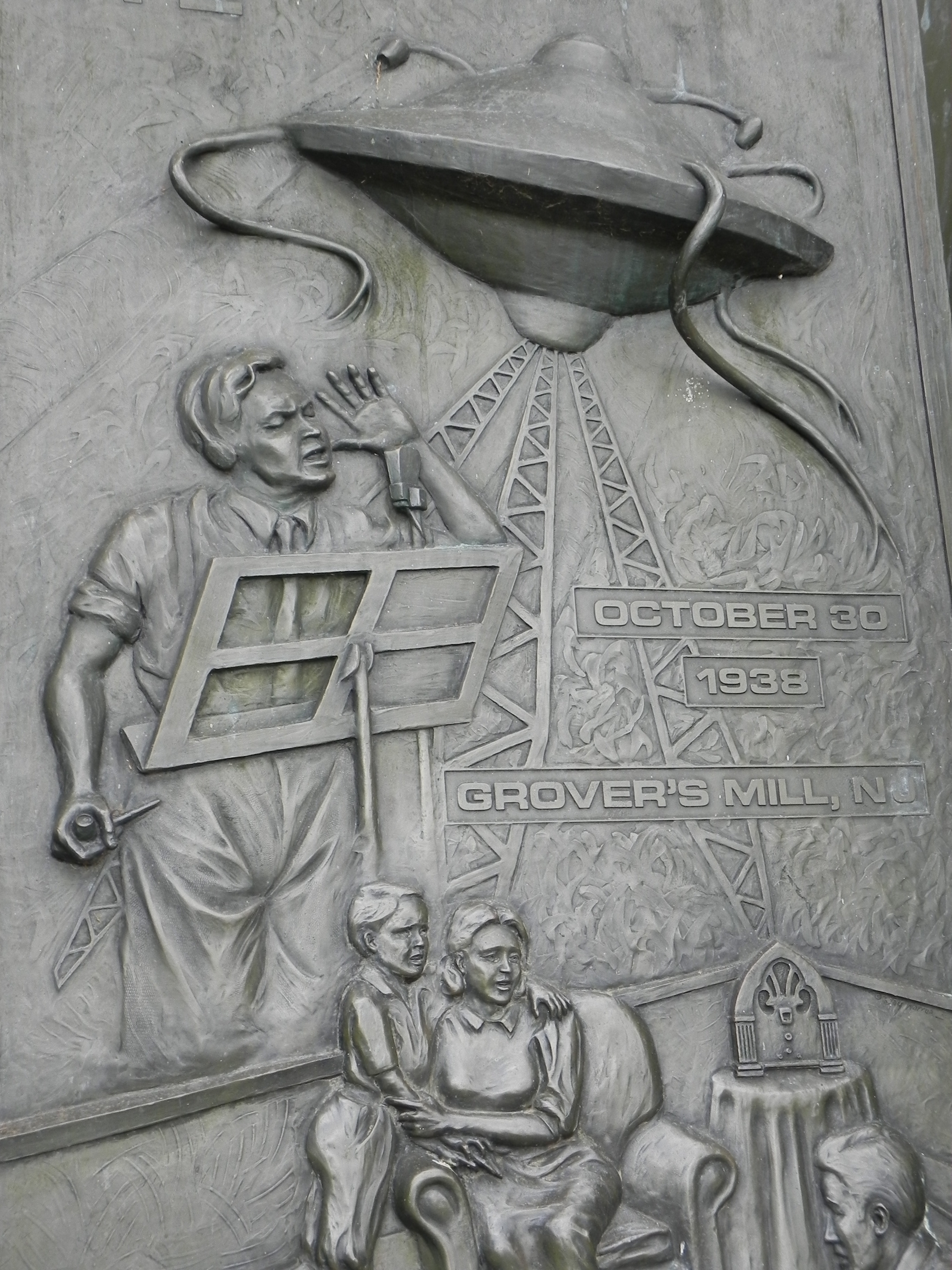
75 years ago today Orson Welles presented a radio drama version of The War of the Worlds. Perhaps it was the looming fear of the Second World War in a society that hadn’t yet overcome the trauma of the First, or perhaps too few people had read H. G. Wells’ novel, but the result was surprisingly catastrophic. Panic arose as listeners supposed that the invasion was real—the broadcast, although announced as a radio drama, followed a news bulletin format that overrode the rational faculties of many. This episode would influence government decisions about what to reveal to the public for years. And, naturally, it all began in New Jersey. Unlike the novel, the radio broadcast set the invasion, initially, in Grover’s Mill, New Jersey. This tiny town is difficult to locate even today, falling as it does between the busy north-south roadways that run through the central part of the state.

DSCN4241

The Hindenburg disaster had taken place the previous year in Lakehurst, New Jersey. Welles, impressed by the radio coverage of that celestial fear, used those broadcasts as models for his play. A few weeks ago I ventured to Grover’s Mill to let my imagination roam free for a while. A great deal of history may have been determined by that broadcast and the public reaction. We are ready to believe that danger lurks above. The First World War began to make early use of the airplane as a weapon. The sky, previously, had been obtainable only with the slowly moving balloon. Only eleven years earlier Charles Lindbergh had crossed the Atlantic by plane for the first time. The Second World War would see air combat as a major component of victory, also for the first time. My mother grew up in New Jersey, watching planes searching for German U-boats off the shore. The skies were not so friendly then.

DSCN4239

As I stood in Grover’s Mill, I recollected an unpublished book I once wrote about the weather in the book of Psalms. The thesis, somewhat loosely, suggested that for the average person the sky reflects the mood of the divine. Dramatic clouds still look angry, even when God is removed from the equation. The Reagan era gave us all new things to fear raining down on us from the skies. September 11, 2001, brought the skies crashing to the earth again. Invasion from above is an apt way to add a chill to Halloween, for it takes the prerogative of the deity and makes it either human or alien. At least most people who believe in God think he’s on their side. When the Wright brothers took their heavier-than-air craft briefly to the skies in 1903, The War of the Worlds had only been on the market for five years. The coming decades would drive God from the skies and we would come to learn that what falls from above would no longer have our best interests at heart.


The Tell-Tale Telegraph

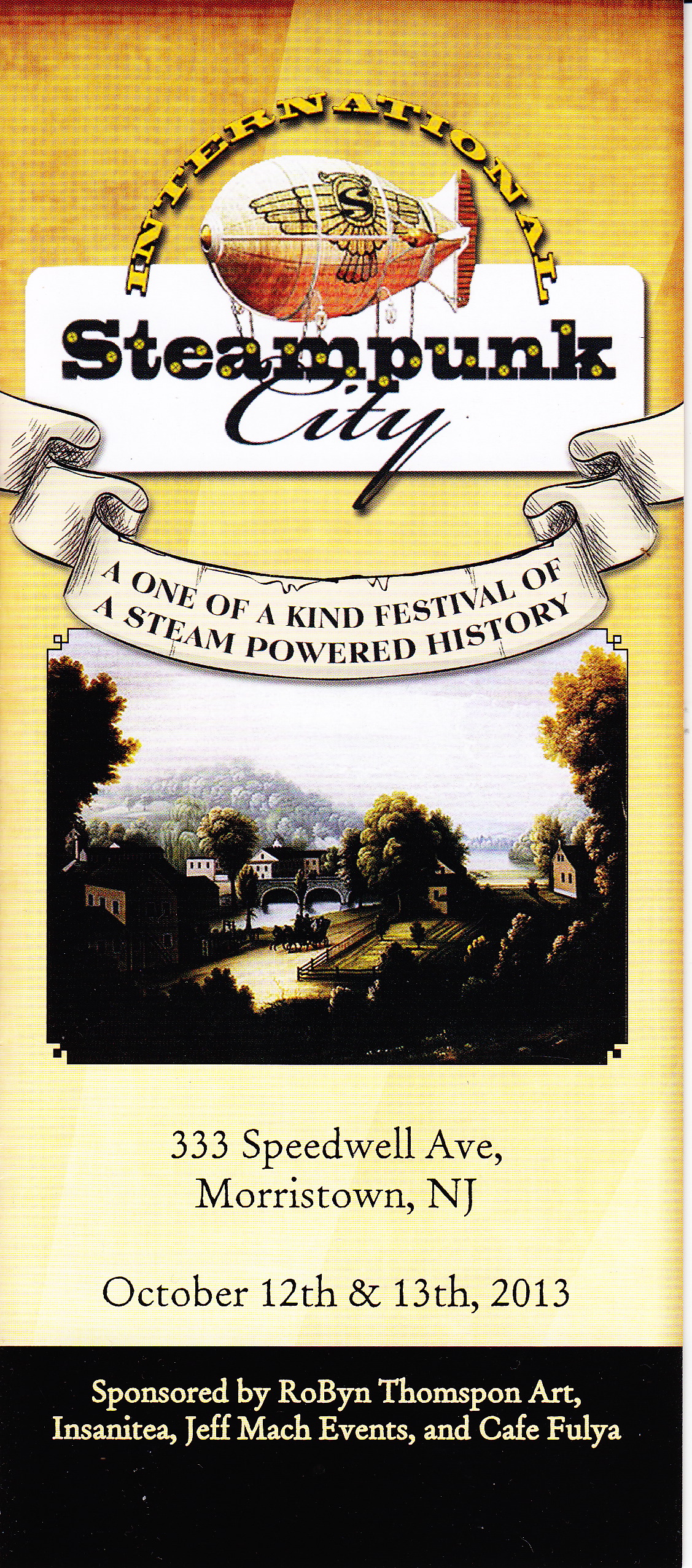
Steampunk CityThere’s a guy next to me with a robotic arm. Women with lace umbrellas and aviator googles walk by on the arms of Victorian gentlemen with walking sticks. A couple have an effervescing water-cooled device on their backpacks. I must be in Steampunk City. The forecast had predicted rain, but it is a beautiful October day in Speedwell, New Jersey. Steampunk City, an event dreamed up by Jeff Mach to make money for local museums, draws in a good crowd of the garishly bedecked, causing my wife and me to feel desperately underdressed. I’ve read my share of steampunk fiction, and I am really thrilled to see so many people taking an interest in such a literary event. I did wonder, however, what demonology had to do with it. Kevin Meares of Delaware Valley Demonology Research is giving a talk on demons, and it’s interesting to notice how the light laughter of customers from the booths outside wafts through the door where stories of possession are being told.

It is difficult to listen to Mr. Meares and believe that he hasn’t seen some pretty strange things. A practicing demonologist rather than the armchair variety, he has accompanied priests on exorcisms and is utterly convinced of the reality of the entities. When asked where demons come from, he relies on the Bible and Bible lore. Either they are fallen angels, remnants of a prior creation (thus the discrepancy between Genesis 1 and 2), or the offspring of the Nephilim of Genesis 6. Whatever they are, he has seen them in the dark, and people have died because of their activity. Being somewhat of a skeptic, I still find myself a little creeped out, kind of wishing I was outside with the laughing, costumed fiction readers.

Steampunk is often about alternate realities. A world where technology developed in the fog of steam rather than the neat circuitry of electricity. Speedwell, ironically, (and probably intentionally) is where the telegraph was invented and first demonstrated. It is a key site in the Industrial Revolution, the development that made the modern world what it is with smart phones, air-light laptops, and iCloud. I’m in the basement of an historic building having my rational worldview threatened by stories of demons. Although I’m wearing my nonplused face, I know that things will be different in the middle of the night. I’ve got brass gears in my pockets and supernatural entities in my head. I’ve met a watch maker outside who translates Aramaic manuscripts. What hath God wrought indeed, Mr. Morse? Yes, I’m in an alternate universe, and I may decide not to come back to the work-a-day one after all.


All Booked Up

I remember places by books. Perhaps it is a sickness, but it is a wonderful illness—I love being surrounded by books. When I travel to a new place, a book often serves as a souvenir, as I recall where I discovered a certain title and decided that I want to own it. Of course, independent bookstores are rare and becoming rarer. Who can remember which Barnes and Noble was which? The loss of independent bookstores is a sign of culture collapsing, at least ideologically. Being surrounded by LED screens is just not the same. The viewing goes both ways. Some towns I associate primarily with their bookstores. Over a recent weekend I visited Cranbury, New Jersey for the first time in many months. Apart from its utterly charming, historic downtown, Cranbury is the home of The Cranbury Bookworm, one of my favorite used book stores. My optimism fell under a cloud when I saw the storefront empty. Suddenly, the compelling draw of this quaint town was somehow diminished. My wife and I walked down another block, and I was somewhat revived to see that the Bookworm had merely moved.

Of course, the new location was much smaller. I heard the cashier telling another customer that they had been forced to move and had kept only twenty percent of their stock. So much was clear from my own browsing. My past visits had been perhaps a little too imprudent, but I often walked out with an armload of happiness. This time I purchased a couple of inexpensive paperbacks out of a sense of duty. I support used bookstores in principle. I have had people tell me that we have too many books for the amount of space we can afford to rent. Some people regularly recommend a purge. In a world where finding a comfortable place to be encased by books is increasingly difficult, I have come to regret some of the treasures I’ve given away, or sold, over the years. If I can’t find a sanctuary for books, I shall have to make one. For those who never learned the rapture of reading, it is difficult to explain. I have a phobia of booklessness.

Photo credit: CillanXC. I miss Borders.

Photo credit: CillanXC. I miss Borders.

Even this thing we call religion began, fairly early, as an expression in writing. After people invented writing as a way of keeping receipts, they began recording religious texts. Eventually a Bible. Religious books proliferated. It may seem counter-intuitive, but even today Christian books make up a huge market, no matter how much head-shaking goes on by those who seek only secular lucre. Religion and books often go together, but even when our published parcels take a profane track, they remain lovable. They are more than texts—they are memories. One of my advisors along my academic path inscribed each book with his name, the place he bought it, and the date. Perhaps he infected me with the books-as-souvenirs idea. If he did, I thank him. And I will continue the elusive quest for the bookstore where I might pass a happy hour or two on an autumn weekend.


Personal Dogma

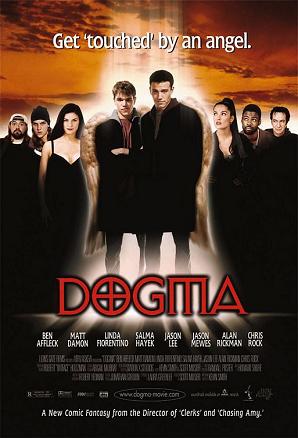
Dogma is a movie that many seminarians discover at some point in their theological education. Smart, funny, and irreverently reverent, the film follows the exploits of a couple of misled angels trying to get back into Heaven and thereby negating all of existence. It is no surprise, given Kevin Smith’s origin myth, that the film opens and closes in New Jersey, but I often ponder the strange coincidence of places in the movie to places I’ve lived since my own seminary career began (and ended, rather like the massacre scene in Red Bank before God cleaned it all up). Nashotah House, where I discovered Dogma, is in Wisconsin. Wisconsin is the state to which Bartleby and Loki, the two angels, have been banished. The means of their escape from this upper-Midwest purgatory is a church in New Jersey. Along their way the angels pass through Illinois and Pittsburgh, before crossing into the very state where God is located throughout the movie (the Garden State, of course!). After having been summarily dismissed from my seminary post in Wisconsin (not for watching Dogma, I’m assured), I too headed for New Jersey. Before that I had lived for a while in Illinois (home of Bethany) and Pittsburgh (home of Moobie). Watching Dogma is in many ways a reflection of a journey that I’ve accidentally undertaken.

YEE.tif

Another kind of dogma seems to be at work in the Eagle Mountain International Church in Newark, Texas. The Associated Press announced that 21 cases of childhood measles had broken out in the church, particularly among the homeschooled and unvaccinated. Fears of inoculating against a pre-medieval faith have led many of those who trust their own knowledge above that of the collective specializations of educators, to put their children at risk for the sake of belief. The belief, perhaps unsurprisingly, is poorly informed. One of the pastors of EMIC (!) has been encouraging vaccination as biblically sanctioned. If not for the sake of your children, for the sake of the scriptures…

Vaccination, in various forms, was developed in both Christian and pagan contexts. The earliest examples come from Asia where the plagues sent by the devil were resisted with human ingenuity. It takes a paranoid twenty-first century, first-world faith to suppose saving our children is some kind of conspiracy. “Let the one without germs,” we can almost hear them say, “throw their tissues away first.” In my Pittsburgh days, I was very much a literalist. How surprised I was to see Lady Aberlin from Mister Roger’s Neighborhood playing an angst-ridden nun, derailed by an exegesis of “The Walrus and the Carpenter” in Dogma. Although the Neighborhood is “anytown” those of us locals knew that Fred Rogers was from Pittsburgh. Lady Betty Aberlin was the niece of King Friday XIII, and only those with no conspiratorial imagination would suggest it is merely coincidence that her cousin is named Kevin. With or without dogma.