Thar She Blows

Any survey of “armpits of America” will laughingly include New Jersey. Having lived here for nearly seven years now, I know the apocrine insults are undeserved—I actually knew that before moving here. New Jersey has the highest per capita Ph.D. concentration in the nation. It also has the highest number of college graduates, and, for what it’s worth, the highest per capita income. These first two points come especially to the fore regarding New Jersey governor Chris Christie’s recent speech, made in Boston—a city with some small higher education affiliations itself. Propping up his creds for a presidential run, Christie said, “I think that we have some folks that believe that our job is to be college professors. Now college professors are fine, I guess. You know, college professors basically spout out ideas that nobody ever does anything about. [Rim shot!] For our ideas to matter, we have to win because, if we don’t win, we don’t govern.” (This according to the New Jersey Star-Ledger.)

The United States, for many years now, has been falling behind in education because we won’t fund it adequately. I’m no jingoist, but I do believe that the principles upon which this country were founded were inspired. To thrive, we must be smart. Education has been the key to our improvement over the decades, and as the focus has shifted from education to capital, the hull has begun to leak. I know that I have felt it. With dismay I’ve watched as colleges and universities have hoisted the November Charlie and no vessel has come to their aid. Departments are jettisoned and we are still taking on water. And the governor of “the education state” guesses that “college professors are fine” but completely irrelevant. This man for president in 2016?

Meanwhile, yesterday, the unexpectedly happy news was announced that President Obama will be visiting my daughter’s university next week. Binghamton University is frequently overlooked by the monied special interests paid to the Harvards and Princetons of the green-lined ivies. It is, however, frequently cited as a “public ivy” for its quality education at state-school prices. Obama’s visit is for precisely that reason: good education can be affordable. Chris Christie went on to say, “For our ideas to matter we have to win because, if we don’t win, we don’t govern. And if we don’t govern, all we do is shout into the wind.” And if we don’t win we gather up our marbles and go home. Yes, I was a child once, too. And I grew up. Higher education does matter—far more than some politicians’ bluster would indicate. Do you agree, Dr. Einstein? I’m sorry, governor, I can’t hear you over the wind flapping the sails.
The_Loss_of_the_Romney_Man_of_War


To a Fallen Goddess

One of my favorite places to visit in New Jersey is Grounds for Sculpture. Over the past several years that we’ve domiciled here, we’ve had the opportunity to take several friends and family members to see the whimsical, creative, and inspirational park over in Hamilton. When my daughter graduated from high school, she requested a visit to Grounds for Sculpture, and, since family were near at hand, we took the opportunity to see it again.

I’ve always been aware of the religious aspect of creativity. Perhaps it is because I like to flatter myself into thinking that I’m the creative sort, despite my years of academic training, or perhaps it is the kind of pipe dream for which the liberal-minded are easily accused. In either case, I have always found that the best art evokes something similar to a religious experience. There is an element of wonder, emotion, and awe here. Not every piece of art conjures it, just as a single god isn’t sufficient for the whole of humanity. As I wander the grounds, I grow convinced that this or that sculpture had a vision akin to what I’d call religion, that led to the creation of such a trenchant piece. I always leave feeling blessed.

Photo credit: Grounds for Sculpture, postcard

Photo credit: Grounds for Sculpture, postcard

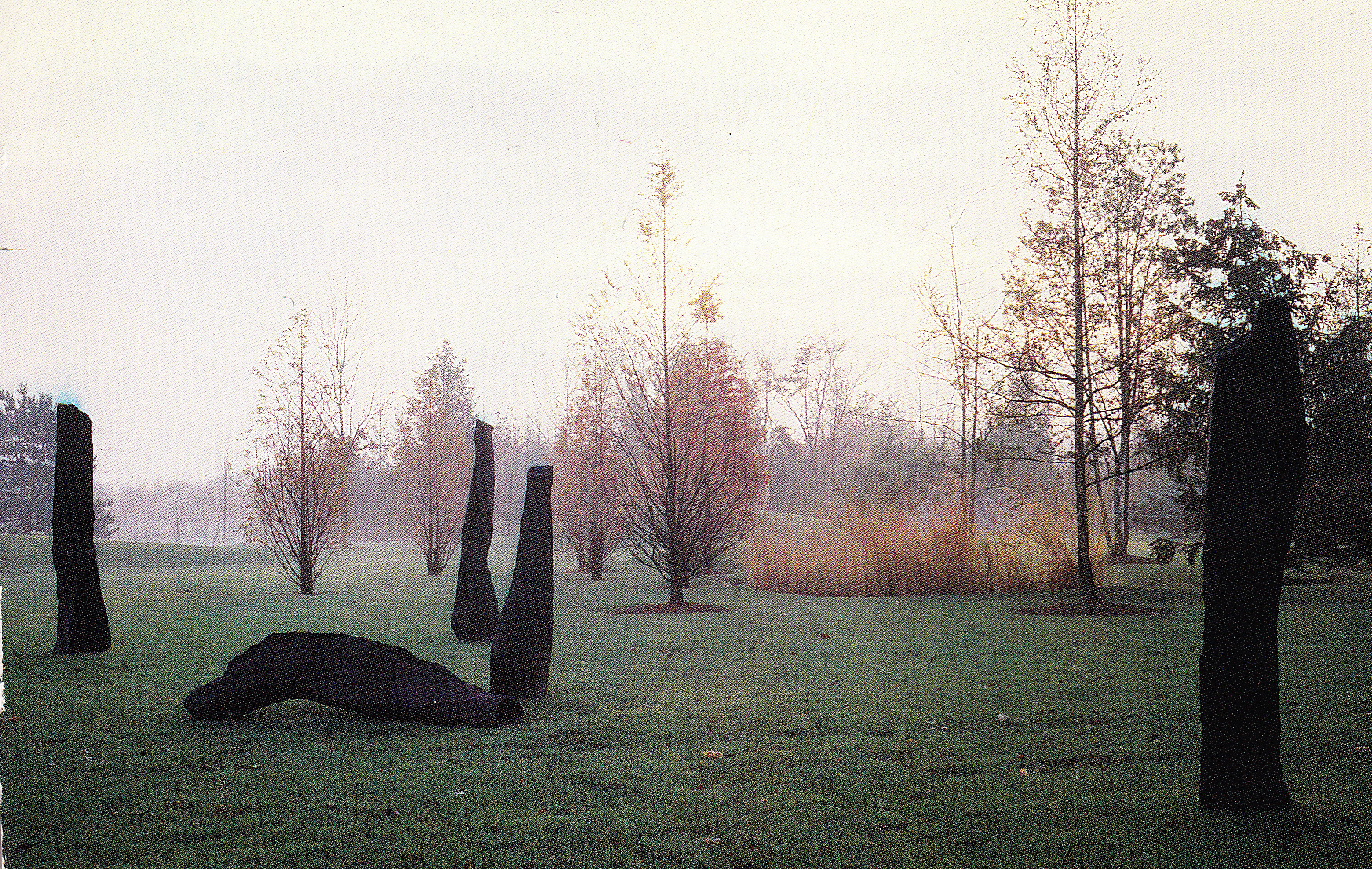
On this most recent visit, a very conscientious relative found, and later sent, a postcard of a sculpture I’d never seen. (It is possible that the sculpture is not currently on display, as the Grounds are continually evolving.) The piece is entitled “Excerpts of a Lost Forest: Homage to Ashera,” by Tova Beck-Friedman. Several of my relatives have me to blame for their awareness of Asherah; she is, after all, a relatively obscure goddess in the Hebrew Bible. The sculpture, however, speaks to me of the continuing ability of even extinct gods to inspire artists. Just as Asherah occupied several years of my academic life, I suspect she also haunts the work of sculptors who’ve come to realize that not all gods must be male, and not all gods must be real to be important. Quite the contrary, the collective deities of our heritage may still be found where art thrives.


Godly Violence

Just a full-term human pregnancy ago, a disturbed young man murdered two grocery store employees in Old Bridge, New Jersey. He then shot himself dead. Of course, such events will never sway those who staunchly defend our right to bear arms. The ratio isn’t too severe after all. Just two to one. We’ve had worse. But that was nine months ago. Earlier this week a police report revealed that Terence Tyler, the perpetrator, had a tattoo on his chest that read, “If there is a God he loves violence. It is his gift to mankind. It is truly magnificent and for this I am thankful.” The newspaper used the understated adjective “disturbing” to describe it. As an erstwhile biblical scholar, my first inclination is to exegete this strange scripture a little bit.

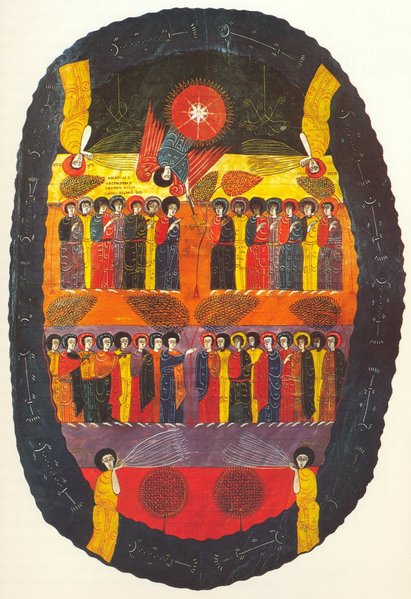
411px-B_Facundus_145“If there is a God.” The mind of the shooter is one for hedging bets. God is an unscientific proposition, and, we are told even by theologians, unknowable. Long ago Pascal urged a wager: God may not be real, but the safer bet is on the divine—you can’t really lose by believing. “He loves violence.” I’m sure many believers disagree, but those who read the Bible will have to admit that Tyler had a point there. There is an ancient kind of bloodlust that hangs heavily over demands for genocide and animal sacrifices. Even, according to mainstream Christianity, the death of an only son will serve divine ends. “It is his gift to mankind.” This may seem counterintuitive, but again, the Bible would seem to back this up, at least in part. Without violence the 144,000 martyrs wouldn’t have much to sing about. “It is truly magnificent and for this I am thankful.” Were this a biblical passage we would probably have to posit a redactor here, or at least an interpolation. Such editorializing doesn’t fit the spirit of the previous three verses.

Religions, while generally abhorring violence, too often condone it. This mostly comes through literal readings of ancient texts whose contexts have changed so much that the originals are unrecognizable by today’s standards. Bibles and Qurans must be understood by those who’ve managed to outlive them. They become the basis for, the excuse for violence that, as a whole, they condemn. In the United States, however, we trust cordite over creed, and guns over gods. We have moved on from the Old Bridge shootings, already for those outside the families of the victims and the local community, the headlines took a minute to jangle the bells of distant recollection. Not much has changed; the NRA still claims, even more vehemently than ever, that guns are our best friends. And, one can almost hear as a subtext, in good eisegetical style, “if there is a god he loves violence.”


Crab Walking

445 million years may seem like a long time. For the horseshoe crab, however, the eons have been spans of years with little change from a rather simple existence that involves lurking under the water and crawling out this time of year to breed. For many of us, Hurricane Sandy is already a somewhat distant memory of days (weeks for some) of no electricity, sitting in the dark, wondering when life would get back to normal. Some parts of the Jersey shore are still suffering from the after-effects, but many of us have had to “just get on with it,” and forget about the damage caused. For the horseshoe crab, however, it is not so easy. For creatures that have survived virtually unchanged for hundreds of millions of years, Sandy dealt a cruel blow. The largest concentration of hermit crabs in the world breeds in Delaware Bay, just down where New Jersey and Delaware nearly come together. Numbers had been declining in recent years as horseshoe crabs were used for bait by fishers, landing them on the “near threatened” scale of the countdown to extinction. Hurricane Sandy eroded the beaches where the crabs breed, and human detritus, left years earlier to protect expensive homes, now provided unsurpassable barriers for most of the crabs. Biologists are at work trying to rebuild the habitat in time.

Not only the time-honored horseshoe crab, but the American subspecies of the Red Knot, a migrating shorebird, has come under threat. The Red Knot, which stops in New Jersey to snack on horseshoe crab eggs on its way to the northern breeding grounds, has been declining in numbers. No crabs, no birds. While the troubles of two species may not seem like cause for concern, the fact that one of those species has been successful since millions of years before the first dinosaur even appeared should give us pause. Dinosaurs showed up some 200 million years after the horseshoe crab had been solidly established on the beaches of the pre-Triassic world. Nature would not be set to wipe out the crabs after a single hurricane, but human obstacles may do what nature would not—endanger a perfectly adapted species so that “valuable” real estate can be protected.

It is tragic when people lose what they’ve worked to attain. It is, however, shortsighted to think that we are the only important species on the planet. We have evolved in a system that includes all the other organisms on our world—our family tree goes beyond that cousin that always embarrasses us to the very crabs that crawl in the silty, brackish water of the Delaware Bay. We’ve all had an impact on each other. Even if you’ve never seen a horseshoe crab, just by reading this post they have come into your life in some way. When we start constructing our grand dreams for a fine life, it seems that we should take into account those who have been here long, long before us. Their requirements are modest, but their place in the cladistic tree of life is just as important as ours. Extinction is forever.

From Wikipedia, by Asturnut

From Wikipedia, by Asturnut


Down Will Come Baby

Princeton Theological Seminary is a school with a history. Unofficially allied with my alma mater, Edinburgh University, PTS is one of the powerhouses for supplying educated clergy to the Presbyterian tradition. And others as well, of course. And not a few PhDs into the ranks of the perpetually unemployed. Seminaries do offer all these services. Despite failing to be considered worthy of even an interview in what I count as five separate applications to the school, I still sympathize with its need to update its technology. I suspect that is what is behind its application for a half-million-plus-dollar New Jersey Higher Education Technology Infrastructure Fund grant. Education and technology surely go together as much as old-school loyalty and fairness, do they not? A front-page story in Tuesday’s New Jersey Star-Ledger proclaims the gnat that remains in the camel juice: state funds are being requested by a fully religious organization. The application for these state pork-bellies is also shared by Beth Medrash Govoha, a male-only Jewish seminary in Lakewood. Desperate times in higher education. What would Christie do?

PTS

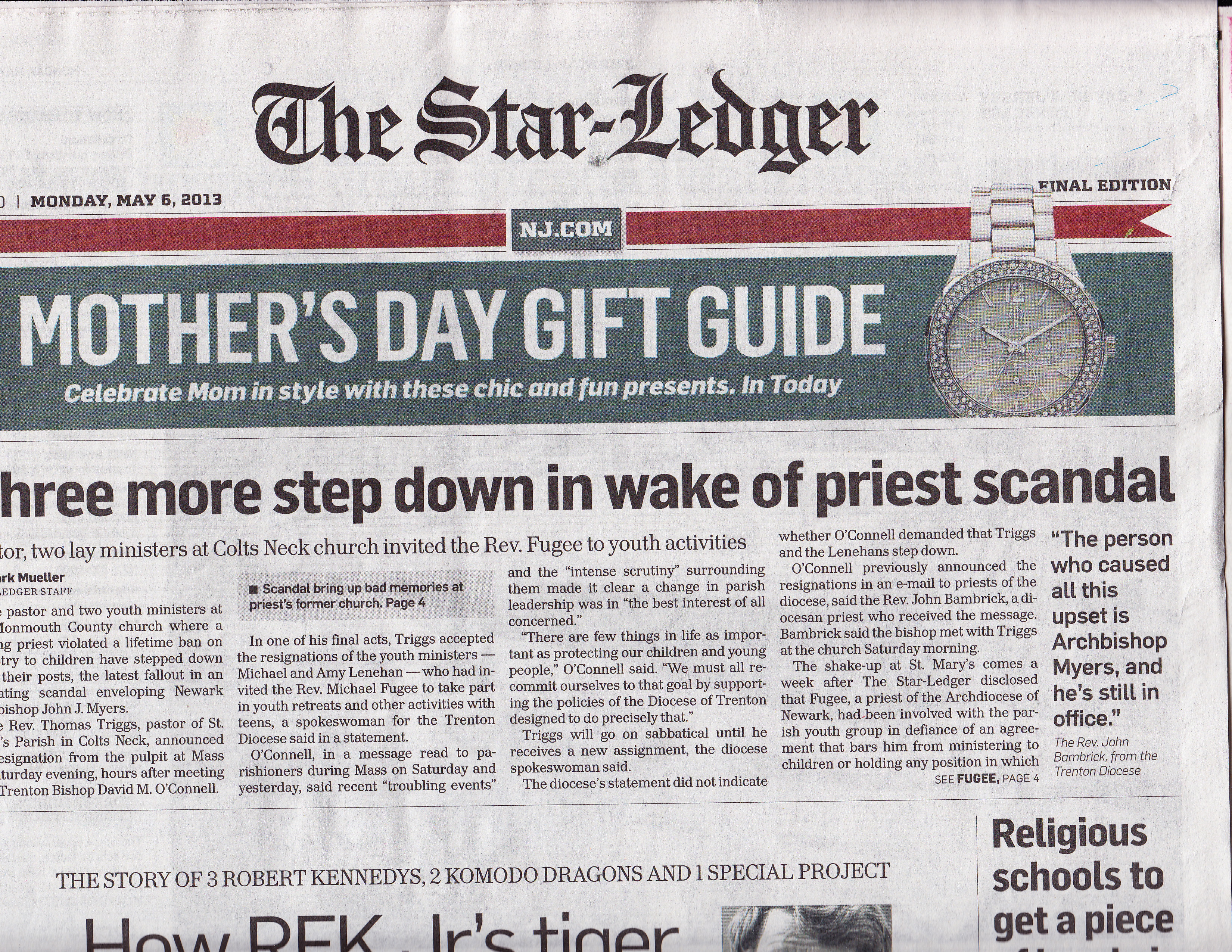
Turning the clock back twenty-four hours, another front page newspaper story places religion squarely in the public face. “Three more step down in wake of priest scandal” hit my bleary eyes on a Monday morning. This is the saga of Fr. Fugee, banned from interactions with children after a molestation case some time back. As seems to be par for this unholy course, such clergy are shifted around rather than defrocked—being seminary fodder myself I can honestly ask, what else would they do? Society has little enough use for those of us who worked our way through seminary for honest means and toward what seemed at the time noble ends. How much more so for those who mask deeply rooted neuroses under the sanctity of ordination?

Fugee_0001

Seeing religious news on the front page of the paper is nearly always cause to shudder. We will occasionally see a new Pope or maybe a genuine act of Christian (or any other religious) charity, but mostly we are served the seedy and sad and downright tawdry. Religion, although in the ascendent, is seeking hard to justify its existence. Or is it just the vaunted liberal media bias showing through? As primates we all like to watch the haughty topple. It’s even in the Bible—Isaiah got a thrill out of tall ships tipping over. Perhaps it is because religion presents itself as the unadulterated good that we like to see it stumble. I always felt a tad uncomfortable reading Goofus and Gallant while waiting for a doctor’s shot or the dentist’s chair. Yes, Goofus screwed up big time once in a while, but that confident little eagle-scout-in-waiting Gallant could do no wrong. I knew who I was supposed to emulate, but life’s just not that simple. Maybe that’s why religion makes the front page. Maybe Gallant is a myth after all.


Book Friends

Along highway 12 in Hunterdon County, New Jersey stands an armory with an obtrusive tank stolidly facing the road. Over the weekend the tank was draped with a banner proclaiming the Hunterdon County Library book sale. I wished I’d had a camera. It had been a few years since I’d been free on the book sale weekend (it often classes with robotics competitions), so I decided to visit on Saturday. No, they usually do not have much in the way of academic books, or even the books on my extensive wishlist. The books are not in pristine shape, not alphabetized, and sometimes miscategorized. But still I love to go and browse around. It is always crowded. I feel like a babe in its mother’s arms around so many people who want to be near books. Although the vast minority of the American population, book buyers are of a kind. We get along.

The event is so large that parking is off-site and a shuttle bus is hired to ferry people the extra mile down the highway to the armory. I emerged with a small bagful of guilty pleasures and waited for the shuttle behind three elderly gentlemen. On the bus they lovingly pulled out their special finds to share with one another, smiling and quietly praising the virtues of each one. When I was checking out a few minutes earlier the elderly lady counting the books asked me if I recycled them back into the system when I was finished. I had to confess that I keep most of them. There are books in every room of our apartment except the bathroom. You can read in bed, in the kitchen, or in front of the television. I couldn’t live any other way. “It’s a good problem to have,” she affirmed.

A few weeks back our refrigerator died. For the third time since Hurricane Sandy we had to throw out all our refrigerated goods. Our landlord magnanimously agreed to replace the derelict cooler. I worked from home that day to let the delivery guys in. Their faces fell. “We’ll never get it in past all those bookshelves,” they lamented. The doors on this older building are offset, and we do have bookshelves covering much of the wallspace. So I began pulling down books. The piles grew and eventually I freed a shelf enough to move it from the wall and to get the oversized appliance in place. On the way out, one of the movers stopped by an unraped bookshelf and stared for a moment. “You read interesting books,” he said. Perhaps he just pronounced my epitaph. He read interesting books. I can’t think of a better compliment in this world where reading for pleasure is an endangered species.

"Interesting reading"

“Interesting reading”


Ad Lib

Somewhere in the back of my mind I’ve had a notion to research and write a book on the history of “bad words.” Being raised Evangelical, I had a preternatural fear of saying something that might damn me to Hell, and even today working in Manhattan, I still flinch when I hear f-bombs falling all around me. Still, the concept of “bad words,” although almost universal, is very odd. We all know the tired jokes of a particularly offensive word in one language being common in another, with an entirely different denotation leading to embarrassing situations. No set of sounds, inherently, means anything bad. Surely it is the intention behind such outbursts that lead to accusations of profanity or blasphemy. I wonder how it got started. The Bible says nothing about bad words—in fact it contains a few—but it does warn against thoughtless curses. That’s because ancient people believed curses really worked.

As I stepped out in the dark to pick up the paper this morning I was curious, then, when a front page story announced, “At school, cursing’s out—for girls only.” The school in question turns out to be Queen of Peach High School in North Arlington, New Jersey. According to Leslie Brody the girls at the school were asked to take a no cursing pledge yesterday, while the boys weren’t. The real story here, however, is not my curiosity about “bad words,” but an insidious sexism. One of the teachers is quoted as saying “We want ladies to act like ladies.” And, of course, what lady would ever have anything to cuss about? Being paid lower wages than a man for the same work? Being blocked out of clergy positions in some churches? Being regularly maligned as “the weaker sex” who, like Eve, bear the guilt of bringing sin into the world? If anything, it seems to me, women have more cause to swear than men.

Just when I’ve been lulled into thinking we’re making strides toward equality, such stories dash the ice water of reality into my face. Who decided that it is appropriate for gentlemen to cuss? Can they just not help it? Are the same words any more offensive for slipping past feminine lips than masculine ones? I’m still not convinced about the entire bad word concept. As someone who smiths words every day, indeed, whose living depends on words, I find all words have their uses. It’s really a matter of context. And if I were a girl being told not to say what boys can say, I think I might have some choice words to add to that conversation.

Good, bad, and ugly.

Good, bad, and ugly.


Moocher Man

Influenza seems to be going around. Since I spend at least three hours a day on a crowded bus I get to observe all kinds of uncouth behavior. Not that I’m always Mr. Manners (New York has a way of doing that to you), but I do cover my face when I cough or sneeze and sometimes I feel that I’m in the minority. My wife, concerned with supplies dwindling, made an appointment for me to get a flu shot at the local clinic. I went in and took a number. I guess I’ve been cursed with good health, and that may be a good thing. For my first five years in New Jersey I couldn’t afford health insurance—this was known as Bush Care—and hadn’t needed to see a doctor. Yesterday was my first time in the clinic. Although I had a confirmed appointment, a kind of argument broke out in the office (this is, after all, New Jersey) because non-patients weren’t supposed to be given the inoculation. Or they were, but they had to pay for it. Or their insurance would be charged and they could get the shot as long as they had insurance. Or why didn’t people just go to Walgreens instead. In the midst of the melee, a nurse called my name and a few minutes later I was being jabbed and sent on my way.

In all of this, one of the largest ethical issues of this country is highlighted. Who has a right to basic medical care? Among the conservative crowd that even includes some who can’t afford insurance, there are those who decry moochers. I grew up without health insurance. My mother relied on welfare to help raise three boys whose father had disappeared and our medical care was very, very basic indeed. Maybe people just didn’t say it in front of kids back in the 60’s, but I never heard anyone grousing that the poor should be left to fend for themselves. That took Reaganomics. In any case, working as hard as I could to break out of that lower class, I earned a Ph.D. only to be turned out of a job by a devout worshipper of George W. Bush. No medical insurance. Again. Now with a child of my own. What I’ve heard since the new millennium is that for those who can’t afford insurance—too bad! Just get a job, bum!

JesusHealing

I often think about those who make such statements and how they valorize the Bible. If I recall correctly, Jesus handed out free health care. Socialized medicine existed in his corner of the world twenty centuries ago. And we in one of the most prosperous nations on earth argue about who can get a flu shot. In the end, I paid for it; I’d even taken my checkbook along with that intent. Nobody thought to ask me. But as I sat there within full view and certainly full conversational distance, I was objectified by the medical system. I wasn’t a guy who sits on a crowded bus with people who don’t cover their mouths. I was a moocher. A liability. In the waiting room around me I noticed patients tucking away passports and green cards. This is New Jersey, after all. For many, however, despite the cold we’re experiencing, it might feel like a much, much hotter place indeed. A place where, the Bible intimates, nobody cares about anybody else and the flames never die.


Biblical New Brunswick

One of the true sadnesses of my life is that New Brunswick’s biggest institution, Rutgers University, couldn’t find a full-time place for a dreamer like me. Ever hopeful, I taught there for four years, counting on a miracle. Although I’ve got many good memories of my time at Rutgers, one of the side-benefits was getting to know New Brunswick a little bit. Probably not topping too many vacation must-see lists, New Brunswick, New Jersey nestles in the shadow of New York City and its train station is a place I’ve spent a bit of time. Last night I had occasion to stop in to get my bus pass so that I can start off the new year by going to work. As I climbed the stairs to the ticket window, I heard a street preacher holding forth. There he was, a young man, open Bible in hand, explaining to a mostly disinterested commuter crowd why they needed salvation. (If their experience on New Jersey Transit has been anything like mine, believe me, they already know.) Many of those in the waiting room are the homeless trying to get out of the cold for a while. New Brunswick has never struck me as a particularly religious town, although many of my students in my Rutgers days brought their religion to university with them. I didn’t have time for another conversion last night, however, as my family had another purpose for being in town.

A friend had kindly given my family tickets to Joseph and the Amazing Technicolor Dreamcoat at the State Theater. Although put on by Plays-in-the-Park of Middlesex County, being in the shadow of New York City sets a very high bar for public performances. The show was excellent and energetic and I couldn’t help connecting the dots on how the Bible had played into the evening. Andrew Lloyd Webber long ago realized that even a very secular Britain had a hunger for biblical stories. Although I am biased, given my failed choice of profession, the story of Joseph is one of the great tales of all time. Although likely half the audience couldn’t say that the story occurs in Genesis, the rags-to-riches plot of betrayal and forgiveness is so deeply embedded in human dreams that even assigning it to the wrong testament would make no difference. As Lloyd Webber knows, we all want our dreams to come true. Joseph, certainly a flawed hero, does finally see himself as the second most powerful man in the fictional world of Moses’ Egypt. It’s difficult not to root for the guy.

Outside the temperature hasn’t managed to reach 40 degrees today. A few blocks away at the train station, some of those being force-fed the Gospel were almost certainly refugees from the cold. I’ve seen this every time I have to catch a train in Newark as well. The homeless know that at least they won’t freeze in the depot, even if they are chased off the seats by security. Moving from Joseph to James a moment, we hear “And one of you say unto them, Depart in peace, be ye warmed and filled; notwithstanding ye give them not those things which are needful to the body; what doth it profit?” In other words, if you are offering the homeless words only, you’re not getting the point of the gospel at all. The homeless would benefit more from having a dream come true, I’m certain, than from having a message of salvation before being turned out to the cold for the night. The real salvation in New Brunswick is being offered at the State Theater tonight, but you do need a ticket to get inside.

Any dream will do

Any dream will do


A Big Joke

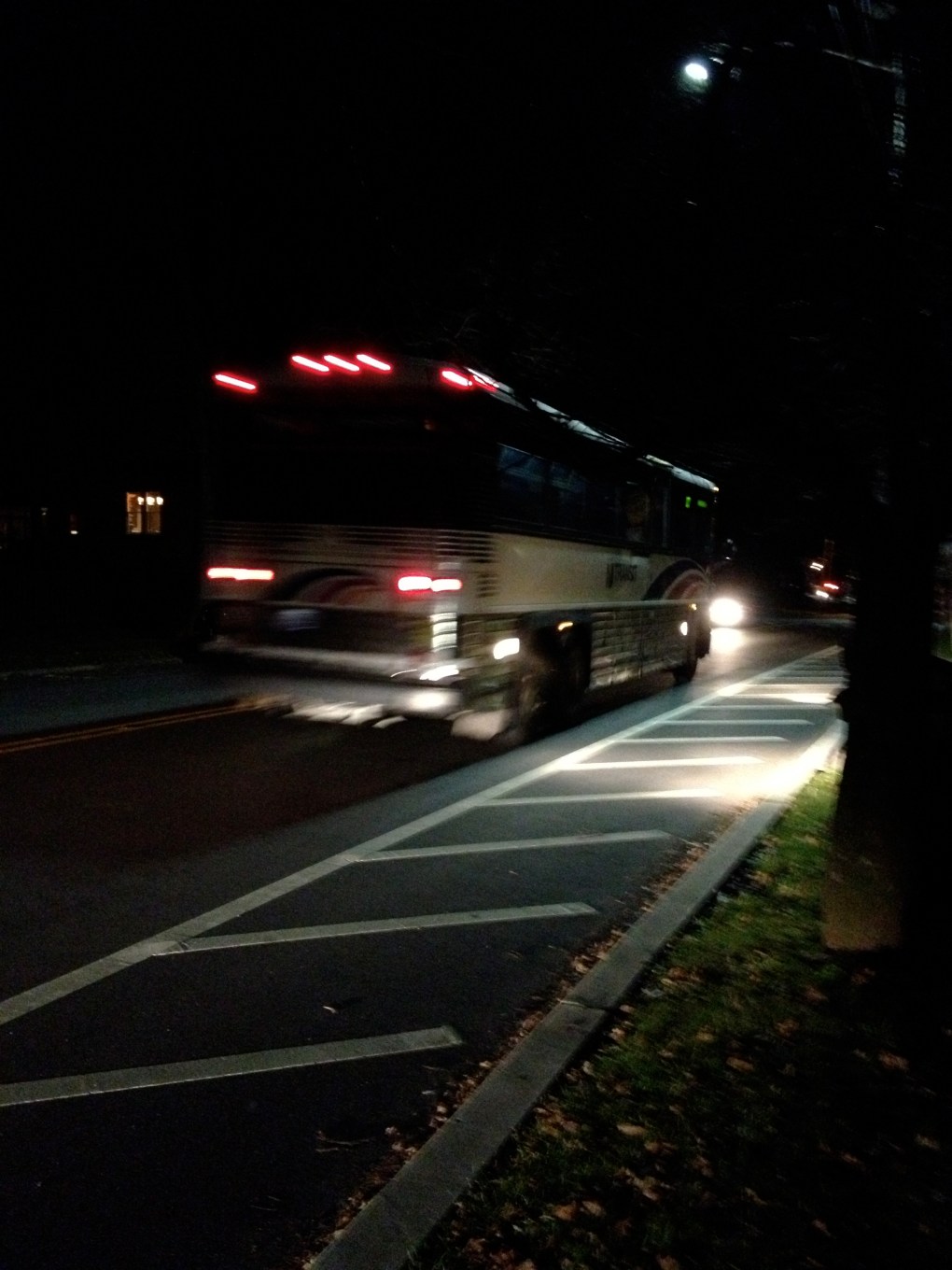
On the evening table my wife left a token of hope for me to read in this hopeful season. New Jersey “Transit” claimed that the very next day riders of the extensive bus system would be able to track buses precisely on their smart phones. No more wondering “has the bus already come, or is it late (again)?” I laughed when I read this because that very evening in the Port Authority my bus never came. The frazzled and apologetic dispatcher said nobody knew where the driver was. Did anyone think to drag the East River? I wondered. As other buses pulled to the gate, drivers refusing to switch routes, the line grew and grew. The bus scheduled for the next half hour did not show. My daughter was waiting for me to fix dinner. On a good day I’m home by 6:30. This was not a good day. I laughed ironically at the article and went to bed. My morning bus leaves, in theory, before 6:00 a.m. A day later, in the Port Authority. My bus, which can now be tracked with precision, precisely failed to show up. I’m sure you know the dispatcher’s chorus—please join in—”nobody knows where the driver is.”

So what is a diatribe like this doing on a blog about religion? I’m as mad as Hell about this, that’s why! Every month I pay hundreds of dollars for a bus pass. I think the least New Jersey Transit could do is the courtesy of sending a bus. In case anyone from NJ Transit is reading this, a bus is a large vehicle that seats about 50 adults and generally runs the same way every day. It’s called a “route.” People use it to get to and from work. Of course nobody expects the executives of a company that services over 19,000 bus stops to take a bus to work. They probably have to be on time. I take the earliest possible bus from my town to New York City. Most days it is late and consequently so am I. For this I spend over three grand a year.

This is not about Hurricane Sandy. Buses have been back on schedule since Thanksgiving. What it comes down to is the fate of most capitalistic ventures—the working person butters the bread of the Executive Director who earns more than $260,000 a year. Last night I toyed with the idea of getting other disgruntled commuters to link arms and stand across the exit ramp, or to lay down in front of the buses until a bus for my route was sent. I suspect, though, that they realize as well as I do that Tiananmen Square doesn’t take much to morph into Times Square when an individual stands in the way of corporate gain. Tonight I plan to wear my good walking shoes. After all, I paid good money for them too. Unless, of course, anybody out there would like to drive this bus?

Ghost bus

Ghost bus


Two Swords

One of the more interesting situations to emerge from Hurricane Sandy’s aftermath was the celebration of Halloween. I know that I’ve already lost some readers right there since Halloween is a disputed holiday. Often Halloween is maligned as “Satanic,” a claim that is absolutely untrue. It may have some paganism in its roots, but then, so do most religious events and ideas. Halloween is a Christianization of various folk customs, frequently Celtic in origin, on a night when the protective wall between the living and the dead was believed to be especially thin. As adults grew more sophisticated and scientifically informed, the holiday lingered as a children’s fun day with dress-up and pranking, both normal childhood ways of playing. This neutered holiday has proved to be commercially viable as well, now supporting September-October Halloween stores at a density of about a dozen per square mile. Its success is rivaled only by Christmas.

In light (or perhaps dark) of the devastation of Sandy, New Jersey Governor Chris Christie canceled Halloween. We heard the news on our battery-operated radio, sitting in the dark. While this was one of those rare times when I think Christie was motivated by the concern of both poor and rich, I did ponder the implications of a government canceling a holiday. All Hallows’ Eve is the night before All Saints’ Day. “Hallows” is simply another—less used but more evocative—word for “Saints.” While largely secular in its present guise, Halloween is a religious holiday. My mind went back to the doctrine of Two Swords that I learned about many years ago. Originating in the papal bull Unam Sanctum, very early in the fourteenth century, the doctrine teaches that in spiritual matters the church holds the sword while in temporal matters the state holds its own sword. Who has the right to cancel a holiday?

Of course, Chris Christie has his own ways of issuing bull, but his real concern was that conditions were too dangerous for trick-or-treating. Indeed they were. On a short walk, I saw power cables dangling like electrified cobwebs on just about every block, snaking along the ground. Branches were still falling from trees. Curfews (many still in effect) were widespread. Not a good night for masked strangers to show up at your door. But as in the case of the Grinch leaning out over Whoville after he’d stolen all the trappings, Halloween came, it came just the same. What we saw on Halloween was people helping one another. No tricks (for the most part, although among the first to recover were businesses who recorded new ads to broadcast on the radio before the wind even stopped blowing), just good natured mortals helping one another, protecting others from the grim reaper. To borrow a line from Charles Schultz, “That’s what Halloween’s all about, Charlie Brown.”

Will the real Halloween raise its hand?


For Saints, All

The year without a winter has also become the year without a Halloween. As the first surge of Sandy made herself felt, we were among the 5 million households in New York, New Jersey, and Connecticut without power. To put things in a little context, I have training in wilderness camping, having learned to survive outside with little more than a ball of twine and a pocket knife. Still, when Sandy knocked out our lights, heat, and most importantly, Internet, for three days I found myself in a new kind of wilderness. Each night, buried under blankets, in one room lit with candles (incidentally, candles that we made ourselves nearly a decade ago on a candlemaker spree in Wisconsin), we sat around a card table and played games, read, or just pondered the imponderable. I actually took to working on a blanket I’ve been making, but had set aside for a few years. If it weren’t for wondering if I had to go to work the next day until evening every night, I might have actually enjoyed it.

And the experience has made me a little leery of what I’ve become. Less than hour after the power came back on, everyone in the family was on the Internet. I confess to feeling that missing my blog was among the most disjointing aspects of the power outage. With no way to charge my laptop’s battery, and no router to connect me to cyberspace, I jealously conserved my iPhone power to get the text message that told me if the office was open the next day and if New Jersey Transit was running so that I could get there. My dreams all week were nightmares. Mostly about missing work. Another perspective: my grandfather was born on a farm. He built his own house and raised five kids while traipsing from New York to Montana and Virginia before settling in western Pennsylvania. He didn’t go to college but he kept his family well. He never lived to see a computer or an email.

So 2012 is the year without a Halloween. The lights came on on All Saints. To me those saints are the men and women of PSE&G who finally got our power back on. I’m sure they’ll understand the darker tones my thoughts took about the company as I trimmed wicks and recharged candle holders for the third night in a row when darkness fell on All Hallows Eve. Here I am, feeling decidedly wimpy and not a little disingenuous, posting on Sects and Violence in the Ancient World once again. I managed to update my blog while on the road in England, and from hotel rooms across the country as I’ve traveled for work. I can’t help but think how this reflects on my atrophied survivor skills. Maybe I’m beginning to feel what idol worshippers experience when they neglect their gods. I wonder if there will be nightmares tonight or work tomorrow.


Pipe Dreams

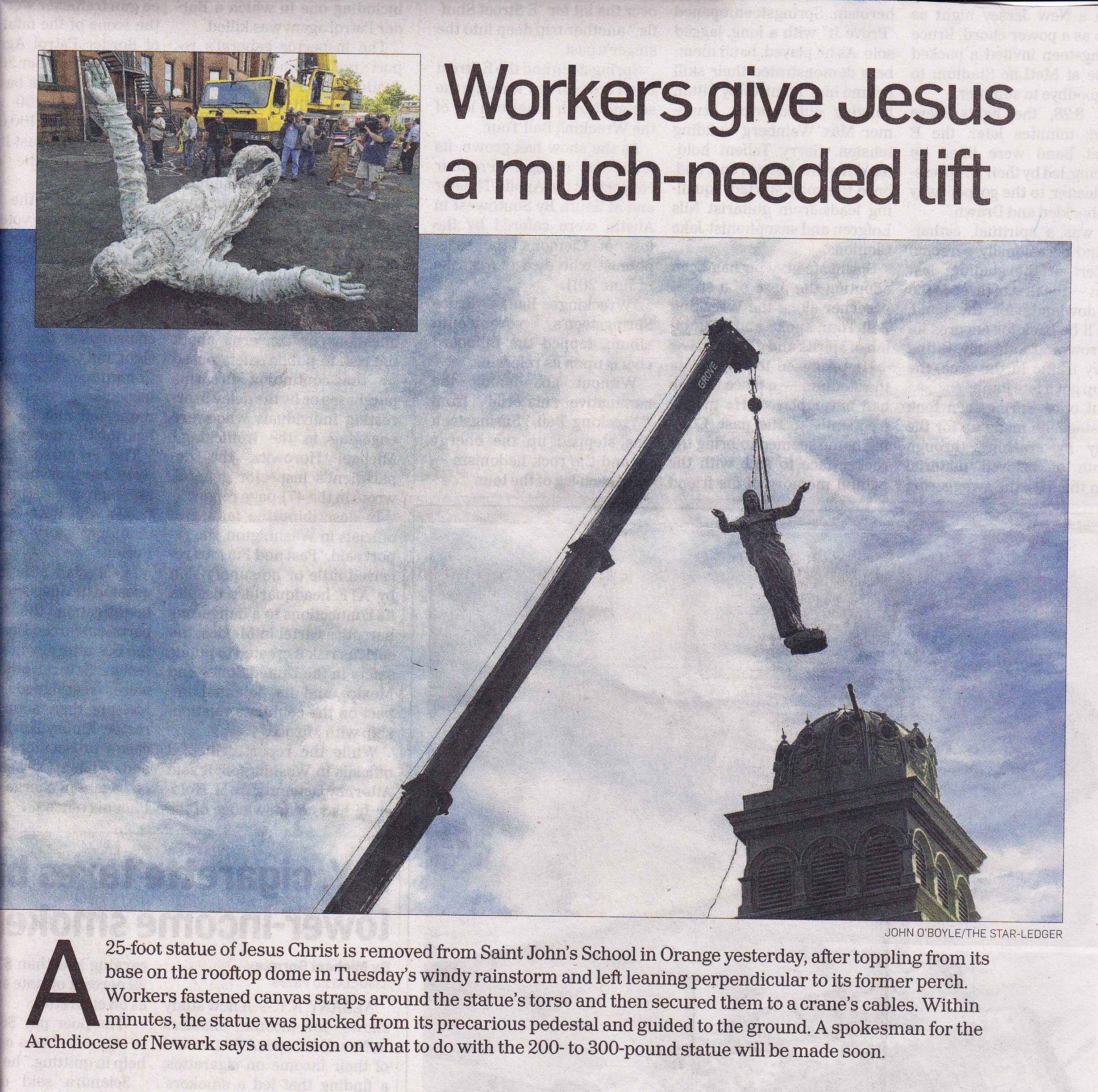
While I was off in Indiana, Jesus was coming down in New Jersey. Well, at least a graven image was. My wife saved the front page of Thursday’s New Jersey Star-Ledger that had a front-page, above the fold headline, “Workers give Jesus a much-needed lift.” The caption notes that in a gusty storm on Tuesday the 200-300 pound Jesus (this is America, after all) tumbled off his pedestal at Saint John’s School in Orange. A crane hoisting the fallen Lord dominates the first page. Clearly a bit of irony on a slow news day, the social commentary is thick indeed. Despite Magritte’s assertion, we still say the painting is a pipe. The representation is the object. This is the native logic behind the “idols” of old—to capture an image is to somehow to encompass some of the essence. This is precisely why the Hebrew Bible forbids images to be made.

I realize that “essence” is a disputed concept these days. Some scientists have declared that no such thing exists, along with souls, deities, and free will. Nevertheless, most mornings I wake up aware that I am me and not you, that my physical body is relatively near where I last remember it being, and that it faces the same hopes and limitations it did the day before and before and before. Perhaps this continuity is an illusion, but I can’t afford to treat it as such. It’s hard for an identity-less person to hold down a job. As usual, it is money that comes back to define us.

We recognize that it is disrespectful to mistreat representations of what we hold sacred. Does Jesus suffer any real harm for his image laid out on the ground? The nuance necessary to separate likeness from reality is something we obviously possess, but as we deal with the physical world the distinction frequently fades. Religion may have lost much of its explanatory value for the material world we inhabit, but images of a fallen savior demonstrate that we still operate otherwise. Much of our religious life concerns appearances. And for many people that step between appearances and reality is a very small step indeed.


Preachers and Pirates

One of the more colorful characters, albeit briefly mentioned, in Jon Butler’s New World Faiths, is Rev. Henry Loveall. While not a major historical figure in any sense of the word, and as a man who is known without the benefit of his own account of himself, the little we know of him intrigues. According to Butler, Loveall was dismissed as pastor from the Baptist church in Piscataway, New Jersey (a town in which I once worked) on charges of bigamy, prompting the Philadelphia Baptist Association to note he’d chosen an appropriate name for himself. Genealogical records online indicate that his given name was Desolate Baker and that he was born in Cambridge, England. As a youth he found himself in trouble for immorality with a woman at his church and he moved to America. Records are sketchy, but he apparently moved from Rhode Island to New Jersey to Maryland to Virginia. He had married but had gone to Virginia with another man’s wife. Even the usually forgiving genealogical records indicate some suspicion of his character.

Loveall lived in the eighteenth century when the world was still large enough to hide in. While I’m not the one to be impressed with Disney’s attempts at profundity in the Pirates of the Caribbean series of movies, there is one parsimonious line from At World’s End where Barbossa and Sparrow are discussing the incursion of business interests (in a delightful irony for a Disney film) into the free-spirited world of piracy. Barbossa avers that the world is smaller, but Jack Sparrow retorts that it’s not a smaller world after all, but “there’s just less in it.” Our world has been rapidly reduced to the pixels we can see on the screen in front of us. Bloggers are acclaimed as experts while those who’ve gazed across the war-torn promised land from atop the Mount of Olives with its frenetic network of churches start to doubt what their own eyes have revealed to them. We are content to let the Lovealls and Sparrows live it for us.

Our names are seldom a matter of choice. Like being born, they are factors in the midst of which we find ourselves—someone else supposed that we might turn out like this. The names we would select for ourselves show the size of our inner worlds. To love all is a noble sentiment. A sparrow is nervous, flighty, and has but a small brain. Our inner worlds are partially constructed by our religions. Declaring on divine authority what we must and mustn’t do, we find ourselves born into religions like we’re born into names. Few question the faith tradition fed to them by parents with such certainty, and that religion, just as surely as our name, becomes an integral part of our identity. History tell us little of Henry Loveall, a man who changed his name, and a clergyman who lived religion on his own terms.

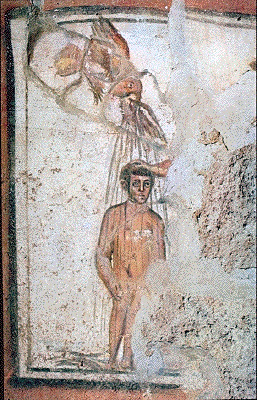
Baptized!


Friday the Sixth

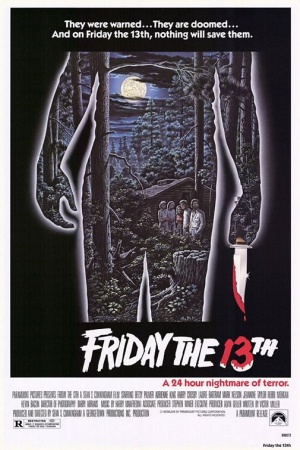
I tend to run behind on the movie front.  In some cases, decades behind.  I have never been a fan of slashers, although I did take a date to A Nightmare on Elm Street in the staid, dry town of Grove City while in college.  We broke up shortly after.  Still, I have a soft spot for “the classics,” and Friday the 13th has spun enough sequels to qualify.  “Jason” is a household name for the heartless serial killer, and the movie is set in New Jersey.  And it was hot outside and lazing on the couch trying not to stick to myself seemed about as much of a challenge as I could handle. Besides, a week from today is Friday the thirteenth. Now that I’ve finished with the excuses, here is a declarative sentence: I finally got around to watching Friday the 13th.  After many other films I’ve seen, I have to say that it didn’t really qualify as scary.  You know in advance that the counselors, by rote, must by killed in what are supposed to be shocking ways.  Shadowy corners and rainy woods and aluminum canoes are to be avoided, if the movie and its successors have taught us anything.  Nevertheless, the religion and scary film equation still applies.  And a strange kind of throwback to an unexpected classic (the literal kind).

The religious element comes in the form of the stock crazy local named Ralph.  Ralph warns the kids that they will die and says he’s been sent by God to warn them.  Of course they don’t listen.  If they had, there would have been no movie. As a child I was always offended by the caricature of the religious crazy, but I have come to see that this stock character is itself a symbol of fear.  Although ubiquitously laughed off, the person passionately driven by religion is indeed a potential danger to society.  In the days of my innocence we had little hard data upon which to hang such fears.  In the post-9/11 world it seems there are far too many sky-hooks for that purpose. Some of those sky-hooks are a little closer to the ground, but they inspire fear nonetheless. I’ve known all along that one of the reasons I watch scary movies is to give myself some advance warning of what might go wrong.  Not that it would help in any real way, but sometimes avoiding the shock by anticipating the worst seems like the only human thing to do.

What about the literal classic that I mentioned? Beowulf falls outside the Greco-Roman period, but is clearly a classic of English literature.  (Spoiler alert for anyone even more behind the times than me—) The only thing scarier than Grendel was, of course, Grendel’s mom.  So in Friday the 13th, the killing is done by Jason’s mom.  Like Grendel, Jason dwells underwater and surfaces to pull down his victim(s).  Like Grendel’s mother, Jason’s mother is decapitated by a sword (actually, a machete in the modern version), on the shore of the Crystal Lake.  After the mother’s death the child (Jason/Grendel) is resurrected.  Whether it was intentional or not, there is a lot going on here. The sacrificial mother is an inherently religious theme although many formal religions make it a male prerogative. The death of the mother brings the son back to life.  I wonder how Christianity might have differed if instead of three male deities, there had been a divine mother.  In such cases resurrection of the son comes only at a very steep price. Just like watching Friday the 13th on a hot summer night.