
A story going around the internet features pictures of Paula Osuna’s bruised second toe. According to the YouTube story, Osuna fell down the stairs then had her boyfriend rub some sacred dirt from the shrine of El Santuario de Chimayó in New Mexico over the injury. As part of the healing process, an icon of Jesus appeared on her injured toe. Now, New Mexico has a reputation for hiding some potent sites of paranormal import (at least 51 of them), but I had never heard of Chimayó before. It is apparently one of the most visited shrines in the country. Like Holy Hill, a local shrine I used to visit once in a while back in Wisconsin, the site itself is supposed to lead to healing. Healing sites sometimes hold their own irony.
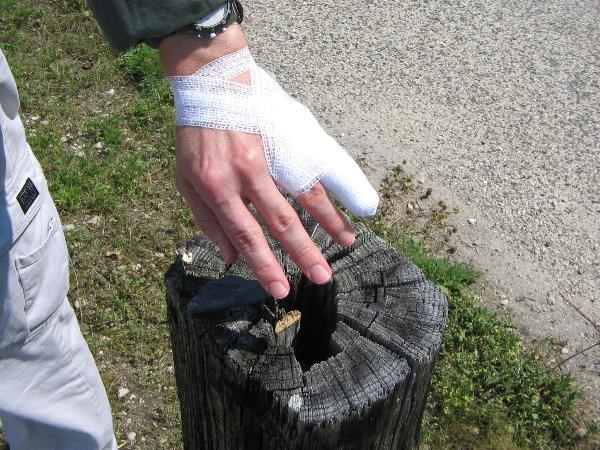
When we lived in Wisconsin, my family used to be avid geocachers. We still go out once in a while to find the little boxes hidden in the woods, but in Wisconsin there were plenty of day trips to be had with minimal traffic (unlike our current setting). One day we drove to Holy Hill National Shrine of Mary, Help of Christians, a discalced Carmelite community built atop a glacial moraine that gives spectacular views of the southeastern corner of the state. Inside there were many abandoned crutches, as I knew from previous visits, but this time we were present to find a small ammo box filled with trinkets, hidden in the wooded grounds. As our GPS narrowed us in on the coordinates, I made the typical error of watching my device rather than my feet. I slipped on a pile of rocks and my left hand slid onto a broken beer bottle, slicing open my little finger. Fortunately our geocaching bag held a small first aid kit, but no amount of gauze and holding my hand over my head could stop the bleeding. After we’d logged our find, we drove to a local emergency room where I received about ten stitches. Although the injury took place on the grounds of a healing shrine, no Jesus appeared on my shredded pinkie. Nor did miraculous healing come because of the location.
Pareidolia is a most fascinating evolutionary development. One of the first things imprinted on a newborn person is the image of a human face. In remarkably short time the infant can register the intent of various expressions on a human face and will soon learn to mirror them. That desire to find a friendly face never leaves us. We see faces everywhere. There are entire websites dedicated to pareidolia. We like to think there is a watchful parent ensuring that we won’t stumble and fall. Life, however, is full of accidents and injuries. Some of them are even the results of visiting healing shrines. Belief is what makes the difference. Ironically, even when Osuna’s bruise lost the shape of Jesus, she still believed in the healing power of the dirt. Her story has been covered on television and is easily found on the web. It is a fame born of faith. Miracles are always there for the taking.
 Steve A. Wiggins