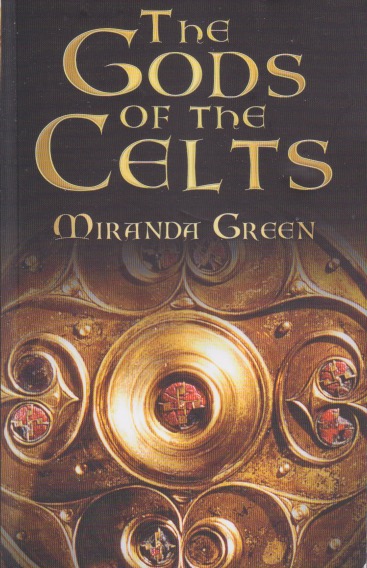
Celts and Gods

We’re accustomed to religions being written out.  Indeed, many world religions have sacred texts from the Avestas to Dianetics.  Some ancient cultures, however, didn’t have written traditions and when they disappeared, as all cultures eventually do, their religion became nearly impossible to understand, or reconstruct.  Miranda Green has tried to provide, in written form, a summation of her understanding of The Gods of the Celts.  Celtic mythology, interestingly, had long ago caught the attention of New Religious Movements, as well as the New Age movement.  Much of the Wiccan calendar is based on Celtic religion and many New Age practices trace their roots to the ideas of Ireland, Scotland, and Wales lost to the mists of time.  What we actually do know about these cultures is about as fascinating as what’s been reconstructed.

Green’s study shows us a religion that grew out of profound respect for nature as well as human prowess at fighting.  (The “fighting Irish,” indeed may touch on an historical pulse.)  Celtic gods reflected a large swath of thinking throughout western, and parts of eastern, Europe.  Their names may be less familiar to us, and some may well have been lost to the vicissitudes of time, but there was a vibrant devotion to them that went as far as human sacrifice.  We know that it occurred, but it probably wasn’t frequent.  Although polytheistic, Celts were moral in their own understanding of their world.  Morals tend to come from human understanding of their place in a world they didn’t create.  How do you live in somebody else’s property?

Unlike the more literate Greeks, or even the Semitic religions on which they drew for their stories, we have no narrative Celtic mythology.  We have fragments and glimpses.  Nobody had a recorder while sitting around the fire, recounting the activities of the gods.  Later, sources such as the Mabinogion were written down, which surely held some memories of such fireside tales.  The originals, however, we’ll probably never have.  Such is the way of conquered peoples.  What the Romans started the Christians finished.  We’re left with some deities, such as Brigit, made into saints, but their stories forgotten and not originally written down.  Our time looking back isn’t ill-spent.  It teaches us who we are and guides who we might become.  Our own violent politicians, threatening to murder those who are different, clearly have learned nothing from history, ancient or modern.
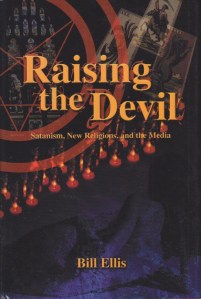

Lore of the Folk

Once in a great while you read a book that has the potential to shift paradigms.  The unusual and provocative Raising the Devil: Satanism, New Religions, and the Media, by Bill Ellis, is such a book.  Perhaps the main reason for this is that Ellis is a folklore scholar who takes his subject seriously.  He cites some unusual sources non-judgmentally, but critically.  He suggests that folklore can actually dictate reality for its believers, while not demanding that it defines how everyone else sees the world.  This fine parsing allows him to examine the satanic cult scares of the 1980s and ‘90s with a kind of passionate dispassion.  He traces the historical contexts that made such panics possible, all the while keeping belief structures in place.  In the end, the giving in to this folklore on the part of society can lead to tragic results.  Understanding folklore might well prevent that.

Since our prevailing cultural paradigm is a materialism based on empirical observation, at least among those deemed “educated,” it is easy to lose track of how belief constructs our worlds.  Ellis finds the cradle of satanic panics in the Pentecostal tradition where deliverance ministry—a Protestant form of exorcism—takes seriously the belief in demons of many kinds.  This leads to a study of ouija boards and Spiritualism.  Although neither led to Pentecostal theology, both play into it as doorways for demonic activity, in that worldview.  Add into this dissociative identity disorder (what used to be called, and what Ellis refers to as “multiple personality disorder”) and the recipe for a spiritual mulligatawny is simmering away.  You need not believe what the victim says, but if s/he believes, you must pay attention.

Outside the strict confines of Satanism, other cultural phenomena allowed for panics to grow.  Popular narratives, largely false, of satanists cum evangelists (think Mike Warnke) mingle with cultural fears such as the Highgate Vampire scare and cattle mutilations to make a narrative of satanic ritual abuse believable.  A folklorist sees the connections that a strictly wielded razor by Occam tries to shave away.  All of this fits together.  When we don’t pay attention to how real this is to those involved, a half-baked public panic can erupt.  Ellis suggests such circumstances might well have led individual witch hunts into large-scale witch crazes.  While both are unfortunate, the latter tend to lead to many, many ruined lives.  The subtle awareness that one need not believe in order to understand those who do is something worth pondering.  Reality may be far more complex than the activity of electro-chemical signals in a strictly biological brain after all.