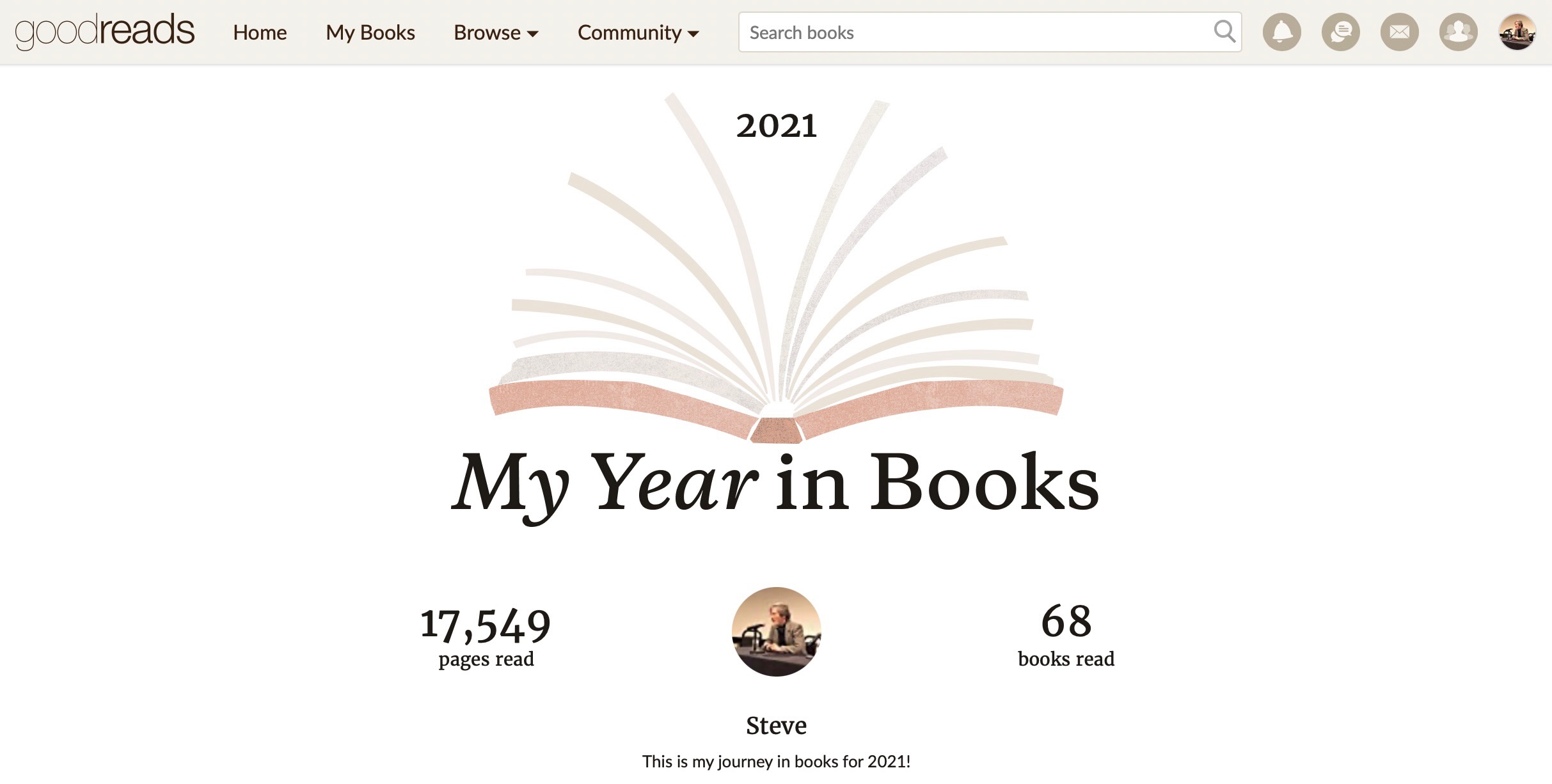
2021 in Books

It’s become my habit, on the last post of the year, to think back over the year in reading.  This gives me a chance to give a separate boost to the books I found particularly valuable, for a variety of reasons.  My Goodreads total for 2021 will end up being 70 (two haven’t yet shown up on my page).  It’s easiest to do this by category, so I’ll begin with fiction.  My favorite novels of this past year were Haruki Murakami’s Kafka on the Shore, Stephen Graham Jones’ Night of the Mannequins, Lisa Tuttle’s Familiar Spirit, Hank Green’s A Beautifully Foolish Endeavor, and Christina Henry’s The Girl in Red.  I really enjoyed Joseph Bruchac’s Bearwalk as well, but it’s for younger readers.

For what might be called spiritual memoirs I found Ernestine Hayes’ Blonde Indian remarkable and Heather and Gary Botting’s The Orwellian World of Jehovah’s Witnesses revealing.  Vine Deloria’s God Is Red was stunning.  (It should be clear by now that I read quite a lot from indigenous writers.)  If you count love of books as spiritual I would include Andy Laties’ Rebel Bookseller as well.  As long as we’re on spiritual, books by religion professors might count, so I would add Intimate Alien by David Halperin.  If you count just memoirs, I would also add Follow the Rabbit-Proof Fence by Doris Pilkington.  And if reflective essays count, John Green’s The Anthropocene Reviewed.  And Thich Nhat Hanh’s Love Letter to the Earth.  I learn so much from reading about how others deal with their lives.

Books in the nonfiction category tended toward horror movie analyses (ahem), but some stood out even among the weirdness.  Daniel Ogden’s The Werewolf in the Ancient World inspired me.  Kendall R. Phillips’ A Place of Darkness was a well-written account of early horror movies.  Tanya Krzywinska’s A Skin for Dancing in was insightful and helpful to my research, if difficult to locate.  Likewise Hammer and Beyond by the late Peter Hutchings.  Mathias Clasen’s A Very Nervous Person’s Guide to Horror Movies was fun and informative.  For importance I’d rate Dag Øistein Endsjø’s Sex and Religion at the top.  So much of the world’s conflict is based on these two factors.  It’s difficult to believe that we don’t talk about them and end up fighting and killing over them.  If we can’t talk about it, at least we can read about it.  There are many other books I enjoyed over the year.  Enough that even a brief mention of each would put me over my usual word limit.  (They’re easily found, in any case, by using the “Books” category to the right.) 2021 may have been a challenging year, but books helped me make it through it.

2019 Books

  Goodreads is always a little eager to put the tally on a year’s worth of reading.  This year, however, since I’ve been engaged in some larger books, they may be on target.  According to their count I’ve read 71 books this year.  (I re-read two, so my personal count is 73.)  New Year’s Eve, for me, is a time to reflect about what I’ve learned in the past year.  Much of that involves books I’ve read.  A good deal of my reading has been for Nightmares with the Bible.  To write a book you need to read books.  Frequently it means taking them on regardless of your mood—and I tend to be a mood-driven reader.  So what books stand out from 2019?  (They all have individual posts on this blog, in case you missed them.)

My first nonfiction book of the year was Christopher Skaife’s The Ravenmaster.  Animal intelligence always makes for good reading and this was reprised in Jennifer Ackerman’s The Genius of Birds.  I’ve fallen behind in my Frans de Waal reading, though.  Of the many research books on the Devil and demons, Jeffrey Burton Russell’s Mephistopheles stands out.  Russell’s clear thinking and wide view make him a pleasure to read even on unpleasant subjects.  Other books in that category didn’t quite rise to his level.  Monster books, on the other hand, rocked.  I loved James Neibaur’s Monster Movies of Universal Studios, Mallory O’Meara’s Lady from the Black Lagoon, and Kröger and Anderson’s Monster, She Wrote.  These were all excellent.  Tipping toward the unusual, Guy Playfair’s This House Is Haunted and Jeffrey Kripal’s The Flip gave me pause for thought.

Perhaps because I was reading longer books, this year didn’t have fiction in the numbers I usually strive for.  Most of it was quite good, though.   David Mitchell’s Cloud Atlas was memorable and Italo Calvino’s If on a Winter’s Night a Traveller (strangely similar to Mitchell) became an instant favorite.  My young adult fix came through Christy Lenzi’s Stonefield and Lois Lowry’s The Giver.  Victor Gischler scored with Vampire a Go-Go and Cherie Priest made a fine impression with The Toll.  I mentioned Neal Stephenson’s Fall yesterday, but it will stay with me into 2020.

A couple of memories/biographies also made deep marks on my mind.  Anne Serling’s As I Knew Him brought me close to Rod Serling and Barbara Taylor Brown’s Learning to Walk in the Dark found me where I live.  America’s Dark Theologian by Douglas E. Cowan isn’t really biography, but it was thought-provoking (as his books always are) and increased my resolve to read some more Stephen King.  The books I read make me more myself.  At the end of each year I think back over it all.  And this year I pondered what got me through a difficult 2019.  I have ended the year more myself than ever, I suspect, and I looking forward to a reading through the new decade.