In Praise of Libraries

It felt like a rare, and momentous moment in a young writer’s life.  While working at Routledge I happened to notice that the New York Public Library did not have a copy of A Reassessment of Asherah in their catalogue.  The first edition was published in Germany, so I wasn’t surprised that it was not there.  Gorgias Press, however, had published a second edition and few people were citing it.  I contacted the office on Fifth Avenue and offered to donate a copy.  A librarian contacted me and we set up a time.  I went between the stone lions (Patience and Fortitude by name), met my contact, and handed my work over without ceremony.  He seemed genuinely glad to have the book and I felt like I’d made a small contribution to a big city.

When I need a pick-me-up I look at WorldCat.  WorldCat is a conglomeration of library catalogues where you can find just about any book, including obscure ones, such as mine.  I recently hopped on to see how many libraries had Holy Horror.  (The answer is 90.)  While there I decided to check my others.  Nightmares with the Bible registered 68.  These numbers aren’t bad considering neither publisher markets the books and they’re priced too high.  The Wicker Man is still new and is only in 42.  What surprised me was when I looked back.  A Reassessment of Asherah is in 305 (total for both editions, one being in the New York Public Library).  What really surprised me was Weathering the Psalms, which 324 libraries claim.  Since it’s priced under $30, maybe there is something to the idea people will buy books if they can afford them.  As an editor I know that sales of monograph over 300 are considered successful.  Two of my books qualify.

Publishers don’t share sales information.  I can look up those at my current publisher, and I can check some on Nielsen’s BookScan (now called NDP BookScan), the service publishers use to get an idea of other publishers’ sales.  That’s the same Nielsen that does television ratings, by the way.  Searching my own titles there is too depressing, so I stick to library catalogues.  Libraries are feel-good places.  (I couldn’t help but notice that Princeton has all my books—thank you, Tigers!  The seminary has my first two, but the university has my books on horror films.)  I can just feel all the ideas in the air.  And I’m humbled to have contributed to them in a way, no matter how small.
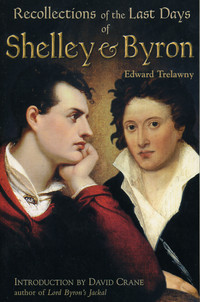

Shelley, Byron, Trelawny, and Ahab

“I took up the word [atheist], as a knight took up a gauntlet, in defiance of injustice. The delusions of Christianity are fatal to genius and originality: they limit thought.” The words come from Percy Bysshe Shelley, according to Edward Trelawny. After visiting the display Shelley’s Ghost at the New York Public Library last week, I was struck by how little I knew of Shelley. I’d read some of his poetry, and had watched the fictional movie Gothic (maybe more times than is really healthy) to get a sense of this candle in the wind, the Romantic poet who died in a shipwreck before reaching 30. Edward Trelawny’s reputation as an historian is somewhat suspect, but he did form friendships with Shelley and Lord Byron and arranged the disposal of their earthly remains. His book, Recollections of the Last Days of Shelley and Byron, while somewhat self-serving, weaves an intriguing account. Among the mementos in the library display are some fragments of Shelley’s skull, taken after his cremation by Trelawny. This erstwhile biographer did prove his mettle by reaching into the pyre and pulling out Shelley’s heart, according to his own account, that eventually returned to Mary Wollstonecraft Shelley, his widow.

Trelawny admired Shelley’s atheism, and even applauded Darwin’s Origin of Species when it appeared. The nineteenth century was setting the stage for a strange Frankenstein’s monster of political and religious backlash against the freedom of the Romantics. Not all of the Romantics, obviously, were atheists, but their works extolled the wonders of nature and a sense of liberty from tyranny that would define them as dreamers and idealists. Lord Byron comes across much less favorably in Trelawny’s account, although their friendship lasted through some difficult times. After the poet’s death, Trelawny claims to have examined his feet, discovering the cause of a lifelong limp. His psychologically astute conclusion is that Byron’s disagreeable personality traits arose from his lifelong anger and anxiety about his birth defect.

Being an ardent admirer of Herman Melville’s Moby-Dick, I have to admit that the elements of anger at the divine for a limp (Captain Ahab forcefully stomps into mind), and the emphasis on ships and shipwrecks (as in Shelley’s death) tie these three literary geniuses together into a knot of suffering and seeking. Religion had consoled many in the nineteenth century, just as it continues to do now in the twenty-first. Among many of those who have endured through their literary works, however, God had slowly disappeared. Not quite as dramatic of a demise as Shelley’s, nor as unforgettable as Captain Ahab’s, but one for which there will be few biographers.


Varieties of Non-Religious Experience

The New York Public Library is an icon of rationality. Daily tourists throng by—some inspired by Ghostbusters, others by Between the Lions. Nestled in among some of the tallest buildings in New York City, it is a symbol of culture amid its antithesis, business. Nearing its last days is a small display in the library entitled “Shelley’s Ghost.” Containing handwritten manuscripts and a few artifacts from Percy Bysshe Shelley’s cradle to his grave (literally, his baby-rattle and fragments of his skull), the display celebrates one of England’s most famous and short-lived poets. Shelley, although his life was scandalous at points, was no doubt an idealist. A vegetarian, advocate of “free love,” and protestor, he would have fit well into life a century-and-a-half after he died. He was also an early atheist.

“If ignorance of nature gave birth to gods, knowledge of nature is made for their destruction,” he wrote in The Necessity of Atheism. Not quite the angry atheism often found today, but then, despite his obvious spirituality, Shelley was a rationalist. Born during the English Enlightenment, be was a strange mix of the alchemical and the reasonable. To his young mind the truth was self-evident: the belief in gods grew from nature and therefore the study of nature would reveal those origins. Today the origin of gods is still up for debate, as is the nature of the human animal. It is routine for scientists to claim that our brains are simply processing electro-chemical signals that have no reality beyond this physical world in which they occur. To be a human, however, sure feels like more than that. Shelley was a writer at this nexus. No one writes poetry like that who believes their brain to be full of only electrons.

Reductionism often gets us into trouble. The problem has always been that humans are myopic; we can only see so far and yet assume we have all the data. This myth persists despite the fact that we know some animals pick up on environmental factors that we as humans miss. It need not be supernatural to claim that there is more to the world than we can perceive. This is a double-edged sword. Many of the absolute pronouncements of religions simply don’t match our experience of the world. We find ourselves bombarded by authoritative statements by experts who know as little as we do. I have yet to hear a televangelist who can claim on any intellectual basis any reason that anyone else should pay attention to his raving. Perhaps what the world needs is a few more like Shelley’s ghost—rationalists who still recognize the necessity of poetry.