Missing the Rose

It was Edinburgh, my wife and I concluded.  That’s where we’d seen The Name of the Rose.  Edinburgh was over three decades ago now, and since the movie is sometimes called dark academia we decided to give it another go.  A rather prominent scene that we both remembered, however, had been cut.  If you read the novel (I had for Medieval Church History in seminary), you knew that scene was not only crucial to the plot, but the very reason for the title.  In case you’re unfamiliar, the story is of a detective-like monk, William of Baskerville, solving a suicide and murders at an abbey even as the inquisition arrives and takes over.  It isn’t the greatest movie, but it does have a kind of dark academic feel to it.  But that missing scene.
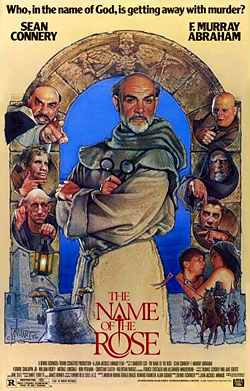
Of course, it’s the sex scene between Adso, the novice, and the unnamed “rose.”  Sex scenes are fairly common in R-rated films, often gratuitous.  But since this one is what makes sense of the plot, why was it cut in its entirety?  Now the internet only gives half truths, so any research is only ever partial.  According to IMDb (owned by Amazon; and we’d watched it on Amazon Prime) the scene was cut to comply with local laws.  More to the point, can we trust movies that we stream haven’t been altered?  I watch quite a few on Tubi or Pluto and I sometimes have the sneaking suspicion that I’m missing something.  How would I know, unless I’d seen it before, or if I had a disc against which to compare it?  There was no indication on Amazon that the movie wasn’t the full version before we rented it.

The movie business is complex.  Digital formats, with their rights management, mean it’s quite simple to change the version of record.  Presumably, those who’ve pointed out the editing (quite clumsy, I’d say) in reviews had likely seen the movie before.  Curious, I glanced at the DVDs and Blu-ray discs on offer.  The playing time indicated they were the edited version.  Still, none of the advertising copy on the “hard copy” discs indicates that it is not the original.  Perhaps I’m paranoid, but Amazon does run IMDb, and the original version is now listed as “alternate.”  Now that I’ve refreshed my memory from over three decades ago, it’s unlikely that I’ll be watching the film again.  I’ll leave it to William of Baskerville to figure out why a crucial scene was silently cut and is now being touted as the way the story was originally released.


The Printed Word

I miss them, newspapers.  Now, I’ve never been a great newspaper reader—I tend to live in my own little world, I guess, and I really have no taste for politics.  I still glance over the New York Times headlines daily (mostly) but that’s not what I’m talking about.  I’m talking about physical newspapers.  The other day we had a family creativity session.  This generally involves painting in some form or other and I realized with chagrin that we had no newspapers to lay down.  Nothing to protect the table top.  The same is true when we carve pumpkins, or do other activities that make you think that you want to protect your furniture.  Newspapers were always there.  We used to line our birdcage with them.  Made papier-mâché out of them.  They were handy to have around.

Josef Danhauser, Newspaper Readers, public domain. Image credit: Österreichische Galerie Belvedere, via Wikimedia Commons

We live fairly close to our means, so we don’t have lots of drop cloths lying about.  (Plastic is so much less feeling than paper.)  We don’t have rolls of butcher paper in our kitchen.  We even use cloth bags for groceries, so grocery bags are at a premium.  Our electronic mania has meant that physical creativity suffers.  I do applaud the saving of trees, but you sometimes just need the disposable broadsheet to catch the drips.  (And when I paint, believe me, there are drips.)  But perhaps this is a symptom of this insipid internet life into which we’ve slipped.  The other day I was searching for an electronic services store.  I’m not even sure what to call them anymore.  I had to go to the physical store (yes, they still make them) to have something looked at.

The website kept telling me a store with a different name was what I was looking for.  All I wanted to know was whether this was an actual store or some knockoff.  If you’ve purchased what are being called “dups” now you know that companies blatantly use other companies ads to sell cheap knockoffs that don’t resemble the product you wanted at all.  This all seems to be perfectly legal.  I guess I’m just nostalgic for the days when you had to have patience and doing things slowly was a sign of good quality.  The 24-hour news cycle has hardly been a benefit, and Trump could’ve never been elected without it.  And if you wanted to paint something, you’d just go to the stack of newspapers that every house seemed to have, and paint over any headlines you wished you hadn’t seen.


Weather Bugs

In one part of my life (ahem) I’m compelled to use Microsoft Windows products.  (In my personal life I’ve used Macs since before 1990.)  On a recent update they’ve added little, frequently changing icons in the lower left end of the task bar.  It took me a few days to figure out how to stop it from sending distracting news and sports updates (I don’t need these, and they disrupt my concentration).  They also send weather updates.  I couldn’t figure out how to turn off the weather, so I let it stand.  Perhaps it’s a sop thrown to workers who now spend more hours a day on the job because commuting is becoming less of a thing, a bit of relief from staying on task.  Something to make you feel connected.  Fine and good.  But does it have to be so alarmist?

Some of us can’t ignore sudden changes on the screen (much of advertising relies on this).  When the weather icon shifts, which it does periodically, it draws my eye.  It uses the language that’s become typical to dramatize the weather.  Temperatures will “plummet” on Saturday, for example.  I looked at a more sober weather website.  The high would be ten degrees lower than it was for that day.  Hardly a “plummet.”  Or it will tell me, in rather heightened tones, that four inches of snow are coming on Wednesday.  The more sober site says possibly one inch.  An hour or so later, the icon humbly admits maybe it’ll just be one inch.  The question is, do we really need these constant updates?  With theatrical exaggeration?  I turned off news and sports, otherwise the work day would include an almost subliminal news feed that goes from boot-up to log-off.

I get through these difficult days by mostly ignoring the news.  I don’t ignore the weather—it seems more real than what’s happening in Washington.  Besides, I wrote a weather-oriented book once upon a time, and I haven’t lost the interest.  We’re going through the time of year when spring and winter are duking it out.  Every few days it snows or ices, and in-between I find wasps inside that think maybe it’s time we should just be getting on with this.  Meanwhile, each day, all day, I’m sent weather updates meant to shock and awe me.  Into what?  Yet more panic?  I’ve noted before that in some respects I have a monastic personality.  I prefer calm, most of the time, without too much extraneous stimulation.  I go for hours each day without even glancing at my phone.  And for the weather, I prefer just to look out the window.


Major Drum

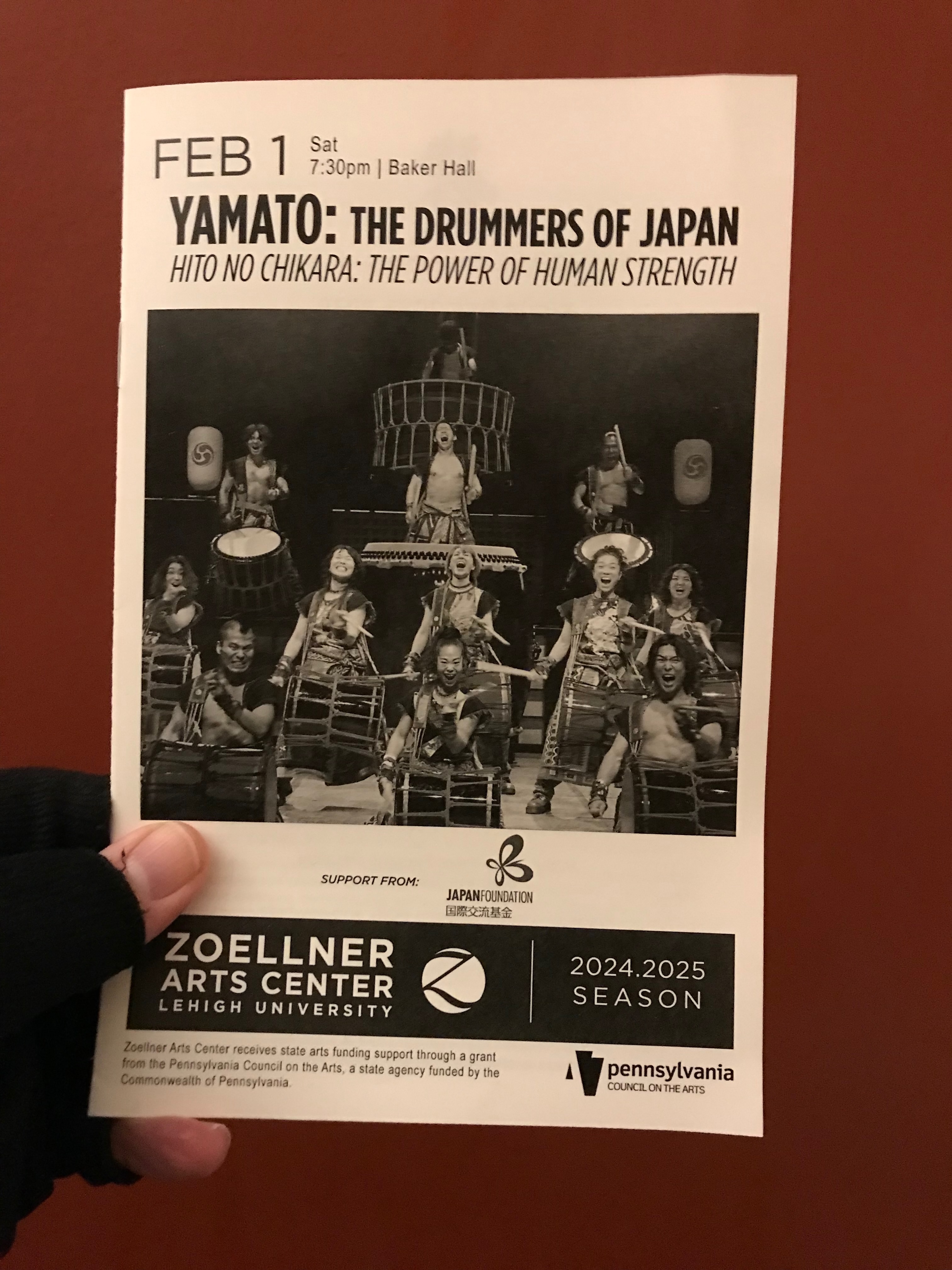
We don’t get out much.  Live shows can be expensive and these cold nights don’t exactly encourage going out after dark.  Living near a university, even if you can’t officially be part of it, has its benefits, though.  Over the weekend we went to see Yamato: The Drummers of Japan.  Our daughter introduced us to the concept while living in Ithaca, a town that has a college or two, I hear.  These drummer groups create what might be termed a sound bath, that is profoundly musical while featuring mainly percussion.  Now, I can’t keep a beat for too long—I’m one of those guys who overthinks clapping in time—but that doesn’t mean I can’t appreciate those who can.  The timing of the members of Yamato was incredibly precise, and moving.  At times even funny.  It’s a show I’d definitely recommend.

This particular tour is titled “Hito No Chikara: The Power of Human Strength.”  Now this isn’t advertising their impressively well-toned bodies, but is a celebration of human spirit under fire from AI.  The program notes point out some recurring themes of this blog: to be human is to experience emotion, and to know physical limitations, and to be truly creative.  Would a non-biological “intelligence” think to wrap dead animal skins around hollowed out tree trunks, pound them with sticks and encourage hundreds of others to experience the emotions that accompany such things?  I live in a workaday world that thinks AI is pretty cool.  Humans, on the other hand, can say “I don’t know” and still play drums until late in the night.  We know the joy of movement.  The exhilaration of community.  I think I can see why they titled their show the way they did.

Bowerbirds will create nests that can only be called intentionally artful.  Something in biological existence helps us appreciate what they’re doing and respond in wonder.  Theirs is an innate appreciation for art.  It spans the animal world.  Japan is one of many places I’ve never been.  I’ve never played in any kind of band and you don’t want me setting time for your pacemaker.  If a computer keeps such precise timing we think nothing of it.  It’s part of what humans created them to do.  When a group of people gets together, stretching their muscles and working in perfect synchronicity, we sit up and take notice.  We’ll even pay to watch and hear them do it.  Art, in all its forms, is purely and profoundly biological.  And it is something we know, at our best, to appreciate with our emotions and our minds.


Science of Convenience

One thing I’ve noticed about employers is that they’re all for science, except when science contradicts capitalism.  Then they become all mystical.  I had a situation illustrate this particularly well with one of my many employers.  Touting everything to be “evidence based,” they liked to refer to the science behind their reasoning.  Then a study came out demonstrating, scientifically, that more breaks actually increase efficiency in learning and working.  Suddenly silence from management. Crickets chirped.  This observation was just as “evidence based” as daily operations, but it was ignored because, well, it would be giving too much to employees.  You see, science that benefits the upper levels of management is one thing, but by the time it trickles down, well, you know.

American culture is based on the premise that you need to drive people to work as hard as possible.  Perhaps anecdotally, the Covid-19 pandemic showed that workers at home were just as, if not more, productive than they were after enduring an often horrendous commute to get to the office.  Once pandemic strictures began to lift, however, it was all “we want you back in the office.”  Bosses like to look out over seas of employees in their cubicles and feel the surge of the galley master with his whip.  You need to keep workers in line, you understand.  That’s the way capitalism works.

I often wonder where the world would be if superpowers didn’t have cultures based on greed.  One of the seven deadly sins, or capital (!) vices, the worship of personal gain stands behind capitalism as we know it.  And we’ve seen the results.  A shrinking middle class as those with all the wealth make plutocracy out of what was intended to be a democracy.  (Of course, the wealthy founders of the country probably didn’t have a real grasp of what life was like for the poor, even at the start of things.)  Capitalism is good at using aspects of all human endeavors in order to increase its reach.  Science is one such tool.  Religion is another.  Science says more time off is good, and can increase productivity in our current world.  Religion says greed is evil.  These are the parts we’d like to ignore.  Even the Harvard Business Review suggests a four-day work week is beneficial.  Business leaders are skeptical, of course.  Skepticism is one of the elements of science.  And science can be very profitable, if it favors those who hold the reins of power.

Photo by Alex Kondratiev on Unsplash

Tech Trust

Tech problems are a part of life, of course.  The recent problem at CrowdStrike that grounded airlines and prevented 911 from working and interfered with medical services is a scary thing.  The word “fragility” was used in the New York Times.  Please allow me this jeremiad.  I appreciate technology and what it can do for us.  I really do.  I can usually find a movie to watch online on a day off work.  I can navigate most places without a map (although recently when there was no 4G coverage, I was left lost for a little while).  What’s really scary, to me, is those who claim tech, and only tech, is our future.  I’m a simple guy with simple tastes.  I enjoy reading books and watching movies to stimulate my restless imagination.  Yet I’m constantly being told that I should read on a screen, not on paper.  And that artificial “intelligence” can—or worse—should run things.  What happens when the grid goes down?

Photo by Markus Spiske on Unsplash

I love art glass, but I’ve also broken quite a bit of it over the years because life is rough and tumble.  Some fragility is part of the attraction. For a while, when I was young, I was fascinated by card houses.  Constructing one that used an entire deck was not only a goal, but its own kind of art.  Sometimes the beauty of art inheres in its very fragility. The house of cards took skill, but someone slamming a door, or even walking into the room could bring it all down.  A trembling hand or a drop from a millimeter too high could spell the end of this particular installation.  But nobody died.  No worldwide travel plans were interrupted.  The consequences were minimal.

I don’t dislike computers.  It’s just that I think balance is desirable.  After work, which is pretty much all online these days, I tend to move away from the internet for the rest of the day.  I pick up a book, made of paper.  Sometimes I’ll watch some media, preferably on DVD.  I don’t miss VHS tapes, I assure you—although we still have quite a few of them, some of which contain media that has never been released either on disc or online.  I can’t watch them.  Oh, if I had the time, gumption, and cash I could purchase a player.  I’d have to buy some kind of adapter to connect it to the TV.  Is that a downgrade?  My understanding is that CrowdStrike’s problem was all caused by an upgrade.  I’ve known smaller catastrophes with upgrades, and they seem to come every couple of months now.  What’s to be done?  Maybe we should slow down a little and read a book.


Holy X

It took several years, but we finally closed the X-Files.  It was shortly after we bought the house, I believe, when we decided to watch the series the whole way through.  This was prompted by my wife giving me season eleven as a present, and I was wondering if I’d lost track of the thread.  We recently finished the last episode of the last season, with the movies interjected into the correct locations.  It was an impressive franchise.  I didn’t watch The X-Files when it originally aired.  We didn’t watch TV in those days (Nashotah House didn’t have cable and reception was awful), but another reason was that I was unmercifully teased for being interested in such things as a kid, and now it was trendy.  Once I got started, though, I was hooked.

Copyright: FOX; fair use screen capture

A few things struck me this time through, but one of the bluntest instruments to hit me was just how profoundly religion was interlaced with the series.  Many episodes involve religion directly, and others address faith and belief, even if outside the confines of established religion.  Since I tend to pause to reflect, I come a bit late to the table most of the time.  If I’d been on the ball, and if I’d begun writing books on horror sooner, I might’ve found a project in the religion of the X-Files.  As it is, several books have been written analyzing the series.  Maybe that’s where I’ll turn next.

You see, the original projected end for the series was season seven in 2000.  The mythology was wrapped up, and David Duchovny was leaving the show, which was, in essence, the story of Fox Mulder.  Two more seasons were ordered, however, with Fox on the run.  Things again were wrapped up in season nine.  Season ten came to air in 2016 and we watched it in real time, with primitive streaming.  In 2018, however, moving ended up being chaotic, and any watching would have to wait.  It seems pretty clear that, even with endless resurrections of the Smoking Man—Mulder’s Darth Vader—that the crisis of the world’s end (on which season ten ended) had finally been resolved.  That season, however, was eerily prescient regarding the pandemic.  Season eleven was a strong pushback against the Trump presidency with its “fake news” and constantly shifting facts.  Many of the episodes note how dangerous this is.  At the end it seems that the miraculous son, dead and resurrected, immaculately conceived, survives, as do the father and, if it’s not reading too much into it, a holy spirit.


Craving Stability

As memorable events go, earthquakes are right up there.  Well, we don’t get them often around here, but at 10:23 a.m. yesterday a 4.8 hit about 30 miles east of us, in New Jersey.  The whole house was shaking and it took quite a while to calm back down.  (Me, not the ground.)  The only other time I experienced an earthquake was the Virginia quake of August 23, 2011.  Yesterday’s was much closer and therefore felt much stronger.  It took a few seconds to believe it was even really happening.  Work will do that to you.  Such an event, just 3 days ahead of a total solar eclipse, has an almost apocalyptic feel to it.  And we’d just come off of a punishing super-soaker storm that left puddles in one of our bedrooms.  Those of us out east just don’t get these kinds of things happening very often.  It’s a little difficult to process and it kind of makes me wish I’d gone into geology after all.

Since apparently nobody was hurt, this goes into the category of transcendent earthly things.  Ironically, confirmation came from social media before any news networks had anything to say about it.  Big wheels turn slowly, I guess.  The first minutes after it hit were a time of confusion—did it really happen?  Was that actually an earthquake?  What else could it be?  The same was true after the Virginia quake.  I don’t want to brag about surviving an earthquake if that’s not what it was.  Funny how you want validation, even at a time like that.  Such events remind us that we’re small compared to this planet we call home.  When the earth moves there’s nothing you can do about it.

Ironically, there are no maps detailing the Ramapo Fault line that was responsible for this quake. At least there aren’t any on the web. At 5:58 p.m. we had a 4.0 magnitude aftershock, much briefer than the main event.  An end-of-the-day reminder that we rely on mother earth for just about everything.  Earthquakes are times to call certainties to question.  Time to ask what we really know.  The tri-state area (in this case New York, New Jersey, and Pennsylvania) isn’t particularly susceptible to earthquakes—or isn’t prone to them, in any case.  I grew up in Pennsylvania and never felt one, although a bolide shook my childhood house back in January 1987, I believe it was.  Such reminders serve a purpose and in that sense they’re signs and portents.  We need to listen to the earth.  If we don’t, she will get our attention.  And then we must ponder.

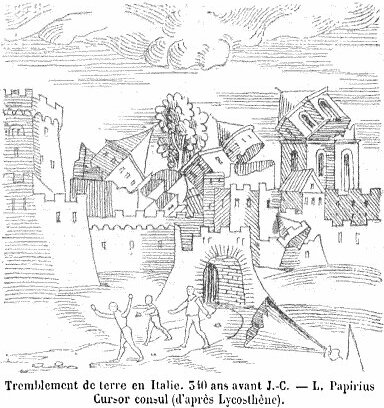
Nothing as bad as this! Image credit: illustration extraite Prodigiorum ac ostentorum chroniconde Lycosthène, public domain via Wikimedia Commons