
Auld Reekie

DSCN3452

Those of us who once tried to storm the walls of academe from humble beginnings soon learn our lesson. This is a guild meant only for those whose parents knew enough to suggest an Ivy League education. Those whose parents have never heard of Harvard (they exist!) and who don’t know what an Oxford is aren’t really well-placed to give advice on these matters. At a small-town high school you couldn’t count on a guidance counselor noticing your academic prowess as anything more than a statistical blip in a non-challenging career. I learned about the Ivy League too late. It was, therefore, a very pleasant surprise to have an Edinburgh colleague ask me to write a piece for a Cambridge Companion. I don’t have the contract yet, but even the invitation made my day. Maybe my month. Or career.

I spend my days commissioning just such works for a different press. I know hundreds of colleagues. Only one ever said, “would you consider writing…” I’m not being entirely fair here. I’ve been asked to contribute to Festschriften. Such volumes are the highest praise an academic can be given. John C. L. Gibson, of blessed memory, was the first honoree. Nick Wyatt was the second. Simon Parker, also departed, whose Festschrift is currently in the works, was the third. I’ve been asked for others, but regular research is beyond my reach with my current schedule. I can churn out an original article once a decade, it seems. The ideas are still there, alive and popping. The time, alas, is not.

So I’m happily sitting here thinking of how to write a Companion article. The colleague who asked me is someone I recently met. He found out that I had attended his alma mater and wondered why I hadn’t landed a regular teaching post. Edinburgh University, in the larger world, is a recognized name. I can’t see through the ivy to discern it on this side of the Atlantic, but I’m assured it’s still there. Recognizing that those who fall between the cracks can still sink a taproot and make a contribution, he asked me if I might consider it. He had me at Edinburgh. School loyalty still counts for something, I’m glad to learn. For once I feel that I don’t have to apologize for having ventured to Scotland with only my transcripts and high hopes in my pocket (and with an indulgent wife by my side). Now I’ve been asked to write. I’ve gone all red, and I hide my face behind my hand. Of course I’ll do it.

Vive la compagnie

I’m cleaning out the closet at work. I doubt that either J. C. L. Gibson or Nicolas Wyatt envisioned my future thus. Edinburgh University was exotic and optimistic, designed to make my curriculum vitae stand out. More like standing out in the rain. “We have to ask what’s best for the company,” I’m told. I’m not a proud person, but earning a Ph.D. to take out the trash seems like a strange allocation of resources to me. “Take one for the team,” we’re told, since we’re part of a company and when the company prospers, we prosper. On a pro-rated scale, of course. It’s not that taking out the trash is beneath me. I willingly do it at home; my first career aspiration was to be a janitor. Only now I’m dressed in work clothes for the City. And I spent nine years in higher education to get here.

Lately I’ve been pondering how this “for the company” trope is a one-way street. Knowing in advance that Nashotah House could be a Hindenburg career for a liberal, I gave it the old college try. Writing about 90 pages of class notes a week for my first year of teaching, attending mandatory chapel twice a day, I tried not to step on any toes. Even though the theology over which I was forced to chew smelled a bit like this garbage I am now carrying, I made no fuss. Don’t rock the boat, especially if it’s a garbage scow. Take one for the team. After fourteen years of not making a fuss, I was summarily dismissed. I found out, literally, how hard it is to get a job as a garbage man.

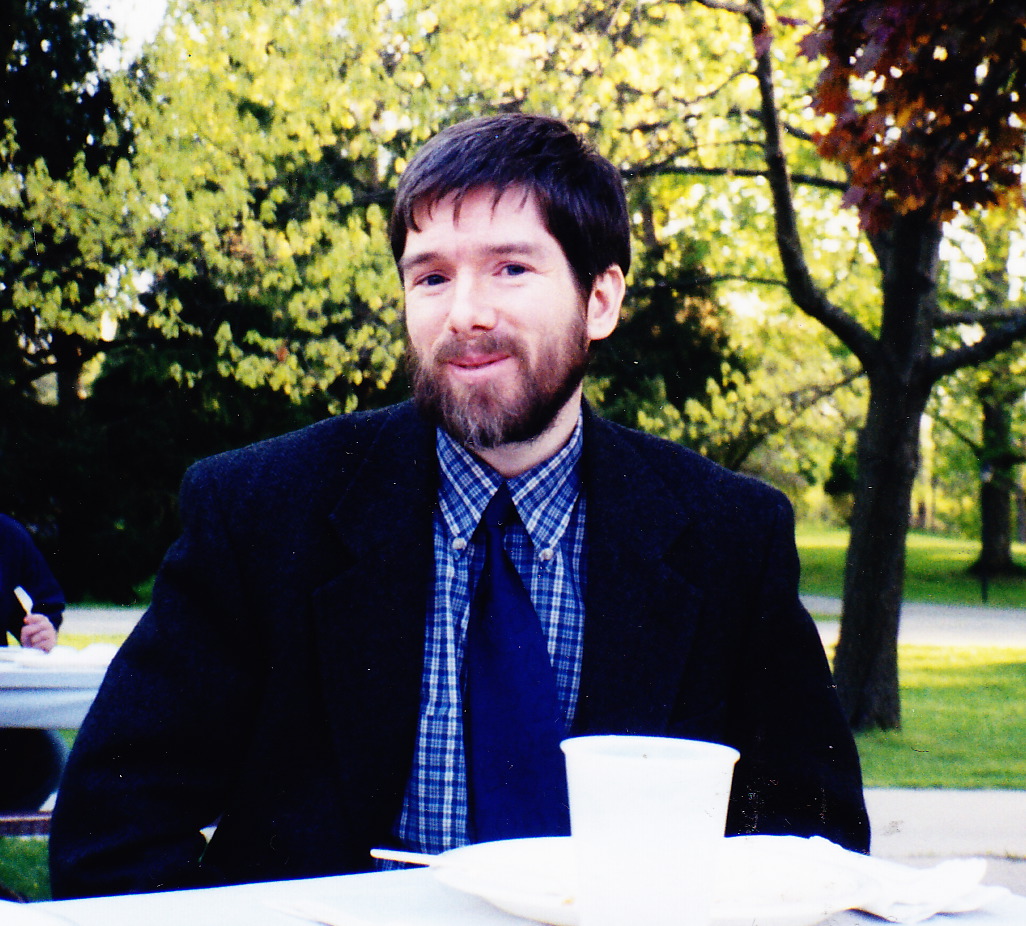
Portrait of a livelihood about to end.

Portrait of a livelihood about to end.

Eventually I landed a job at Gorgias Press. Neither prestigious nor lucrative, it was a job and I had already proven I could take one for the team. Positions evaporate around here like dribbles from a spilled cup of coffee. So I found myself at Routledge, jetting around the country, spending long hours on the bus, being told to think what was best for the company. Only don’t expect the company to do the same for you. Stoking egos, I tried to get people with qualifications I could match to write a book for me. At Nashotah House I played on the football team (don’t laugh, it’s true). We had only one game a year, against our rival—the now defunct Seabury-Western in Chicago. During practice one day, one of my students blocked me with a forearm to the chin that left me on my back, seeing stars. I can take one for the team. But sometimes the company needs someone to take out the garbage. Ask the guy with a doctorate in rubbish removal. He always thinks about the company.


Into the Great Beyond

It is a sobering moment when one of your advisors shuffles off the mortal coil. Just a year after my master’s degree, Harrell Beck, my program advisor passed away amid a flurry of unusual happenings. Just a few years back, Simon Parker, his colleague and an Ugaritologist who befriended me, also slipped into the netherworld. I just received the obituary of John C. L. Gibson, my doctoral advisor from Edinburgh, reminding me that my obvious concerns with death and religion in this blog have a very practical application. We all have to face it sometime, and hopefully our legacy will be a good one.

Professor Gibson was best known for his revision of outdated but valuable reference materials. His work as a Semitic linguist was highly regarded, but he didn’t wander too far from convention. As a clergyman in the Scottish Kirk, he had natural constraints. He also had a clever way of turning a phrase. Late in my time at Edinburgh University, I started to keep a list of his aphorisms. If I’d started earlier I might have some more nuggets to lay out here, but I thought it a fitting tribute to a fine gentleman scholar who always took a dram with his breakfast to pass along a few of his choice quotes in this post. You’ll have to do your best to imagine the Scottish burr —

“Don’t lead with your chin” (this was in the context of taking on academic debate).

“Skullduggery is just around the corner in archaeology.”

“Archaeologists and epigraphers shoot each other on sight” (this was in reference to Ebla).

“In Job the daring word is often the right one.”

“If you want to stand against him, do so. But get your armor on first!” (This remark came after I challenged a time-honored thesis by the late James Barr, while he was still early.)

“Every word in Arabic refers to a part of a camel as well as something else.”

“Inscriptions like Ajrud, they’re a nuisance; they shouldn’t be there.” (Kuntillet Ajrud is the site of one of the famous “Yahweh and his Asherah” inscriptions.)

“Who is Asherah and what is she doing here with Yahweh?” (In the same conversation as the previous comment.)

“Turning pages is a major activity of scholarship.”

There were, of course, many more. Professor Gibson will always remain a large part of my Edinburgh experience. Sitting in his pipe-smoke during one of my sessions, I noticed he had no computer. “Ach, aye, they offered me one, but I wouldna used it,” he explained. He didn’t even own a typewriter. In my mind, his passing is like the passing of old school scholarship itself.

J. C. L. Gibson, a cipher, and Nicolas Wyatt

J. C. L. Gibson, a cipher, and Nicolas Wyatt