
You just never know. I’ve read lots of books about horror movies, but clearly not enough. The field only gained academic respectability in recent years, but once the flood gates opened… So I use my limited time off work both reading and watching horror movies—trying to catch up on what I’ve missed. Lately I’ve been reaching back to the early stuff, movies from the forties and fifties. Some of these are what we’ve been led to expect. Others are not. I’d heard of Night of the Demon (its American title is Curse of the Demon) but my sources suggested nothing remarkable about it. As soon as I began watching, however, I realized that this story adapted from M. R. James would be worth the time. This despite the fact that the monster is shown early and isn’t that great. (The director, Jacques Tourneur, lost out on this one.) After I saw it I read that it is considered by many the greatest horror film of all time.
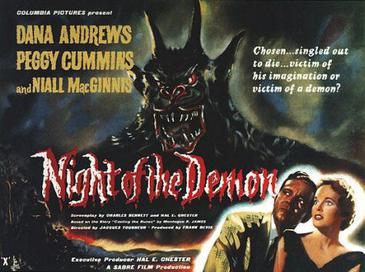
I wouldn’t go quite that far, but I would say that it is very good and, as I learned, extremely influential. So much so that I was rather stunned after a casual weekend viewing. The story is about a Satanist whose true motivations are uncertain. Those to whom he gives runes copied from Stonehenge are killed by the demon we’ve already seen. The story plays out as a conflict between skepticism and belief—the supernatural is real, but alternative explanations are offered—you can see why the obvious demon scenes are so controversial. The film makes effective use of jump startles and stingers. And it’s one of those movies that, in its day wasn’t really appreciated, but reassessment polishes it as the gem that it is.
Proving later influence, such as the wind storm in The Omen, is difficult without a director revealing their sources, like a magician, but others are perfectly obvious. Kate Bush’s song “Hounds of Love,” plays a clip of a line from the movie. Richard O’Brien’s lyrics for “Science Fiction/Double Feature” (famous because of the Rocky Horror Picture Show) make reference to Dana Andrews passing the runes. That line had always puzzled me. And now I discover that I’ve been missing out on a foundational piece of horror history. When friends recommend movies, not surprisingly, they tend to be relatively contemporary ones. The thing is, to appreciate what’s popular now, one must do one’s homework. And that might must mean hunting down the oldies. You just never know when you might come across one worth the effort to find.
 Steve A. Wiggins