Horrible Delays

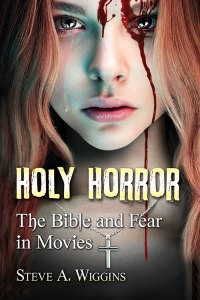
It’s not that the delay is actually horrible.  Horror movies, after all, come into their own with the darkening days of fall.  Nevertheless it occurred to me that now August is about to exit stage left, some may be wondering where Holy Horror is.  After all, the website originally said “August.”  The truth is nobody really understands the mysteries of the publishing industry.  Like so many human enterprises, it is larger than any single person can control or even comprehend.  I work in publishing, but if I were to subdivide that I’d have to say I work in academic publishing.  Further subdivided, non-textbook academic publishing.  Even further, humanities non-textbook academic publishing.  Even even further, religion—you get the picture.  I only know the presses I know.

It suits me fine if Holy Horror gets an autumn release.  I don’t know, however, when that might be.  I haven’t seen the proofs yet, so it’s hard to guess.  Appropriate in its own way for horror.  The genre deals with the unexpected.  Things happen that the protagonists didn’t see coming.  In that respect, it’s quite a bit like life.  My work on Nightmares with the Bible is well underway.  When you don’t have an academic post your research style necessarily changes, but I’m pleased to find that books can still be written even with the prison walls of nine-to-five surrounding one.  It may be a bit like Frankenstein’s monster (happy birthday, by the way!), but it will get there eventually.

Of my published books so far, Holy Horror was the most fun to write.  It wasn’t intended as an academic book, but without an internet platform you won’t get an agent, so academic it is.  It’s quite readable, believe me.  I sometimes felt like Victor Frankenstein in the process.  Pulling bits and pieces from here and there, sewing them together with personal experience and many hours watching movies in the dark, it was horrorshow, if you’ll pardon my Nadsat.  We’re all droogs, here, right?  I do hope Holy Horror gets published this year.  Frankenstein hit the shelves two centuries ago in 1818.  Horror has been maturing ever since.  So, there’s been a delay.  Frankenstein wasn’t stitched up in a day, as they say.  And like that creature, once the creator is done with it, she or he loses control.  It takes on a life of its own.  We’ll have to wait to see what’s lurking in the darkening days ahead.


Moving Books

One of my anxieties about moving is that commuting time was my reading time.  Enforced sitting for over three hours a day meant consuming book after book.  Now I have to carve out time to read.  Life has a way of filling the time you have.  I say the following fully aware that you’re on the internet now, but one of the biggest time drains is the worldwide web.  Humans are curious creatures and the web offers to answer any and all queries.  (It still hasn’t come up with a satisfactory answer to the meaning of life, however, IMHO.)  Even when I’m working on my current book, a simple fact-check can lead to surfing and before I know it, I’m out to sea.  That’s why books—paper books—are such a good option.  A footnoted source meant another trip to the library, and libraries led to more reading.

I’m a Goodreads author.  I like Goodreads quite a lot, and I actively accept new friends there.  In the past I set goals of reading 100+ books per year.  Aware back in January that a move might take place, I lowered my expectations.  I figured, even without commuting, that 65 books would be attainable in a year.  Of course, Goodreads doesn’t count the books you write, only those you read.  I had to tell even Amazon Author Central that Holy Horror was my book.  Moving, however, is a liminal time.  Every spare minute is spent packing.  And you still owe “the man” eight hours of your day.  That rumble that you feel is the moving truck growing closer.  Reading time has become scarce.  I fear I’m becoming illiterate.

And Goodreads makes me think of Twitter.  I’ll just click over there a while and wonder why I can’t seem to grow a following.  Ah, it turns out that you have to tweet often and incessantly, with erudite and trenchant things to say.  The birds chirping once a second outside my window can’t even keep up.  Problem is, I have a 9-to-5 job, and I’m trying to write Nightmares with the Bible.  And there’s just one more fact I have to check.  Wait, what’s the weather going to be like today?  Gosh, is that the time?  I have to get packing!  That moving van will be here only hours from now.  I need to calm down.  The way to do that, in my case, is to read a book.


Wolves Again

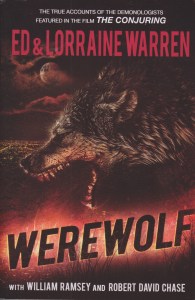
Although I don’t read movie reviews until after I’ve seen a film, I have a confession to make. With rumors swirling of The Conjuring 3, and since a chapter of Nightmares with the Bible will involve The Conjuring, I was a little curious what it might be about. Word on the street—and by “street” I mean “internet”—is that it will feature the case of Ed and Lorraine Warren that’s presented in Werewolf. Co-written by William Ramsey (the victim) and Robert David Chase, the book describes the strange malady of Ramsey, who never actually changed into a wolf, but for inexplicable reasons (at the time) thought himself a wolf and took on a wolfish look as he attacked people. The reports suggest he had preternatural strength at such times.

Since most of the Warrens’ books are concerned with demons, it should come as no surprise that in this case that was the diagnosis as well. With no real reason given, once upon a childhood evening Ramsey was possessed and occasionally broke out into violent fits. He landed in a psychiatric hospital a couple of times, but was eventually released. Noticed by the Warrens on one of their trips to England, Ramsey was invited to come stateside for an exorcism. According to the book, the rite was successful at least up until the time of publication. That’s the thing about demons—you can’t always tell for sure when they’re gone.

It’s pretty obvious why such a story line would appeal for a horror flick. You’ve got a werewolf, an unnamed demon, and an exorcism—there’s a lot to work with here. Weird things happen in the world, and there’s not too much to strain the credulity in this case. It would seem possible that a mental illness could cause much of what’s described as plaguing Ramsey, though. Its episodic nature is strange, I suppose, and the Warrens had a reputation for spotting demons. I did miss the conventional elements of the exorcism, however. No demon forced to give its name, no levitating and no head-spinning. Not even a bona fide bodily transformation. They’ll be able to fix that in Hollywood, I’m sure. Credulous or not, there will always be people like me who feel compelled to read such books. And since there’s no final arbiter but opinion in cases of the supernatural, that can leave you wondering.


Behind the Scenes

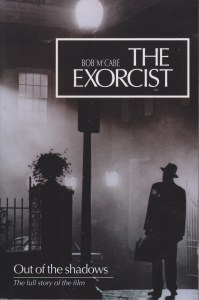
Although I confess to being a horror aficionado, it took many years before I could convince myself to watch The Exorcist. I finally saw it in the mid-20-aughts, and have watched it many times since. It’s a movie that I discuss in Holy Horror, and it will star in Nightmares with the Bible as well. Although younger people often don’t experience the movie as scary—certainly the increasing trust in science and growth of secularity contribute to this—there is a sincerity about it that earns it its deserved place in the pantheon of horror. Bob McCabe surely counts as a fan for his The Exorcist: Out of the Shadows. Sub-subtitled The Full Story of the Film, this book is a gallimaufry of anecdotes, interviews, and facts about the movie and even its sequels. It’s like of like a sustained reaction shot.

The book doesn’t lack insight and McCabe is surely right that this was one of the most influential movies of the early 1970s. It has become a frame of reference on its own and it has defined, in large measure, what people believe about demonic possession. One of the quotes from McCabe’s treatment however, uses the phrase “metaphysical unknown” to explain why the film retains its power to scare, and there’s a great deal of wisdom in that assessment. Fear of the unknown, of course, is prime real estate for horror, and one of the most interesting things about demons is how little the Bible, or other ancient texts, really says (or say) about them. They are an embodiment of the unknown that can take over a person and make her somebody else. But it’s that metaphysical that’s really scary.

As we continue into a time of less and less that remains unclaimed by scientific theory, those metaphysical unknowns continue to lurk and to frighten. Maybe it’s the concept of the metaphysical itself that scares—can there really be something larger, more intelligent than us? The human psyche bruises easily, and we don’t like to be reminded that we lack the control we suppose we have each day. The metaphysical challenges all that. Since it refuses to submit to empirical verification, it remains unknown. A great many people interpret this as the same as not believing in it. Every once in a while, however, a powerful statement such as The Exorcist comes along. Few people thought about demons before William Peter Blatty’s novel and subsequent film. Then the world was full of them again. Requests for exorcisms are on the rise, and the metaphysical unknown haunts us now as much as it ever has.


Watching Research

Now that Holy Horror’s been announced, I’m at work on my next book based on horror movies. Although some people might question the aesthetic of the horror genre, these films are sometimes remarkably intelligent and can indeed be good cinema. Having spent the better part of last weekend watching multiple flicks, however, I’ve come to realize that watching films for research is quite different than viewing them for fun. We all know the feeling of going to the theater to be exposed to the mythology of the present day; movies are the new mythology and are a common source of meaning and hope for individuals in a post-religion era. We go for the spectacle and the story. We leave, if the movie is good, with a renewed sense of purpose, or in a thoughtful state. That’s what mythology does.

In writing up my analyses of many films, I’ve noticed how little the detail is generally acknowledged in many synopses. They can make a flick seem banal. I’ve even had very intelligent people ask me why I think watching movies should be considered intellectual exercises. One reason for this, at least in my experience, is how often people rely on what they see in movies to inform them of important things. Historical events, for example. For the average person, an historical recreation on celluloid can provide recall better than a detail from some 400-page tome on the topic. Human beings are visually oriented by nature and evolution. It takes us years to learn how to read, and if we don’t keep up with the practice our ability to comprehend advanced writing atrophies. It’s easier to watch a film.

No doubt movie scripts are available for purchase. To get the message of a film, however, you need to watch. Immerse yourself in a kind of flickering light baptism. Research watching, however, involves multiple viewings. Taking notes. Watching again to make sure you got that detail correct. Some may doubt that this is an intellectual exercise at all. Still, one of the concerns that some scholars feel is that we’ve lost touch with what hoi polloi believe. People have turned to mythology from the beginning of time in the quest for meaning. Science tells us how the world works, but not why. For such questions we need our mythologies, ancient and modern. Since Nightmares with the Bible focuses on demons, I’ve had to construct a cinematic demonology that’s quite different from those of the Middle Ages. It requires, after all, a modern research method for a modern mythology. And movie watching. Lots of movie watching.


Nightmares with

One of my greatest phobias is that people will think I’m arrogant. Those who know me realize that I’m highly self-critical, as befits a lapsed Fundamentalist. Self-image isn’t my strong suit. So it is with great trepidation that I celebrate a tiny bit at another book contract. Book number three (still not officially titled) now rests with McFarland Books. Shortly after I signed the contract for the book nameless here forevermore, Lexington and Fortress Academic announced a new series: Horror and Scripture. Maybe you know the feeling too. You’ve just done something you’re proud of and then you’re upstaged. My book deals with the Bible and horror films—what could be more Horror and Scripture than that?

The new Lexington/Fortress series has two editors. One of them is a friend of mine. (Monsters and horror don’t often mix with the Good Book, and those few of us interested in such things receive glances askew.) She asked me if I’d consider contributing to the series. This takes a lot of careful thought on my part. I have a sum total of about an hour a day to write, often less. I can read research-related material on the bus, if I can stay awake, but other than weekends—already quite busy catching up from not being home all week—I have very circumscribed writing time. Nevertheless, I do get up at 3:00 a.m. so that I can have that vital hour to write. Why not focus my efforts onto another book? Perhaps insanely, I submitted a proposal. This week a contract came.

In the short span of one year I’ve gone from being able to claim two books to four, almost like a parable. My untitled book is written and submitted. My contracted book is already half-drafted. After my McFarland book I’d already begun work on a sequel, you see. It lacked form and substance, but the proposal forced me to bring it together. Now, barring any unforeseen disaster, I should be able to submit this new book within a couple of years. By admitting this to you, dear readers, I fear I open myself to accusations of either arrogance, or at least greed. It is, actually, rather like this: my wife often tells me “we must cut the coat to fit the cloth.” I don’t have an academic position, but I’ve learned a lot about the publishing industry over the past decade. Research is a constant in my life, as it is with most credentialed people, no matter their jobs. So it is with fear and trembling that I announce my next book: Nightmares with the Bible. Watch this space for cryptic updates as the details unfold. And please don’t think less of me for it.