
This podcast deals with the myth of the great flood. It begins with a consideration of why modern expeditions do not find anything (nothing to be found), and considers the reasons the story is so appealing to present-day readers. The Sun Pictures productions on the flood story are reviewed, along with the story of the hoax played on Sun in their 1992 made-for-television movie. The history of the flood story is briefly narrated, beginning with George Smith’s 1872 discovery of the Mesopotamian flood story, back to Atrahasis and the Eridu Genesis from Sumer. The flood story is one of the earliest religious stories known.
Science Me This
I’ve just finished going over the creation and flood myths in Genesis 1–11 with my students. By my reckoning, this is about the twentieth time I’ve taken this journey. One comfort of walking a well-known trail is you know what to expect. The fact that always sticks in my mind is how good of a job the Creationists have done. In every setting where I have taught I have many students who unquestioningly accept that Genesis 1–11 was written as science by some kind of Mosaic mosaic of scientist, law-giver, and prophet, a regular Bronze Age Renaissance man. Since biblical scholars do not communicate well with the public (nor do they play nicely with each other), most students come into class wondering why the Creationist viewpoint is even under question.
I want to suggest something radical here: in our culture where science, technology, and finance are highly valued, we neglect to educate our kids in the basics of literary study. Schools push the technological envelope, and this is not a bad thing, but the kids come home and are shuffled off to church where the Bible is revered and a basic disconnect forms in their minds. A compartmentalized Bible, factually true, resides in one region of the cortex while in another scientific theory lurks. And when fact clashes with theory, fact always wins. They know they have to tell biology teachers that they understand evolution, they simply don’t believe it. They come to collegiate religion classes expecting Sunday School part 2.
Just this summer a grown man, Randall Price, director of Liberty Uni-, Univ-, University’s (sorry, I always choke on that one) Center for Judaic Studies once again made the weary trek to Mount Ararat to find Noah’s Ark. If he’d read Atrahasis or even Gilgamesh, he might have known he was looking in the wrong place. Nevertheless, he received coverage from a major news network (FOX, of course!), and those who never studied ancient mythology cheered him on. If we could teach children that the Bible is a literary document, teach them that it can be studied seriously, and that the Big Bang and “let there be light” are not the same thing, we might make some progress. Until then, we will have to contend with silly cartoons trumping hard-earned education.

Jack Chick has more publications than any Bible scholar
Bible Land
Once upon a time I took a trip to visit a friend in West Virginia. I made the drive from New Jersey across parts of Pennsylvania and Maryland. Having grown up in Pennsylvania I never supposed it to be considered part of the “Bible Belt,” but it seems that some of the spillover may be making its way north of the Mason-Dixon line.
Interstate 78 has recently struck me as being highly evangelized. I saw a billboard reading “Blessed is the nation whose God is the Lord” and remarked at how out of context this verse was taken. Last time I checked, the Bible tended to be concerned with Israel, not the United States. Further along I saw a church near Bethel, PA called the Assembly of Yahweh. Not being aware that there was confusion as to who the God of the Israelites was, it amazed me to see that they have their own radio station called “The voice of the Assembly of Yahweh.” This struck me as a missed opportunity; the real message could have come through more clearly with “of the Assembly” left out. Yet further along was an ominous billboard from a local Mennonite Church that sounded eerily like Amos. “You Will Meet God” it announced.
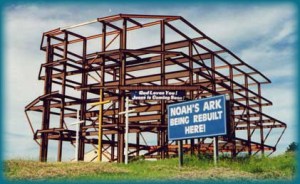
Storm's a-comin'
The United States is truly an impressive reservoir of biblicism. Perhaps university administrators who believe the study of religion isn’t worth the meager salary of an assistant professor should take a road trip. It would be a learning experience.
 Steve A. Wiggins