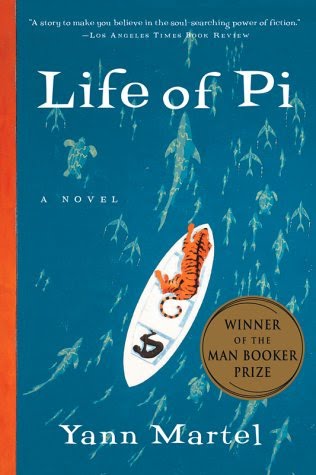
A Tiger’s Tale

When my wife finished Yann Martel’s Life of Pi she said, “You’ve got to read this book!” Philosophical novels don’t often capture the interest of publishers or agents, but when they manage to slip through the fine-mesh mail-armor of the guild, they sometimes become best-sellers. Publishers often underestimate the intelligence and the hunger of the average reader. I was glad to have something so provocative to read on my long daily commute. Since the book was published in 2001 I won’t worry too much about spoiler alerts. It should come as no surprise that the biblical flood theme comes through a book where a zookeeper’s son is stranded on a lifeboat with various forms of wildlife. The most unexpected and endearing member of this menagerie, the tiger Richard Parker, is also the most deadly. How easy it would be to spin off in a Melvillesque direction of the beast as a representation of an uncomfortable God! Indeed, when Richard Parker scampers away when the boat runs aground, Pi laments how it was like losing God.

Setting the stage for this development is the tale of three religions. As a boy raised in India Piscine (Pi) is surrounded by traditional Hindu culture. On a family vacation he notices that atop the three hills are three houses of worship: Hindu, Christian, and Muslim. Curiosity draws the young boy in, and by the end of part one he is happily and concurrently Muslim, Hindu, and Christian, to the deep chagrin of the various religious leaders. They, coincidentally, all meet Pi with his parents one day in the park and each insists that although they encourage the boy’s continued membership in their tradition, he must drop the other two. Like any sensible person, Pi has chosen the safe road when it comes to conflicting religions: accept them all. It is only religion itself that deconstructs his triune belief system.

After his eventual rescue, Pi is questioned by insurance agents concerning the fate of the ship. They cannot believe his incredible tale, because they can only believe what they have seen for themselves. Pi asks, “What do you do when you’re in the dark?” An appropriate question for us all. This story is a parable about perceiving more than what can be seen. Tigers are hidden all around. Sometimes we call them Hobbes. Sometimes Richard Parker. They are protectors and they are dangerous. Some people call them God. In the end our protagonist is left without the divine presence that had kept him alive all the way across the Pacific Ocean. When the book is over, I think we would all admit, it is the tiger that we miss most of all.

Failing Geology

Rocks of ages

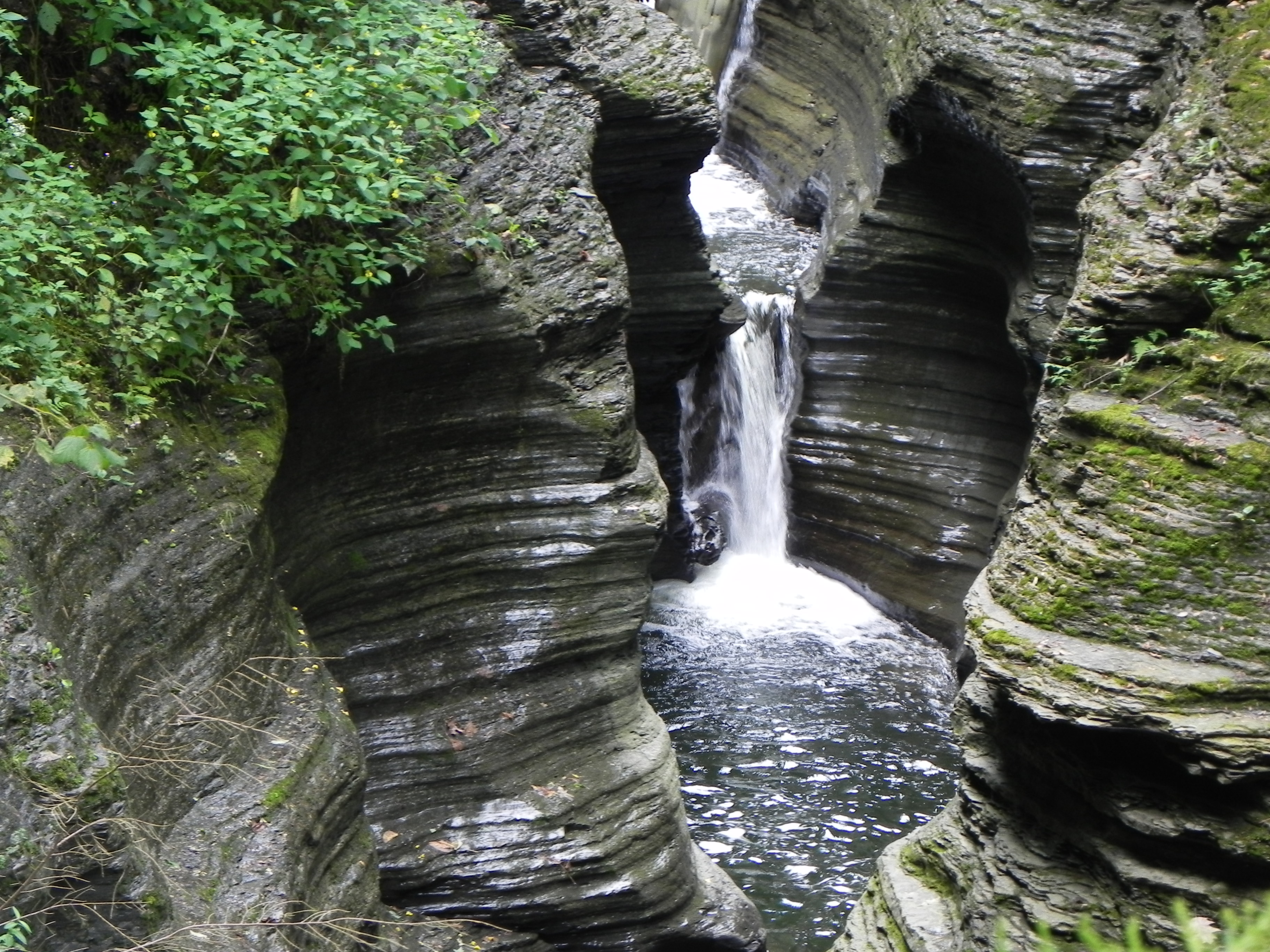
Watkins Glen, New York, sports a natural wonder that has occasionally drawn me to the Finger Lakes region to refresh my memory of the view. The eponymous glen has been carved out of the relatively soft shale by a tireless stream that falls to the level of nearby Seneca Lake. The relentless persistence of this water has left a canyon of striated layers over a period of 12,000 years. Even today tourists from around the world flock to the site, captivated by its natural beauty. To assist walking the gorge, 832 steps have been added alongside a mile and a half of the stream, taking the visitor past, and occasionally behind numerous small waterfalls. When we visited yesterday, what struck me—beyond the sheer number of out-of-shape Americans complaining of the number of stairs (this was well before the hundredth riser), a number that continually thinned the further we climbed—was the special compensation that biblical literalists claim to accommodate their view. The typical response is that all geologic wonders are a result of Noah’s flood, despite the different erosional rates and dates of the sites. Watkins Glen is a fairly new piece of earth architecture.

Some years back while driving out to the western United States, my family camped in Makoshika State Park in Montana. This particular park, apart from its wild, arid, and rocky scenery, also boasts many dinosaurs. You can sidle right up to the exposed, fossilized backbone of a hadrosaurus, and triceratops skulls can be found in situ. Preparing to hike one of the trails, we stopped at the ranger station for a map. As usual, interpretive displays explained what we were about to see. As we entered, an older couple spoke with the ranger. One of them said, “How can that be, since the earth is only 6,000 years old?” Special compensation is required to refuse the evidence that lies all around us. The Fundamentalist movement seldom takes into account that this distorted and bizarre worldview is almost uniquely American. Religion drives their scientific outlook, even as they are relying on the factuality of actual science to prolong their lives with medical advances or to allow them to read this blog (although the latter is not likely).

The same flood had to carve out the buttes of Makoshika and expose its Cretaceous fossils of 65 million years ago at the same time as eroding the first 6,000 years of Watkins Glen, leaving the remaining 6,000 to be worn away during our world’s lifespan so that we might declare the great works of God. It is a worldview that demands a constant center stage for a feeble explanation based on the worship of a misunderstood book. And yet they come to see the beauty. No matter how many persuasive words might be penned, the possibility of changing this outlook will elude us. Reinforced by television personalities and politicians, this utter breakdown of reason is one of our national characteristics. As a nation we suffered through eight years of “leadership” by a president who did not believe in science, and we are still paying off his tab. In another 6,000 years or so we may succeed. By then, however, I expect, if I’ve learned anything from the movies, we will have reversed roles with the great apes.