Street Clearing

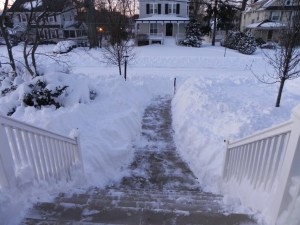
Not driving to work definitely has its advantages. Although studies suggest commuting takes a great toll on hapless riders, the stress of driving in traffic—more often just sitting in traffic—also takes its pound of flesh, and more. A recent snowstorm had me reflecting on this. Once in a while I like to demonstrate that the male of the species is worth keeping around, so after the Bomb Cyclone that closed schools and offices in the trial-state area a couple weeks back, I went out to brush off and start the cars. It’s not that women can’t do this, but it’s more the fact that nobody wants to do it that motivated me. Besides, I have a secretly fond memory of the years of enforced, Dr. Zhivago-esque labor on our Lake Erie snow-belt blessed driveway. My stepfather’s shack sat atop a long, unpaved driveway. Ironically, although he drove the borough snow plow, he insisted that we boys do the shoveling at home. Maybe that’s where I get it. A poor family, our winter coats were substandard and aching fingers and toes, not to mention frozen faces, were pretty typical. I hated every minute of it. Or did I?

Bundled up against the arctic winds that had brushed a noticeable breeze past my face the night before (in the present-day) when I climbed into bed, I stepped out in first light. Immediately the cold found the small gap between my gloves and sleeves and began to work it’s chilling magic. Before the powdery snow was even off the car my fingers were numb and painful, reminding me of an unfortunate frostbite episode as a child. Unconsciously I found myself smiling. I’m no longer forced to do this. Kindness is a far better motivator than hate. At least as a renter I didn’t have to shovel the drive.

Afterwards, inside an apartment that we all habitually decry as too cold, I quickly warmed up. There’s a pleasure in doing something so that someone else doesn’t have to. I miss that, working in New York City. Focused on getting to work, it’s far too easy to step past those for whom even a glance is a blessing. Those who sleep in cardboard boxes on nights like that through which I felt an annoying draft, although secure inside. I see the police “evicting” tenants of paperboard towns even as I glimpse Trump Tower in the distance. The storm they called a Bomb Cyclone. We clear the streets quickly so that we might get back to work and make more money for the one percent. Studies show commuting is killing us. It seems the cold is doing so as well.
Oil Heritage

I love optical illusions. Apart from the sheer fun of ambiguity, such illusions are really all about perspective. Shifting perspective can be one of the most powerful ways of changing a person’s life. One of my more stalwart perspectives is that those who originate something deserve recognition. If that something is important, they may even deserve acclaim. And sometimes that thing may turn bad, in which case the discoverer may end up being notorious. Originality, the subject of bestsellers and media gurus, is sometimes the result of thinking differently than other people do. It can be cultivated and grown. Sometimes it’s simply fortuitous.

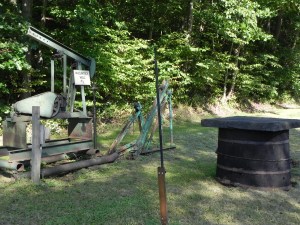
Every time I visit my own place of origins in western Pennsylvania, I think of the oil industry. It’s pretty hard not to around here. “Pumping jacks” still operate in some back yards, and petroleum tanks suddenly appear along beautiful rustic roads. The presence of fossil fuels isn’t as evident as it was when I was a child, for all the big refineries have closed down. Many of them have been dismantled. Still, I can’t drive by the site where a refinery fire glowed beyond the next hill from my childhood home and not wonder about it. Seeing those huge oil tanks melted and crumpled as if they’d been made of wax is an image that doesn’t get easily erased. Today, that’s all gone. Still, the oil industry itself was originally from this region. The auto industry—although increasingly electric—would’ve never started without the obvious boost that petroleum production gave transportation.

In the light, or perhaps dark, of Hurricane Harvey we’re set to see increasing gas prices. They will impact the economy in other ways, and energy giants will continue to degrade the environment in the quest for cheap and abundant crude. I’m not sure if that makes the discovery of oil in this region worthy of acclaim or notoriety. It does seem, from my perspective, that since big oil is so lucrative, a lifeline ought to exist for the struggling communities in my childhood home. Empty storefronts were rare here in my youth. Now they are almost as common as shops that remain open. I know; if people can’t move on, then maybe there’s a reason the economy is sagging. There are ghost towns in this area, and there may be more in the future. I just wonder how all this will looks from another perspective. Will it all be an illusion once electricity makes the past superfluous?


Christian Cookie

During my childhood and adolescence, we didn’t eat out. Of course, food didn’t cost nearly as much then, and it was cheaper to cook raw ingredients at home than it was to buy something exotic that someone else had made. I clearly remember our first trip to McDonalds—it seemed so strange to buy food already prepared. It was so unusual that we went with our neighbors in a kind of exploratory posse, discovering this strange world of pre-cooked food. College, eventually, introduced me to the idea that, if done reasonably, eating out could be a reasonable choice. Particularly if you were wanting to impress a girl. Still, most of my meals were in the dining hall, and trips to restaurants were generally reserved for special occasions. Although Chinese food was known to me, it wasn’t readily available in rural western Pennsylvania. I did encounter my first fortune cookie in college.

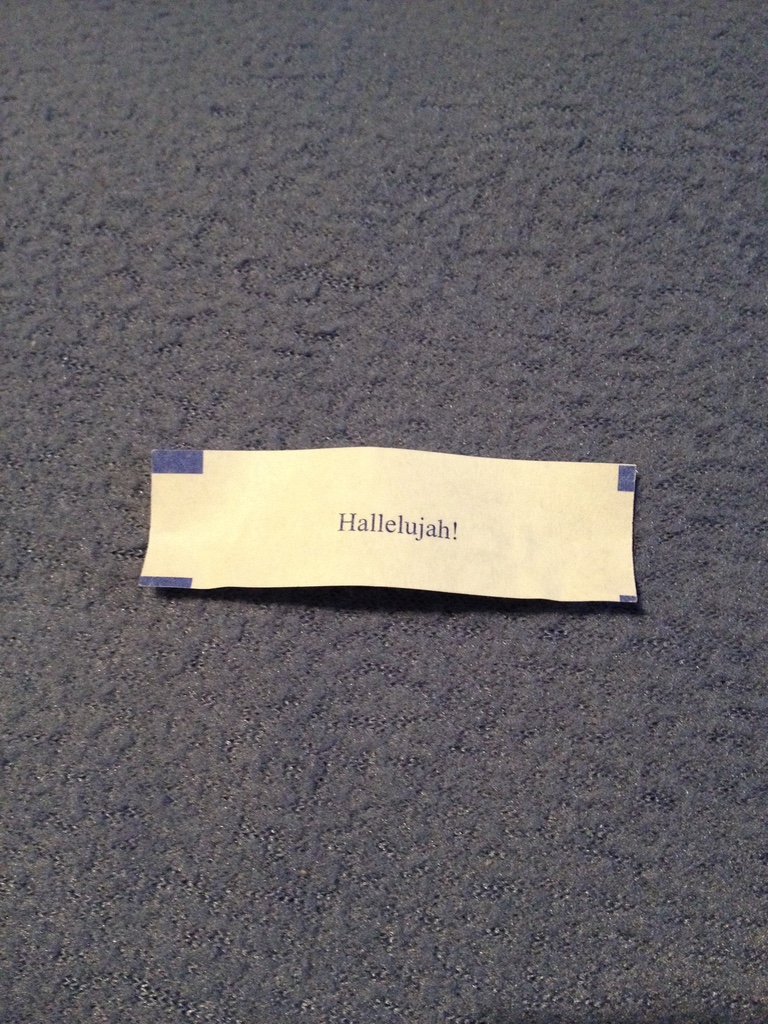
thumb_IMG_2185_1024There was something vaguely unsettling about a cookie that could tell your future. Prophetic comestibles were relatively unknown to me. Of course, the whimsical aphorisms seldom indicated any misfortune. They were more like horoscopes, harmless and often amusing. Recently we had carry-out Chinese. I’d noticed that over time fortune cookies had become more and more banal and less and less predictive. They claimed to know something about the world and I was supposed to believe because, well, would a cookie ever try to steer you wrong? My wife cracked open her cookie to find the “fortune” a single word: “Hallelujah!” An evangelical dessert? Was she destined to win the lottery? Perhaps we should play the lucky numbers on the next Powerball?

This really shouldn’t be bothering me, but what exactly was that cookie trying to tell us? It can’t be easy, I realize, to come up with millions of bits of advice so that those who often eat out don’t get the same prediction twice, but what if a Buddhist had ended up with this sweet? Or a Confucian? “Hallelujah” is, by its nature, a Judeo-Christian expression. Even so, it only occurs in two books of the Bible: Psalms and Revelation. My sneaking suspicion is that my culture is being pandered to. A bit of internet research revealed that Chinese fortune cookies are actually a Japanese recipe and were likely invented in the United States. They date back to the 1890s, at the earliest. I guess I shouldn’t be surprised then, at my wife being evangelized by her dessert. She does work for the Girl Scouts, after all, and they know a thing or two about the amazing abilities of the humble cookie.


Sunday Best

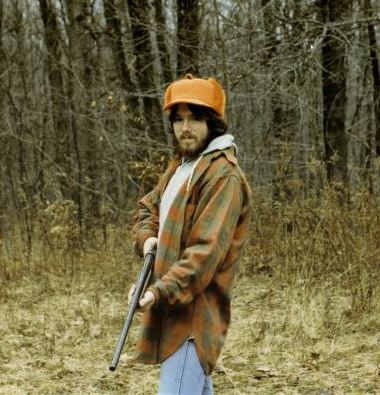
When my rural, northwestern Pennsylvania shows up in the news, I pay attention. An Associated Press story recently appeared concerning Rev. Chris Terbush of Bradford, Pennsylvania. Inspired by the success of Duck Dynasty (which seems poised to overtake even Apple as the most popular purveyor of popular culture), Rev. Terbush has encouraged his congregation to show up on Sunday mornings in camouflage, ready to go forth and claim dominion over nature once the service is over. I’ve been ambushed by enough clergy that the idea makes me a little nervous, I’ll have to admit. But then again, I know where he’s coming from. I grew up in a town that celebrated the first day of deer season as a public holiday, with schools closed and the hills alive with the sound of muskets. Not being a hunter, I just enjoyed the day off school. This upbringing, however, gave me a profound appreciation for the Jeff Daniels’ movie, Escanaba in da Moonlight. But I digress.

Religious services evolve, just like any other social phenomenon. When I was young, just as the sixties were wresting the color of life from the black-and-white fifties, going to church was a formal event that demanded your “Sunday best.” Only the worst of heathens would show up before the Almighty in anything less than a white shirt and tie, a jacket and uncomfortable shoes. You had to show the divine that you were willing to go that extra mile and implicate that you didn’t intend to have any fun when it was over because the sabbath is a solemn occasion. I remember the weird feeling of walking into church during the weekday wearing jeans for the first time. It felt as if I were dissing the rules of the club. It was an exclusive affair.

The “theology of dress” has become an area of scholarly investigation with the growth of embodiment issues. What we wear says something about our beliefs, and the fact that we wear clothes at all is sometimes even traced back to Genesis 3. The origin of “good clothes,” clearly, was a status issue. Those who could afford to keep some surplus clothes unsullied by labor wished to strut their stuff on occasion. And who better to impress than God? All of this has eroded over the years with many churches as casual as any man cave. Now you can camouflage yourself in church. There may be more going on here than meets the eye, both literally and metaphorically.

What happens in the woods stays in the woods

What happens in the woods stays in the woods