
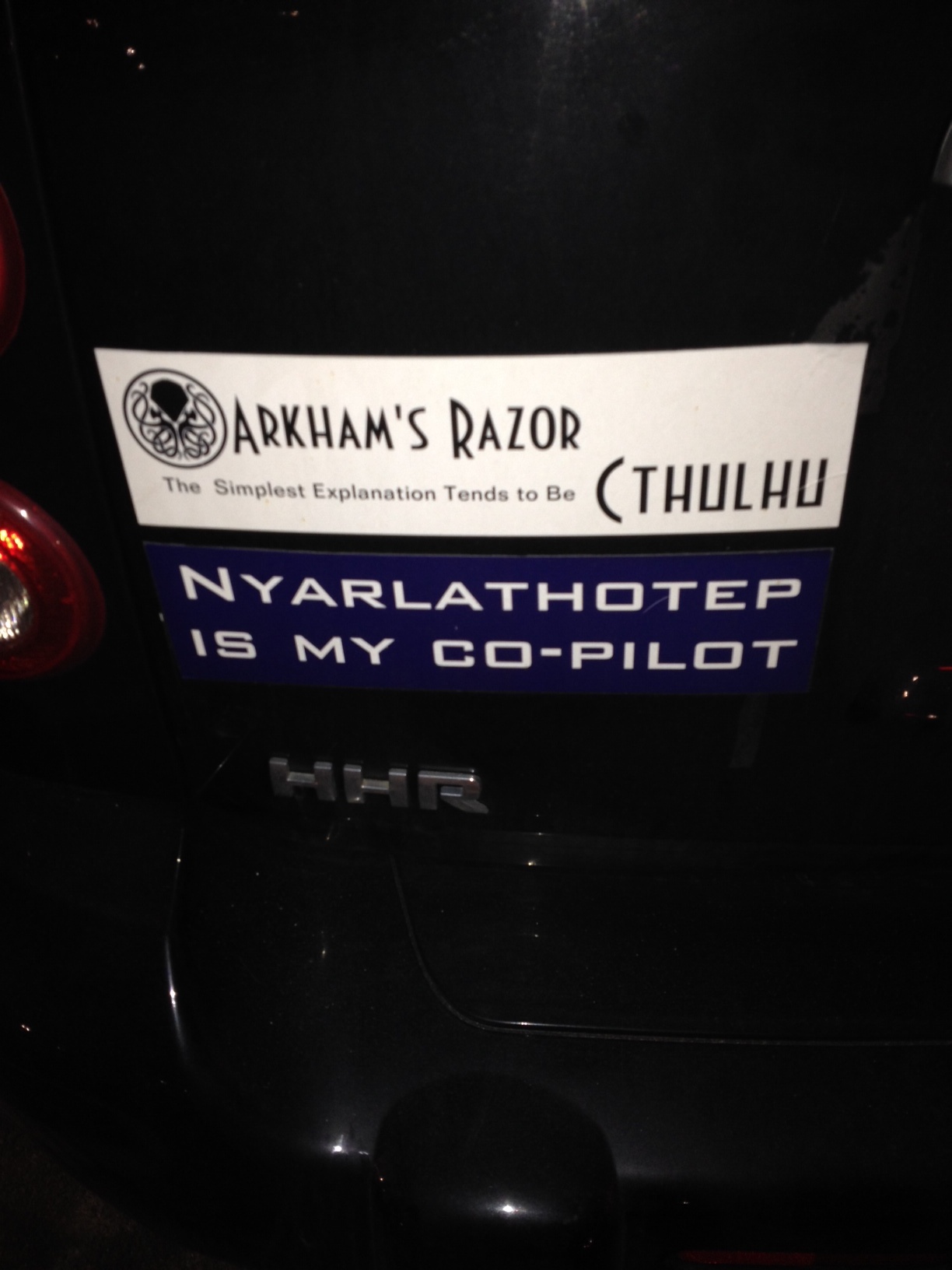
Cthulhu has taken over the world, thanks to the internet. I wonder what H. P. Lovecraft thinks as he lies dead, but dreaming under the loam of Providence. A lifetime of struggle to gain recognition as a writer left him without much of a following, relegated to pulp magazines for low brow and Innsmouth-dwelling mentalities. Now everywhere from Davy Jones’ face in Pirates of the Caribbean to car bumpers in any parking lot, Cthulhu has awakened. My wife sent me a photo of a couple of such bumper-stickers recently: “Arkham’s Razor,” reads one, “The Simplest Explanation Tends to Be Cthulhu.” “Nyarlathotep is my co-pilot” reads another. I first discovered H. P. Lovecraft through bumper-stickers.
Back in my post-graduate days in Edinburgh, I had decided to write my dissertation on Dagon. This seemed a reasonable topic as no serious, book-length treatments of this elusive, Mesopotamian deity existed. My advisors talked me out of it, however, noting that material on Dagon was so scarce that it would be extremely difficult to scrape enough together to call it a dissertation. A few years later, it turns out, an academic book on Dagon finally appeared, but the fact remains that he was, and is, a major deity who somehow mostly disappeared from the ancient records—the victim of chance finds and perhaps more aggressive gods. For my birthday one year my wife bought me a bumper-sticker with a “Jesus fish” that had the word “Dagon” inside. I posted it on my office door in Oshkosh and the department chair asked me what the tentacles were meant to represent. An web search indicated that the Dagon was not the biblical “fish god” but the Lovecraft reincarnation. I had experienced an epiphany.
Lovecraft, although an atheist, knew his Bible. I once wrote a scholarly article on the Dagon story in 1 Samuel 5 where the Philistine statue of Dagon falls down, decapitated, before the captured ark of Yahweh. This is the sole narrative involving Dagon in the Bible, and it concludes by saying only Dagon’s “fishy part” was left intact. Lovecraft took this obscure Bible story and built an entire mythos from one of its characters. Cthulhu, Dagon, Nyarlathotep, Shub-Niggurath, and their companions have risen from the deep, and encircled the world in an electronic web. The fact that kids who’ve never read Lovecraft can identify Cthulhu at a glance, attests to his power. Even Batman fans who cite Arkham without knowing that it was originally Lovecraft’s creation keep the master alive beyond the grave. Isn’t that what resurrection is really all about? Even if a writer has to be discovered through bumper-stickers.

 Steve A. Wiggins