Singing Darkly

Euro-horror has become one of the more profound sub-genres of film.  I can’t recall who it was that recommended A Dark Song—set in Wales although filmed in Ireland—but it was immediately obvious I was in for a treat.  Dealing with Gnosticism, occult, and demonic manipulation (I wish I had the script!), it takes on the big issues of death, loss, and forgiveness.  The premise begins chillingly enough.  A woman rents an isolated country house for an entire year, paying in advance so there will be no disturbances.  She brings in an accomplished occultist to let her speak to her dead son again.  The two don’t know each other and this ritual will take many months, during which they will not be able to leave the house.  Neither really trusts the other, but Joseph (the occultist) tells Sophia that she must obey everything he says if she wants the ritual to work.  Once they begin they cannot stop until it reaches its conclusion.
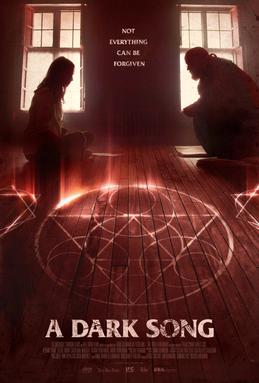
Sophia hasn’t revealed the real reason she wants to summon her guardian angel.  She wants revenge on those that used the occult to murder her son.  The truth Sophia kept from Joseph requires them to restart, so he drowns her in the bathtub and then uses CPR to revive her.  As they grow increasingly tense, a fight breaks out where Joseph is accidentally impaled on a kitchen knife.  With only bandages and whiskey to treat the wound, they press on, but Joseph dies leaving the ritual unfinished.  Sophia can’t escape but after being tormented by demons, her guardian angel arrives.  Her request is actually wanting the ability to forgive.

This profound story has many twists along the way, but a scene that I would like to consider is where Joseph tells Sophia “Science describes the least of things… the least of what summat is. Religion, magic… bows to the endless in everything… the mystery.”  The suggestion that science is indeed correct, but limited.  Religion goes beyond science, however, to the world of possibility.  The movie suggests these two worlds intersect.  After Joseph dies Sophia can’t escape that other world until its rules have been met.  And when she does reenter the world of science, what happened in the world of magic has lasting effects on her.  A Dark Song is one of those movies that will haunt you after watching.  The Euro-horror of the last decade or so has been incredibly profound, showing the promise of what horror can be.
Six-Hundred and Sixty-Six

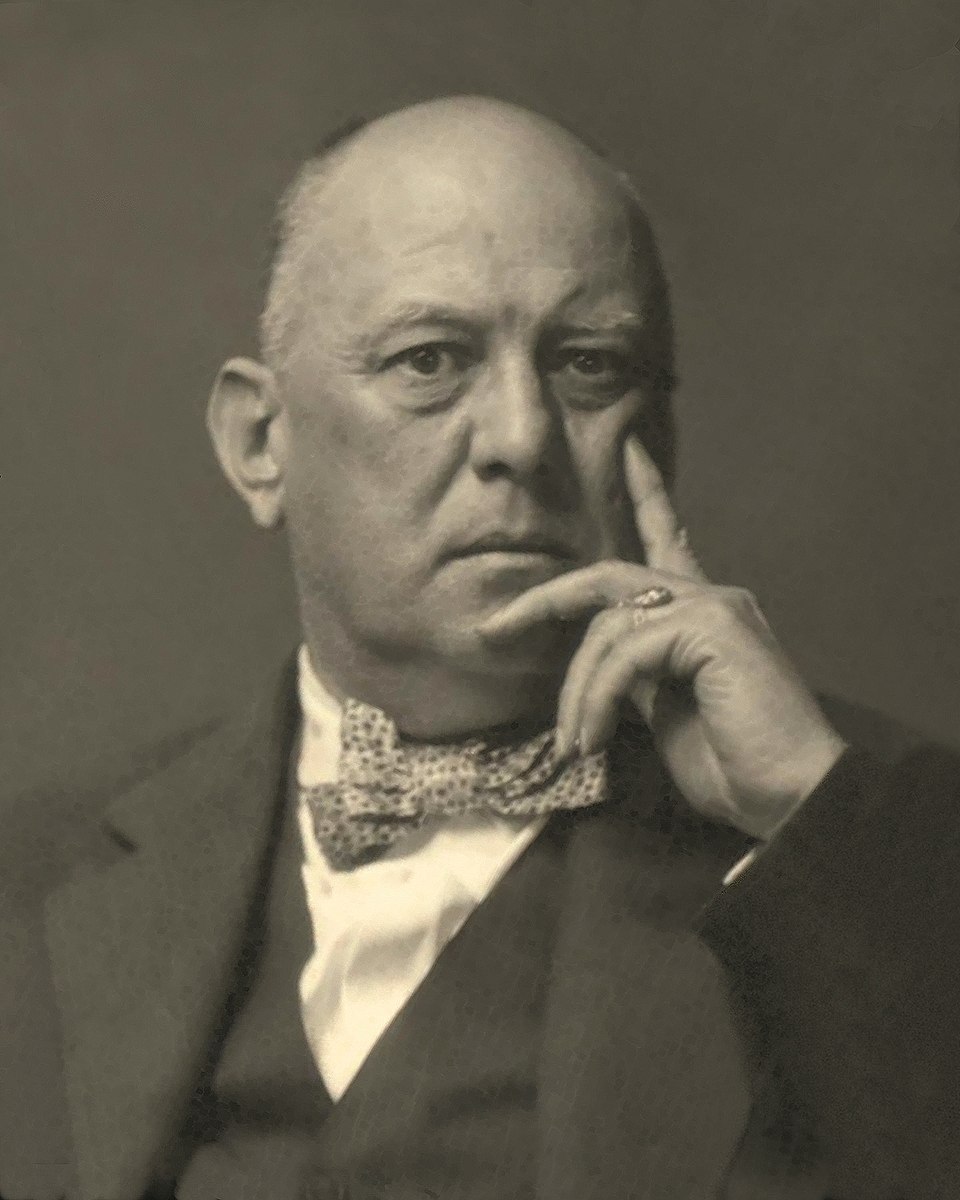
I have to confess to never having read a biography of Aleister Crowley.  I’ve known of him since I was a teenager, however, since you can’t read very much about esoteric stuff without running into his name once in a while.  Crowley was famous for starting the religion called Thelema, revitalizing interest in magick (the additional “k” was to distinguish it from stage magic), and for generally being a bad boy.  In fact, he declared himself the “wickedest man on earth” and liked to be called “the Beast” and loved the number 666.  It was the latter point that caught my attention recently.  In pop culture, 666 really only took off after The Omen.  (Movies often dictate, or at least inform, our religion.)  Crowley, who lived much earlier than the film, saw the marketability of 666 and I wondered how it caught his attention.

Aleister Crowley, public domain via Wikimedia Commons

As I recently posted, the end of the world as we know it is a fairly modern construct.  I happened to be reading about Crowley recently and learned that he was raised in the Plymouth Brethren tradition.  (They don’t loudly claim him as a native son, for some reason.)  He is probably the most famous of the Brethren, across all walks of life.  He even earned a place on the cover of Sgt. Pepper’s Lonely Hearts Club Band.  The Plymouth Brethren were massively influenced by John Nelson Darby, the inventor of dispensationalism.  Dispensationalism is the fairly new Christian belief that time can be divided into ages, or “dispensations,” during which God has a plan already mapped out.  He apparently waited for Darby before letting the rest of the world in on this secret.

Things about Crowley then began to make a little more sense.  His choice to name himself after Darby’s preoccupations adds up.  I haven’t read any biographies so this may be old news, well known among scholars of esoterica.  It nevertheless bears pondering because the religion we teach our kids may have unexpected consequences.  Crowley rejected the Brethren (whose moral predilections were not to his liking, especially as a hot-blooded young man) but the religion influenced him nevertheless.  I wonder if the teachings Crowley received as a child encouraged him to become, in his own mind, the opposite.  Crowley wasn’t “the Beast.”  His precepts included “love is the law” (granted, his version of love was a touch earthier than Christians with whom he’d be raised, but still), not a bad start for an ethical system.  Even the wickedest man on earth believed in the power of love, even if his religion introduced him to 666.


Panic Inducing

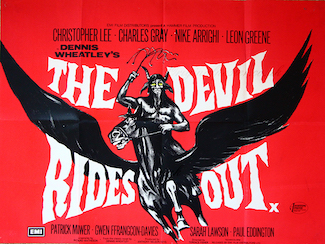
Many movies appreciate in value over time.  The Devil Rides Out (also known as The Devil’s Bride) was not well received initially, but has become a highly regarded horror classic.  One of the few with a G rating, no less.  It’s also hard to see in the US, due to lack of streaming (at least where I stream) and DVDs coded to Europeans viewers.  Anyway, taken from a Dennis Wheatley novel, and screen-written by Richard Matheson, it features Christopher Lee in an heroic role during the days just before public concern about Satanism would become downright panic.  The story itself, effective if long-winded, develops among the aristocracy in England during the 1920s.  It was released, by the way, the same year as Rosemary’s Baby, which helped play into the Satanic panic.  Movies do influence the way we view “reality.”

I’ve never read any Dennis Wheatley novels, but it’s safe to say the story is pretty Manichaean in its outlook.  A coven of Satanists wants a young man and woman to complete their number but the chosen young man has a couple of older friends who quickly comprehend what is happening and attempt to put an end to it.  The Satanists, however, control real power and the movie is pretty much a tug of war between the young man’s friends and the coven.  This is done in such a way that you see very little blood, no gore, and surprisingly for the subject matter, no nudity or sex.  The Satanists here are old school—they want to worship the Devil in exchange for personal power.  It’s pretty clear that some research was done before undertaking all of this, even if the paranoia born of such things was fueled by largely imaginary scenarios. 

I’d been wanting to see this film for some time because of its clear connection between religion and horror.  There’d be no Satan, as we know him, without Christianity.  Indeed, there’s heavy Christian imagery in the film, in keeping with Wheatley’s outlook.  Crosses cause demons to disappear in an exploding puff of smoke.  Interestingly, however, there’s no crucifixes or holy water.  This is a Protestant view of the Dark Lord.  The Satanists, however, are defeated by the spirit of one of their own who refuses to allow them to sacrifice a young girl.  The ending stretches credibility a bit more than the rest of the movie, but still, overall it isn’t bad.  A Hammer production, it never had the box-office draw of its contemporary Rosemary.  Still, The Devil Rides Out was influential in its own right.  Even if finding a viewing copy requires almost selling one’s soul.


Unusual Places

I don’t recall how I first learned about Mitch Horowitz’s work.  I read Occult America as soon as I found out about it—it helped as I was transitioning to writing about religious culture (largely through horror films) since there’s a healthy dose of occult in horror.  While still in publishing Mitch agreed to look at Holy Horror before it landed with McFarland.  The thing about my life is that it’s too busy (9-2-5 isn’t a size that fits all) to keep up with writers I find fascinating.  I hadn’t been aware of Horowitz’s continued, and continuing, book writing.  As soon as I saw Uncertain Places: Essays on Occult and Outsider Experiences I ordered a copy.  It brought back to mind the semester break at Nashotah House when I realized that to get anywhere near the truth you need to question and question boldly.  I told my students that if they didn’t challenge their perceptions with reading during semester breaks they were wasting them.

I met Mitch (although we’ve never seen each other in person) through our mutual friend Jeff Kripal.  They both have the courage to question apparent reality and to not stop at the line that the wall of materialism throws up around the pursuit of knowledge.  Uncertain Places is well titled.  Like almost all collections of essays some speak to the reader more than others, but I found myself pausing frequently to consider what I’d just read here.  One thought that keeps recurring is how even someone with a terminal degree can constantly feel like there’s so much more to explore.    Horowitz is a seeker unashamed.  And that also took me back to my past.

Growing up poor, I didn’t have many resources other than my mind to help draw some preliminary conclusions about reality.  Like many red-neck families of the time we had a CB radio and we were each instructed to come up with a “handle.”  I believe it was my mother who suggested “Searcher” to me.  She knew that I would never stop looking.  Uncertain Places is the work of another searcher—one who’s less fearful than I tend to be.  (I’m working on it.)  Reality, it seems clear to me, is far more subtle than most of higher education has taught me that it should be.  We try to make occult scary and demonic but Horowitz is, like yours truly, an historian.  Those of us who explore the history of religion can find ourselves in some pretty unusual, one might say uncertain, places.  And rather than dismiss what we see there, we take a closer look.


An October Movie

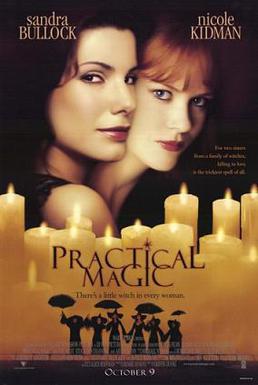
October means different things to different people.  I know what it feels like to me and I suspect, and hope, that there are others who experience it like I do.  When I search for October movies I’m looking for a kind of happy melancholy unique to the season, but others seem to think movies about witches capture the feel.  So it was that I came to watch Practical Magic, which was recommended on more than one October movie list.  It’s not a horror film, in fact it’s a rom-com and it doesn’t try to frighten anyone, although there is one tense scene.  Like many movies about modern-day witches, it has a good message of female empowerment.  I’m glad I watched it for that reason, and the story isn’t bad.  Set on an island community, presumably in Massachusetts, but shot in California, it’s not exactly falling leaves and pumpkins, though.

Witches seem to be the preferred monsters for feminine endorsement.  Most people, I suspect, wish they had magical powers.  We all want things to go our way and would like to manipulate them in that direction.  But there’s something more to it.  It’s tapping into an ultimate power—something that can’t be challenged.  Practical Magic, although not always in a serious mood, does portray the struggles witches have against occult powers.  The story is of the Owens family, which have been witches since the pilgrims landed.  They suffer under a curse dooming the men with whom they fall in love.  Not all the women are cut out for such a life.  So it is that Gillian and Sally set out to break the curse, each in their own way.

Other occult powers are at work, however.  One is clearly the curse itself and another seems to be an undead boyfriend who eventually possesses Gillian.  The women of the community have to come together to exorcise this entity, and that finally leads to communal acceptance of witches.  A major studio production with a reasonable budget and star power, it really didn’t do well at the box office.  Barbie seems to have struck a feminist chord that Practical Magic was reaching for, but the late nineties were a time when women’s power seemed to be starting to secure itself.  I noticed that, when looking for the movie on streaming services, it’s now having a limited theatrical run—it’s October, after all.  This may not be my October movie, but it has a good message that still needs to be learned.


Good Wrinkles

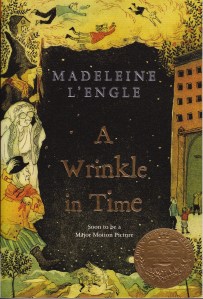
Since I was late getting my Banned Book in order this year, I went to something that I could read within a week. While my bus time is generally reserved for non-fiction reading, I had to pick something fairly easy so that I could get back to more serious stuff. Madeleine L’Engle’s A Wrinkle in Time was published the year I was born, and I’d never read it. It has ended up on banned and challenged lists every decade since it was published, so I was prepared for some radical stuff. Instead what I found was a well-written book for young readers that quoted the Bible quite a bit and even had a worldview that was appropriate to the Gospel of John. When the Murry children try to name the forces that fight the encroaching darkness, the first name offered is Jesus. The differences between good and evil are the subject of discussion among the characters and it’s pretty clear there’s an obvious distinction. So why is it a challenged book?

Never underestimate the sententiousness of the self-righteous. Objections to a medium, and characters—perhaps best understood as guardian angels in the book itself—perceived as witches, have led to the now familiar accusations of the occult. Here is a book that quotes the Bible, upholds the distinction of good and evil, and encourages children to fight for the former rather than the latter. Yet it also teaches tolerance. Parents who want children to think that only those like them can possibly be righteous start to shudder a little at that. The only good heretic is a dead heretic.

When I saw just how benign A Winkle in Time was, I had to think back over my own Bible. In addition to stories of horrendous violence, explicit sex, and with even a “witch” or two, the Bible contains diverse views. Paul argued with Peter in public, after all. Madeleine L’Engle was concerned about the book burning tendencies of Nazis. We now seem to think that the place for illiteracy is in the White House and, more recently, Alabama. Reading the news convinces me more and more each day that a steady diet of banned books is just the catholicon our society needs. Different viewpoints, like the rays of the sun, will shrink the mildew that finds its ways into dark corners, rotting the very fabric of our universe. A Wrinkle in Time may not sway adults in the same way it has engaged the wonder of children for the past half-century, but it is a start in a battle against darkness that is never-ending. There’s always time to read a banned book.


Magic Tricks

Magia SexualisTo a scholar who has spent many years studying ancient religions, new religions hold a strange appeal.  After all, we are trained to look at obscure texts from forgotten cultures and to decipher the mute clues they have left behind.  New religions have the benefit of being (generally) documented in ways that ancient religions aren’t, and often exist in societies more literate than those of the remote past.  Finding out about them may be easier, but understanding them may be just as difficult.  In my research on magic, I was led to Hugh B. Urban’s Magia Sexualis: Sex, Magic, and Liberation in Modern Western Esotericism.  I’ve always found Urban’s work engaging, and since this book is one of the few academic studies to investigate magic seriously, I was eager to see what he had to say.  As usual, I wasn’t disappointed.
 
Sex magic is frequently at the heart of magical beliefs.  Urban shows that this has been the case from ancient times.  Those of us who’ve studied ancient Syrian, Egyptian, Mesopotamian, or Aramaean religions aren’t surprised by this.  Those cultures inhabited a world pummeled by magic, and it doesn’t take a genius to figure out that sex might have had something to do with it.  The majority of Urban’s book, however, concerns figures starting in the nineteenth century who introduced new religious forms of sexual magic into the occult circles of their times.  Focusing on a specific practitioner in each chapter, he brings us up to the present with some familiar, or often less familiar, names.  Magic, by its very conception, is a religious idea.  Even if some of the more notorious modern magicians such as Aleister Crowley and Anton LaVey took religion in a darker direction, it was still religion.  The founding of Wicca by Gerald Gardner naturally receives some attention.
 
As Urban notes from the beginning, sex magic is not a topic for titillation.  It involves some transgressive, but also original thought about something that is so basically human that we all know about it even if we won’t discuss it.  And the dark practitioners have seemingly exhausted the vaults of extremism regarding sexuality that even a straight-laced, nay even Presbyterian, culture may find itself with no further options.  Where does one go when the foulest of profanities has been executed?  Certainly not back to the beginning, for we’ve come too far for that.  The postmodern world deconstructs itself leaving us to wonder if there can be any magic left at all.  It is no wonder, I should venture, that Harry Potter was gathering steam even as Urban wrote his book.  Magic will, by its nature, always find a way.


Star Struck

One of the coveted symbols of approval in my childhood was the star at the top of a paper. I watched in amazement (perhaps because they were so rare) when a teacher would inscribe a star without lifting her pencil from the paper. I thought I had never seen anything so perfectly formed. Of course, in my teenage years under the influence of Jack T. Chick and his ilk, I learned that the five-pointed star, especially in a circle, and more especially upside-down in a circle, was a satanic symbol. My childhood achievements had been, apparently, a demonic blunder. This fear of geometry still persists in America, as a story of a woman in Tennessee fighting to have “pentagrams” removed from school buses shows. The woman, who has received death threats and therefor remains anonymous, took a picture of the offending LEDs and has asked, out of religious fairness, to have the satanic symbols removed from the bus. The news reports are almost as tragi-comic as the complaint.

600px-Hugieia-pentagram

The pentagram, or pentacle, has a long history, some suggest going back to the Mesopotamians. (Uh-oh! We know how they loved their magic!) In fact, the symbol was benign in religious terms until it was adopted by Christians as symbolic of the “five wounds” (zounds!) of Christ. The symbol could also be used for virtue or other wholesome meanings. The development of Wicca began in earnest only last century, although it has earlier roots. Some late Medieval occultists saw the star as a magic symbol, and the inverted pentagram was first called a symbol of “evil” in the late 1800s. As a newish religion seeking symbols to represent its virtues, Wicca adopted the pentagram and some conservative Christian groups began to argue it was satanic, representing a goat head. (The capital A represents an ox head, so there may be something to this goat. I’m not sure why goats are evil, however.) Wicca, however, is not Satanism, and is certainly not wicked.

Symbols, it is sometimes difficult to remember, have no inherent meaning. Crosses may be seen in some telephone poles and in any architectural feature that requires right angles. The swastika was a sacred symbol among various Indian religions, long before being usurped by the Nazis. And the pentagram was claimed by various religions, including Christianity, long before it was declared dangerous by some Christian groups. There may be a coven in Tennessee seeking to covert children by designing and installing taillights of school buses, but I rather doubt it. School children feel about their buses as I feel about mine on a long commute to work each day. A kind of necessary evil. The truly satanic part, I suspect just about every day, is the commute itself. There must be easier ways to win converts.


Washed Out or Burnt Over?

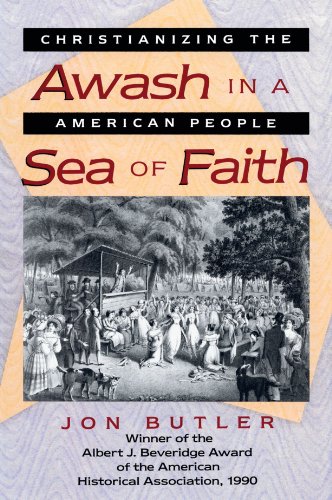
AwashInASeaOfFaithIs America a Christian nation? The answer to that question will no doubt raise ire in some part of the room. People, speaking mostly without data, will assert yes or no, generally based on opinion and sensibility. It is refreshing, then, to read what an historian uncovers by asking the right questions. Jon Butler’s Awash in a Sea of Faith: Christianizing the American People is a book that asks the right questions. On the surface, yes, colonial America was settled by disgruntled Christians from various religious conflicts in Europe. Actions, however, are notoriously louder than words. Butler examines church attendance patterns and affiliations among these early (and later) settlers and finds that they weren’t nearly so Christian as one might think, listening to the rhetoric. Indeed, for people struggling to survive in a new land, religion might well have been the last thing on their minds most of the time. Throughout the book surprising changes of perspective appear. When clear thinking is railroaded by political agendas the issues often become clouded.

A good example of this is Butler’s exploration of the survival of magic and occult traditions. It is not unusual to hear, anecdotally, that the Enlightenment did away with superstitious thinking. In fact, the data point elsewhere. Not only did Americans bring magic and occult practices with them from overseas, they actually continued to develop them in the New World. At times these beliefs substituted for congregational religion. At others, they subsisted alongside it. There was a “sea of faith” here, but it wasn’t always very orthodox. It wasn’t until fairly late in the history of the country that church attendance could be considered the norm. At the same time, many read back into history that “we’ve always been like this.” Not so.

The “myth of the American Christian past” was born out of wishful, and one suspects, political thinking. The country’s founding by Deists led to a fear of Deism—a fairly new phenomenon that descended from that self-same Enlightenment. Still, America could give birth to Spiritualism and a host of new religions. Perhaps it would be more accurate to think of the United States as fertile soil for religions rather than a Christian country. Certainly, by the numbers, Christians have been in the majority since statistics were kept, but, if the anachronism may be pardoned, the “nones” are not a new phenomenon. They were previously just those to be converted. Through much of history, we’ve been a people who didn’t think too much or too deeply about religion. Only when the issue really became politicized did the past become distorted. We have Dr. Butler to thank for providing a clear view into what history actually reveals.


Gods in Spandex

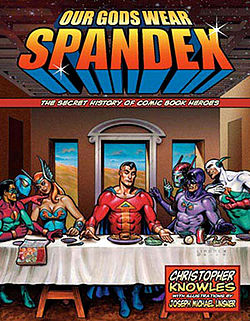
OurGodsWearSpandexOne thing leads to another. Reading Jeffrey Kripal’s Mutants and Mystics stirred an interest in comic books that I hadn’t felt since before my college days. Often excoriated as puerile, escapist doggerel for pre-pubescent boys, comics have grown to be respected members of adult society. I often wonder what the draw might be. Hollywood has certainly cashed in on it with any number of blockbuster flicks each year coming from the brains of the comic book writers and artists. So I picked up the quirky book by Christopher Knowles and Joseph Michael Linsner entitled Our Gods Wear Spandex: The Secret History of Comic Book Heroes. Reading it was kind of like looking in a mirror that has been buried in dust for a few decades. I hadn’t realized that my tastes in childhood comics was a reflection of a longing for the divine world with healthy doses of science fiction, and even H. P. Lovecraft, thrown in along the way. Knowles ties in a remarkable breadth of material to demonstrate that our superheroes are, in the final analysis, gods. That point may be taken in any number of ways.

The academic world suffers from a fear of respectability. That may seem a strange assertion, but I’ve spent a great deal of my life among academics and I know that many of them are insecure and tentative. Does all this reading, writing, and analysis ever get read by anybody? Does anybody take me seriously? Academics are haunted types. So when a subject as vulgar as comic books arises, scholars are reluctant to touch it. It might look like we actually enjoy reading the funnies. Still, popular culture has demonstrated an unexpected depth to much that we read in the strip world. As Knowles points out, a deep undercurrent of the occult and esotericism runs through many hero story lines. Several heroes began their lives as classical gods, only to assume the spandex and become incarnate humans with special powers we long to have ourselves. We would fly, if we were given the chance.

Our Gods Wear Spandex may never be viewed as an academic book by most. It has too much visual interest and not enough recondite footnotes. All the same, it is a profound look at what people really desire. We worship gods because of their special powers. If God were one of us with our humiliating weaknesses and limitations, would we ever worship him or her? Of course not. We only seek to appease those who are stronger than we are. Entire governments and ecclesiastical bodies are built on that very principle. Heroes are like us. Mortal, and yet, with something more. They die. But like the gods, they can come back. Reading Knowles it becomes clear just how much religious thought pulses through the veins of the comic book world. We may be grown up and sophisticated. We may have left behind childish things. But when our backs are to the wall, who doesn’t secretly wish they were Wonder Woman or Superman? And maybe that wish is a prayer.


Home Grown

In a seedier neighborhood of Midtown stands a five-story apartment building that would be easily overlooked on an ordinary day. Back in the late nineteenth century an investigator of the Lincoln assassination, and lawyer, by the name of Henry Steel Olcott began to meet in this apartment with a Russian mystic who came to be known as Madame Blavatsky. Their base of operations was call the Lamasery. The “religion” that resulted from their collaboration came to be known as Theosophy.

I remember distinctly when I first learned of Theosophy. I was attending an academic conference and as I passed along the bookstalls I noticed the Theosophical Society with their table of wares. A newly minted doctor of philosophy, a nagging worry sprung up in my head: was this a form of philosophical thinking that I should’ve learned about? Had I somehow forgotten lessons on Theosophy? Should I rush back to the library (this was before the Internet, let alone Wikipedia) and find out what Theosophy was? Well, I did make the effort and soon learned that it was considered an occult group and therefore I need not concern myself any more.

What I hadn’t fully realized is that although Theosophy did indeed integrate some elements of the Spiritualist movement, it was in many ways America’s introduction to Buddhism and Hinduism. America in the nineteenth century had some experience of Islam, but generally the only religions that were widely recognized were Christianity and Judaism. Anything else sounded occultish and vaguely heathen. Olcott and Blavatsky raised awareness that religions elsewhere in the world did not necessarily conform to American tastes. There was more to religious belief than met the eye.

Theosophy never made it big in the New World, but it continues to survive to this day. America has become the premier place for new religions to emerge. Indeed, it would be difficult to imagine a religion like Mormonism—a distinctly American belief system—gaining an infant foothold anywhere else in the world. Although largely identifying ourselves amorphously as “Christian,” Americans are great religious experimenters. And Theosophy was a faith that grew out of experimental ideas in New York City with tendrils stretching all the way to India and China. The movement even bestowed upon Gandhi his famous epithet of Mahatma. The words inscribed on his Serbian monument would serve us all well to memorize: “non-violence is the essence of all religions.”


Occluded Religion

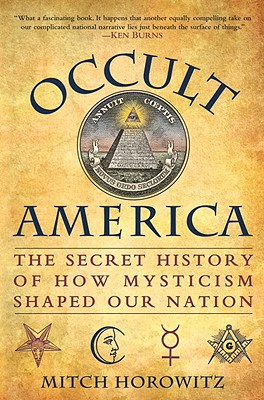
In my youngest days the word “occult” conjured the most perilous kind of fear in my inexperienced, Christian heart. It sounded malevolent and sinister, suggesting Hell, Satan, and the coercion of the divine. Therefore it took considerable time to pump up the courage to read Occult America by Mitch Horowitz. Well, maybe it wasn’t that dramatic—I learned in the course of my many years studying religion that “occult” is very difficult to tease out from “religion.” What I really feared is what others would think of me as I sat on the bus reading Occult America while heading to the Lincoln Tunnel. The word “occult” refers to the “hidden” or “secret” nature of certain religious practices. In ancient times it might refer to the Gnostics or Mandaeans, while in more recent days it might be used to describe Rosicrucians or Theosophists. Unconventional, yes. Evil, hardly.

Horowitz takes his readers through a whirlwind tour of some very colorful characters and, perhaps more importantly, shows just how deeply rooted occult practices are in the most Christian nation on earth. Few people realize just how influenced high office holders in this country have occasionally been by the occult. It seems a hard-and-fast rule that to be elected president you must be a professing Christian, strongly preferable if of the evangelical, Protestant flavor. Ronald Reagan made a great show of that while being personally convicted of the efficacy of astrology and some popular mediums. And Reagan has not been the only one. Still, politicians have to keep their more unconventional religious beliefs secret. The populace likes a straight shooter, devotionally speaking. The fact is that even what many people think of as regular Christianity has been seasoned somewhat with occult.

I can recommend this little book for getting a sense of just how deeply the occult has tunneled into the American psyche. The chapter on the ouija board took me straight back to a very straight-laced Grove City College, bastion of conservative evangelicalism. When I matriculated (which sounds vaguely occultish in its own right) the yearbook was called The Ouija. It was explained away as the combination of the French and German words for “yes,” but everyone knew, given what yearbooks are, that it had that spooky, occult vibe. By my senior year a more fluffy, evangelical-safe title of The Bridge replaced it. And many heaved a great sigh of relief. Christians thanked their lucky stars that they’d been delivered from the evils of the occult just as they were lining up to elect Ronald Reagan to a second term in office.