Around Us

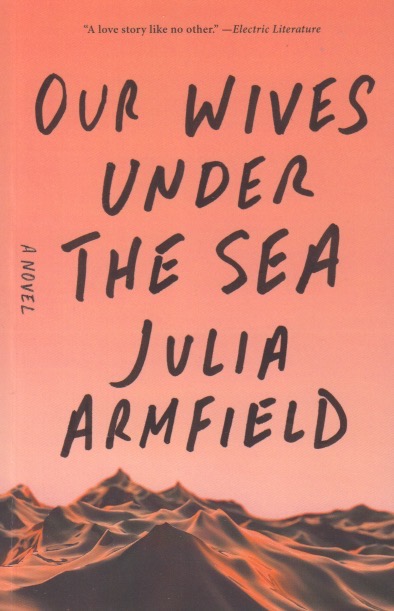
Our Wives Under the Sea is a gentle, but chilling horror story by Julia Armfield.  Two women are married and one of them is a marine biologist being sent on a submarine to explore deep ocean life.  A planned three-week voyage becomes six months and when the sub finally surfaces again, Leah, the biologist, has “come back wrong.”  She’s transforming.  Something happened to her under all that water.  Told alternately by Leah and Miri, the story is one of loss and mourning and lack of any reasonable explanation.  Haunting, in a word.  The writing is exceptional.  And probing.  I quite enjoyed this book.  I can’t recall how I first heard about it—it was published in 2022—but I knew I wanted to read it even then.  The sea is that way.  Moby-Dick, cited in an epigraph, has always been my favorite novel.  One of my early reading memories is Rachel Carson’s The Sea Around Us (also cited here).  The story is a winner.

There’s something about the ocean.  We, in reality, know little about it.  Penetrating the crushing depths requires a well-funded science, something we’ve moved away from in favor of personal greed.  Life takes unexpected forms deep under the surface, even as we deplete the resources we can reach—over-fishing and consuming.  We’re never told what it is Leah and her crew-mate see so far down.  We all know of lantern-fish (lately in the news) and other sub-surface terrors.  We don’t know the potential life we might discover if we only cared to look.  The company that sent Leah down, however, is as shadowy as the government.  Promising help but not answering the phone when you call.  Yes, this is a haunting book.

Mostly, however, at least in my reading, it is about coping.  We attach our lives to others and when something changes them we have to try to adjust, because love is that way.  Caregivers understand.  The novel evokes both the endless draw of the ocean and its mystery.  Even as a child I wanted to live on the stormy east coast, preferably in Maine.  I wanted to be near the water.  As my mother was in her final decline, one of her dearest wishes was to return to the ocean.  She’d spent a fair bit of her childhood in New Jersey and always felt the draw of the sea.  She was no swimmer, but just being near the ocean was something she loved.  And that has passed down, it seems, to my generation.  Fearful yet drawn.  It is the dilemma that can lead to effective horror stories that make you both think and feel.

See Monster

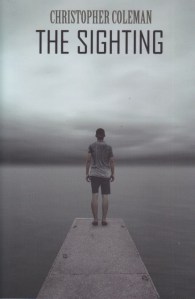
What happens when someone encounters something anomalous?  In real life this is often described as a religious event.  In fiction that sometimes happens as well, as in Christopher Coleman’s The Sighting.  Set on a beach somewhere along the Atlantic, the story is about a woman who encountered a sea monster and decided it was a god.  Gods, of course, require sacrifice, and thus the tale turns on her effort to placate the beast in its current appearance cycle.  Such sacrifice doesn’t come willingly, and this introduces a murderous main plot.  Unlike the gods of lore, however, this one literally eats, tipping the reader off that its divinity is somewhat of an illusion.  The hungry beast becomes the divine only to its blind follower.

I’ve not read any of Coleman’s fiction before, and this self-published novel appears to be a good introduction to his story-crafting.  His monster, like a god, comes with no explanation.  It simply is.  Since religion isn’t really susceptible to being examined under a microscope, the truth of not being able to locate an origin for gods seems natural enough.  Still, people are curious about monstrous origins.  Mary Shelley tells us the genesis of Frankenstein’s monster, but Bram Stoker leaves Dracula’s ultimate origins somewhat misty.  In the present day, with its ubiquitous cell phones and information, we do wonder if monsters can’t simply be explained.  Even if that simple explanation is complex.  Coleman’s title page tells us this is book one, so further elucidation perhaps comes later in the series.

The sea, in classical thought, gives rise to monsters.  Coleman’s creature comes from the Atlantic.  All the world’s oceans are organically connected, and their surface area is so massive that we really haven’t figured out all of what’s under there.  Stories still appear in newspapers announcing this or that unidentified creature that has washed out of the sea.  Its depth and relative impenetrability make it a natural birthplace for monsters.  By the end of The Sighting the reader is really still only given a glimpse of what this god might be, or why, indeed, it is considered a god at all.  Origin stories make monsters less scary sometimes—Shelley’s genius was to take it in the opposite direction.  Often in horror stories, the humans are more frightening than the monsters.  So it is here.  What makes this story so disturbing is the unquestioning human acceptance of belief, for it is often here that gods can become monsters.


Good News Shipping

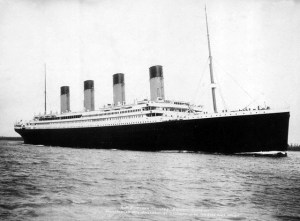
“And all the ships at sea,” was the closing of Walter Winchell’s radio broadcast introduction. The phrase has a certain poignancy about it—a cross between Melville and Edmund Fitzgerald. The idea of being isolated at sea is foreign to most people, but it is truly as far from others as you can get on this planet. In ancient times the sea was considered evil. It was well-nigh unsurvivable and chaos monsters dwelt in its depths. In the book of Revelation, in God’s kingdom “the sea shall be no more.” But the economic fact is, it’s still cheaper to ship by sea than to fly things from here to there. Amazon seems to have made us forget just how complex delivery is. I was forcefully reminded of this the other day when I received an email saying that the Bibles were at sea. Literally. They’re on a boat in the middle of the Pacific, along with who knows what else.

This is only a parable

The vastness of the ocean makes humans painfully aware of our smallness. As does the Bible. I remember thinking, as a child, that those offering printed salvation did so from the goodness of their hearts. That may be part of the story, for sure, but Bibles are big business. Not as big as they used to be, but still not inconsequential. This was captured well by the character of Big Dan Teague in O Brother, Where Art Thou? “It all about the money, boys!” he shouts as he robs Everett and Delmar. Yes, that evangelist giving away Bibles may have your soul in mind, but your pocketbook too. Like those Bibles snuggled against crates of condoms and smart phones, it’s just business. You’ve got to keep the bottom line in mind.

Bibles can be a lucrative business. The Bible is, however, a large book—expensive to print and bind because it requires special paper thin enough to hold all that text. Such specialized work done domestically would drive the price of the Good Book out of comfortable profit margins. So the word of God is printed overseas and sent across the ocean by boat. There’s a parable deep within this hidden life of Scripture. The romance of the high seas—being completely isolated from land and its comforts. “Here be dragons,” the Hunt-Lenox Globe famously proclaimed, and that’s a parable too. That Bible in your hands comes with considerable cost. Even in a world where drones for personal delivery are not far off, the sea still surrounds us.