Finding Family

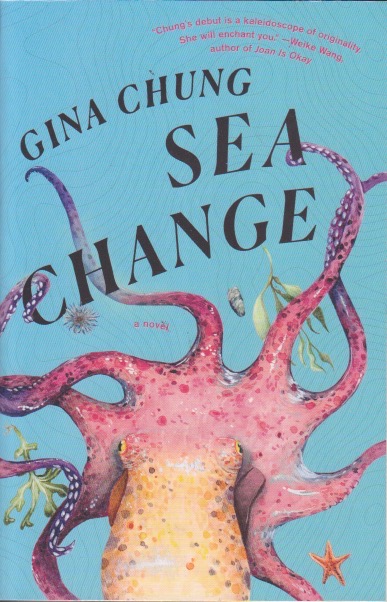
Sea Change is a probing story of learning to live with loss.  Of learning how to say goodbye.  I’m sure that I didn’t catch all that was being offered in this novel, but for those of us who did grow up without a father there’s a kind of therapy here.  I know that I eagerly awaited the end of work each day so that I could pick it up and read a bit more.  Framed as the story of the only child of Korean immigrants, the novel features Aurora (Ro), a young woman who has had to find her way ever since her father has gone missing.  And even before that, actually.  Her father, as a marine biologist, had captured an octopus (Dolores) who now lives in the aquarium where he once worked.  Ro, whose relationship with her mother is strained, takes a job in the aquarium after her father goes missing and befriends the remaining part of him—Dolores.

At the same time Ro’s boyfriend is accepted into a mission being launched to Mars.  (This isn’t science fiction, just to say.)  The loss is another deep cut to a woman who had to deal with the earlier significant loss of her father.  I won’t say much more about the plot since I think you should read the book, but it is a thoughtful, and from my experience, realistic journey through the mental states of those who cope with abandonment issues early in life.  Of course, I can’t speak to the experience of being a child of immigrants, but the novel shows we all deal with the same kinds of issues, no matter where we’re from.  At least we do in modern civilization.

Sea Change made me ponder, however, whether children raised communally would feel the same kind of loss if a parent they didn’t know was theirs left.  The mother-and-child bond is a deep one, so I guess it could be that fathers, after conception, would be expendable in such a situation.  It’s difficult to project how such a society would work.  The family unit is so deeply engrained into our experience that, unless a situation is truly dire, we know we can rely on our parents not to try to harm us, but rather to protect and love us.  Those of us who grew up without fathers (I’m not sure if that’s the case with Gina Chung or not) deal with insecurity issues that never quite go away.  This beautifully written novel was, for me, a healing kind of experience.

Learning from Nature

Netflix is one of those companies that has shown that new models for providing both television and movies are emerging.  Of course there are many subscription services, but Netflix rose to the top of the pile during this pandemic.  I don’t watch it much, since my time is generally otherwise spoken for, but I did have a chance to watch My Octopus Teacher, a documentary about Craig Foster’s relationship with an octopus.  The story unfolds over a year in which Foster comes to know, and to be recognized by, an octopus.  Quite apart from the Cthulhu references that may come to mind, octopuses are often skittish, highly intelligent mollusks.  Perhaps what made this movie such a surprise hit was just how emotionally attached viewers become to the cephalopod through Foster’s relationship with her.

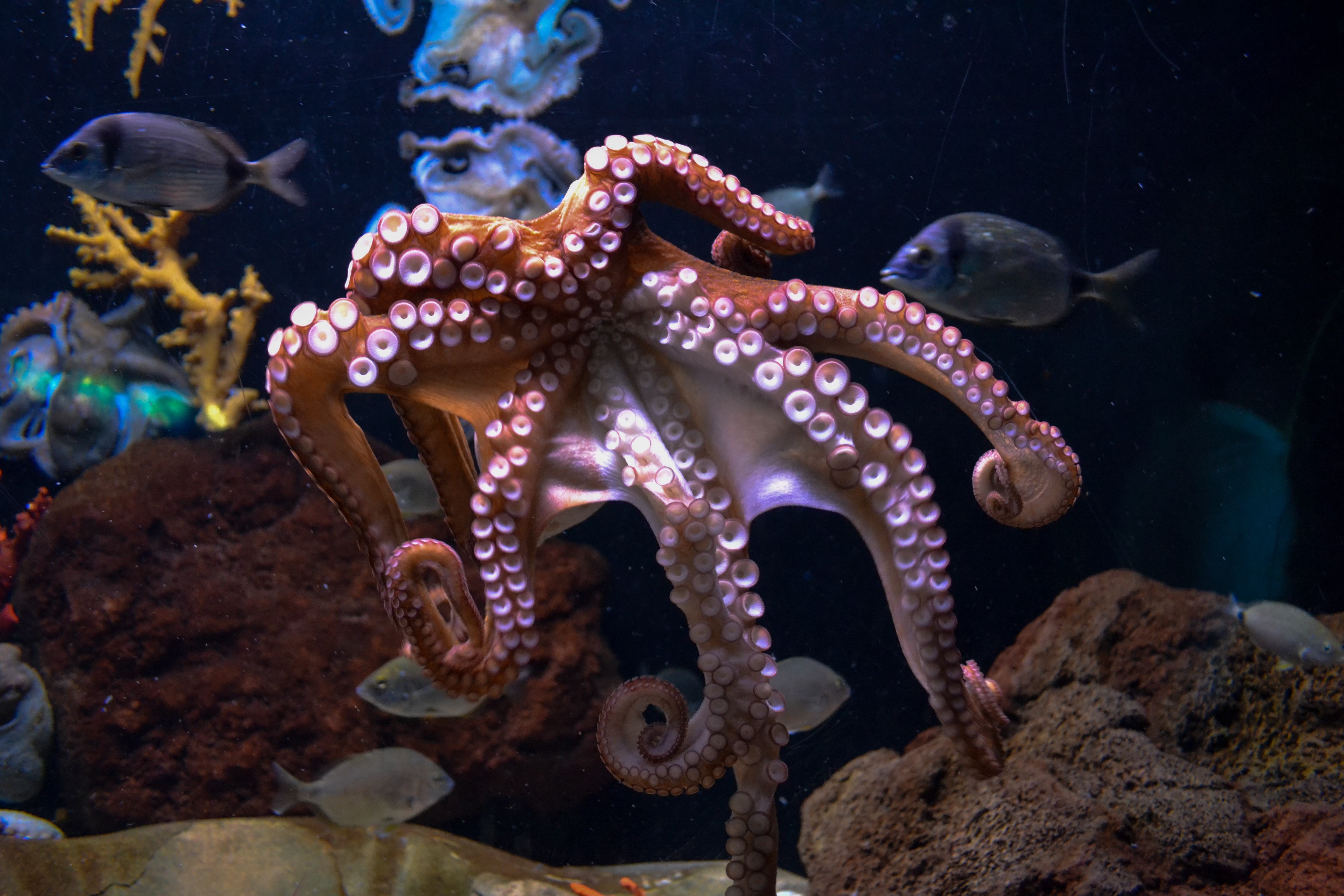
Photo by Serena Repice Lentini on Unsplash

Almost immediately in the documentary, the viewer is struck by just how intelligent octopuses are.  The particular personality—and there is no other word for it—featured in this film is able to think and solve problems.  Not only that, but she is capable of forming a relationship with a human being she came to trust.  For many decades we’ve been taught that animals are like automatons, reacting with stock behaviors, because they can’t think.  Any claims to animal intelligence were chalked up as “anthropomorphism,” or inappropriately allowing animals to share in that coveted human trait of being “intelligent.”  The idea comes from the Bible and not even scientists would question it for the longest time.  Spending part of each day with one octopus, however, gives the lie to animals being subject to programmed behavior.  Like both Heisenberg and Schrödinger demonstrated, being involved in the scenario necessarily changes it. 

Animal intelligence has great implications for religion, of course.  This is perhaps why it is such a taboo subject.  What does it mean if animals can think and act intentionally?  Does it imply morality?  Foster implicitly raises that very question as he tries to decide whether to keep the pajama sharks away from the octopus he’s befriended.  Is he watching nature or has he become a part of it?  Our religions are often our ethical signposts.  In more recent years ethics has been shifted to the philosophy department since many people outwardly distrust the obviously mythical aspects of religious stories.  Nevertheless, the implications are clearly there.  Doesn’t it make a difference that our world is filled with other intelligent beings apart from those of us with opposable thumbs?  Watch My Octopus Teacher before deciding on an answer.


Fictional Fact

Do you remember that tragic sinking of a Staten Island ferry when a giant octopus pulled it under? Sounds vaguely familiar, but I wasn’t living near New York at the time. A story in The Guardian tells how Joseph Reginella, a sculptor, made his commemorative piece of art for Battery Park for a fictional incident. Like the memorial for War of the Worlds in Grover’s Mill, New Jersey, this is something we remember that never really transpired. We remember what never happened. It’s easy to forget that memory evolved for specific purposes. Mainly we remember for survival. Our brains evolved to keep us alive. If we don’t recall where we found water, or where that hidden cliff edge is, we don’t last for long. But we remember other things as well. The time that Oog borrowed your stone axe and didn’t give it back. Our social memory made us human, so we’re told.

dscn4239

No doubt it is possible to develop a keen memory. Precise recollection of events just as they happened, in sequence. It’s also possible, even collectively, to misremember things. We tell stories. We make myths. There was no giant octopus incident. Maybe we saw such a thing in a movie one time. That movie, paired with the plausible evidence of a public monument commemorating the event becomes a modified reality. I’m just sure I can remember it happening, can’t you?

Studies of such phenomena tell us that memories aren’t what they seem to be. To make distant recollections Holy Writ, for example, we have to rely on divine inspiration. Without it we might just be remembering a story somebody told once upon a time. And where did I put the car keys? Yes, our memories are open to manipulation. Things that never happened become real this way. George Washington did not chop down a cherry tree and confess to his father because he could not lie. And yet we believe. We make myths because they give our lives meaning. Face it, evolution is a pretty boring explanation for why we’re here. Natural selection has no goals in mind. Things that work best tend to survive in the gene pool. And in some people’s memory there may be a giant octopus in that pool as well. Did the the Cornelius G. Kolff get pulled under or not? Would a ship with such a name ever be made up? Myths are still born every day, even as the octopuses cower in their caves, awaiting the next naive ferry to transcend reality.


Consciousness Times Eight

SoulOctopusPerhaps the characteristic that marks our species most distinctly is its arrogance. Conscious of who we are (we think) we stake the claim for minds for ourselves alone while all the evidence points away from that very conclusion. Naturalists are castigated for “anthropomorphizing” animals by stating that they have consciousness too, or—oh the heresy!—personality. Any of us who’ve spent time with two or more of the same non-human species, however, know that personality is a given. Animals think and feel and, yes, act on their own view of the world. I have to admit I fell in love with Sy Montgomery’s The Soul of an Octopus. I’ve read animal books from my youngest days, but finding an author so forthright about the feeling of getting to know another species is rare. And I learned tentacles full of information about octopuses. I had already known that octopuses are intelligent—I hadn’t realized just how smart—but since my interactions have only been with sleeping cephalopods on the opposite sides of aquaria glass, I had little to go by.

Throughout her charming book, even if the evidence is anecdotal, Montgomery reveals the personalities of the octopuses she got to know at the New England Aquarium. The reader can be left with no doubt that these are animals with personality, different from one another and strikingly conscious. We can’t define what consciousness is, but I tend to agree with Montgomery that it is what many people call “soul.” She admits that her religious tradition would likely frown upon her willingness to share such a valued commodity with an animal—an invertebrate, no less—but surely she is right. Many, if not all, animals have a form of consciousness. Heaven will be a much more interesting place for it.

Please don’t confuse my enthusiasm with sentimentalism. Those of you who regularly read this blog will know that books on animal intelligence by a variety of scientists make up a steady part of my literary diet. Biology, however, often has a difficult time in a world where physics and chemistry are treated with reductionistic glee. I was strangely satisfied when Montgomery mentioned that Stephen Hawking signed the Cambridge Declaration on Consciousness which proclaims humans alone are not the guardians of this phenomenon we don’t even understand. The Soul of an Octopus was one of those books that I couldn’t wait to keep reading, even if it meant being on my long commute each day. And I can’t help but think of how much intelligence we squander by claiming that only our own kind possesses it.