O Come Let Us

During the height of the zombie craze a meme went around the internet proclaiming “zombie Jesus.”  It was funny because the salient feature of zombies is that they come back from the dead.  Noting the resurrection and the easily annoyed trigger finger of Fundamentalist Christians, some wag brought Jesus and the undead together.  We had a good laugh and forgot about it.  A guy in Ohio with a sense of humor, took the zombie Jesus meme and constructed it into a zombie nativity scene in his yard.  None of us knew about it, of course, until it caught the attention of the news.  A story in the Washington Post notes that the man was required to take the scene down for violating zoning laws.
 
People take their religion very seriously and have a hard time laughing about it.  Religion is under constant fire from angry atheists and it already suffers a complex from having so many liberals pointing out the historical and logical faux pas from within the tradition.  Some people take advantage of American gun laws to stock up against the day when they’ll step over the line and join those who shoot up offices where they think Mohammad is being mocked.  Then we’ll sit around and wonder if we should classify them as terrorists or just deranged.  And we’ll post a take-down order, just in case any zombies remain.
NightoftheLivingDead
 
As an academic (at least erstwhile) I noted how little religion scholars reveled in the humor of their traditions.  There’s funny stuff in the Bible, believe it or not, and many religious traditions allow for a Mona Lisa smile every now and again.  A far more common stance, however, is that of taking offense.  Something that most critics just don’t realize is how much religions mean to those who believe.  I chuckle once in a while, but I never belittle the beliefs of others.  I have been in this religion thing since I can remember, and I know what it can mean to people.  The best way to avoid offending, I think, is to keep our jokes among the crowd of those who have a sense of humor.  Of course, the undead obey no rules and the media (and its unruly accomplice, the internet) can’t resist spreading memes that might earn a buck or two of advertising revenue.

Portrait of God as a Young Man

Famed swing state Ohio is back in the news with Jesus in the front lines. It was an unlikely setting to notice such a thing. I was sitting in a conference room at work, awaiting the start of a meeting. A laptop was set up with a projector, and the homepage cast upon the screen was msn.com. There, on the wall at work was Jesus’ name.

The story has to do with a public school in Jackson City. A student group had donated a portrait of Jesus to the school in 1947, but in a multicultural world the constitution sometimes has to take on the Prince of Peace.

CompositeJesus

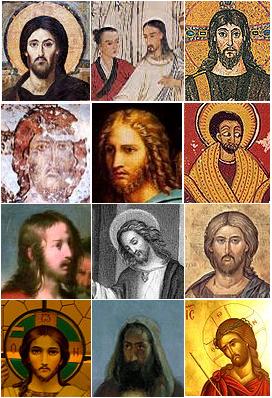
While the legal issues are thorny, I have an even more probing question to ask. What makes a portrait a religious object? There is a fair bit of dispute about the historical Jesus—who he really was, where he was from. Despite the sangfroid of the New Atheists, there is little reason to doubt that there was a historical person Jesus. If that is the case, what makes his picture any different than that of Woodrow Wilson or Ronald Reagan? Or Churchill, with his religious-sounding name? One could argue that we don’t know what Jesus looked like—and this is true—but neither could we really identify many historical figures before the advent of photography.

The making of a picture into a religious object comes down to intent. Intent on the part of those who hung it, and on the part of those who view it. The 1940s were a different era. The Second World War was just ended, America was proudly Christian after fighting for the cause of truth, justice, and, well, the American way. Could the school group have donated Jesus in that era as the portrait of a great man? Without supernatural implications? I suspect we all know the answer to that.

Fast forward a few decades. The world has changed drastically. We are multicultural. The internet entertains us with such stories as this. If not for the internet, and a casually chosen homepage, I would never have even heard of Jackson City, Ohio. Is it possible that we could look at a picture of Jesus in our day without religious adoration? Quite possibly. But the furor raised by the religious right every time a perceived slight stirs up the dust would seem to make such an association impossible. Any prominently displayed picture of Jesus in a government location, no matter how local, is perceived as a religious act. It seems that we’ve lost our ability to appreciate the wider realm of possibilities. And that is sad. Who was Jesus, really? Historians and theologians come to no consensus on the issue. One thing is for certain, he’s sure to set people against one another wherever he appears.


Hair Today

In what may be the most bizarre recent example of religiously motivated violence, the Associated Press reports that a breakaway Amish group is accused of the crime of haircutting. Amish beliefs about personal appearance are well known, and taking various biblical injunctions seriously, they believe cutting a man’s beard or a woman’s hair to be a sin. (Any Amish reading this, please correct me if I’m wrong.) The aptly named Sam Mullet, the leader of a breakaway Amish group (the article doesn’t specify the contention) has been charged with forceful barbering with intent to shave. Not himself, but other Amish men in Ohio. The Amish trace their roots back to the Anabaptist movement that only accepted adult baptism and would rebaptize those who were sprinkled as infants. They acquired other beliefs along the way such as hard work and industriousness, distinctive dress styles, and the shunning of electricity. They are devoted to pacifism.

The story, which Rod Serling would have been proud to air, has Mullet forcefully cutting the beards of men and the hair of women in another Amish community. The article doesn’t explain how Mullet took on his Delilah-esque treason, but after giving his enemies the Seville treatment, he took photos of his victims. The Amish don’t like pictures either. Apparently the Amish community is terrified of this mad shearing heretic. The mind reels attempting to conjure an image of the struggle or even what might have led to it. Where did the camera come from?

Religion, no matter the denomination, prescribes unusual behavior. What one society supposes to be normative is simply a matter of socialization. When you are brought up with, say, a man wearing a colorful brocade dress while breaking a translucent wafer over a goblet of wine and claiming it to be God, that seems perfectly normal. Anyone who tries to challenge or desecrate this rite would be designated an infidel, heathen, pagan, or worse. Many think the Anabaptists, whether Mennonite, Hutterite, or Amish, to be quaint and curious like forgotten lore. In fact, their religious beliefs go back to a venerable past. Images of The Witness flood to mind when reading how the FBI has become entangled in the barbarous act. Perhaps it is time for Mulder and Scully to make a reappearance. But just in case, perhaps they should sport some sturdy helmets and Kevlar, since reports are out that some Amish are sitting on the porches with shotguns, while one lurks in the shadow with his snipping scissors.


Joltin’ Jesus

Jesus has been having a hard time lately. Just last month he was hit by a car, and on Monday night lightning struck a second time. Literal lightning. A touchdown-style Jesus in Monroe, Ohio, formerly six stories tall, received the paragon of divine punishments in a Midwest thunderstorm. Struck by lightning, the fiberglass and plastic foam savior melted leaving only an eerie, Lovecraftian idol of a steel frame behind. The statue had adorned the Solid Rock Church in Monroe since 2004. According to MSNBC many motorists said that America needs more symbols like this; God apparently disagrees.

Former Touchdown/Quicksand Jesus

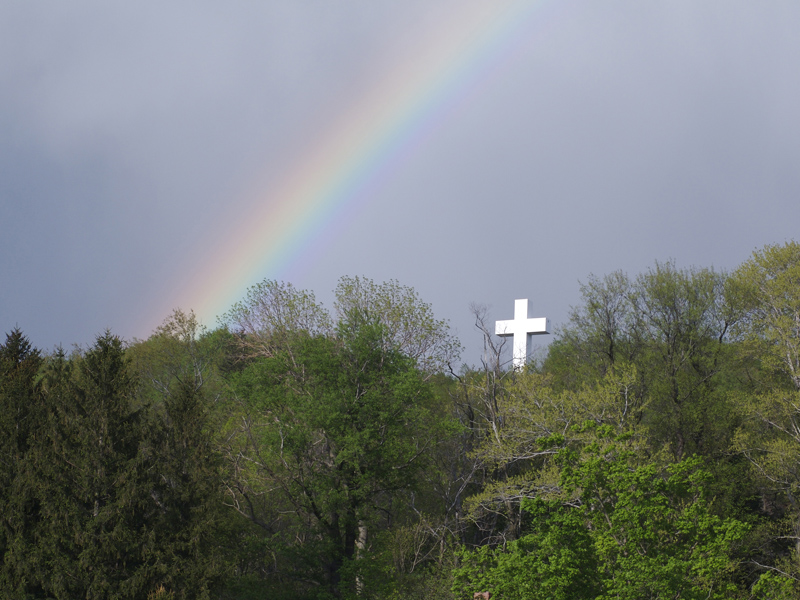
Obtrusive religious symbols dot many high hills and adorn many quotidian highways as signs of the donors’ faith. Lawrence Bishop, horse-trader-cum-pastor, and his wife Darlene made a substantial investment in this eviscerated Touchdown Jesus sculpture. As a camp counselor in my youth, I slept in the shadow of the great steel cross of Jumonville in southwestern Pennsylvania. The 60-foot tall cross is lit at night and is visible in three states. The monolithic cross always seemed incongruous with the blackened roasted weenies and gooey banana-boats we managed to choke down. Staring at its gleaming whiteness by night was an epiphany to many.

With the rainbow seal of approval

When my wife and I lived in Scotland some years ago, a terrific wind-storm blew through. In itself that was nothing uncommon, as any Scot will tell you. Wind gusts in this storm reached about 140 knots (160 mph), causing widespread damage. In an interview on the BBC, the sexton at one of Scotland’s cathedrals (time has robbed me of the details) recorded seeing the wind topple a statue of Jesus atop the building. He quipped, “I looked up, saw Jesus coming down, and ran for my life!” Although the exact location escapes me, the words have taken on an unexpected significance as icons crash down all around me. The demise of “Quicksand Jesus” is simply one further reason to avoid trusting in anything less than solid rock.