Is That Cookie Free?

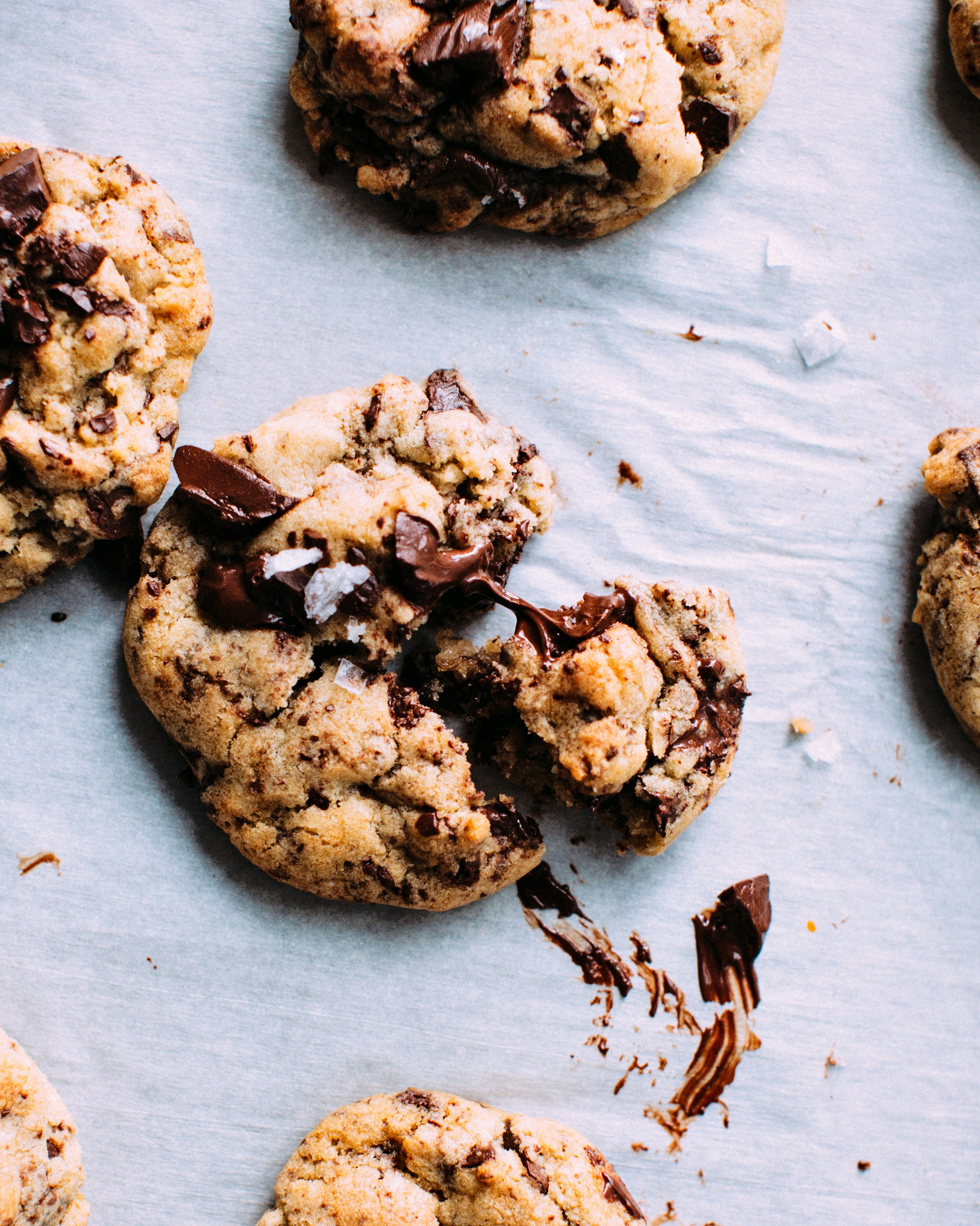
I offer free editorial advice here, from time to time.  Not many academics, I expect, pay any notice—what have they to learn from a mere editor?  Still, it’s a public service, so here goes.  It really pays to do your research.  I don’t mean about the topic of your book, but research into what publishing is and how it works.  Some authors, for example, think that if they pay an Open Access fee their book will get bells and whistles that other mere monographs won’t.  They underestimate how much it costs to print a book, especially when they’ve already undercut their own sales by making it available for free online.  There some basic business sense lacking here.  There’s a free cookie but then there’s also giving away the whole box.  Who’s going to buy what’s free?  (There are good reasons for Open Access publishing, but wishing for special favors isn’t one of them.)
I make no claims to be some kind of publishing guru.  I tend to think of myself as a guy who got lost along the way, career-wise.  But I’ve learned that I wish I’d known more about publishing when I was teaching.  I see the same rookie mistakes over and over and over again, made even by senior scholars sometimes.  I remember, however, when I was teaching.  It never even occurred to me to find out anything about publishing.  In the academic’s eyes, publishers are there to serve up what researchers discover.  To a point that’s true, but publishers vary quite widely in their tolerance for the purely academic exercise.  You see, you actually have to sell books to stay in business, and if your research to too obscure, well, I guess you could try to find some Open Access funding.

One of the things that amazes me about the biz is just how many academics assume that editors are menial workers in the larger enterprise of getting their important ideas in print.  My time in publishing has been an education in itself.  I may not have time to keep up with Ancient West Asian studies anymore (the draw is still there, but it’s a terribly expensive habit).  Horror’s a bit easier to handle since you really have only about two centuries to cover, rather than four millennia.  But I can’t help but muse on what a missed opportunity presents itself when a free cookie is passed up.  It’s far easier to stay wrapped in that academic shell than it is to try to break out and discover what is freely offered.  Strange how the world works sometimes. Have a cookie…

The Archive

Publishers hate it, but I bless its holy name.  The Internet Archive is a major boon for “independent scholars.”  If you’re not familiar with it, the Archive is a repository of scanned books.  It doesn’t contain everything, of course, and some publishers have tried to sue, but it operates like a library.  You set up a free account, and if you just want to look up a reference in a book they have, you can “borrow” it for a while, check your reference, and then return it.  All without leaving your home.  Internet Archive really took off during the pandemic.  You couldn’t get to the library and some of us research as long as we breathe, so here was a solution without breaking the bank.  The bank, ah, there’s the rub.

The reason publishers hate Internet Archive is that it makes content available for free.  Working in publishing, I understand the concern.  Publishers have to make money off their books—they are businesses, after all.  And if somebody scans it and makes it free online, your sales are undermined.  But are they?  Now, I can only speak for people like myself, but if a book is directly relevant to my research I will buy it.  Reading online is a last resort. My library is full of books bought for that reason.  Once in a while, though, my research leads into areas I don’t intend to come back to.  Or I remember reading something in a book long ago, back when I had library access with interlibrary loan, and I can’t afford to buy the book just to look up that reference.  Well, Internet Archive to the rescue.  Publishers don’t often turn their mind to independent scholars since we’re not prestige authors.  Waifs of the academic world.

That’s one reasons I don’t feel bad blogging about Internet Archive.  Most traditional academics pay no attention to my blog.  If I were hired by Harvard that would change overnight.  Those of us who skulk in the shadows of the ivory tower don’t mind getting by with freebies like Internet Archive.  And some part of us, even if we work in publishing, applauds such ventures as SciHub.  I do not suggest visiting SciHub, however, and I’ve never done so myself.  Its software automatically scans your hard drive for content that it can add to its huge repository.  It’s not safe.  The idea stands behind Open Access as well.  Knowledge should be free.  But even publishers have to eat.  And those in ivory towers have everything to gain by keeping their edifices pristine.


Paywall

They were my former employer, for goodness sake!  Here’s how it happened.  It begins with research.  Nobody is born knowing all they need to learn.  Research teaches you to question what you read and check sources.  That’s how bibliographies are built.  So I came across a reference to an article I needed to read.  The problem was it was behind a Taylor & Francis paywall.  (Taylor & Francis own Routledge.)  The cost to read one article in an academic journal?  $45.  That’s usually my upper limit for buying an entire book.  Working in publishing I know the reason for this.  They want you to go to your library (I don’t have one) and ask them to subscribe.  If you need access, probably somebody else will too.  This particular author isn’t on Academia.edu.  Should I risk Sci Hub? I mean the article is right there, but I’m not allowed to see it!

I did find that you can ask the author for a copy on Research Gate.  First you have to join Research Gate.  They want your institutional email.  My email doesn’t have a .edu extension.  I therefore had to go through a lengthy process of verifying that I am a researcher.  I had to claim papers I’ve authored.  I had to explain why I don’t have an affiliation.  I had to have them email me, twice.  Each time I had to provide further information.  I swear, it’s like getting a Real ID all over again.  All this so that I can ask an author for a paper that’s only available for $45 on the publisher’s website.  Every time I start a new research project I ask myself why I keep at it.  I guess I want to be part of the conversation.

The open access movement is gaining steam.  The idea is that research should be free.  Very few object to paying nominal fees for access, but often prices are extortionate.  Publishers are caught in this web because overheads are so high—they have to pay employees—and the cost of materials isn’t cheap.  Traditionally this has been overcome by passing some of the expense on to customers.  That’s why academic books are so pricy.  With journals, such as the one I need, the scenario’s a little different.  Journals are purchased by libraries via subscription.  “They wouldn’t subscribe to them,” so the argument goes, “if researchers could get the contents for free.”  Still, putting in place a free article or two before dropping the price bomb would seem to be in the best interest of actually moving knowledge forward.  Hey, T&F, don’t you remember me?


Online Research

Given my current lack of a university library, and my continued rapaciousness for research I’ve had to sample internet offerings.  There’s a reason academics are skeptical of the internet’s research reliability.  Just about anything you want to verify brings you up against a paywall where you can sometime buy an article you could read for free if you were a professor, for about $15 or $20.  The privileging of academic information.  (Hey folks, I give it away here!)  In any case, I often run into websites on the topic on researching that give “facts” with a breezy assurance that isn’t followed up with footnotes, making me wonder where they got their information.  Who was the publisher?  Who says they know what they’re talking about?  No wonder alternative facts rule the day.

One of the things I learned in the course of my doctoral work is that those three insignificant letters, if applied correctly, indicate that you know how to do research.  Earning a doctorate is often considered (and sometimes is) a matter of becoming a specialist.  Those willing to peel back the top layer realize that underneath what’s going on is a transformation of your way of thinking.  You can find facts, but you can also weigh them in the balances.  You take no one’s word for it.  Unless, of course, they’re published by a prestige press.  And even then, if the lesson really sunk in, you’ll have your doubts.  The internet is a frustrating place to try to find reliable information.  Oh, it’s great for looking up phone numbers, and even for getting directions.  Just don’t trust it with history.

Currently at work on my fifth book, I’m finding research somewhat of a hurdle.  I’ve reached out to local universities and they seem only to want to let you in if you’re an adjunct (which is considered a conflict of interest in my current post).  You’re therefore locked out of knowledge.  I recently learned that JSTOR may be offering a fixed number of free articles to independent scholars.  If so, that is a great and farsighted boon.  You see, the problem is you need to look at the footnotes to know which articles are actually based on solid research.  There’s a move afoot that makes academic presses shudder.  The move for free information.  It’s the business of academic presses to sell it, of course—that’s where the money comes from.  So I sit here facing another paywall and I wonder is wisdom can ever truly be free.

Photo by Sharon McCutcheon on Unsplash

Citation Anxiety

As a recovering academic, I sometimes am compelled to look when Academia.edu sends me notices. Academia, most of my academic colleagues don’t realize, is a for-profit website that advocates open access. “Open access” (or OA in the biz) is academic trash talk for making the published results of research available for free. It’s a great idea, but it often doesn’t take into account how complex publishing really is. Peer review, printing, and distribution of articles all take money and to make all research free cuts out what those who publish the research can use to fund the venture (with a cut taken out, of course, to make the whole thing worth their while). That’s the way capitalism works. (Look it up under economics.) In any case, not realizing that Academia is also a profit-making venture, lots of us put our published papers on it, making them freely available to anybody who cares.

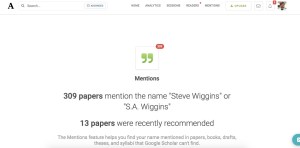
Once in a while Academia will send its users a flattering notice: “X-hundred people have cited your papers.” Be still, my throbbing heart! Desperate for any attention, most academics (let alone us exes) are thrilled that more than 100 people have read their stuff. So I clicked their link. “309 papers mention the name ‘Steve Wiggins’ or ’S.A. Wiggins’” it cheerfully reads. I know something the robot apparently doesn’t. I’m not the only Steve Wiggins on Academia. There is a slightly older agronomist whose name I share. He’s employed in academia and has more papers than me. And “S. A. Wiggins” could be anybody. My 309 paper mentions shrinks to double digits. Not high double-digits either. Names are hardly unique identifiers. With some seven-and-a-half billion people, there’s bound to be some reduplication. I always tell the few curious to search “Steve A. Wiggins”—with the quotation marks—to find the few, true references.

Taking on the internet is a fool’s errand. This blog gets a few piddly hits a day. I often consider closing it down. Readers don’t share it enough to get any attention. It takes a lot of effort on my part since I write books (both fiction and non) in my hours not at work. So when Academia shows up in my inbox my excitement spikes, just for a moment, and I go on with my other work, which never seems to get done. And then, when I’m sure nobody else is looking, I go ahead and click on the link.