Keep Remembering

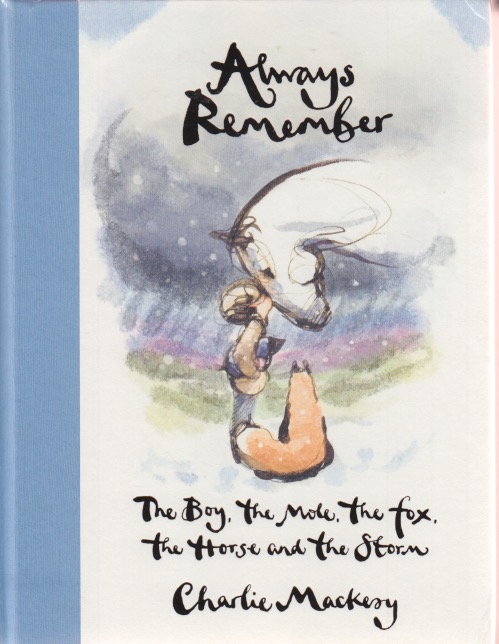
Books used to be, and often still are, works of art.  I can’t imagine my life without them.  I read Charlie Mackesy’s The Boy, the Mole, the Fox and the Horse back in 2023.  A psychiatrist that’s a friend of mine recommended it.  Mackesy’s next book of wisdom, Always Remember: The Boy, the Mole, the Fox, the Horse and the Storm just came out in 2025.  It was a stormy year and I can’t help but think this book was one of the antidotes that the world seems to hide next to the poisons it contains.  The book is a work of art.  Like its predecessor, it builds on the importance of love, friendship, and hope.  These are the kinds of things we need in difficult times.  Indeed, we are in the midst of a four year storm that threatens to tear apart 250 years of progress.  We need this book.

I wanted to save this book to be the first I finished in 2026.  To start the year off in a good way.  I’m not a maker of resolutions since I try to self-correct as soon as I become aware of a problem.  But reading a positive book at the start of the year seems like something that is smart to do.  It’s so easy to get drawn into negativity.  Doomscrolling invites itself to be shared with others.  Pretty soon we’re all mired down.  But the horse is fond of reminding the boy, mole, and fox, “The blue sky above never leaves.”  It is there waiting for us, after our self-inflicted storm ends.  As I’ve noted before, writing books is a hopeful exercise.  Reading them can be too.

Charlie Mackesy is my age.  He seems to have distilled more wisdom from our time on this planet than I have.  Reading his observations is the very definition of nepenthe.  When the headlines foreground hate, we must respond with love.  When everyone tells us the storm will never end, we must beg to disagree.  Humans are problematic creatures.  We create our own ills much of the time.  There are those among us, however, who are wise.  And we can improve our state if we choose to listen to them instead of those who loudly proclaim their own praises.  Wisdom is often in short supply in this world we’ve created for ourselves.  It is not, however, completely absent.  Do yourself a favor and find Always Remember.  No need to save it for a rainy day.


Welcome 2026

I put great stock in holidays, but I’ve never felt a deep connection to New Year’s Day.  I’m more of a morning person than the stay up late sort, and the New Year also seems cold after the coziness of Christmas.  But here we are in 2026 nevertheless.  We’re encouraged to look ahead.  I’m not much of a corporate person and I don’t see much wisdom in devising five year plans in an unpredictable world or any such nonsense.  The way things have been going in the news, it’s hard to have a five-day plan that bears any resemblance to reality.  But New Year’s Day does seem an appropriate season for optimism.  Hope stands here, anticipating better days ahead.  I am, despite appearances, an optimist.  I do believe in progress and the calendar keeps on ticking over regardless.  What will 2026 hold?  Who knows.  Best to take it one day at a time.

For me personally, I’ve got a couple books nearly complete and I do hope to find publishers this year.  And I’ve got many others started as well.  Writing is an act of optimism.  I’m always touched when someone lets me know they’ve found my work interesting, or even helpful.  Someone once contacted me to let me know Holy Horror had helped them through a difficult time.  This made me happy; writing books is a form of connection.  When I read books—a major planned activity for 2026—I’m connecting with people I don’t know (usually).  Writing to me feels like giving back.  The funny thing about it is the tension of having little time to do it seems to make it better.  I always look forward to the break at the end of the year but I find myself using the time to recover rather than for the intensive writing I always plan to do.

I have spent the last several days doing a lot of reading.  That too is a coping technique.  I’ve got some good books that I’m looking forward to finishing in 2026.  And the blog bibliography continues to grow.  Looking ahead I see reading and writing.  That to me is a vision of hope.  I didn’t stay up to midnight last night—that only makes me start out the new year grumpy.  No, instead I woke up early to start the year by writing.  And reading.  What does 2026 hold?  I have no idea.  I’d rather not speculate.  I do believe that as time stretches on some improvements will begin to take place.  I do believe holidays are important, both looking back and looking ahead.


Optimism

On the homepage of my website (of which this blog is a part) is the statement that jaded optimism lurks here.  I’ve been thinking a lot about optimism and hope lately.  Trying to change the way you think is difficult.  Musing with my wife the other day I realized—and this should’ve been obvious—that my optimism became “jaded” when I lost my job at Nashotah House.  You see, our lives have been uncertain since then.  The steady income of an academic job with a retirement plan, a future mapped out (at least a little) with summers free for research and travel, the flexibility to have time to contemplate; all of this fits my neurodivergent way of thinking.  Having suddenly to cope with finding an apartment, finding jobs (not vocations), losing retirement options, all of this has led to a turmoil that has lasted going on two decades now.

I need to challenge my jaded optimism into becoming real.  I keep coming back to Mark 9.24, “Lord, I believe; help thou mine unbelief.”  I’m not a materialist, although academia led me close to it a time or two.  The universe, however, is an untamed place.  We don’t know the trillionth of it, let alone the half.  We’ve figured out a good bit of the physics of this world and think that it applies the same everywhere in this infinite, expanding space-time.  Then we discovered quantum physics and quantum entanglement which looks more like religion than science.  It seems to me that optimism—hope—lies in a combination of what science tells us and what is traditionally called religion tells us.  You may call it “belief,” “intuition,” or “hope.”  Yes, when Pandora’s box was opened, only hope remained.

John William Waterhouse, Pandora (1896), public domain, via Wikimedia commons

There’s a parable in the story of Pandora.  As told by Hesiod, Pandora’s jar contained the gifts of the gods which escaped when Pandora opened it.  Thereby evil entered the world.  Yet one gift of the gods remained for humankind, and that was hope.  Arguably the most valuable gift of them all.  I have been letting my career malfunction at Nashotah House dominate and drive my outlook for far too long.  It will never cease to hurt, I know, but it’s time I learned the meaning of what the Pandora myth teaches us.  Myth, please understand, functions like religion.  It provides insight and guidance.  And the tale of Pandora, especially when things turn unexpectedly frightening, reminds us that hope is the only necessary gift of the gods.


Better Things

It’s only a store brand, but still.  Maybe like me you remember opening a box of Raisin Bran and pouring out the first bowl.  And finding only bran.  Maybe a raisin or two.  By the time you munched your way to the bottom of the box you’d get a bonanza in that last bowlful.  It was more fruit than cereal.  Then they somehow figured out how to suspend raisins so that didn’t happen.  My mind hasn’t caught up yet, I guess.  I was down to the last bowl, and I was eagerly anticipating it.  Especially since the day before I’d only had three raisins and it was clear that the end was near.  Then the last bowl.  One raisin.  That’s a lot of bran to start your day, like C. S. Lewis’ always winter but never Christmas in Narnia.

Speaking strictly for myself, I like to save the best for last.  When I receive snacks in my Christmas stocking, I keep my favorites until all the others are gone.  In my personal myth of scarcity I’m quite aware that good things run out.  And they’re not always easily replaced.  Therefore I tend not to buy the things I like best.  This is the kind of psychology that drives economists mad.   As a child I was taught to put others’ needs before my own and that lesson has dovetailed with the running out of good things.  Of such things monasticism was made.  The raisins are now near the top of the box, but the crumbs are still on the bottom.

I often find breakfast to be the most philosophical of meals.  Perhaps it’s because I write my blog posts in the early morning.  Perhaps it’s because others are awake when I eat lunch and supper.  Perhaps it’s because that valuable things are rare.  It’s the nature of what we find most meaningful.  We live in a culture of largeness and acquisition.  What we truly want, however, may be very small indeed.  Ours is a culture of choice and plentifulness.  Raisin Bran is a choice, as is the store brand.  And it’s even possible to open the box at the bottom and return to my old form of expectation.  I doubt I will ever outgrow the idea, however, of trying to save the best for later.  It’s a form of optimism, after all.  And isn’t it best to start the day with the knowledge that better things are coming?