Balance

Psych!  Yesterday was actually the vernal equinox.  And speaking of psychs, it was about the coldest morning jog I’ve had all winter.  (The equinox itself didn’t occur until 5:24 p.m., which is way it was the 20th instead of the 21st.  And I honestly can’t understand how that works since don’t you need 24 hours for night and day to be equal?  There’s a reason I went into the humanities.)  Interestingly, in the pagan Wheel of the Year, it was Ostara.  And the similarity of that title to Easter isn’t really coincidence.  (By the by, I discuss this to some extent in The Wicker Man, due out in September.)  Easter is, in essence, a spring holiday.  Ēostre, a germanic goddess of spring, seems to have been its namesake. 
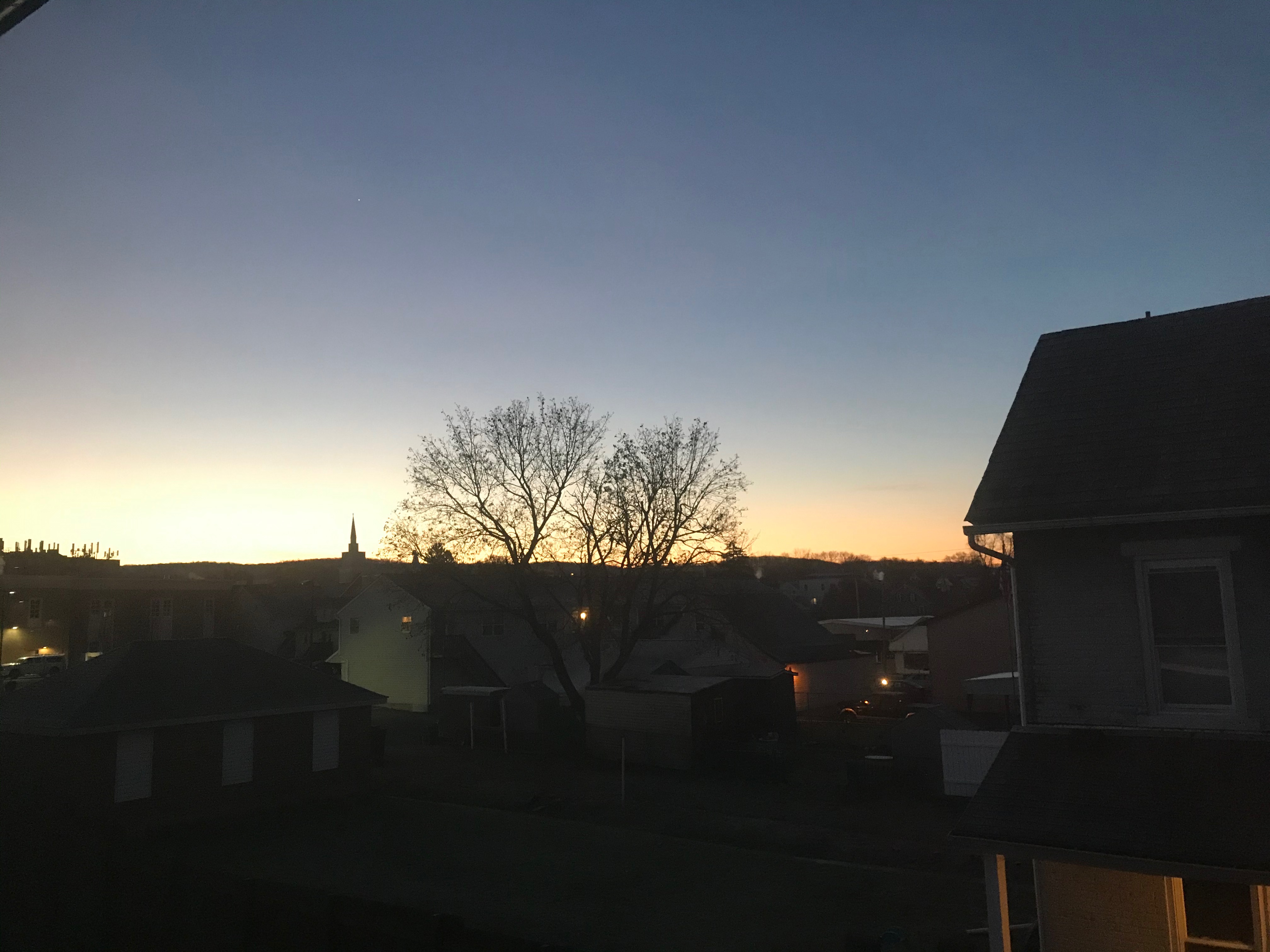
First light comes suddenly, for those awake early enough to see it.  I keep a close eye on the diminishing darkness so that I can get out and jog in the twilight.  It will be too dusky to see and then suddenly it’s not.  Sunrise is like an epiphany each day.  From now on light will increase both morning and evening until the summer solstice, or Midsummer.  Between Ostara and Midsummer lies May Day, or, as it was also known, Beltane.  Beltane is the fuel behind The Wicker Man, or so I argue in my book.  Holidays are important.  More of them should be recognized.  If the pandemic taught us anything it’s that most of us probably work too hard.  At any rate, spring is now here.

The mornings are still below freezing, at least around here.  The winter never got very cold and we had very little snow.  Some would argue that it was more like an extended, chilly spring.  The light, however, was missing.  I spend a lot of time awake in the predawn hours.  There’s a stillness to that time that’s a daily gift.  Yesterday was a brief moment of balance.  Soon it will be time to start mowing the lawn and to do the endless weeding of summer.  Those will last until long after the other equinox, awaiting in September.  Climate change has assured us that the weather will be erratic, but the waxing and waning of the light is as old as the spinning of this weary planet.  We’ve entered the light half of the year.  Equinoxes remind us that balance is rare and should be appreciated when it arrives.  It’s worth making into a holiday once more.

Spring Forward

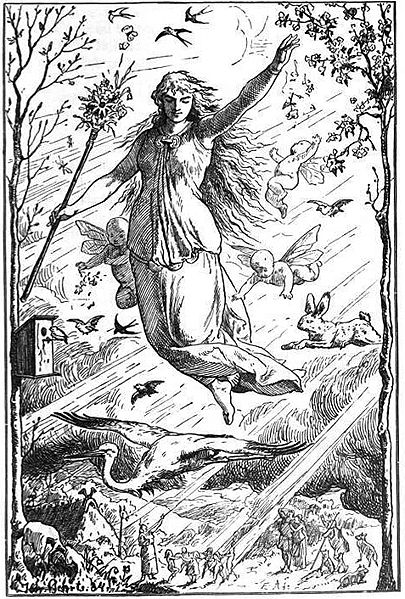
Spring officially arrives in the northern hemisphere today.  Days will be longer than nights for six months after this and many pagans will be celebrating Ostara.  Named after Ēostre, the goddess who apparently gave Easter its name, Ostara is an amalgam of the various equinox feasts and observations of antiquity.  The ancient Celts, as far as we know, held four particular holidays that fall roughly halfway between the solstices and equinoxes, with February marking Imbolc and Beltane yet to come in May.  We don’t know that they celebrated the equinox, but we don’t know that they didn’t either.  Equinoxes are a bit difficult to measure precisely with the sun’s position overhead, but we know the clever folks responsible for Stonehenge and Maes Howe could do such things, even in antiquity.

Ostara, maybe

According to Bede the Anglo-Saxons had several feasts for the goddess Ēostre.  Luckily (from his perspective), Christians had Pascha (Easter) some time near the equinox.  It’s late this year, however, since we just had the full moon (the “Worm Moon”) on Friday.  Easter is the first Sunday after the first full moon after the vernal equinox.  So today we’ve got Ēostre.  We know little of her beyond Bede.  Ancient Germanic peoples, like the ancient Celts, didn’t keep extensive written records.  Their religions, based on what we know of most ancient religions, were likely lively affairs.  Spring is a celebratory season and already buds and blossoms are appearing around here.  Goddess or no, there’s a feminine wonderment about the season.  It’s difficult not to feel at least a little hopeful.

Ancient deities have long been a source of fascination.  Eclipsed by an aggressively political Christianity, many of them vanished without leaving us many traces at all.  The human mind seems inclined to create gods to explain this strange but wonderful world we inhabit.  It’s clear that it wasn’t made just for us.  The birds and insects, and even the elusive reptiles and amphibians, are beginning to reappear.  Many mammals and some birds rough it through the cold hoping to emerge again into the warmth of spring.  We’ve had some warm days already, but there are likely more cold ones to come.  As the pagan gods, as Ēostre remind(s) us, transitions come in fits and starts.  Setbacks are part of progress.  Many of us believe the moral arc of the universe tends toward what is good and right.  It may take a long time to arrive, but the equinox, in its very name, bears the clue.


Palming the Truth

For some today is Palm Sunday. For others it is not. And I’m not referring to those outside the Christian camp. For many Eastern Orthodox Christians, Lent is just beginning as others prepare to celebrate Easter. Such divisions in the priesthood of all believers. The message was brought home to me when a friend emailed me an article from Archon News headlined “For the first time since the Great Schism, Ecumenical Patriarch to attend Pope’s inaugural mass.” For those of you outside the thrill-a-millennium Catholic-Orthodox drama, it might help to know that about the middle of the eleventh century, Christianity experienced its first major schism. The issues were insignificant to all but those who had far too much time on their hands, but the list of grievances grew and festered for centuries until a clean-shaven Pope and heavily bearded Patriarch stopped inviting each other to one another’s parties. It seems that Pope Francis may be seeing the beginning of the end of that particular tiff.

Christianity is one of the most fragmented faiths in the world. Tens of thousands, yea, myriads of denominations exist. And if some of them got together and compared notes, I suspect they’d be shocked to learn that they are just the same as some of the others. Religious belief is deeply personal and highly individualistic. Belonging to a religious body is more a matter of commitment than it is a full agreement on every point—rather like a marriage, I suppose. The funny thing is people join religions that they like, suspecting that these copacetic beliefs will somehow save them from Hell. You can literally write your own ticket to Heaven, based on this system. No religion is right because all religions are right. And we wonder why people are eager to kill one another over matters of belief.

So, is it Palm Sunday or not? It depends entirely on your point of view. Roman Catholicism, followed by many Protestant groups, considers the first Sunday after the first full moon after the Vernal Equinox to be Easter. Never mind that all this equinox stuff smacks of its Pagan forebears—even Easter is named after the Germanic goddess Ostara. I can’t pretend to know how various Orthodox groups calculate their Easter, but the fact is that both dates can’t be right. Unless, of course, one of them is really a celebration of Ostara. Or maybe both are. And if it comes to a matter of debate, it will mean the birth of even more denominations.

Ostara laughs to see such sport

Ostara laughs to see such sport