Being Human

Within the first three pages, if you’re not mortally offended or inexplicably happy, you’re probably not an American.

Growing up with pets, I had a hard time understanding the hard and fast line drawn between animals and people. The failsafe fact used back then is that only people used tools. When we looked closer at animals we found that wasn’t quite true. Well then, only people have language. A large question mark has grown from that assertion too. The final fallback, the sine qua non was souls: only people have souls. It is also the safest of assertions, since it can be tested for neither people nor animals.

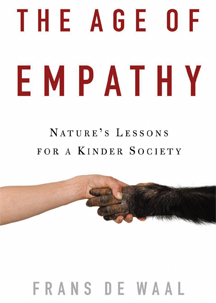
This way of thinking, according to Frans de Waal’s The Age of Empathy, arises from the western religious tradition—a religious tradition that grew up in relative isolation from other primates. Many world religions do not feel the necessity of making people absolutely different from our animal cousins. In Christianity at least, heaven itself rides on it. What are we so afraid of?

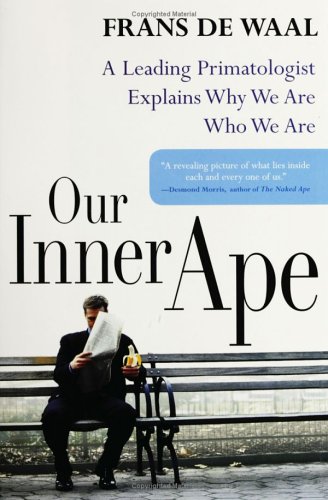
I posted, a couple years back, on Frans de Waal’s Our Inner Ape. Having just finished The Age of Empathy, I have reaffirmed my earlier accolades—he is one of the most sensible and important writers alive. Step by slow, evolutionary, cautious step, de Waal illustrates that one of the taboos of science—that animals don’t have emotion—is patently wrong. Not only do they experience emotion, but apes, cetaceans, and dogs at least, know empathy. Even scientists don’t like to admit this because science grew up in the shadow of the Judeo-Christian-Muslim worldview of human superiority.

But there’s even more at stake. As de Waal makes perfectly clear, the unbridled capitalism of the United States goes against nature. The unlimited acquisition of the vast majority of the resources by the few sets our primate sensibilities on end. Empathy, the ability to feel for another and take their perspective, is not only part of animals’ experience of the world, it is also a mandate of our religions. In order for society to survive, we must come to know this truth. Falsely applying Social Darwinism as factual, biological Darwinism, the few have taken more than either biology or religion permits.

The Age of Empathy should be on every school’s mandatory reading list and corporate climbers should learn that even selfishness has a very steep price tag. Not only for themselves, but for all of us.

Thoughts Off de Waal

Although Frans de Waal’s Our Inner Ape was published half a decade ago, the monograph remains terribly relevant. I gave some primary impressions of the book last week, but one section has remained firmly in my head and has mingled with all the harsh rhetoric in the news about health care reform in the United States. Asking the question of whether Homo sapiens are still evolving biologically, de Waal withholds his final opinion on the matter, but he points out that statistics indicate Americans are falling behind much of the rest of the developed world in terms of general health. This he ascribes to the competition inherent in a free market economy that favors the best health care only to the wealthy while the average citizen is offered substandard options. The numbers bear him out on this – he notes that on the standards utilized to measure general health, the United States is not even in the top 25 industrial nations.

With the conviction of a true prophet, de Waal notes that privatization of health care has led to a precarious imbalance in medical care in the United States, where the top 1 percent of citizens has more income to spend than the bottom 40 percent combined. This, he believes, is because we have lost sight of the altruism inherent in apedom. Although the great apes are endangered (ironically, by their overly greedy genetic cousins) their societies show no such disparity. An ape family will assist a weakened or feeble member and give it extra care to ensure that it is offered a life as comfortable as possible. They do not discard the fragile and “expendable” members. Republicans, however, wave placards trying to shout down basic health coverage for the poor.

Does biological evolution continue among the human species? Have we stopped natural selection’s eternally ticking clock? Only time will tell. It does seem, however, that the very Bible pounded by the Religious Right (health care reform’s greatest opponent) would argue that the apes got it right. We should care for the poor, disadvantaged, and underrepresented. While the Tea Party belles are busy trying to rewrite history with America founded as a Christian nation they daintily wipe their mouths on the pages of the very book they treasure so deeply and claim as their authentic heritage.


Hate, in the Name of Love

I knew I was in trouble when I looked up the concept “codependency” on Wikipedia this morning and read, “This article has multiple issues.”

I was reminded of an article my wife pointed out to me on MSNBC earlier this week concerning Fred Phelps and his Westboro Baptist Church. My thoughts about religious freedom clash with my outrage over what may be legally classified as a religion. I’ve mentioned Phelps before, but the deeper issue here is whether freedom of religion can truly be free. Westboro is being sued (rightfully, imho) in a case that is going to the Supreme Court. His codependent hatred is causing excessive grief to the father of a soldier killed in Iraq. Phelps claims it is God’s will that he spread his Gospel of Hate.

Reading Frans de Waal’s Our Inner Ape, it quickly becomes apparent that empathy is what makes human society possible. Without our ability to feel for another, nature would lead us on a selfish rampage that would not be satiated until everyone but the alpha male was ruthlessly butchered. This seems to be Phelps’ idea of Heaven. It should be a stark warning sign when apes have better bred manners than a pastor.

Hatred and religion may form a codependent bond. Each feeds off the fear and distrust of the other, striking blindly at anything that is different, challenging, or unclear. Religion does have its noble children – those who in the name of their faith try to make life better for others. If the world were run according to Phelps’ religion, however, I would opt for life on the planet of the apes.


Ape Versus Primate


I have just finished reading one of the most important books I’ve found in quite some time: Frans de Waal’s Our Inner Ape. My attention was first drawn to the author when Rutgers University sponsored a talk he gave in the fall that I was unfortunately unable to attend. Simultaneously I saw his book footnoted in a text I was reading and decided to follow up on it. In addition to containing fascinating, documented anecdotes concerning ape behavior (he tells of a bonobo that attempted to help an injured bird fly!) de Waal holds a mirror up to the great apes and sees humanity reflected back. His discussion of the origins of morality makes far more sense to me than any theory I’ve seen a professional ethicist concoct. Our sense of empathy, de Waal notes with considerable evidence, derives from our common ancestor with the apes.

After discussing the understudied trait of kindness in the apes, de Waal writes: “With morality firmly rooted in sentiment it’s easy to agree with Darwin and Westermarck on its evolution and to disagree with those who think culture and religion contain the answer. Modern religions are only a few thousand years old. It’s hard to imagine that human psychology was radically different before religions arose. It’s not that religion and culture don’t have a role to play, but the building blocks of morality clearly predate humanity. We recognize them in our primate relatives, with empathy being most conspicuous in the bonobo and reciprocity in the chimpanzee. Moral rules tell us when and how to apply these tendencies, but the tendencies themselves have been in the works since time immemorial” (225).

These might just be platitudes if ample evidence did not demonstrate their veracity. Apes plan ahead, recognize fairness, and can even see issues from the point of view of others (something Gorgias Press might benefit from learning). They are clearly inheritors of the moral sense that evolution has crafted among all cooperative animals over the eons. Religions like to lay claim to the origins of morality: we behave this way because our god told us to. In a sense that may be true, but only if the “god” is nature itself and the instruction it gives is the way for a species to thrive. Caring for one another, all religions aside, is the formula that evolution presents as the most successful choice of natural selection.