Dictionary Dreams

“Lord, now lettest thou thy servant depart in peace.”  Thus begins the venerated Nunc dimittis, familiar from so many years of chanting evensong at Nashotah House.  It comes to mind when I’ve reached a milestone I never dreamed of attaining.  One that makes me feel as if I’ve accomplished my life’s work.  Strangely, it didn’t occur when my name ended up in a study Bible’s front matter.  But a friend recently sent me a note that immediately brought old Simeon’s words to mind.  I have been cited in the Oxford English Dictionary.  My book Weathering the Psalms is quoted (in the web version) under “simile.”  I have no idea how examples are selected for the OED.  It used to be scraps of paper sent in by astute readers, but I suspect things have changed.  How my obscure book ended up there, I haven’t a clue.
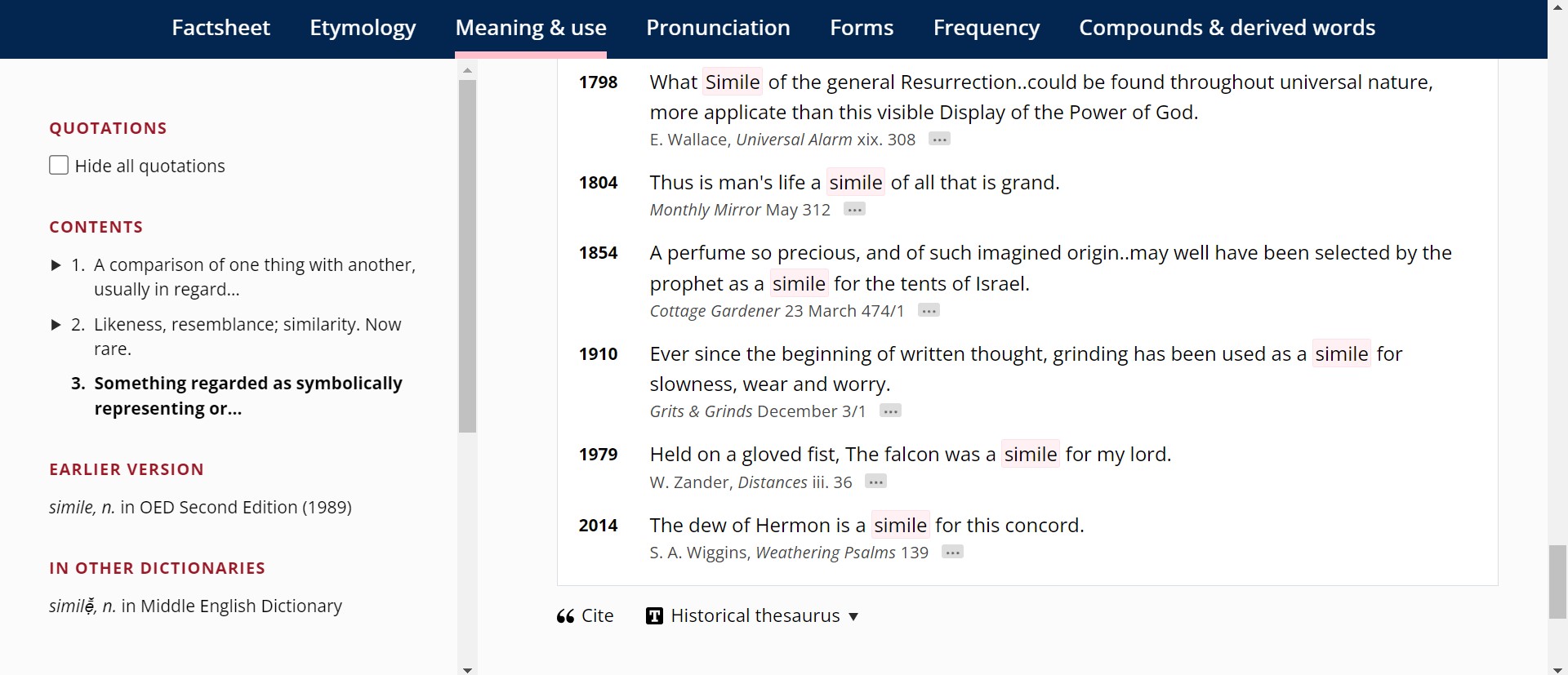
There’s an irony here as well.  Like most academics clueless about publication, I initially proposed Weathering the Psalms to Oxford University Press, assuming they published such things.  It was turned down on the basis of a reviewer—one or two I know not—that I later met at a social function, where he was clearly embarrassed.  I really just wonder how the OED found the book to cite in the first place.  In terms of copies sold, it has been my most successful book, but that’s not saying much.  As far as I can tell, it’s only sold less than 400 copies (the royalty statements don’t have the total and I haven’t received a check in years).  I guess all things in the world are connected, whether we notice it or not.

Those who know me personally are aware that validation is a huge thing for me.  I suspect that is true of most people who grew up in difficult circumstances and who managed—and this is never a certain thing—to pull themselves out.  Having been fired from my long-term teaching post (where I was working on this book) only made me want to prove myself more, I guess.  Insignificant things like getting a Choice review for one of my books (which continues to sell poorly) and having that behemoth of a dictionary notice that I used a fairly common word in a fairly common way do tend to release the endorphins.  It’s like maybe someone noticed that I’ve passed this way.  Maybe there was a reason for trying to capture the Wisconsin thunderstorms in a book about the Psalms.  Maybe there’s a reason each working day there concluded with the Nunc dimittis.

The Grammar of Evil

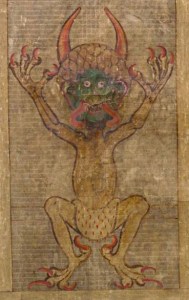
I stepped into a devil of a situation. Elevators are strange spaces. Given the choice, I’ll take the stairs any time. At work, however, as one of the many quirks of Manhattan, our elevators only stop on certain floors and we’re not able to use the stairs unless it’s an emergency. After a meeting on a floor where the only option was to elevate out, I stepped into a crowded elevator where a conversation was going. “You always capitalize Satan,” someone was saying. The usual questions among non-religion editorial staff ensued. Why is that? What about “devil”? “It’s never capitalized,” came the reply. My profile at work is about the same as it is on the streets of New York. Not many people know who I am or what I do. Although I’ve struggled with this very issue before, on a professional level, I kept silence and waited for my floor.

So, was the elevator authority right? “Satan” has become a name, rather along the lines of “Christ.” Both started out as titles. In the Hebrew Bible “satan” is “the satan.” The accuser, or the prosecuting attorney—something like that. As one of the council of gods, the satan’s job was to make sure the guilty were charged of their crimes. Diabolical work, but not evil. By the time of early Christianity, however, Satan had evolved into a name. It is therefore capitalized. It was specifically the name of another title, “the Devil.” Or is it “the devil?” Do we capitalize titles?

The Devil wears underpants.

The Devil wears underpants.

In seminary and college the received wisdom among those of my specialization was that there is only one Devil and the title should be capitalized. My elevator colleagues were discussing the number of devils when I stepped out. Traditional theology says there’s only one. Not that the Bible has much to say about the Devil—he’s surprisingly spare in sacred writ. Demons, however, are plentiful. Some people call demons devils, just as many believe that when good people die they become angels. The mythology behind demons seems to be pretty well developed in the biblical world, but again the Bible says little. Demons can be fallen angels or they can be malign spirits who cause illness. Either way they’re on the Devil’s side. But should we capitalize his title? The Oxford English Dictionary doesn’t help, giving examples of both minuscule and uncial. I suppose that’s the thing about the Devil; you never really know where you stand.


Exegesis Dies

One of the time-honored adages among composition primers is that a serious writer will own a well-worn dictionary and thesaurus. In twenty-first century terms that equates, I suppose, to frequently visiting bookmarked dictionary and thesaurus websites. While writing my dissertation I once cited a dictionary—likely Merriam-Webster—only to be told that the definitive dictionary for academic purposes was the Oxford English Dictionary. Copyright laws prevent some dictionary sites from including entries from the OED, and, given the perpetual vicissitudes of streams of income, I really can’t afford to subscribe to the fee-based OED website, much less purchase the physical hardcopy. Dictionary.com remains free and even has a handy thesaurus, so it is my well-worn website. Many electronic wordsmithies offer a word of the day, and so on my morning visit to dictionary.com I found a familiar word awaiting today: eisegesis. Eisegesis, according to the this online dictionary is: “An interpretation that expresses the interpreter’s own ideas, bias, or the like, rather than the meaning of the text.”

In biblical studies eisegesis is utilized like an academic swear word. The true scholar engages in exegesis, the practice that is supposed to reveal what the original text actually meant. The problem, of course, is that what the text originally meant depends on the baggage the reader brings with him or herself. Reader-response theorists inform us that even an author loses control of words once they are scrawled on paper (or electrons, I suspect). The words convey their own interpretation, and, as in any communication system, the transmission must be interpreted through the medium of a receiver. My understanding of the original meaning will depend on what I bring to the parchment. Even the author cannot control the denotation of what s/he has written, for connotation always lurks in the shadowy corners of the room.

The implication of this simply truth for any religious writing should be transparent. We do not control the words—we interpret them. I’ve taught many fundamentalists over the years who bring this weary refrain to the text: “I don’t interpret the Bible, I just read it.” Reading is interpreting. The words on a page (or monitor) are simply a system of ciphers that must be processed. The way your brain processes them will be different from the way my brain does. For the fundamentalist, God wrote the words, but God has no physical brain so how are we to find the true meaning? Exegesis. At the heart of the matter, however, all exegesis is eisegesis. The example I like to give my classes is the word “die” —what does it mean? Most say something like “to stop living.” Those with a background in machining might say die is a noun indicating a mould or tooling device to form an object. Some even know it could be the singular of the word “dice.” Once they’ve exhausted their suggestions, I inform them any of them could be correct, only I had neglected to tell them it was intended to be the feminine singular form of the definite article in German.