Ancient History

Every great once in a while somebody in the popular media seems to remember suddenly that the ancient world existed. I suppose that it is the fate of forward-looking species to forget the past, at least until it looks trendy. An editor for Sunday’s paper, for example, ran an article by Tom Standage, “Facebook, Twitter: That’s all so 1st century B.C.,” written originally for the Los Angeles Times. Tom Standage has written popular histories that go back to the Sumerians; I really enjoyed his A History of the World in Six Glasses. He’s got a great grasp of antiquity. In this short article, Standage points out similarities between modern, electronic social media and the distribution of gossip in ancient times. Indeed, he is basically right about writing: as soon as people learned to do it, it proliferated. Communication at a distance is such a wonder that we seldom pause to consider just how revolutionary it is. Social media has just made it that much easier. Instant thoughts, at the speed of light. Anywhere in the wired world. And yet…
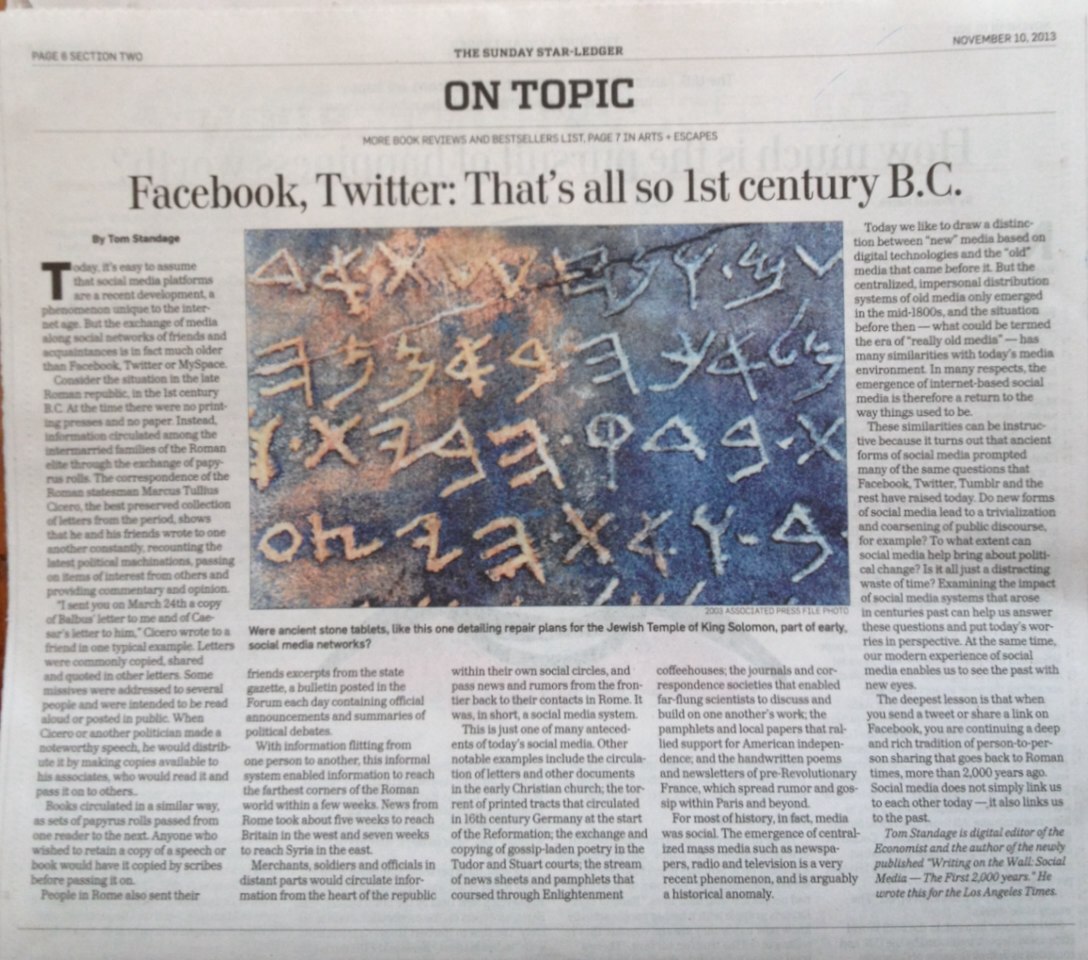
SolomonFakeNot having been trained properly in journalism, I don’t know how newspaper articles are designed. People, I know, don’t like huge blocks of text without some visual candy. To illustrate Standage’s article is a close-up photo of some funky paleo-Hebrew letters with this caption: “Were ancient stone tablets, like this one detailing repair plans for the Jewish Temple of King Solomon, part of early social media networks?” I may be obsolete in the scholarly world, but I instantly recognized this inscription. It was “discovered” and rapidly disseminated in 2003. Almost immediately it was clearly demonstrated to have been a forgery. Scholars nowhere accept this as an authentic artifact. Even those of us who last saw this a decade ago know that it’s fake. Social media, indeed? Somebody in the design department needs to read their ancient history.

What is so striking about this faux pas is that most well-meaning readers have no way of assessing or ascertaining the validity of such an image. Oh, the script is cool, no doubt about that—but the artifact is fake. To answer the question posed by the caption: no, this is not ancient social media. It is a modern hoax. People are susceptible to hoaxes because of two factors: TMI and P. T. Barnum. Too Much Information exists for anyone to stay on top of it all. For progress to occur we need to rely on experts on the past to clear the way for us. Phineas Taylor Barnum knew how to turn any cheap scam into instant cash. It is no surprise that Solomon’s inscription first appeared on the antiquities market, certainly with an eye for cashing in on the success of the recently promoted James Ossuary, the one where someone much later added the phrase, “the brother of Jesus.” I’m sure that Tom Standage was in no way involved in the choice of image for the reprint of his article in our local paper. It does, however, suggest an old message that will even fit on your Twitter character limit: “There’s a sucker born every minute.”

P. T. Mammon

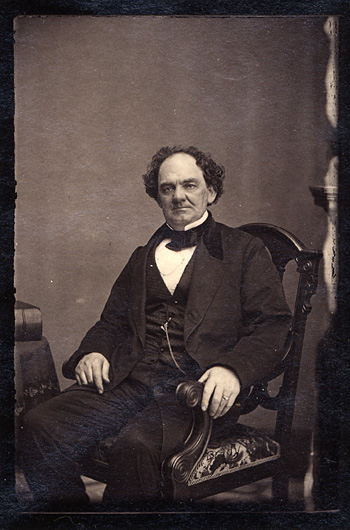
Phineas Taylor Barnum is frequently treated as a figure of cynicism personified. As the founder of what would eventually become the Ringling Brothers, Barnum and Bailey Circus, P. T. was a noted hoaxer and scam artist. He capitalized on the fact that people will pay to see anything they are gullible enough to believe. Unfortunately, many human beings were exploited for their unusual characteristics, but he was also known as a philanthropist with an eye for reform. Most people don’t realize that Barnum’s early career involved being a salesman for the Sears’ Pictorial Illustrations of the Bible. From Bible salesman to huckster extraordinaire. The great American success story.

In what I see as a related article on Religion Dispatches, St. Paul’s Cathedral, London, has taken legal action to move Occupy London protestors from its property. As religions go, it is difficult to conceive of a more established, conformist church than the C of E. (Well, maybe the Roman Catholic Church could vie.) St. Paul’s Cathedral actually charges an admission fee (not a cheap one either), perhaps cashing in on Mary Poppins; Feed the Bishops, I believe it’s called. The reason that the Cathedral is seeking to remove the undesirables (the cathedral is next door to the London Stock Exchange) is that they interference in business. Hard to charge admission to people who can’t come in. It’s not so much to save souls as it is to horde pounds. Problem is, the message of ancient Christianity more closely matches that of the Occupy movement than it does the Church of England. Barnum knew the selling power of religion. So do bishops and countless priests. How long do you suppose the clergy would remain if Christianity went back to the “tent making” model of the first century? I suspect there would be quite a few more prelates at Occupy London.

Somehow money and religion have become all tangled together. Not that I would begrudge any clergy of a fair salary—I’ve been on the receiving end of not receiving adequate pay myself, and I wish it on no one. When money, however, is the sine qua non of the religious establishment, where has compassion gone? One would like to think that clergy would be among the first to stand in solidarity with those protesting unfair business practices. But ah, the church is very establishment-oriented. Not just the C of E, either. Most churches have fallen into the comfortable zone of supporting the system and teaching their adherents that this is all in the divine plan. A kind of cosmic quid pro quo. According to the Gospel writers Jesus chased the money-changers out of the temple. Phineas Taylor knew that giving people what they wanted often trumped the honest truth. “The noblest art is that of making others happy,” he once stated. Somewhere along the line, the admission price shifted from the circus to the cathedral. There is one born every minute, indeed.


One Percent Solution

A colleague just pointed out an article in Vanity Fair that should be required reading for all Americans and it should be offered with a generous quaff of nepenthe. Please pardon any excess indignation you may find in today’s post. Whenever I’m teaching my course on the Hebrew Prophets I tend to get swept into the spirit of their oracular outrage. The latest statistics reveal that 40 percent of American income goes to only 1 percent of the population. Despite protests to the contrary, wealth does not trickle down like milk and honey (even though the latter takes its sweet time). The disparity between the ultra-wealthy and the middle class, as suggested by the article, has its closest analogues in Russia and Iran. Once the top is reached all political systems begin to look the same. Even President Obama’s budget will continue the legacy of tax cuts to the wealthy.

Where is the outrage? Americans are among the most complacent people in the world. Kept at the cusp of sufficiency, most people will not complain. Louis XVI himself could waltz into congress and be heartily greeted by his peers. All things being equal, if we the bottom 99 percent have enough then complaint is only sour grapes. All things being equal, however, is always hypothetical. All things are not equal. While many hard-working people are caught in a cycle of diminishing returns the bloated oligarchs help themselves to performance bonuses lofty enough to support hundreds of suffering families for a year. “Let them eat fake,” one can almost hear them say.

In the idealistic world of the Bible a pipe-dream was touted. Wealth itself is not evil, but it comes with an obligation. Trickle-down is a dried wadi in summertime. The wealthy are obligated to make certain that their fellow citizens all have enough. No one gets two houses before everyone has one. Once this level of fairness is reached, go ahead and get stinking rich. But that principle has never been realized. Those who have always require more. From those in such stratospheric positions magnanimity cannot be expected; for others to benefit some of their astronomic wealth must be taken. What are taxes for? Josef Stalin is laughing in his grave and shaking hearty hands with P. T. Barnum. They share a cigar and neither one of them need speak the motto they both know to be as true as the gospel.

Trickle-down economics